
Lot 235 Suzuki Harunobu (1725-1770) | The complete set of Marriage in Brocade Prints, the Carriage of the Virtuous Woman (Konrei nishiki misao-guruma), also known as the Marriage series | Edo period, 18th century
落槌价
****
成交价
****
| 拍卖公司 | 苏富比 |
|---|---|
| 拍卖时间 | 2026年06月11日 |
请安装多宝古瓷宝典APP,查看高清无损大图
拍品信息
拍品名称
Suzuki Harunobu (1725-1770) | The complete set of Marriage in Brocade Prints, the Carriage of the Virtuous Woman (Konrei nishiki misao-guruma), also known as the Marriage series | Edo period, 18th century
起拍价
EUR 60,000
估值区间
60,000 - 80,000 EUR
尺寸
未知
品相
如欲了解本拍品狀況的更多資訊,請聯絡 jon.adjetey.consultant@sothebys.com
更多信息
the complete set of seven woodblock prints, embellished with embossing, from the series Marriage in Brocade Prints, the Carriage of the Virtuous Woman (Konrei nishiki misao-guruma), also known as the Marriage series, each signed Harunobu ga (Pictured by Harunobu), circa 1769; each with collectors' seals of Hayashi Tadamasa, Felix Tikotin and Gerhard Pulverer, and comprising:
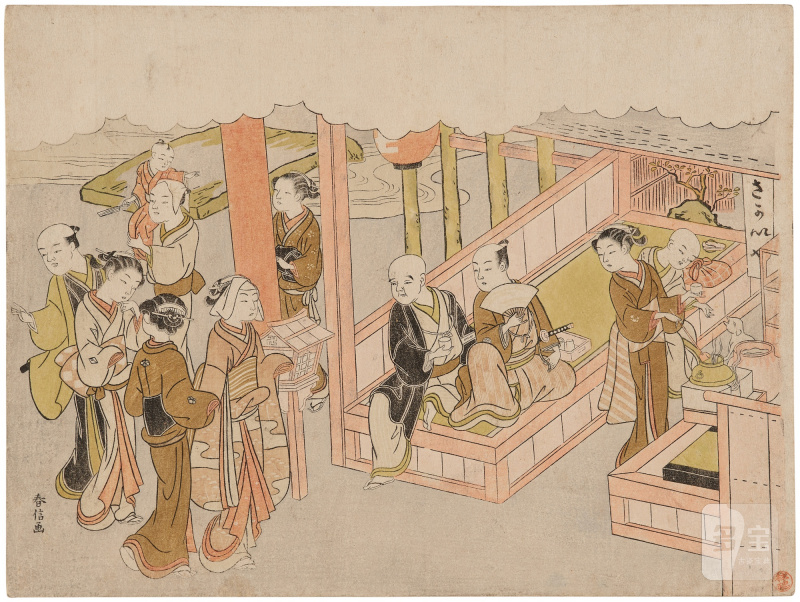
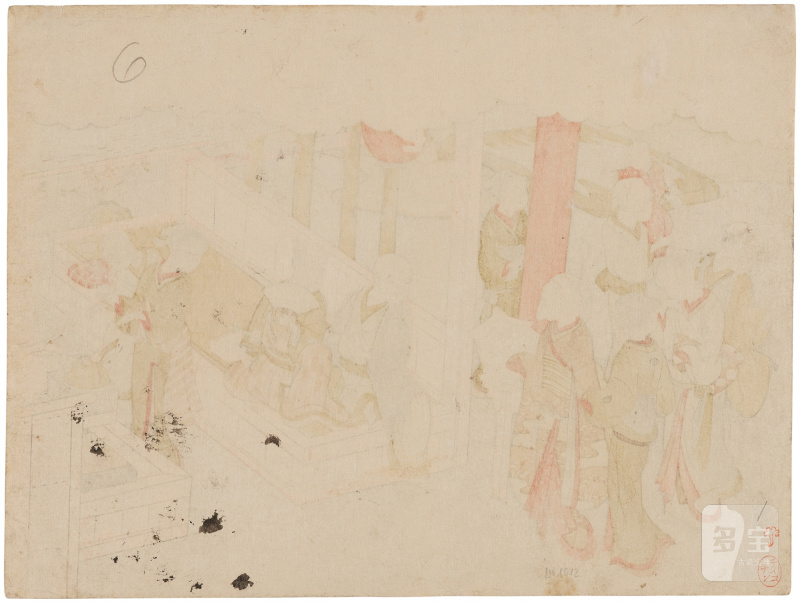
- Introductory Meeting (Miai)
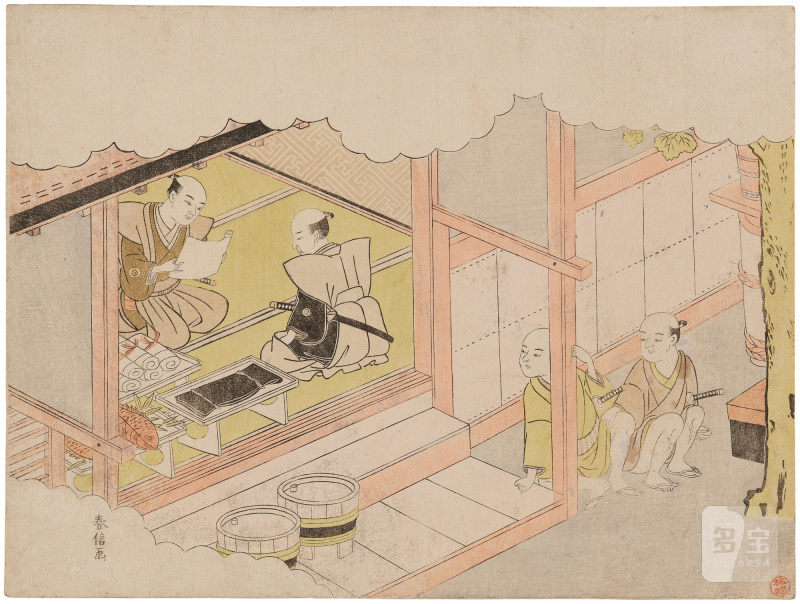
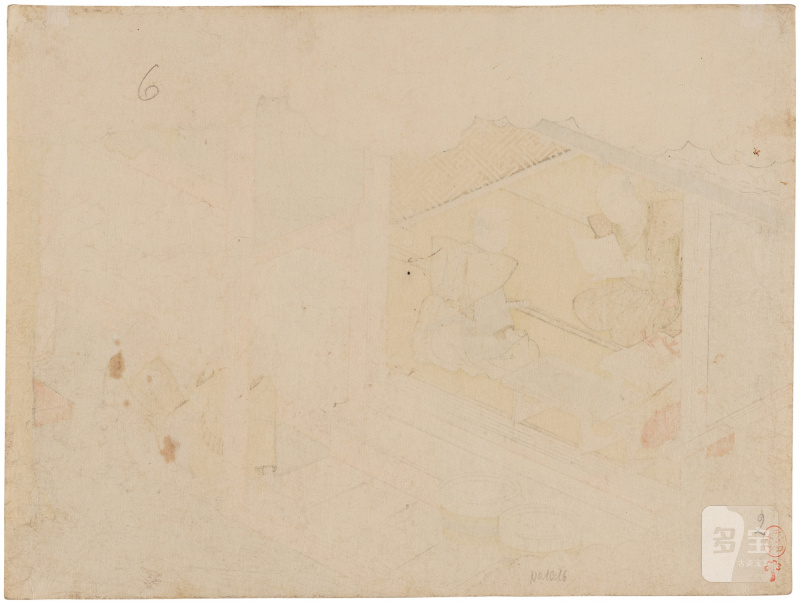
- Exchange of Gifts (Yuino)
- The Bride Riding in the Palanquin (Koshi-iri)
- The Sake Cup (Sakazuki)
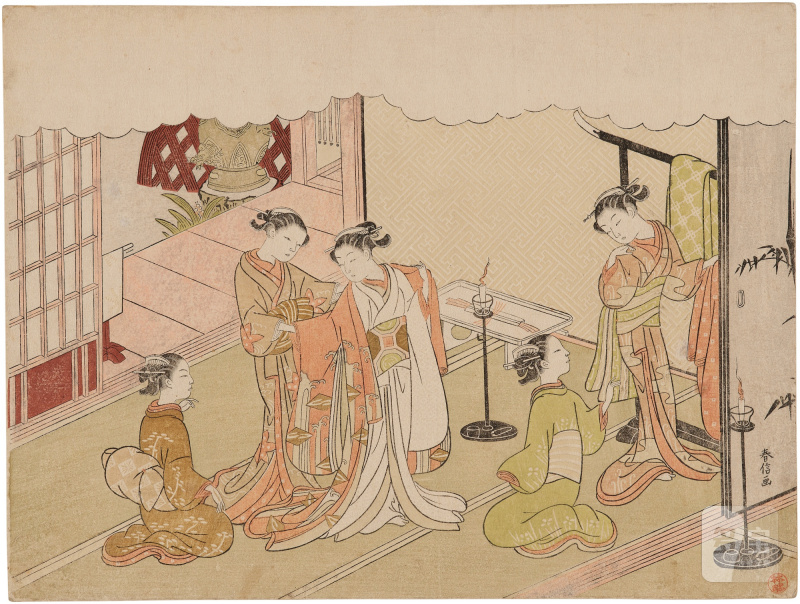
- The Bride Changing Clothes (Iro-naoshi)
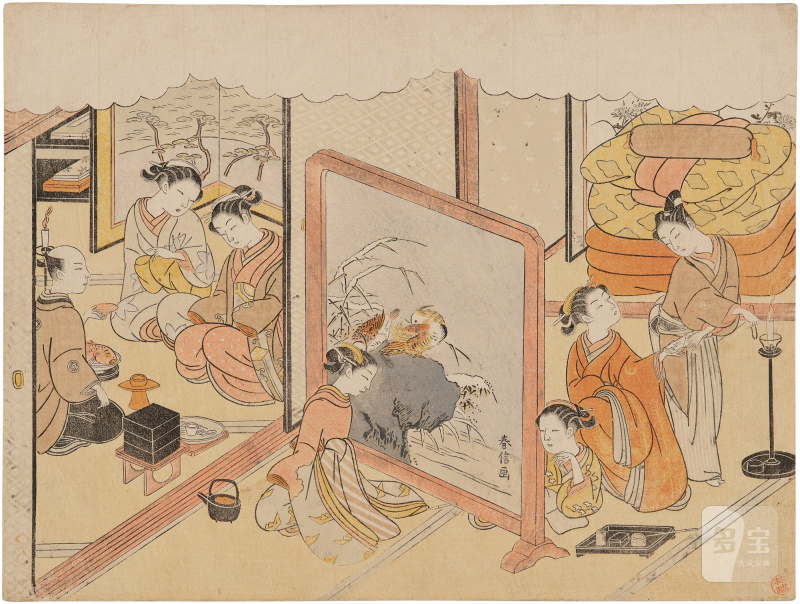
- The Cup of Sake before Bed (Toko-sakazuki)
- The Birth of the First Child (Uizan)
Horizontal chuban: each approx. 22 x 28.6 cm, 8⅝ by 11¼ in.
来源:Hayashi Tadamasa (1853-1906)
Adolphe Stoclet (1871-1949)
Edith Ehrman (1932-1974)
Felix Tikotin (1893-1986)
Gerhard Pulverer (b. 1930)
展览:Philadelphia Museum of Art, Suzuki Harunobu, 18 September - 22 November 1970. ('Introductory Meeting' and 'The Bride Riding in the Palanquin')
Doitsu Puruvera korekushon ukiyo-e hanga meihinten [Masterpieces of Ukiyo-e from the Pulverer Collection], exhibited at the following venues:
Matsuzakaya Department Store, Osaka, 27th December 1990 - 8th January 1991
Matsuzakaya Department Store, Ginza, 24th - 29th January 1991
著录:Jack Hillier, Suzuki Harunobu (Philadelphia, 1970), pg. 168-69. ('Introductory Meeting' and 'The Bride Riding in the Palanquin')
Narazaki Muneshige, ed., Hizo ukiyo-e taikan, Puruvera korekushon [Ukiyo-e Masterpieces in Western Collections: The Pulverer Collection] (Tokyo, 1990), nos. 13-19.
Doitsu Puruvera korekushon ukiyo-e hanga meihinten [Masterpieces of Ukiyo-e from the Pulverer Collection] (Tokyo, 1990), pp. 26-29, nos. 1-18-1-24.
图录
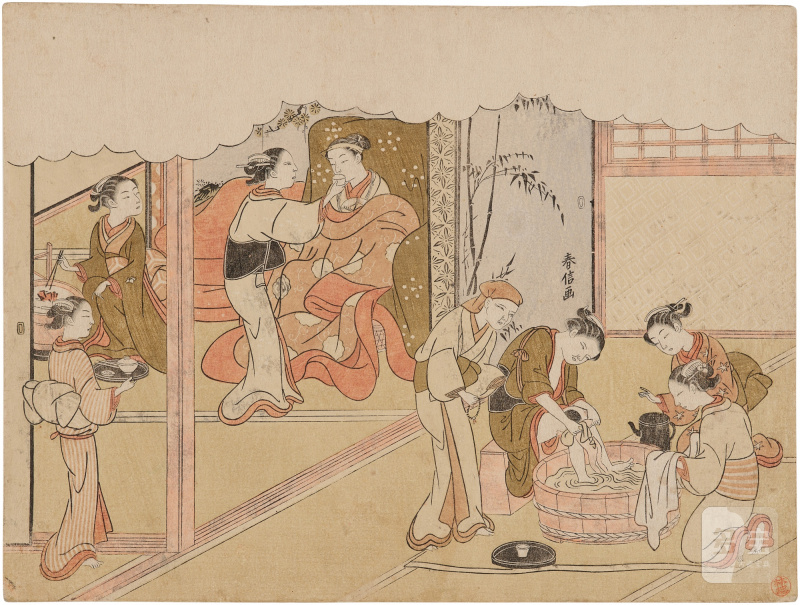
说明:Seven prints form the set of Marriage in Brocade Prints, the Carriage of the Virtuous Woman, also known as the Marriage series, each framed at top with a cloud scroll border. This narrative series outlines the main steps of Japanese traditional marriage customs which are generally followed to some degree today, although Japanese marriage customs and their history are much more variable than the scheme in the series. The title of each print is later ascribed, but there is general consensus of the titles, scenes and figures depicted, with some differentiation in the identification of the minor figures that appear.1
A detailed description of a formal upper-class wedding is contained in Shorei hikki (1706) and was translated by Algernon Bertram Freeman-Mitford, 1st Baron Redesdale (1837-1916) in 1874. The complex ceremonial procedures depicted by Harunobu sixty years later are perhaps somewhat simplified. It is possible that his choice of subjects was determined by some list current in his day; and he took ideas for at least two of his designs (Koshi-iri and Uizan) from Nishikawa Sukenobu’s (1671-1750) Ehon masu kagami (1748). It is possible that a complete set mounted as a handscroll, could have been used as a wedding gift for girls from well-to-do samurai or chonin families.2
Introductory Meeting (Miai)
In the first print in the sequence, a young man is seated in the interior of the Sakaiya tea-stall. He wears a sword and holds a fan aloft. An older man is seated beside him who is perhaps acting as a go-between (nakodo) to provide information regarding the suitability of each candidate. A young bride is being escorted from the left, with her parents and attendants in tow. The proprietress of the tea-stall, identified as Osede, is preparing tea for the visitors. Behind her, a young boy, presumably employed to assist in the tea-stalls activities, plays with a small dog. A large stone bridge can be seen spanning a stream behind the torii gate. The miai, or introductory meeting, was the first stage in traditional marriage customs.
Exchange of Gifts (Yuino)
The presentation of formal gifts from the bridegroom’s father. Both men wear formal kamishimo robes and a sword. The bride’s father reads a letter accompanying the array of gifts: five rolls of mawata, or white floss silk, a folded obi sash, two large bream (tai) atop leaves of bamboo and two kegs of sake. Two manservants sit outside the entrance, curious to the happenings in the interior. They have carried the gifts in a portable chest placed beside a paulownia tree and a covered water-barrel. Even during the Edo period (1605-1868), gifts for yuino could vary and were much dependent on social status and the wealth of the families involved.
The Bride Riding in the Palanquin (Koshi-iri)
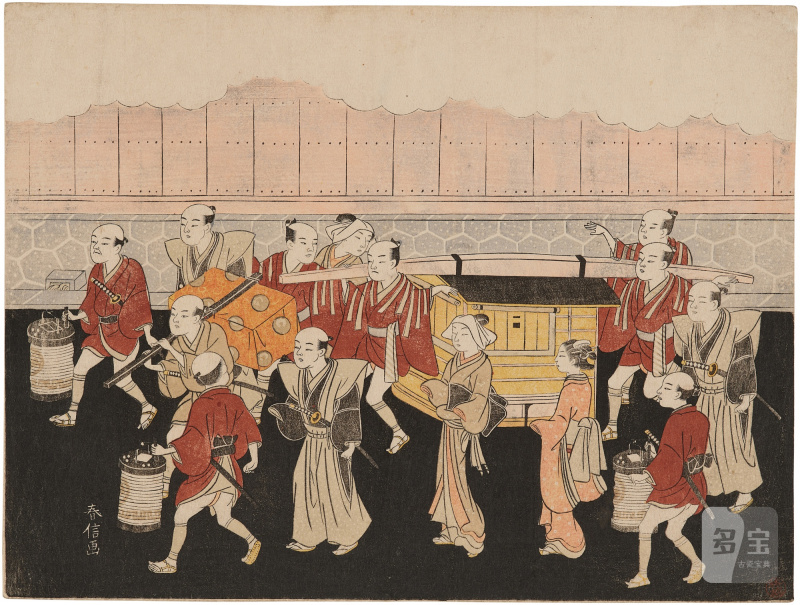
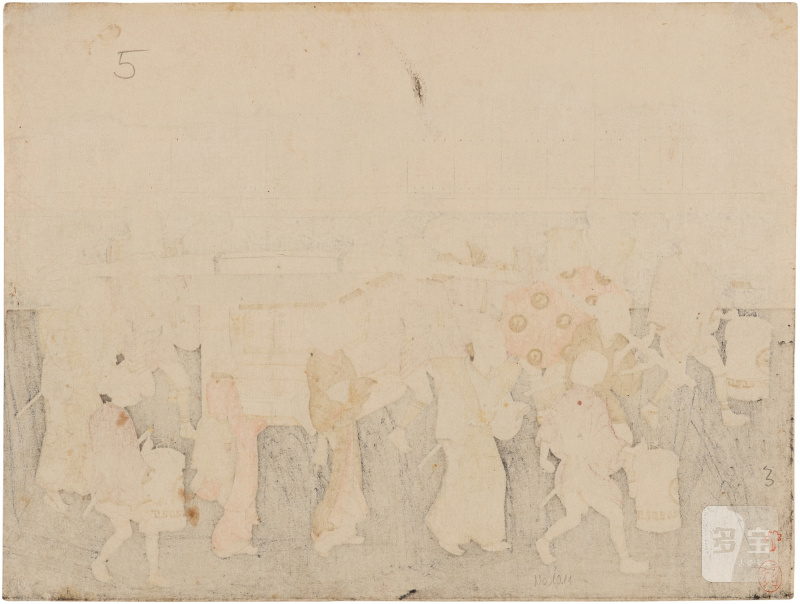
In a closed wooden palanquin (koshi), the bride is being transported to the family house of the bridegroom. Two female attendants wear white headscarves, a maid, and an escort of sword-carrying men bearing luggage (nagamochi) and lanterns form the marriage cortège. They pass the walls of a samurai mansion (yashiki) at night. Somewhat unconventionally, the path is coloured black to suggest nighttime. Bearers and porters in a wedding procession used to sing as they went.
The Sake Cup (Sakazuki)
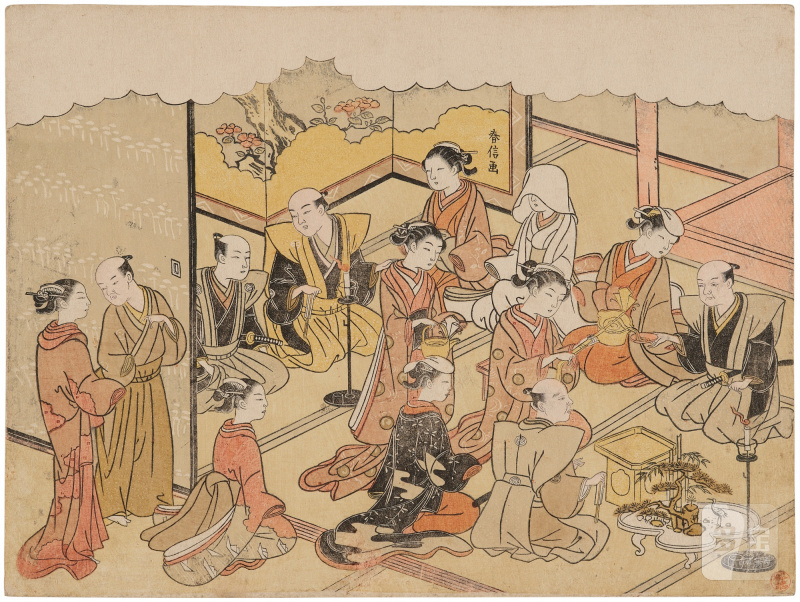
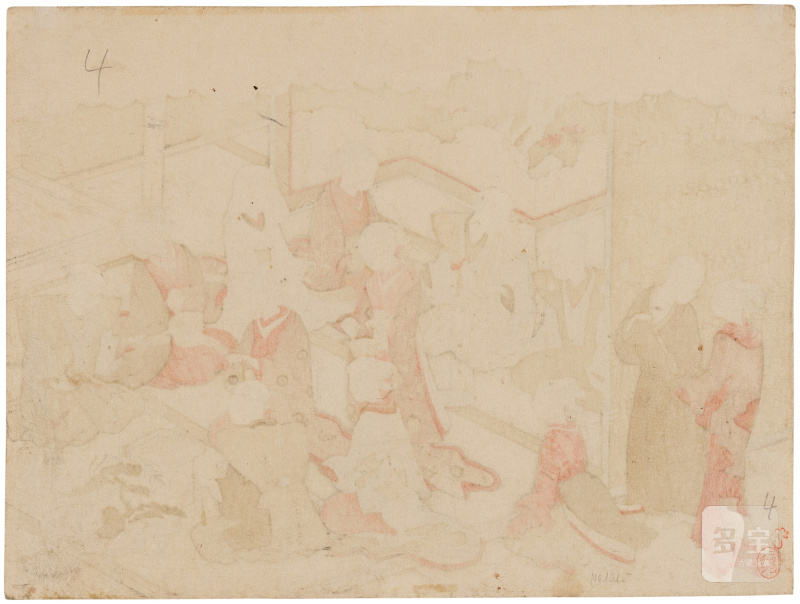
A wedding banquet (kekkon hiroen) now takes place at the bridegroom’s family house. Harunobu does not illustrate the wedding ceremony, and in this sequence, we are to assume it has already taken place. The bride is clad in white; a hood covers her head and the upper part of her face. She sits beside her parents and a lady of their household with their backs turned to the alcove (tokonoma). The bridegroom and a male friend sit before screen painting depicting peonies before a large trunk of pine and scrolling clouds of gold. Harunobu’s signature appears playfully in the corner of the rightmost panel as if he is the artist of this folding screen. The bridegroom avoids glancing in the direction of his newly wed as dictated by decorum.
The interior is lit by two black lacquered candelabra. Elegantly dressed, a woman from the bridegroom’s family attends to the father of the bride, pouring sake for him from a choshi (long-handled ladle). A shimodai and two sanbo (ceremonial trays) are placed between the parents of the bride and groom. The shimodai, a type of decoration used for weddings or other auspicious occasions, here consists of a suhamadai (a low- stand, shaped like an irregular ridge of sand on a shore), on which are placed the Three Friends of Winter (Shochikubai) – pine, plum and bamboo – a model of a crane and an assortment of rocks representing Horaisan, the Daoist Isles of the Blest.
The Bride Changing Clothes (Iro-naoshi)
The bride retires to another room and puts on another, less formal and more decorative kimono over her white wedding robe. This is known as the iro-naoshi, or the ‘changing of colours’ to represent the bride’s transition into the state of marriage. Her pinkish robe is decorated with lozenges over water sprays. Four women assist her in her dress, one of whom is taking a kimono from a tall clothes rack (iko). A congratulatory decoration made of paper is placed on a large sanbo (ceremonial tray) behind a candelabra. The veranda opens on to a garden where we glimpse a large metalware vase and a sodegaki fence.
The Cup of Sake before Bed (Toko-sakazuki)
In a more intimate scene, the bride and bridegroom enjoy a meal and a cup of sake before their wedding night. Stacked lacquer boxes (jubako) containing food and a large bream (tai) are set before them. An attendant kneels on the threshold of the room with a sake kettle before a large tsuitate (standing screen) depicting a pair of mandarin ducks – a symbol of conjugal harmony – in a snow-covered landscape. In the next room, a young man lighting the candelabra and woman furtively exchange a love letter before piled bedding.
The Birth of the First Child (Uizan)
In a large tub of water (ubuyu), a midwife (toriage-baba) and two attendants wash the newly born child, watched over by an elderly Buddhist nun with a rosary (juzu) in hand. The mother rests on a high-backed chair in the adjoining room covered in thick blankets, while a nurse offers her a cup of tea. A maid carries food on a black lacquer tray, and another young girl kneeling by a hibachi (brazier) turns the coals.
For further reading on the series, see David Waterhouse, The Harunobu Decade: A Catalogue of Woodcuts by Suzuki Harunobu and his Followers in the Museum of Fine Arts Boston (The Netherlands, 2013), pp. 248-254, nos. 420-430.
Other impressions of the complete set are in the collection of the Museum of Fine Arts, Boston, accession numbers 21.4452, 21.4453, 11.19477, 11.19475, 21.4456, 21.4457 and 21.4458.
1. David Waterhouse, The Harunobu Decade: A Catalogue of Woodcuts by Suzuki Harunobu and his Followers in the Museum of Fine Arts Boston (The Netherlands, 2013), pp. 248-49.
2. ibid.
Hayashi Tadamasa and Western Print Collecting
Many of these early collections of ukiyo-e [lit. pictures of the floating world] were assembled with the help of Hayashi Tadamasa (1853-1906), the Japanese art dealer from Nagasaki, who came to Paris in 1878 as an assistant and translator for Wakai Kanesaburo (1834-1908), vice president of Kiritsu Kosho Kaisha [The First Japanese Manufacturing and Trading Company, 1873-1891], the company responsible for managing Japan's contributions to the Paris Exposition Universelle. After the exhibition closed, Hayashi remained in Paris to sell off the remaining stock, and in 1884 established the Wakai-Hayashi company together with Wakai. Both men played a significant role in the development of Western scholarship on Japanese art, especially prints. After Wakai's retirement in 1886, Hayashi continued independently, becoming one of the foremost dealers in Japanese art and a leading importer of ukiyo-e to the West.
In Tokyo, Hayashi's wife Satoko worked alongside Japanese specialists to select prints for his Parisian dealership. All works handled by the firm bear the Hayashi seal, which came to be regarded as a reliable indicator of quality and authenticity. Between 1890 and 1902, an estimated 160,000 Japanese prints and around 10,000 illustrated books passed through Hayashi's hands to Western collectors. He also cultivated close friendships with French artists, whose paintings he exported to Japan in return. His expertise and discernment were further demonstrated by his selection of Japanese art for the 1900 Paris Exposition Universelle. In 1902 he closed his business and sold part of his collection before returning to Japan, where he died in 1906.
- Introductory Meeting (Miai)
- Exchange of Gifts (Yuino)
- The Bride Riding in the Palanquin (Koshi-iri)
- The Sake Cup (Sakazuki)
- The Bride Changing Clothes (Iro-naoshi)
- The Cup of Sake before Bed (Toko-sakazuki)
- The Birth of the First Child (Uizan)
Horizontal chuban: each approx. 22 x 28.6 cm, 8⅝ by 11¼ in.
来源:Hayashi Tadamasa (1853-1906)
Adolphe Stoclet (1871-1949)
Edith Ehrman (1932-1974)
Felix Tikotin (1893-1986)
Gerhard Pulverer (b. 1930)
展览:Philadelphia Museum of Art, Suzuki Harunobu, 18 September - 22 November 1970. ('Introductory Meeting' and 'The Bride Riding in the Palanquin')
Doitsu Puruvera korekushon ukiyo-e hanga meihinten [Masterpieces of Ukiyo-e from the Pulverer Collection], exhibited at the following venues:
Matsuzakaya Department Store, Osaka, 27th December 1990 - 8th January 1991
Matsuzakaya Department Store, Ginza, 24th - 29th January 1991
著录:Jack Hillier, Suzuki Harunobu (Philadelphia, 1970), pg. 168-69. ('Introductory Meeting' and 'The Bride Riding in the Palanquin')
Narazaki Muneshige, ed., Hizo ukiyo-e taikan, Puruvera korekushon [Ukiyo-e Masterpieces in Western Collections: The Pulverer Collection] (Tokyo, 1990), nos. 13-19.
Doitsu Puruvera korekushon ukiyo-e hanga meihinten [Masterpieces of Ukiyo-e from the Pulverer Collection] (Tokyo, 1990), pp. 26-29, nos. 1-18-1-24.
图录
说明:Seven prints form the set of Marriage in Brocade Prints, the Carriage of the Virtuous Woman, also known as the Marriage series, each framed at top with a cloud scroll border. This narrative series outlines the main steps of Japanese traditional marriage customs which are generally followed to some degree today, although Japanese marriage customs and their history are much more variable than the scheme in the series. The title of each print is later ascribed, but there is general consensus of the titles, scenes and figures depicted, with some differentiation in the identification of the minor figures that appear.1
A detailed description of a formal upper-class wedding is contained in Shorei hikki (1706) and was translated by Algernon Bertram Freeman-Mitford, 1st Baron Redesdale (1837-1916) in 1874. The complex ceremonial procedures depicted by Harunobu sixty years later are perhaps somewhat simplified. It is possible that his choice of subjects was determined by some list current in his day; and he took ideas for at least two of his designs (Koshi-iri and Uizan) from Nishikawa Sukenobu’s (1671-1750) Ehon masu kagami (1748). It is possible that a complete set mounted as a handscroll, could have been used as a wedding gift for girls from well-to-do samurai or chonin families.2
Introductory Meeting (Miai)
In the first print in the sequence, a young man is seated in the interior of the Sakaiya tea-stall. He wears a sword and holds a fan aloft. An older man is seated beside him who is perhaps acting as a go-between (nakodo) to provide information regarding the suitability of each candidate. A young bride is being escorted from the left, with her parents and attendants in tow. The proprietress of the tea-stall, identified as Osede, is preparing tea for the visitors. Behind her, a young boy, presumably employed to assist in the tea-stalls activities, plays with a small dog. A large stone bridge can be seen spanning a stream behind the torii gate. The miai, or introductory meeting, was the first stage in traditional marriage customs.
Exchange of Gifts (Yuino)
The presentation of formal gifts from the bridegroom’s father. Both men wear formal kamishimo robes and a sword. The bride’s father reads a letter accompanying the array of gifts: five rolls of mawata, or white floss silk, a folded obi sash, two large bream (tai) atop leaves of bamboo and two kegs of sake. Two manservants sit outside the entrance, curious to the happenings in the interior. They have carried the gifts in a portable chest placed beside a paulownia tree and a covered water-barrel. Even during the Edo period (1605-1868), gifts for yuino could vary and were much dependent on social status and the wealth of the families involved.
The Bride Riding in the Palanquin (Koshi-iri)
In a closed wooden palanquin (koshi), the bride is being transported to the family house of the bridegroom. Two female attendants wear white headscarves, a maid, and an escort of sword-carrying men bearing luggage (nagamochi) and lanterns form the marriage cortège. They pass the walls of a samurai mansion (yashiki) at night. Somewhat unconventionally, the path is coloured black to suggest nighttime. Bearers and porters in a wedding procession used to sing as they went.
The Sake Cup (Sakazuki)
A wedding banquet (kekkon hiroen) now takes place at the bridegroom’s family house. Harunobu does not illustrate the wedding ceremony, and in this sequence, we are to assume it has already taken place. The bride is clad in white; a hood covers her head and the upper part of her face. She sits beside her parents and a lady of their household with their backs turned to the alcove (tokonoma). The bridegroom and a male friend sit before screen painting depicting peonies before a large trunk of pine and scrolling clouds of gold. Harunobu’s signature appears playfully in the corner of the rightmost panel as if he is the artist of this folding screen. The bridegroom avoids glancing in the direction of his newly wed as dictated by decorum.
The interior is lit by two black lacquered candelabra. Elegantly dressed, a woman from the bridegroom’s family attends to the father of the bride, pouring sake for him from a choshi (long-handled ladle). A shimodai and two sanbo (ceremonial trays) are placed between the parents of the bride and groom. The shimodai, a type of decoration used for weddings or other auspicious occasions, here consists of a suhamadai (a low- stand, shaped like an irregular ridge of sand on a shore), on which are placed the Three Friends of Winter (Shochikubai) – pine, plum and bamboo – a model of a crane and an assortment of rocks representing Horaisan, the Daoist Isles of the Blest.
The Bride Changing Clothes (Iro-naoshi)
The bride retires to another room and puts on another, less formal and more decorative kimono over her white wedding robe. This is known as the iro-naoshi, or the ‘changing of colours’ to represent the bride’s transition into the state of marriage. Her pinkish robe is decorated with lozenges over water sprays. Four women assist her in her dress, one of whom is taking a kimono from a tall clothes rack (iko). A congratulatory decoration made of paper is placed on a large sanbo (ceremonial tray) behind a candelabra. The veranda opens on to a garden where we glimpse a large metalware vase and a sodegaki fence.
The Cup of Sake before Bed (Toko-sakazuki)
In a more intimate scene, the bride and bridegroom enjoy a meal and a cup of sake before their wedding night. Stacked lacquer boxes (jubako) containing food and a large bream (tai) are set before them. An attendant kneels on the threshold of the room with a sake kettle before a large tsuitate (standing screen) depicting a pair of mandarin ducks – a symbol of conjugal harmony – in a snow-covered landscape. In the next room, a young man lighting the candelabra and woman furtively exchange a love letter before piled bedding.
The Birth of the First Child (Uizan)
In a large tub of water (ubuyu), a midwife (toriage-baba) and two attendants wash the newly born child, watched over by an elderly Buddhist nun with a rosary (juzu) in hand. The mother rests on a high-backed chair in the adjoining room covered in thick blankets, while a nurse offers her a cup of tea. A maid carries food on a black lacquer tray, and another young girl kneeling by a hibachi (brazier) turns the coals.
For further reading on the series, see David Waterhouse, The Harunobu Decade: A Catalogue of Woodcuts by Suzuki Harunobu and his Followers in the Museum of Fine Arts Boston (The Netherlands, 2013), pp. 248-254, nos. 420-430.
Other impressions of the complete set are in the collection of the Museum of Fine Arts, Boston, accession numbers 21.4452, 21.4453, 11.19477, 11.19475, 21.4456, 21.4457 and 21.4458.
1. David Waterhouse, The Harunobu Decade: A Catalogue of Woodcuts by Suzuki Harunobu and his Followers in the Museum of Fine Arts Boston (The Netherlands, 2013), pp. 248-49.
2. ibid.
Hayashi Tadamasa and Western Print Collecting
Many of these early collections of ukiyo-e [lit. pictures of the floating world] were assembled with the help of Hayashi Tadamasa (1853-1906), the Japanese art dealer from Nagasaki, who came to Paris in 1878 as an assistant and translator for Wakai Kanesaburo (1834-1908), vice president of Kiritsu Kosho Kaisha [The First Japanese Manufacturing and Trading Company, 1873-1891], the company responsible for managing Japan's contributions to the Paris Exposition Universelle. After the exhibition closed, Hayashi remained in Paris to sell off the remaining stock, and in 1884 established the Wakai-Hayashi company together with Wakai. Both men played a significant role in the development of Western scholarship on Japanese art, especially prints. After Wakai's retirement in 1886, Hayashi continued independently, becoming one of the foremost dealers in Japanese art and a leading importer of ukiyo-e to the West.
In Tokyo, Hayashi's wife Satoko worked alongside Japanese specialists to select prints for his Parisian dealership. All works handled by the firm bear the Hayashi seal, which came to be regarded as a reliable indicator of quality and authenticity. Between 1890 and 1902, an estimated 160,000 Japanese prints and around 10,000 illustrated books passed through Hayashi's hands to Western collectors. He also cultivated close friendships with French artists, whose paintings he exported to Japan in return. His expertise and discernment were further demonstrated by his selection of Japanese art for the 1900 Paris Exposition Universelle. In 1902 he closed his business and sold part of his collection before returning to Japan, where he died in 1906.
常见问题
拍品的品相状况如何?
如欲了解本拍品狀況的更多資訊,請聯絡 jon.adjetey.consultant@sothebys.com
这件拍品的流传来源是什么?
Hayashi Tadamasa (1853-1906)
Adolphe Stoclet (1871-1949)
Edith Ehrman (1932-1974)
Felix Tikotin (1893-1986)
Gerhard Pulverer (b. 1930)
Adolphe Stoclet (1871-1949)
Edith Ehrman (1932-1974)
Felix Tikotin (1893-1986)
Gerhard Pulverer (b. 1930)
这件拍品曾在哪些展览中展出过?
Philadelphia Museum of Art, Suzuki Harunobu, 18 September - 22 November 1970. ('Introductory Meeting' and 'The Bride Riding in the Palanquin')
Doitsu Puruvera korekushon ukiyo-e hanga meihinten [Masterpieces of Ukiyo-e from the Pulverer Collection], exhibited at the following venues:
Matsuzakaya Department Store, Osaka, 27th December 1990 - 8th January 1991
Matsuzakaya Department Store, Ginza, 24th - 29th January 1991
Doitsu Puruvera korekushon ukiyo-e hanga meihinten [Masterpieces of Ukiyo-e from the Pulverer Collection], exhibited at the following venues:
Matsuzakaya Department Store, Osaka, 27th December 1990 - 8th January 1991
Matsuzakaya Department Store, Ginza, 24th - 29th January 1991
这件拍品被哪些著录书籍记载?
Jack Hillier, Suzuki Harunobu (Philadelphia, 1970), pg. 168-69. ('Introductory Meeting' and 'The Bride Riding in the Palanquin')
Narazaki Muneshige, ed., Hizo ukiyo-e taikan, Puruvera korekushon [Ukiyo-e Masterpieces in Western Collections: The Pulverer Collection] (Tokyo, 1990), nos. 13-19.
Doitsu Puruvera korekushon ukiyo-e hanga meihinten [Masterpieces of Ukiyo-e from the Pulverer Collection] (Tokyo, 1990), pp. 26-29, nos. 1-18-1-24.
图录
Narazaki Muneshige, ed., Hizo ukiyo-e taikan, Puruvera korekushon [Ukiyo-e Masterpieces in Western Collections: The Pulverer Collection] (Tokyo, 1990), nos. 13-19.
Doitsu Puruvera korekushon ukiyo-e hanga meihinten [Masterpieces of Ukiyo-e from the Pulverer Collection] (Tokyo, 1990), pp. 26-29, nos. 1-18-1-24.
图录