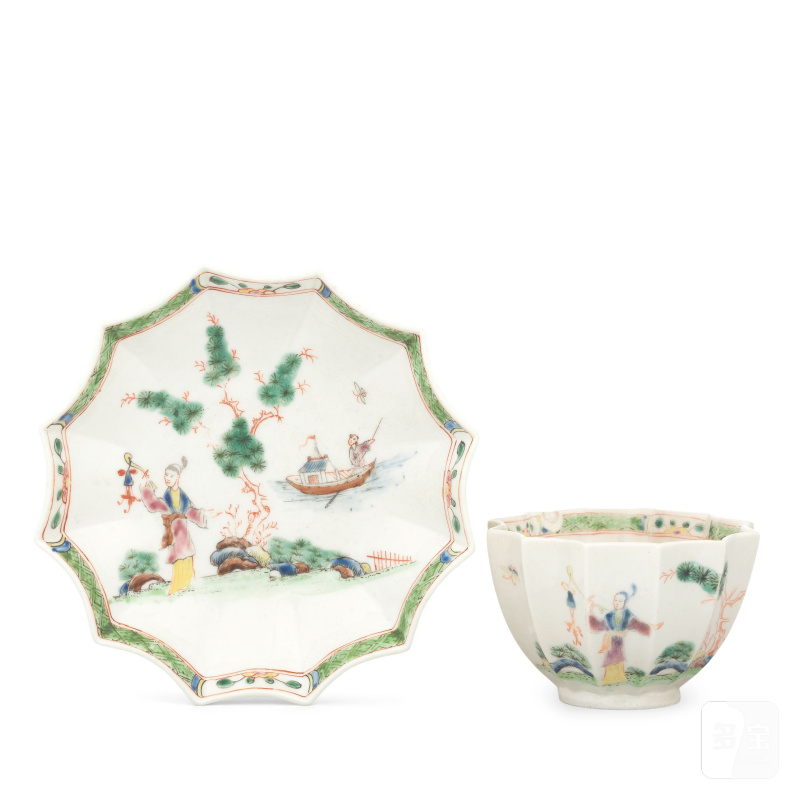

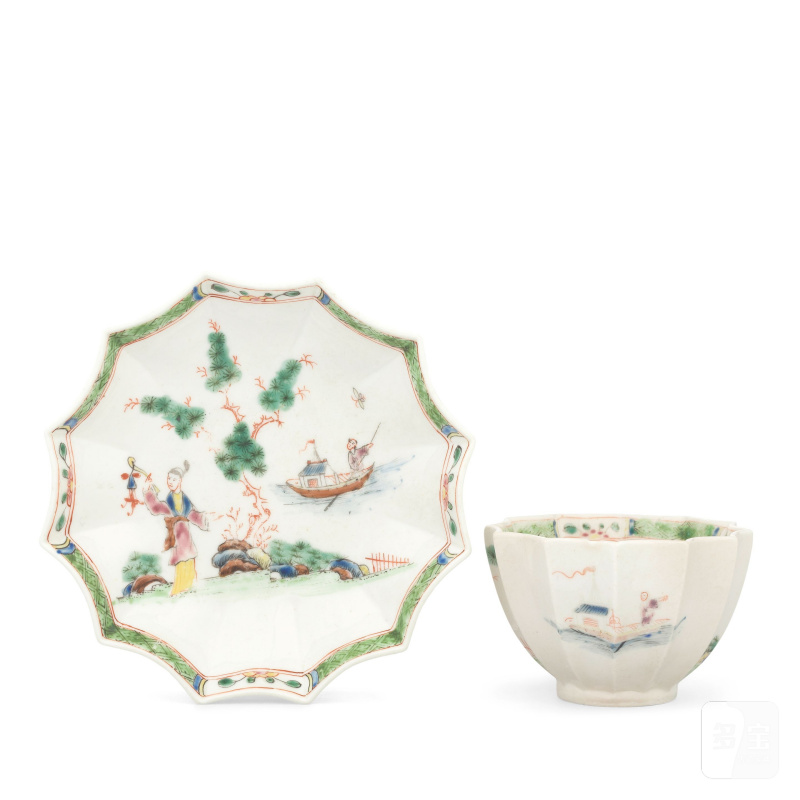
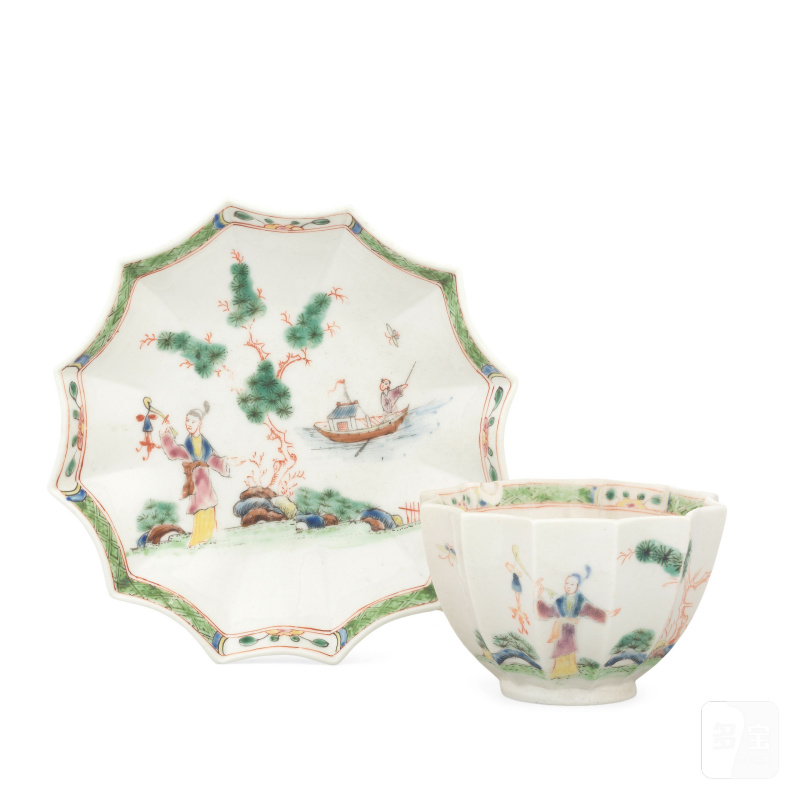
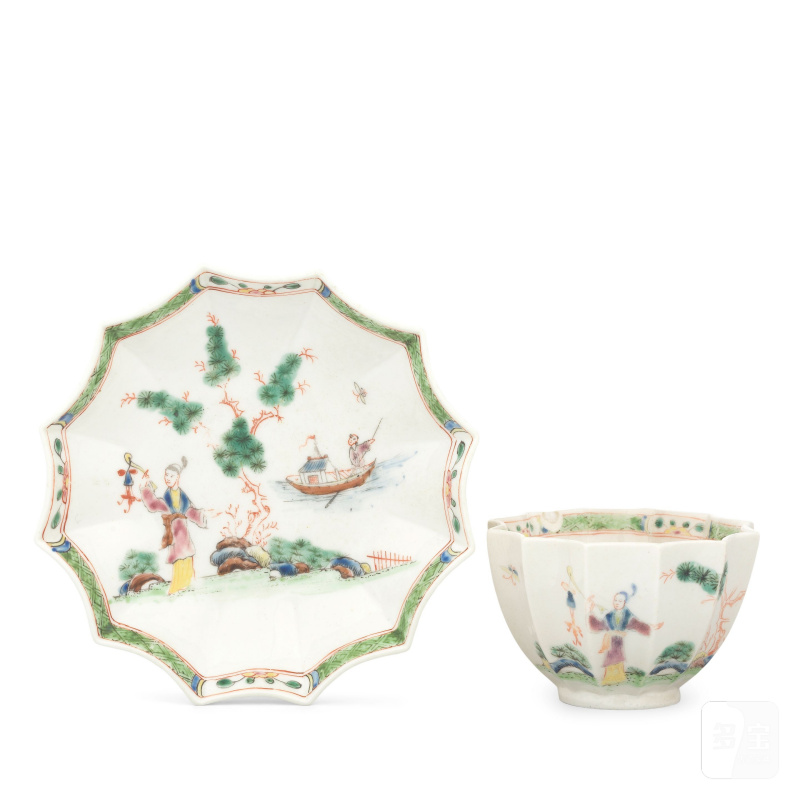
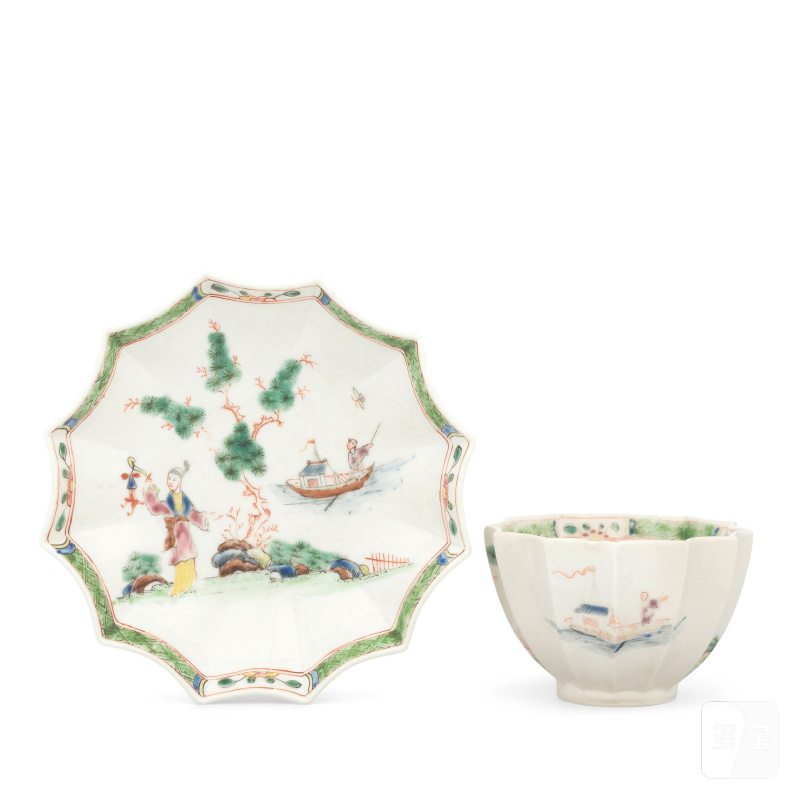
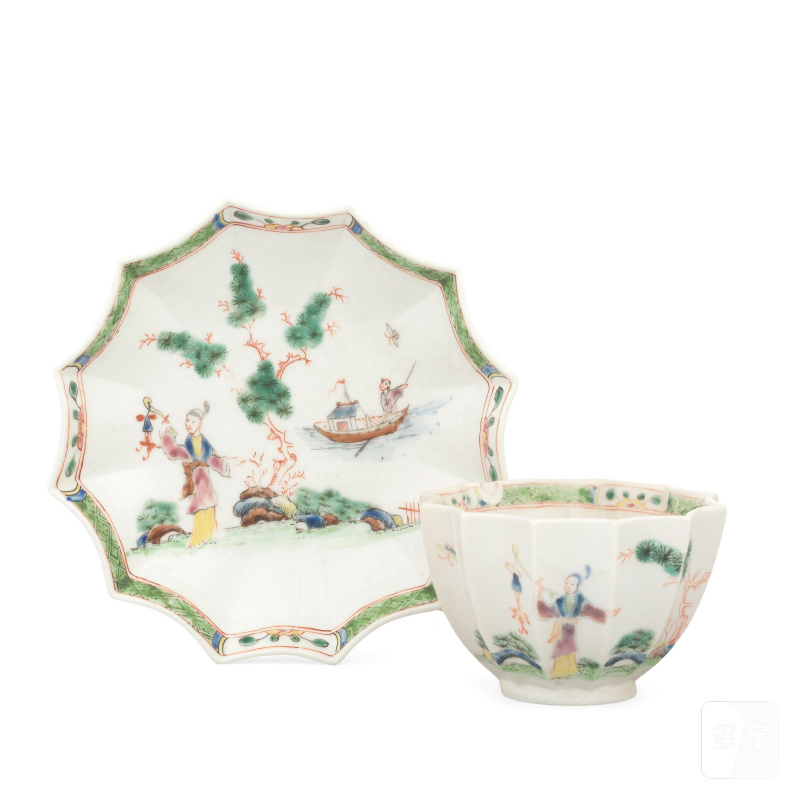
Lot 103 A rare Worcester twelve-sided teabowl and saucer, circa 1752
落槌价
****
成交价
****
| 拍卖公司 | 邦瀚斯 |
|---|---|
| 拍卖时间 | 2026年07月01日 |
请安装多宝古瓷宝典APP,查看高清无损大图
拍品信息
拍品名称
A rare Worcester twelve-sided teabowl and saucer, circa 1752
起拍价
GBP 4,000
估值区间
未知
尺寸
未知
品相
未知
更多信息
Sharply moulded with deep concave flutes, painted in Chinese famille verte style with a 'Long Eliza' figure holding a ruyi sceptre, standing on an island beside a pine tree, a figure in a sampan in the distance and to the reverse of the teabowl, the rims with panelled flowerhead and green diaper borders, a floral sprig inside the teabowl, saucer 12cm wide, teabowl 4.9cm high (2)
Footnotes
Provenance
Nina Weil Collection, New York (saucer);
Simon Spero exhibition, 2015, no.31 (saucer)
Bunny and Paul Davies Collection (teabowl)
Literature
White, Mary, Drinking at the Whites' House, Vol.2, 2021, p.345, fig.d
A few teabowls and saucers of this iconic Worcester form are known to have survived as sets, but the sharp points would have rendered them rather impractical as vessels from which to drink so it is presumed that pieces in this shape were intended purely as cabinet pieces. A biscuit fragment excavated on the Worcester factory site is discussed together with the shape by R B Cole, 'Form Versus Function? A Study of some early Worcester tea wares', , Vol.20, 2003-2004, p.59.
A similar teabowl and saucer from the A J Smith Collection in this rare pattern is illustrated by Simon Spero, , 2005, p.172, no.80. He suggests that the likely origin of the shape was Chinese, drawing comparisons with a Kangxi teabowl and saucer in the Bristol Museum and Art Gallery, p.151. See also the teabowl from the Zorensky Collection was sold by Bonhams on 11 February 2006, lot 14 and the saucer from the Liane Richards Collection on 13 April 2016, lot 137.
Footnotes
Provenance
Nina Weil Collection, New York (saucer);
Simon Spero exhibition, 2015, no.31 (saucer)
Bunny and Paul Davies Collection (teabowl)
Literature
White, Mary, Drinking at the Whites' House, Vol.2, 2021, p.345, fig.d
A few teabowls and saucers of this iconic Worcester form are known to have survived as sets, but the sharp points would have rendered them rather impractical as vessels from which to drink so it is presumed that pieces in this shape were intended purely as cabinet pieces. A biscuit fragment excavated on the Worcester factory site is discussed together with the shape by R B Cole, 'Form Versus Function? A Study of some early Worcester tea wares', , Vol.20, 2003-2004, p.59.
A similar teabowl and saucer from the A J Smith Collection in this rare pattern is illustrated by Simon Spero, , 2005, p.172, no.80. He suggests that the likely origin of the shape was Chinese, drawing comparisons with a Kangxi teabowl and saucer in the Bristol Museum and Art Gallery, p.151. See also the teabowl from the Zorensky Collection was sold by Bonhams on 11 February 2006, lot 14 and the saucer from the Liane Richards Collection on 13 April 2016, lot 137.