
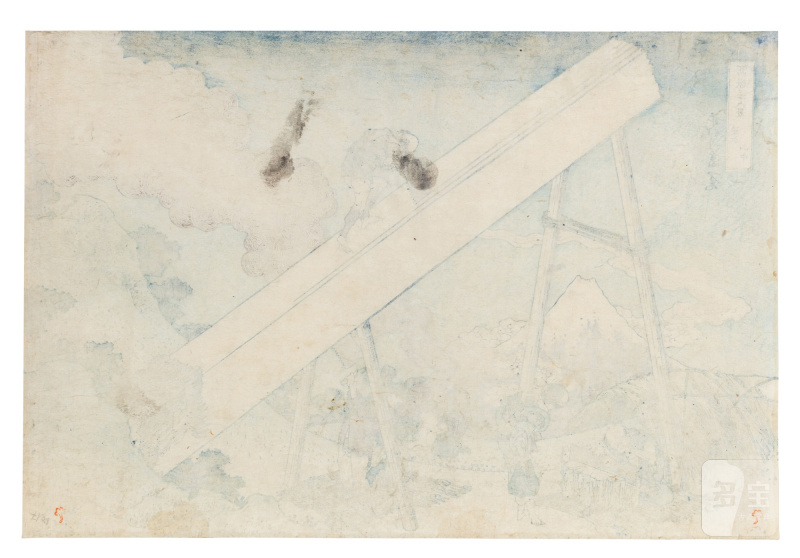
Lot 193 Katsushika Hokusai (1760-1849) | In the Mountains of Totomi Province (Totomi sanchu) | Edo period, 19th century
落槌价
****
成交价
****
| 拍卖公司 | 苏富比 |
|---|---|
| 拍卖时间 | 2026年06月11日 |
请安装多宝古瓷宝典APP,查看高清无损大图
拍品信息
拍品名称
Katsushika Hokusai (1760-1849) | In the Mountains of Totomi Province (Totomi sanchu) | Edo period, 19th century
起拍价
EUR 30,000
估值区间
30,000 - 40,000 EUR
尺寸
未知
品相
Good early impression, good colour, some rubbing overall, slight soiling, slight cracks to the paper in the upper section, thin backing to support paper thinning and cracks, the reverse with soiling and rubbing and small pencil annotation.
If a condition report is provided to assist you with assessing the condition of the lot, it is for guidance purposes only. Such condition report may not refer to all faults, restoration, alterations, or adaptations because Sotheby's is not a professional conservator or restorer but rather a condition report is a statement of subjective, qualified opinion genuinely held by Sotheby's. For these reasons, any such condition report is not an alternative to taking your own professional advice regarding the condition of the lot. Prospective buyers should also refer to the Guide for Buyers at Auction which includes important notices concerning the type of property in this sale.
If a condition report is provided to assist you with assessing the condition of the lot, it is for guidance purposes only. Such condition report may not refer to all faults, restoration, alterations, or adaptations because Sotheby's is not a professional conservator or restorer but rather a condition report is a statement of subjective, qualified opinion genuinely held by Sotheby's. For these reasons, any such condition report is not an alternative to taking your own professional advice regarding the condition of the lot. Prospective buyers should also refer to the Guide for Buyers at Auction which includes important notices concerning the type of property in this sale.
更多信息
woodblock print, from the series Thirty-six Views of Mount Fuji (Fugaku sanjurokkei), signed Saki no Hokusai Iitsu hitsu (Brush of Iitsu, the former Hokusai), censor’s seal kiwame (approved), published by Nishimuraya Yohachi (Eijudo), late 1831, blue outline; with collector's seal of Henri Vever to front, further collector's seal of Gerhard Pulverer to verso
Horizontal oban: 25.3 x 37.8 cm, 10 by 14⅞ in.
来源:Henri Vever (1854-1942)
Gerhard Pulverer (b. 1930)
图录
说明:A large squared timber, placed diagonally across the picture plane, dominates the composition. Supported by wooden props framing the view of Mount Fuji in the distance, the sacred mountain is glimpsed through the gap in the timber's support as though through the eye of a needle. The figures below are absorbed in their work: woodcutters saw the trunk into planks from above and below, a man sharpens the teeth of a saw beside a makeshift hut, while a boy tends a fire nearby. A mother, carrying an infant on her back and a wrapped lunchbox in her hand, pauses beside them. The smoke rising from the fire is rendered in a Western manner, while the mist coiling around Mount Fuji appears more stylised.
Although the title of the design situates us in Totomi (the western part of present-day Shizuoka Prefecture), there are no elements that anchor it to a specific location. The work is concerned above all with composition: the picture plane is configured with concealed triangular forms, and the bold diagonal of the timber, the conical silhouette of Fuji, and the A-frame of the support enter a precise geometric dialogue. The figural types have been connected to the illustrated handscroll Kinsei shokunin zukushi ekotoba [An Illustrated Compendium of Artisans of Recent Times] by Kuwagata Keisai (1764-1824) (Tokyo National Museum, A-83), the influence of which can be detected in the careful depiction of the labourers at work.
This is a fine early impression of the design in which the predominant tones are blue, grey and pale green.
Another impression of the same print is in the collection of the British Museum, museum number 1937,0710,0.153, go to:
https://www.britishmuseum.org/collection/object/A_1937-0710-0-153
Hokusai later illustrated a similar subject in Poem by Harumichi no Tsuraki (circa 1835–36) from the series One Hundred Poems Explained by the Nurse (Hyakunin isshu uba ga etoki). For an example of this print, also in the collection of the British Museum, museum number 1922,0719,0.4, go to:
https://www.britishmuseum.org/collection/object/A_1922-0719-0-4
The Collection of Henri Vever
Henri Vever (1854-1942) was regarded as one of the most distinguished jewellers of his time. By the 1880s, Vever was amongst the earliest Europeans to formally collect Japanese prints. He bought extensively from Hayashi Tadamasa (1853-1906) and was a member of Les Amis de l’Art Japonais, a clique of art enthusiasts, including Claude Monet (1840-1926), who met regularly to discuss Japanese works of art. In the early 20th century, Vever had already amassed a vast collection of fine prints numbering in the thousands. His collection became a focal point for scholars such as von Seidlitz, Migeon, and Lemoisne, who almost exclusively used his collection for their research. During his lifetime, Vever made several important bequests to French national collections. At the peak of World War I, Vever sold much of his collection to Matsukata Kojiro (1865-1950), which would later go on to form a significant part of the Tokyo National Museum’s collection of ukiyo-e prints.
Horizontal oban: 25.3 x 37.8 cm, 10 by 14⅞ in.
来源:Henri Vever (1854-1942)
Gerhard Pulverer (b. 1930)
图录
说明:A large squared timber, placed diagonally across the picture plane, dominates the composition. Supported by wooden props framing the view of Mount Fuji in the distance, the sacred mountain is glimpsed through the gap in the timber's support as though through the eye of a needle. The figures below are absorbed in their work: woodcutters saw the trunk into planks from above and below, a man sharpens the teeth of a saw beside a makeshift hut, while a boy tends a fire nearby. A mother, carrying an infant on her back and a wrapped lunchbox in her hand, pauses beside them. The smoke rising from the fire is rendered in a Western manner, while the mist coiling around Mount Fuji appears more stylised.
Although the title of the design situates us in Totomi (the western part of present-day Shizuoka Prefecture), there are no elements that anchor it to a specific location. The work is concerned above all with composition: the picture plane is configured with concealed triangular forms, and the bold diagonal of the timber, the conical silhouette of Fuji, and the A-frame of the support enter a precise geometric dialogue. The figural types have been connected to the illustrated handscroll Kinsei shokunin zukushi ekotoba [An Illustrated Compendium of Artisans of Recent Times] by Kuwagata Keisai (1764-1824) (Tokyo National Museum, A-83), the influence of which can be detected in the careful depiction of the labourers at work.
This is a fine early impression of the design in which the predominant tones are blue, grey and pale green.
Another impression of the same print is in the collection of the British Museum, museum number 1937,0710,0.153, go to:
https://www.britishmuseum.org/collection/object/A_1937-0710-0-153
Hokusai later illustrated a similar subject in Poem by Harumichi no Tsuraki (circa 1835–36) from the series One Hundred Poems Explained by the Nurse (Hyakunin isshu uba ga etoki). For an example of this print, also in the collection of the British Museum, museum number 1922,0719,0.4, go to:
https://www.britishmuseum.org/collection/object/A_1922-0719-0-4
The Collection of Henri Vever
Henri Vever (1854-1942) was regarded as one of the most distinguished jewellers of his time. By the 1880s, Vever was amongst the earliest Europeans to formally collect Japanese prints. He bought extensively from Hayashi Tadamasa (1853-1906) and was a member of Les Amis de l’Art Japonais, a clique of art enthusiasts, including Claude Monet (1840-1926), who met regularly to discuss Japanese works of art. In the early 20th century, Vever had already amassed a vast collection of fine prints numbering in the thousands. His collection became a focal point for scholars such as von Seidlitz, Migeon, and Lemoisne, who almost exclusively used his collection for their research. During his lifetime, Vever made several important bequests to French national collections. At the peak of World War I, Vever sold much of his collection to Matsukata Kojiro (1865-1950), which would later go on to form a significant part of the Tokyo National Museum’s collection of ukiyo-e prints.
常见问题
拍品的品相状况如何?
Good early impression, good colour, some rubbing overall, slight soiling, slight cracks to the paper in the upper section, thin backing to support paper thinning and cracks, the reverse with soiling and rubbing and small pencil annotation.
If a condition report is provided to assist you with assessing the condition of the lot, it is for guidance purposes only. Such condition report may not refer to all faults, restoration, alterations, or adaptations because Sotheby's is not a professional conservator or restorer but rather a condition report is a statement of subjective, qualified opinion genuinely held by Sotheby's. For these reasons, any such condition report is not an alternative to taking your own professional advice regarding the condition of the lot. Prospective buyers should also refer to the Guide for Buyers at Auction which includes important notices concerning the type of property in this sale.
If a condition report is provided to assist you with assessing the condition of the lot, it is for guidance purposes only. Such condition report may not refer to all faults, restoration, alterations, or adaptations because Sotheby's is not a professional conservator or restorer but rather a condition report is a statement of subjective, qualified opinion genuinely held by Sotheby's. For these reasons, any such condition report is not an alternative to taking your own professional advice regarding the condition of the lot. Prospective buyers should also refer to the Guide for Buyers at Auction which includes important notices concerning the type of property in this sale.
这件拍品的流传来源是什么?
Henri Vever (1854-1942)
Gerhard Pulverer (b. 1930)
图录
Gerhard Pulverer (b. 1930)
图录