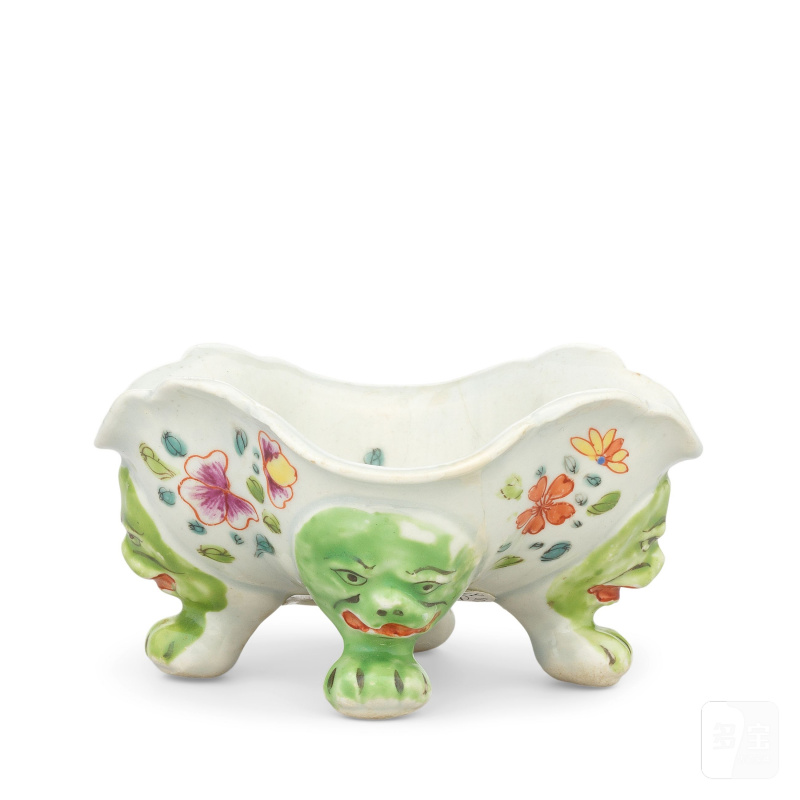

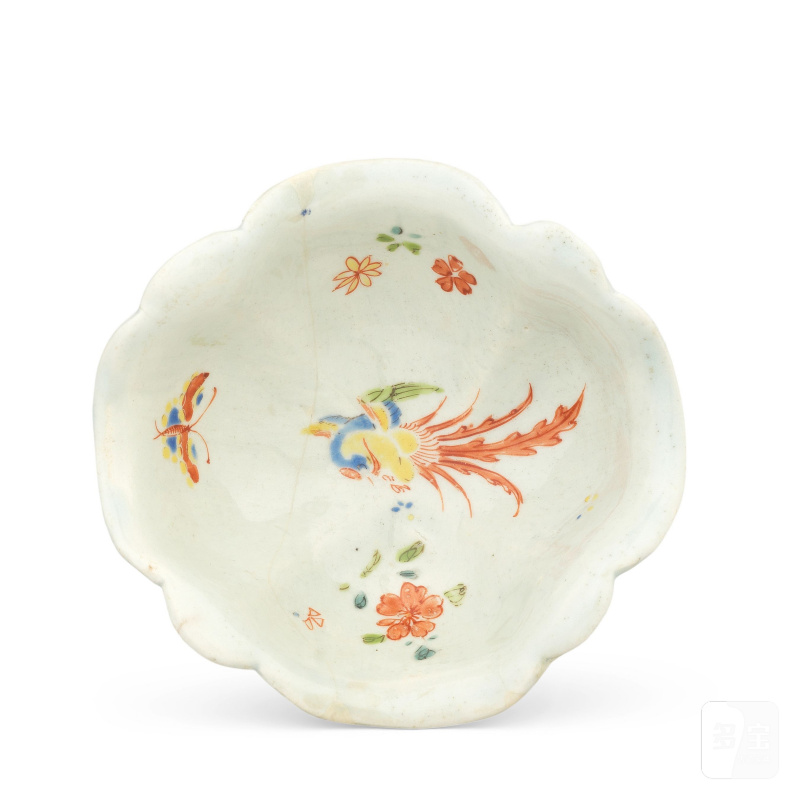
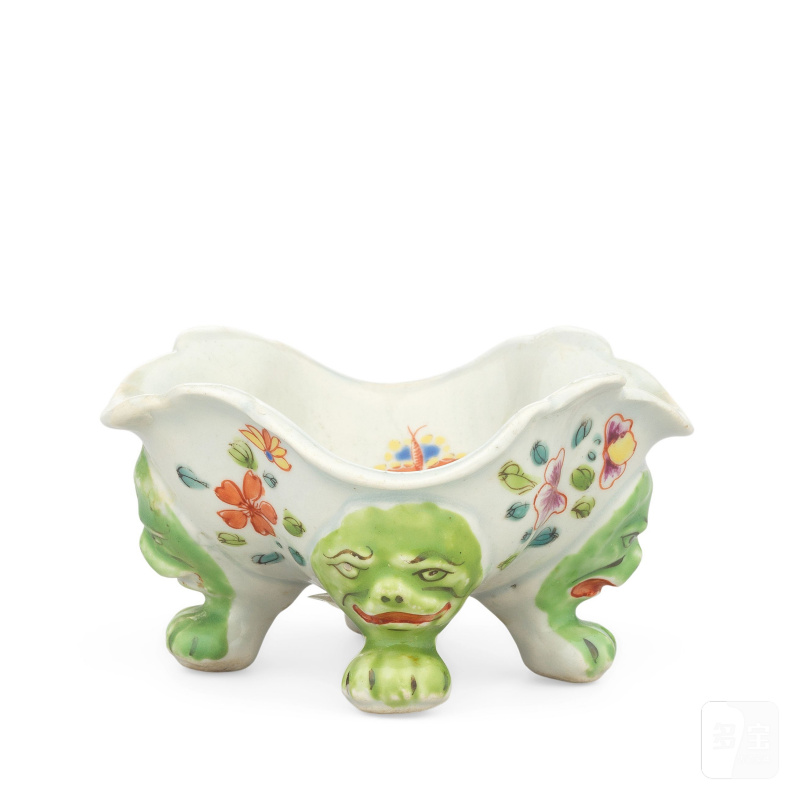
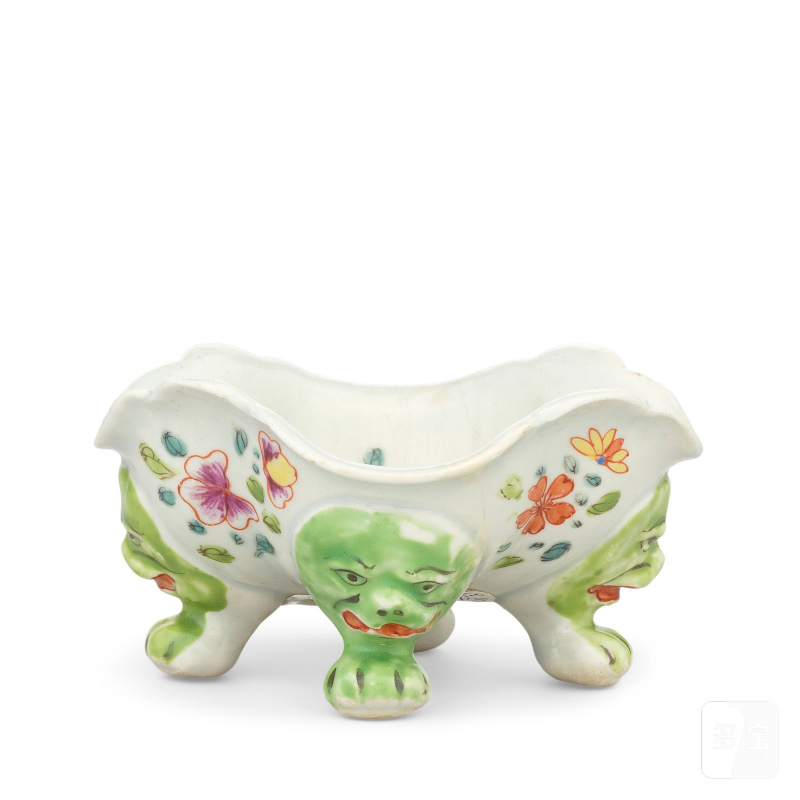
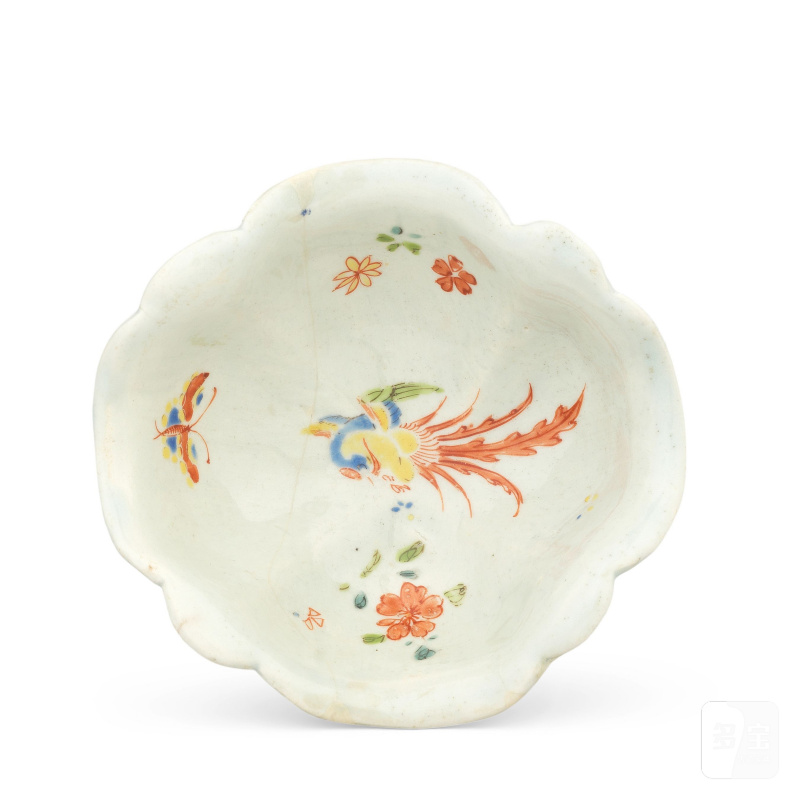
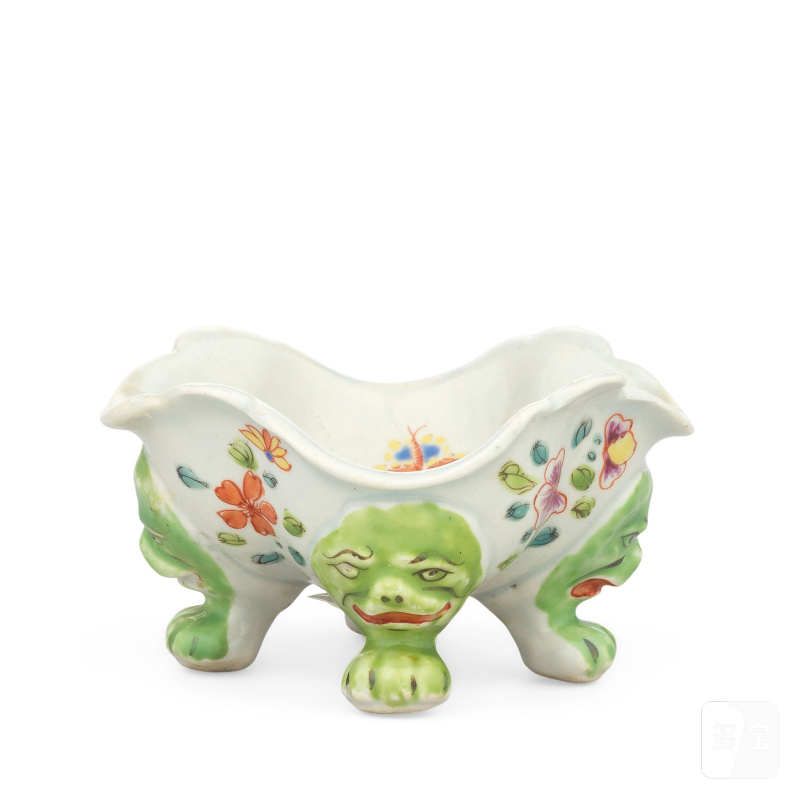
Lot 128 An exceptionally rare Limehouse salt, circa 1746-48
落槌价
****
成交价
****
| 拍卖公司 | 邦瀚斯 |
|---|---|
| 拍卖时间 | 2026年07月01日 |
请安装多宝古瓷宝典APP,查看高清无损大图
拍品信息
拍品名称
An exceptionally rare Limehouse salt, circa 1746-48
起拍价
GBP 1,200
估值区间
未知
尺寸
未知
品相
未知
更多信息
Of quatrelobed form with an undulating rim, raised on four bright green lion mask and paw feet, their mouths in red and features picked out in black, painted with sprays of flowers and leaves, the interior painted in Kakiemon style with a long-tailed bird in flight surrounded by scattered flowers and an insect, 9cm wide
Footnotes
Provenance
Watney Collection, Phillips, 22 September 1999, lot 128;
Bunny and Paul Davies Collection, Simon Spero exhibition, 2013, no.2
Literature
Watney, Bernard, 'Limehouse Coloured Ware', ECC Trans, Vol.15, Pt.1, 1993, p.69, figs.20 and 21
ECC, Limehouse Ware Revealed, 1993, col. pl.XIV
White, Mary, Eating at the Whites' House, Vol.3, 2022, p.303, fig.a
In his 1993 ECC paper, Bernard Watney attempted a classification of known coloured Limehouse wares, all of which match European decoration added to Chinese, Japanese and Meissen porcelain and sometimes on Delft. At the time of writing only 21 pieces of coloured Limehouse were recorded, including two salts with lion mask and paw feet but both of very different form. The present lot belongs to Watney's 'Bold Famille Rose' group and is mentioned by him as being one of a pair, although its companion is not illustrated and this may be erroneous. The salt of different form is illustrated alongside the present lot in , 1993, p.55, col. pl.XV and was sold by Bonhams as part of the Watney Collection on 19 June 2024, lot 268.
To this can be added a unique blue and white example, sold by Bonhams as part of the Susi and Ian Sutherland Collection on 3 October 2007, lot 117. This is illustrated by Rosalie Wise Sharp, , Vol.1, 2015, p.178, no.605, and again by Ray Jones, , 2018, p.221. Whilst very misshapen, it also has lion head and paw feet like the present lot.
Whilst no evidence of enamelling was found on the Limehouse factory site, closely related enamel decoration is found on Chinese and Meissen porcelain enamelled in Europe, as well as Staffordshire saltglaze stoneware. While Bernard Watney felt strongly that this enamelling was Dutch, it is now considered more likely that this group was the work of a Dutch enameller working in England.
Footnotes
Provenance
Watney Collection, Phillips, 22 September 1999, lot 128;
Bunny and Paul Davies Collection, Simon Spero exhibition, 2013, no.2
Literature
Watney, Bernard, 'Limehouse Coloured Ware', ECC Trans, Vol.15, Pt.1, 1993, p.69, figs.20 and 21
ECC, Limehouse Ware Revealed, 1993, col. pl.XIV
White, Mary, Eating at the Whites' House, Vol.3, 2022, p.303, fig.a
In his 1993 ECC paper, Bernard Watney attempted a classification of known coloured Limehouse wares, all of which match European decoration added to Chinese, Japanese and Meissen porcelain and sometimes on Delft. At the time of writing only 21 pieces of coloured Limehouse were recorded, including two salts with lion mask and paw feet but both of very different form. The present lot belongs to Watney's 'Bold Famille Rose' group and is mentioned by him as being one of a pair, although its companion is not illustrated and this may be erroneous. The salt of different form is illustrated alongside the present lot in , 1993, p.55, col. pl.XV and was sold by Bonhams as part of the Watney Collection on 19 June 2024, lot 268.
To this can be added a unique blue and white example, sold by Bonhams as part of the Susi and Ian Sutherland Collection on 3 October 2007, lot 117. This is illustrated by Rosalie Wise Sharp, , Vol.1, 2015, p.178, no.605, and again by Ray Jones, , 2018, p.221. Whilst very misshapen, it also has lion head and paw feet like the present lot.
Whilst no evidence of enamelling was found on the Limehouse factory site, closely related enamel decoration is found on Chinese and Meissen porcelain enamelled in Europe, as well as Staffordshire saltglaze stoneware. While Bernard Watney felt strongly that this enamelling was Dutch, it is now considered more likely that this group was the work of a Dutch enameller working in England.