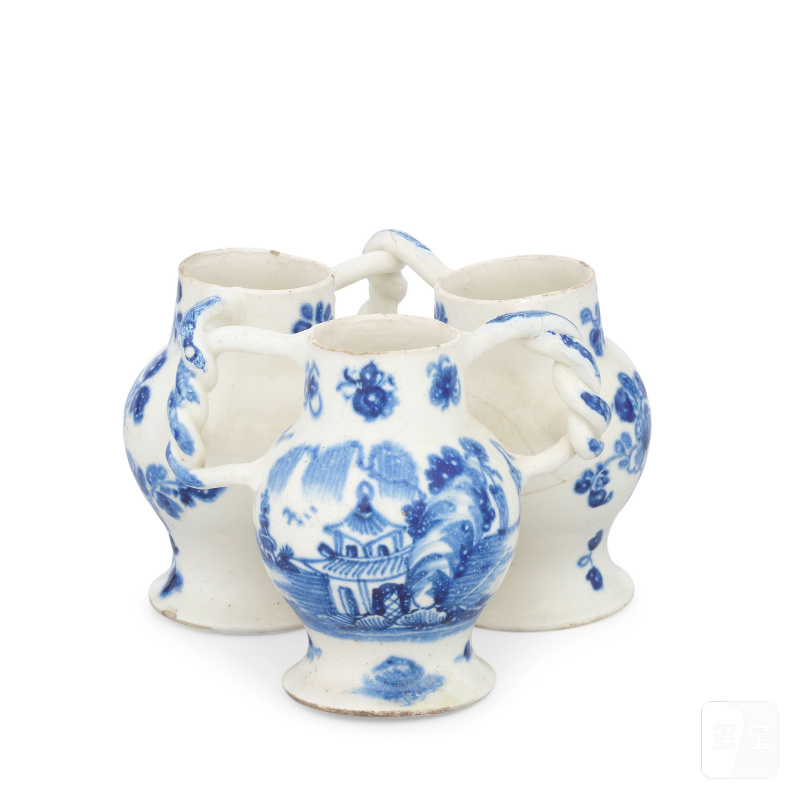

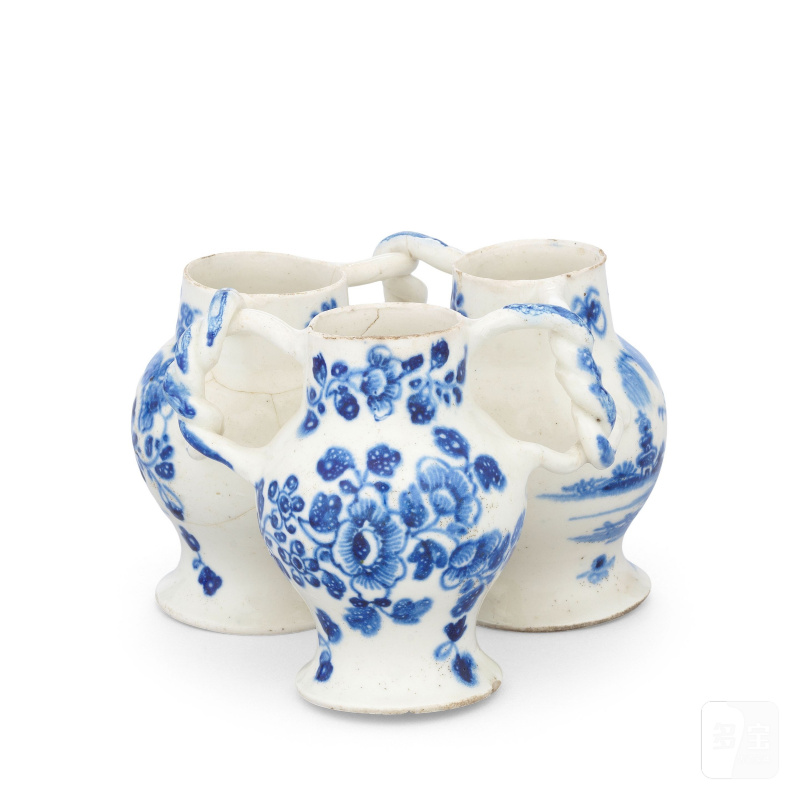
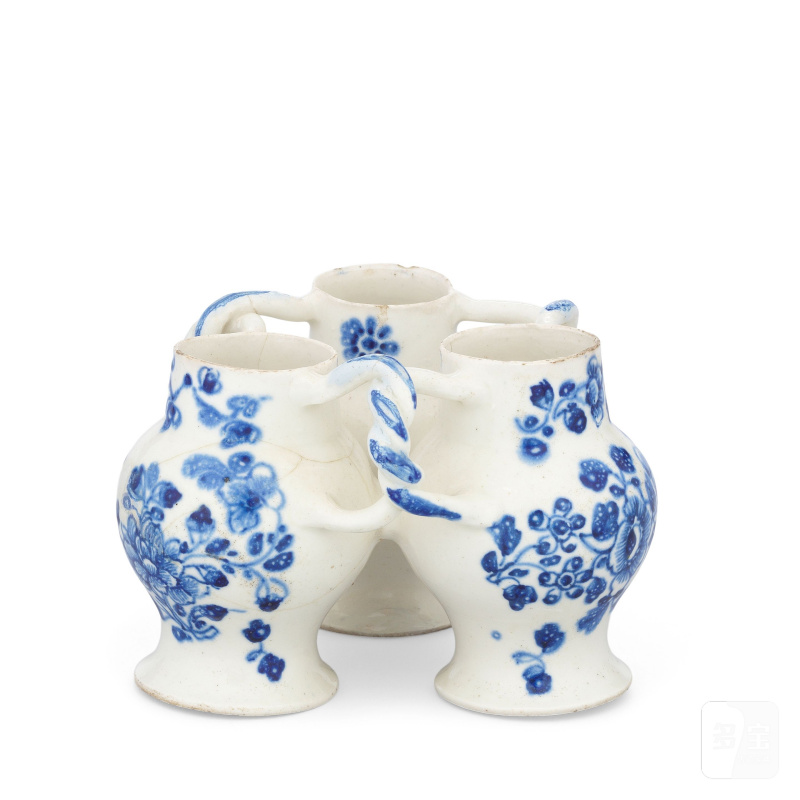
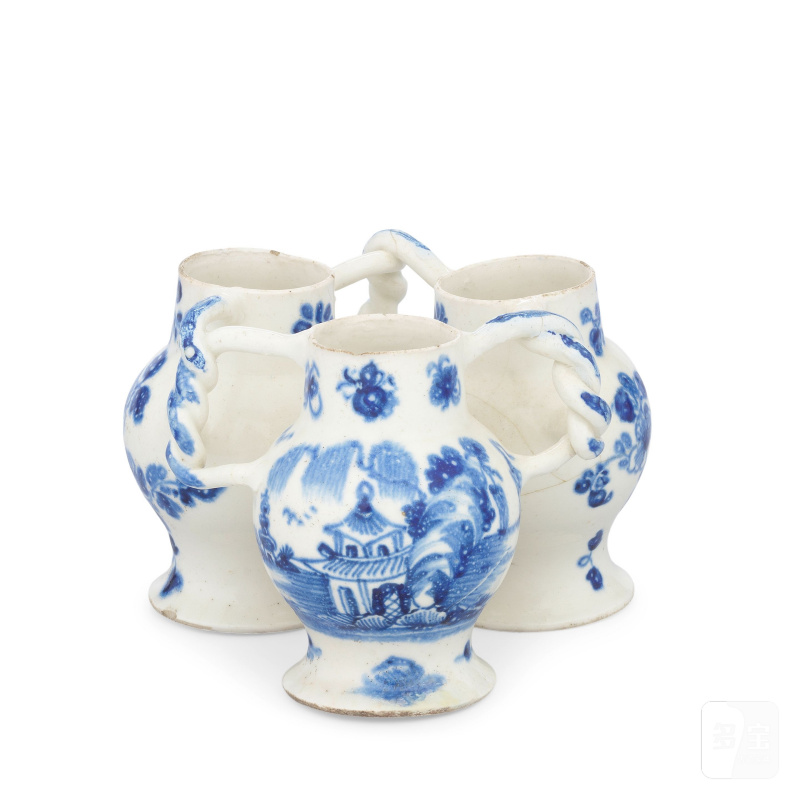
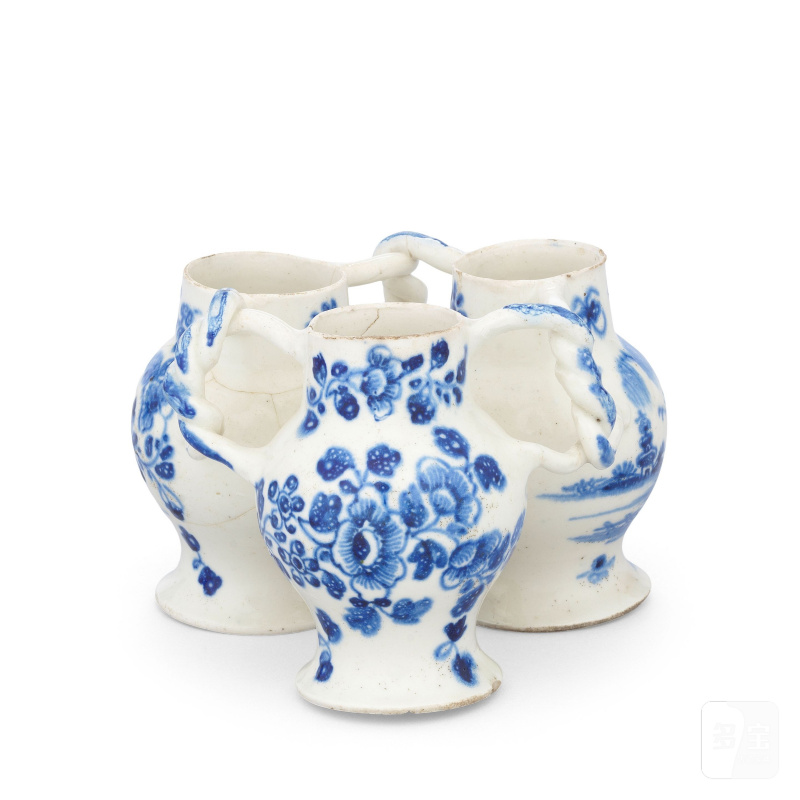
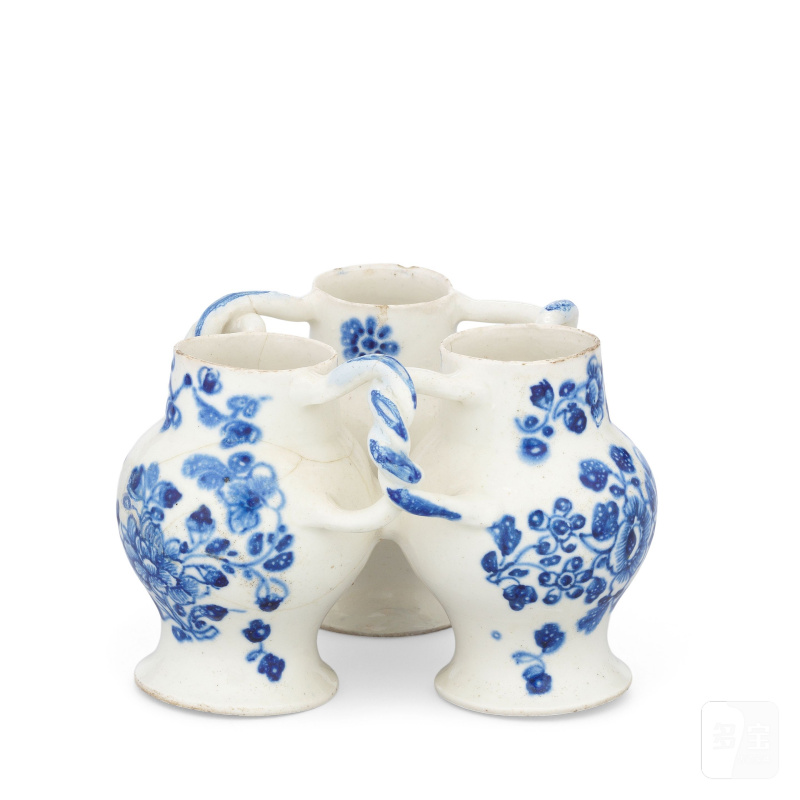
Lot 174 A highly significant Bovey Tracey porcelain fuddling cup, circa 1767
落槌价
****
成交价
****
| 拍卖公司 | 邦瀚斯 |
|---|---|
| 拍卖时间 | 2026年07月01日 |
请安装多宝古瓷宝典APP,查看高清无损大图
拍品信息
拍品名称
A highly significant Bovey Tracey porcelain fuddling cup, circa 1767
起拍价
GBP 1,000
估值区间
未知
尺寸
未知
品相
未知
更多信息
Formed as three conjoined vessels or cups with globular bodies and neat spreading feet, linked by holes to their interiors, their handles intertwined, painted in blue, one with a Chinese landscape incorporating two pagodas on islands with trees and rockwork, insects in flight above, the other two with flowering plants, 8.5cm high
Footnotes
Literature
Adams, Brian, A Bovey Tracey Tin-glazed Porcelain Fuddling Cup, 2005;
Massey, Marno and Spero, Ceramics of Vauxhall, 2007, p.95, no.105;
White, Mary, 'A Bovey Tracey Fuddling Cup', ECC Trans, Vol.19, Pt.3, 2007, p.506, figs.8a and 8b;
Panes, Nicholas and Owen, J Victor, 'Attribution enhanced - a Bovey Tracey porcelain sauceboat', ECC Trans, Vol.21, 2010, p.126, figs.1 and 4 (left);
Dunster, Joanna and Panes, Nick, 'Attribution Enhanced - Another Bovey Tracey Find', ECC Trans, Vol.26, 2015, p.112, figs.2 and 4 (left);
White, Mary, Drinking at the Whites' House, Vol.2, 2021, p.86, fig.c
Following the closure of the Vauxhall factory in 1764, Nicholas Crisp embarked on a venture making porcelain at the Indeo Pottery in Bovey Tracey, Devon. The history of the factory and related correspondence between William Cookworthy and Thomas Pitt are discussed by Roger Massey, 'Nicholas Crisp at Bovey Tracey' and 'Bovey Tracey potteries revisited', , Vol.18, Pt.1, 2002, pp.96-113 and pp.114-121 respectively. Attribution of pieces to this ill-fated factory was made possible following pioneering analysis of a small number of sherds recovered from the factory site, see J Victor Owen, Brian Adams and Roy Stephenson, 'Nicholas Crisp's "Porcellien"', , Vol.15, No.1, 2000, pp.43-78, which established that several different porcelain bodies were experimented with including one based on soaprock with the unusual addition of barite, perhaps as a whitener. This is regarded as unique to Bovey Tracey porcelain.
Chemical analysis of this fuddling cup revealed that the paste has similarities to Vauxhall and some Liverpool porcelain, but that it is set apart by the presence of around 3.6 percent barium, see Mary White, 2007, p.502. This piece therefore represents the first extant piece of porcelain ever to have been firmly attributed to Bovey Tracey. Only a handful of 18th century porcelain fuddling cups are known, with pottery examples being far more abundant, see for example that produced at nearby Donyatt, lot 33 in this sale, which is illustrated alongside the present lot by Mary White, 2021, p.86. Just two other porcelain examples are recorded by Mary White in her 2007 paper, including one of Continental origin (Höchst) and another in the Victoria and Albert Museum (inv. no.C.130-1926) which is also likely to be Bovey Tracey. To these can be added two sauceboats and a two-handled cup, see Joanna Dunster and Nick Panes' 2015 paper. All are decorated in underglaze blue, typically in a 'delft' style also known at Vauxhall.
Footnotes
Literature
Adams, Brian, A Bovey Tracey Tin-glazed Porcelain Fuddling Cup, 2005;
Massey, Marno and Spero, Ceramics of Vauxhall, 2007, p.95, no.105;
White, Mary, 'A Bovey Tracey Fuddling Cup', ECC Trans, Vol.19, Pt.3, 2007, p.506, figs.8a and 8b;
Panes, Nicholas and Owen, J Victor, 'Attribution enhanced - a Bovey Tracey porcelain sauceboat', ECC Trans, Vol.21, 2010, p.126, figs.1 and 4 (left);
Dunster, Joanna and Panes, Nick, 'Attribution Enhanced - Another Bovey Tracey Find', ECC Trans, Vol.26, 2015, p.112, figs.2 and 4 (left);
White, Mary, Drinking at the Whites' House, Vol.2, 2021, p.86, fig.c
Following the closure of the Vauxhall factory in 1764, Nicholas Crisp embarked on a venture making porcelain at the Indeo Pottery in Bovey Tracey, Devon. The history of the factory and related correspondence between William Cookworthy and Thomas Pitt are discussed by Roger Massey, 'Nicholas Crisp at Bovey Tracey' and 'Bovey Tracey potteries revisited', , Vol.18, Pt.1, 2002, pp.96-113 and pp.114-121 respectively. Attribution of pieces to this ill-fated factory was made possible following pioneering analysis of a small number of sherds recovered from the factory site, see J Victor Owen, Brian Adams and Roy Stephenson, 'Nicholas Crisp's "Porcellien"', , Vol.15, No.1, 2000, pp.43-78, which established that several different porcelain bodies were experimented with including one based on soaprock with the unusual addition of barite, perhaps as a whitener. This is regarded as unique to Bovey Tracey porcelain.
Chemical analysis of this fuddling cup revealed that the paste has similarities to Vauxhall and some Liverpool porcelain, but that it is set apart by the presence of around 3.6 percent barium, see Mary White, 2007, p.502. This piece therefore represents the first extant piece of porcelain ever to have been firmly attributed to Bovey Tracey. Only a handful of 18th century porcelain fuddling cups are known, with pottery examples being far more abundant, see for example that produced at nearby Donyatt, lot 33 in this sale, which is illustrated alongside the present lot by Mary White, 2021, p.86. Just two other porcelain examples are recorded by Mary White in her 2007 paper, including one of Continental origin (Höchst) and another in the Victoria and Albert Museum (inv. no.C.130-1926) which is also likely to be Bovey Tracey. To these can be added two sauceboats and a two-handled cup, see Joanna Dunster and Nick Panes' 2015 paper. All are decorated in underglaze blue, typically in a 'delft' style also known at Vauxhall.