

拍品信息
拍品名称
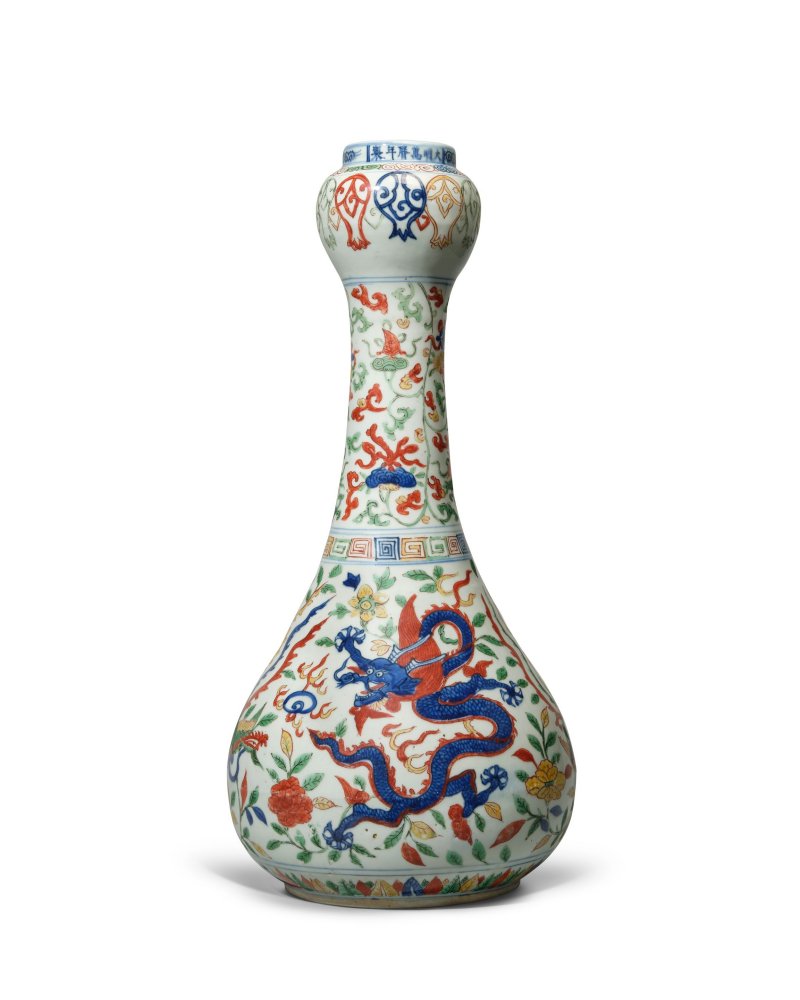
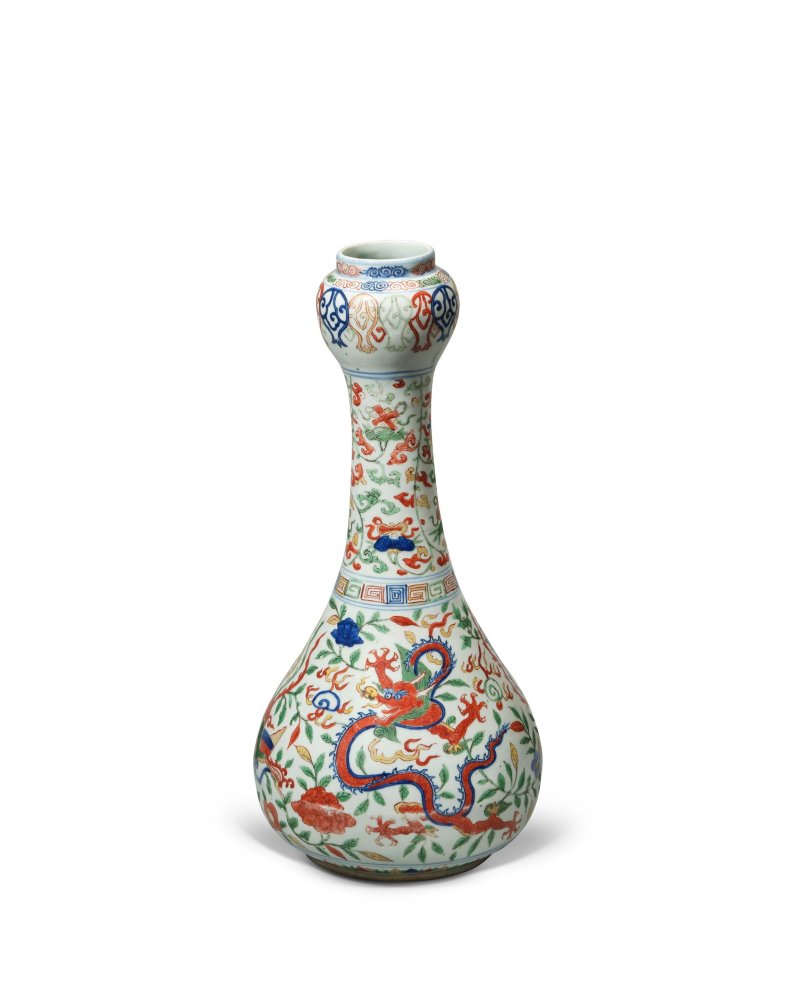
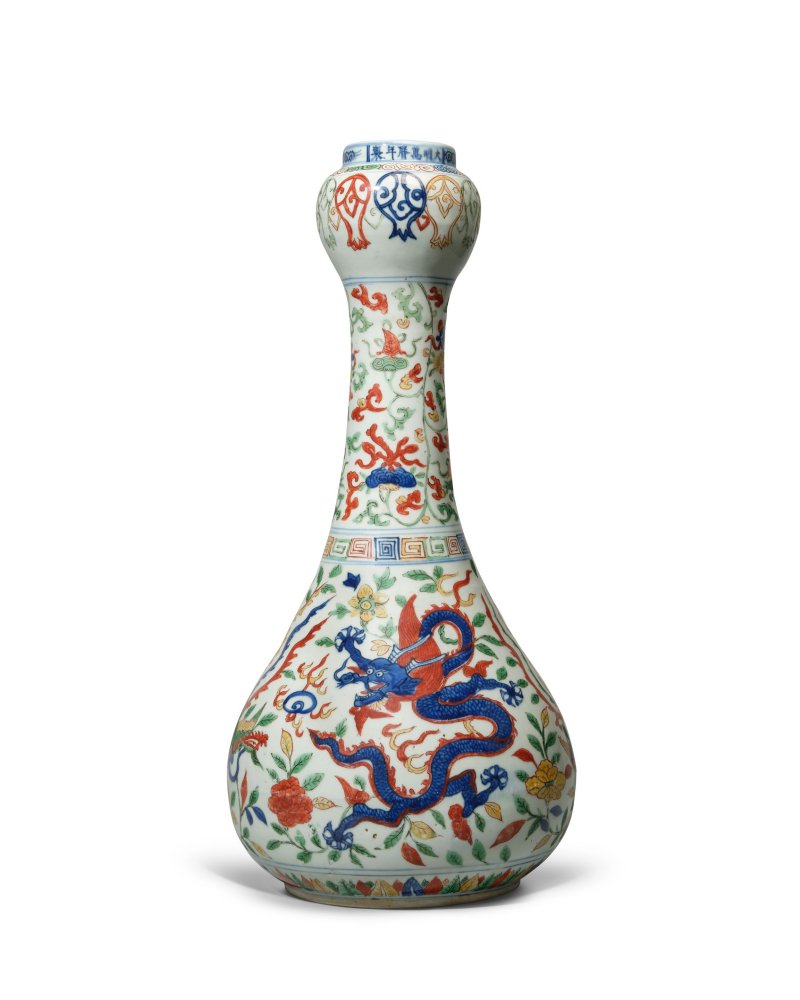
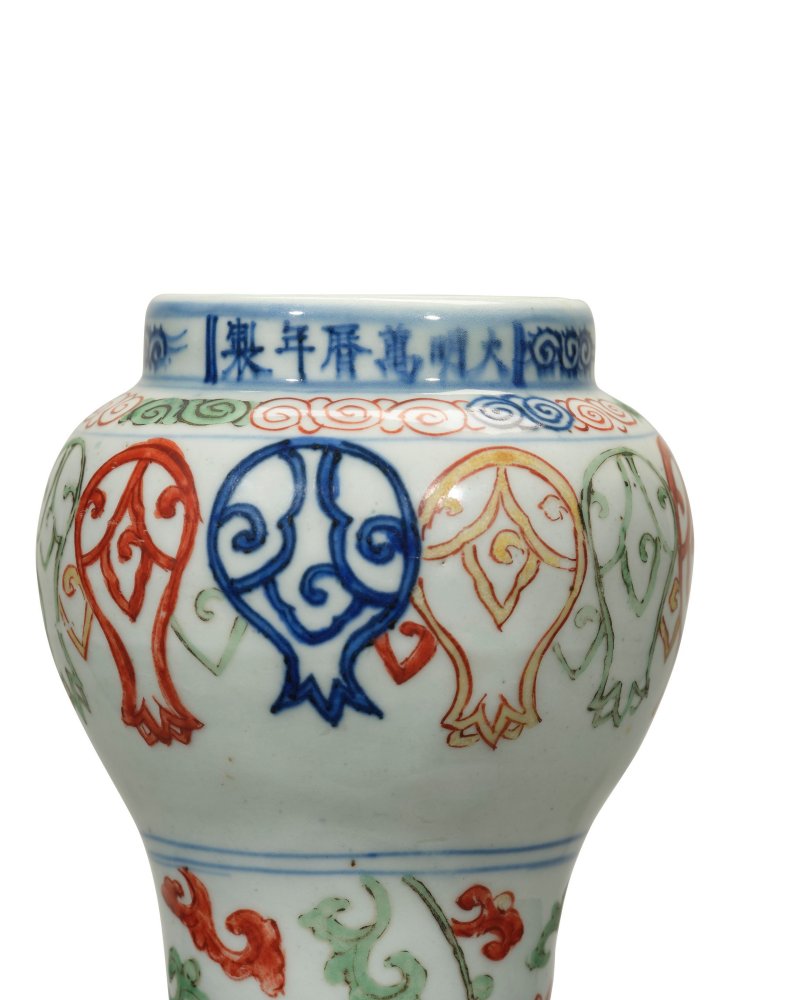
明萬曆 五彩穿花龍鳳紋蒜頭瓶 | A RARE WUCAI 'DRAGON AND PHOENIX' GARLIC-HEAD VASE
年代
Wanli six-character mark and of the period
起拍价
HKD 800,000
估值区间
HKD 800000 - 1200000
尺寸
未知
品相
未知
更多信息
Wanli six-character mark and of the period
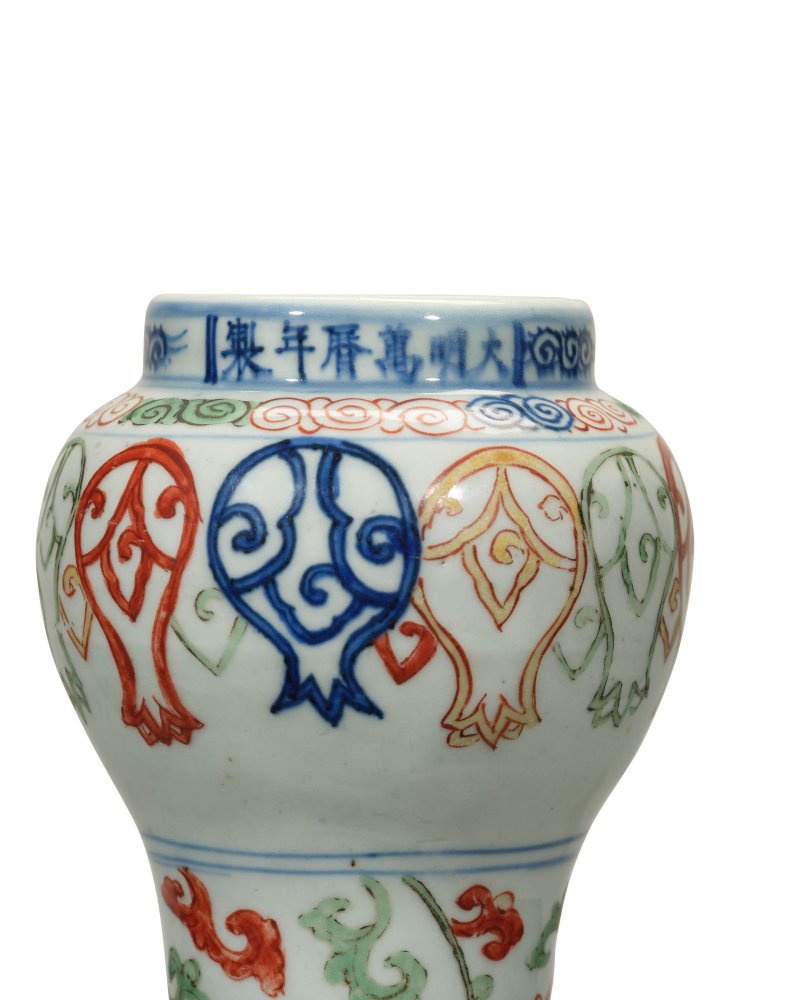
Of tall pear-shaped form, the swollen body supported on a broad foot, gently rising to a tall, elegant neck and prominent 'garlic-bulb' mouth, the lower register brilliantly enamelled in vivid tones of red, yellow, green and black, and painted in underglaze-blue with a powerful design of two pairs of five-clawed dragons and phoenixes in pursuit of flaming pearls, amidst stylised flowers on meandering stems, above a collar of upright lappets encircling the foot, scroll, the neck decorated with various floral blooms amidst meandering stems, below precious objects hanging from strings of beads, box.
46cm (18 1/8in) high. (2).
Footnotes
明萬曆 五彩穿花龍鳳紋蒜頭瓶
青花「大明萬曆年製」楷書款
Provenance:
The Tsui Museum of Art, Hong Kong, no.MPW034
來源:
徐氏藝術館,香港,編號MPW034
Compare a similar garlic-head vase, Wanli mark and of the period, painted to the body with four dragons in flight, in the Palace Museum, Taipei, acc.no.-009303N. See also a garlic-head vase, Wanli mark and of the period, from the Avery Brundage collection, in the Asian Art Museum, San Francisco, acc.no.B60P56. Compare also a related 'dragon and phoenix' garlic-head vase, Wanli mark and of the period, from the collection of the Chang Foundation, illustrated in , Chang Foundation, Taipei, 1990, pl.109, which was later sold at Christie's Hong Kong, 30 November 2016, lot 3397. See also a 'dragon and phoenix' garlic-head vase, Wanli six-character mark and of the period, which was sold at Sotheby's Hong Kong, 7 April 2010, lot 1865.
porcelains of the Wanli period (1573–1620) represent one of the most resplendent achievements of Ming Imperial ceramic production, distinguished by their vibrant palettes, intricate compositions, and luxurious visual appeal. Among the most celebrated forms are garlic-mouthed vases (), whose iconic silhouette adapts archaic bronze prototypes into a refined ceramic vessel. These surfaces served as ideal canvases for imperial artisans, who enlivened them with brilliantly painted polychrome designs combining underglaze cobalt blue with vivid overglaze enamels.
The pairing of the dragon and phoenix — symbolising the Emperor and Empress respectively — represents cosmic harmony ( and ) and wishes for marital bliss and imperial stability. Achieving such a complex decorative scheme required a perilous two-stage firing process: first firing the high-temperature underglaze cobalt blue, followed by the delicate application and low-temperature enamel firing of the iron-red, green, and yellow overglaze pigments.
比較台北故宮博物院藏一件明萬曆五彩龍紋蒜頭瓶,編號:故瓷-009303N。另可比較舊金山亞洲藝術博物館,艾弗里·布倫戴奇(Avery Brundage)舊藏一件明萬曆五彩蒜頭瓶,編號:B60P56。亦可比較台北鴻禧美術館舊藏一件明萬曆五彩龍鳳紋蒜頭瓶,著錄於《中國歷代陶瓷旋即》,台北,1990年,圖版109,後售於香港佳士得,2016年11月30日,拍品編號3397。另參見一例明萬曆青花五彩龍鳳紋蒜頭瓶,售於香港蘇富比,2010年4月7日,拍品編號1865。
明萬曆時期(1573–1620年)之五彩瓷器,以其濃豔華麗之色彩、繁複精妙之紋飾所呈現之視覺美感,堪稱明代御窯燒造史中最為輝煌燦爛之成就之一。其中,蒜頭瓶尤為名貴典雅,其造型源自古代青銅器,經御窯匠人巧思轉化為線條優美之陶瓷佳器。此類器表為宮廷畫匠提供了絕佳之創作空間,以釉下青花之凝重搭配釉上礬紅、綠、黃等多彩顏料,繪就絢麗奪目之御用器物。
龍鳳相配,分別象徵帝王與皇后,既具陰陽調和、天地和諧之宇宙觀,亦寄托琴瑟和鳴與帝業永固之吉祥寓意。此類繁複紋飾之燒造極具風險,需歷兩道嚴苛之工序:先入窯經高溫燒成釉下青花,繼而精繪釉上彩料,再入低溫彩爐二次烘烤方成。如此工藝要求極高,盡顯御窯匠人之湛深藝技。
Of tall pear-shaped form, the swollen body supported on a broad foot, gently rising to a tall, elegant neck and prominent 'garlic-bulb' mouth, the lower register brilliantly enamelled in vivid tones of red, yellow, green and black, and painted in underglaze-blue with a powerful design of two pairs of five-clawed dragons and phoenixes in pursuit of flaming pearls, amidst stylised flowers on meandering stems, above a collar of upright lappets encircling the foot, scroll, the neck decorated with various floral blooms amidst meandering stems, below precious objects hanging from strings of beads, box.
46cm (18 1/8in) high. (2).
Footnotes
明萬曆 五彩穿花龍鳳紋蒜頭瓶
青花「大明萬曆年製」楷書款
Provenance:
The Tsui Museum of Art, Hong Kong, no.MPW034
來源:
徐氏藝術館,香港,編號MPW034
Compare a similar garlic-head vase, Wanli mark and of the period, painted to the body with four dragons in flight, in the Palace Museum, Taipei, acc.no.-009303N. See also a garlic-head vase, Wanli mark and of the period, from the Avery Brundage collection, in the Asian Art Museum, San Francisco, acc.no.B60P56. Compare also a related 'dragon and phoenix' garlic-head vase, Wanli mark and of the period, from the collection of the Chang Foundation, illustrated in , Chang Foundation, Taipei, 1990, pl.109, which was later sold at Christie's Hong Kong, 30 November 2016, lot 3397. See also a 'dragon and phoenix' garlic-head vase, Wanli six-character mark and of the period, which was sold at Sotheby's Hong Kong, 7 April 2010, lot 1865.
porcelains of the Wanli period (1573–1620) represent one of the most resplendent achievements of Ming Imperial ceramic production, distinguished by their vibrant palettes, intricate compositions, and luxurious visual appeal. Among the most celebrated forms are garlic-mouthed vases (), whose iconic silhouette adapts archaic bronze prototypes into a refined ceramic vessel. These surfaces served as ideal canvases for imperial artisans, who enlivened them with brilliantly painted polychrome designs combining underglaze cobalt blue with vivid overglaze enamels.
The pairing of the dragon and phoenix — symbolising the Emperor and Empress respectively — represents cosmic harmony ( and ) and wishes for marital bliss and imperial stability. Achieving such a complex decorative scheme required a perilous two-stage firing process: first firing the high-temperature underglaze cobalt blue, followed by the delicate application and low-temperature enamel firing of the iron-red, green, and yellow overglaze pigments.
比較台北故宮博物院藏一件明萬曆五彩龍紋蒜頭瓶,編號:故瓷-009303N。另可比較舊金山亞洲藝術博物館,艾弗里·布倫戴奇(Avery Brundage)舊藏一件明萬曆五彩蒜頭瓶,編號:B60P56。亦可比較台北鴻禧美術館舊藏一件明萬曆五彩龍鳳紋蒜頭瓶,著錄於《中國歷代陶瓷旋即》,台北,1990年,圖版109,後售於香港佳士得,2016年11月30日,拍品編號3397。另參見一例明萬曆青花五彩龍鳳紋蒜頭瓶,售於香港蘇富比,2010年4月7日,拍品編號1865。
明萬曆時期(1573–1620年)之五彩瓷器,以其濃豔華麗之色彩、繁複精妙之紋飾所呈現之視覺美感,堪稱明代御窯燒造史中最為輝煌燦爛之成就之一。其中,蒜頭瓶尤為名貴典雅,其造型源自古代青銅器,經御窯匠人巧思轉化為線條優美之陶瓷佳器。此類器表為宮廷畫匠提供了絕佳之創作空間,以釉下青花之凝重搭配釉上礬紅、綠、黃等多彩顏料,繪就絢麗奪目之御用器物。
龍鳳相配,分別象徵帝王與皇后,既具陰陽調和、天地和諧之宇宙觀,亦寄托琴瑟和鳴與帝業永固之吉祥寓意。此類繁複紋飾之燒造極具風險,需歷兩道嚴苛之工序:先入窯經高溫燒成釉下青花,繼而精繪釉上彩料,再入低溫彩爐二次烘烤方成。如此工藝要求極高,盡顯御窯匠人之湛深藝技。
常见问题
这件明萬曆 五彩穿花龍鳳紋蒜頭瓶 | A RARE WUCAI 'DRAGON AND PHOENIX' GARLIC-HEAD VASE的成交价是多少?
落槌价为 预展中。 成交价为 预展中。