
拍品信息
拍品名称
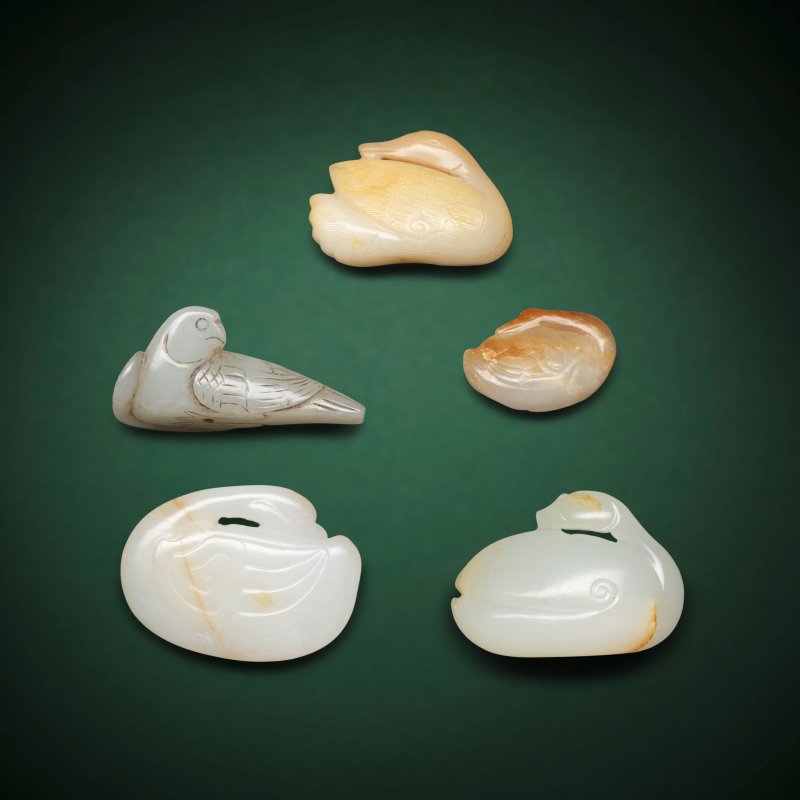
明及其後 玉鳥 一組五件 | FIVE JADE BIRD CARVINGS
年代
Ming Dynasty and later
起拍价
GBP 2,000
估值区间
GBP 2000 - 3000
尺寸
未知
品相
未知
更多信息
Ming Dynasty and later
Comprising: a pebble smoothly carved as a goose with its head turned sharply facing its back with incised curvilinear grooves delineating its wings, the stone of pale green tone with russet patches, 4.5cm (1 3/4in) wide; another flattened pebble of white tone with russet veins, carved as a goose with stylised plumage, 4.5cm (1 3/4in); a stone of pale white tone, carved as a parrot with incised plumage, 4.9cm (1 7/8in) wide; a goose with head turned back, with finely incised plumage, the stone of pale green and yellowish-russet patches, 4cm (1 1/2in) wide; and a small goose, head turned backwards, the stone of pale white tone with amber-russet skin, 3cm (1 1/4in) wide. (5).
Footnotes
明及其後 玉鳥 一組五件
Long believed to mate for life, geese are traditional emblems of fidelity and conjugal harmony. Their seasonal migration also made them symbols of communication, separation and reunion in classical literature, while their orderly flight came to represent loyalty and integrity.
Compare with one small white jade goose-form pendant, 18th/19th century, which was sold at Christie's New York, 20 September 2013, lot 1699. See also a group of eight jade carvings of mandarin ducks or geese, Ming dynasty and 18th/19th century, which was sold at Bonhams London, 8 November 2012, lot 154.
Comprising: a pebble smoothly carved as a goose with its head turned sharply facing its back with incised curvilinear grooves delineating its wings, the stone of pale green tone with russet patches, 4.5cm (1 3/4in) wide; another flattened pebble of white tone with russet veins, carved as a goose with stylised plumage, 4.5cm (1 3/4in); a stone of pale white tone, carved as a parrot with incised plumage, 4.9cm (1 7/8in) wide; a goose with head turned back, with finely incised plumage, the stone of pale green and yellowish-russet patches, 4cm (1 1/2in) wide; and a small goose, head turned backwards, the stone of pale white tone with amber-russet skin, 3cm (1 1/4in) wide. (5).
Footnotes
明及其後 玉鳥 一組五件
Long believed to mate for life, geese are traditional emblems of fidelity and conjugal harmony. Their seasonal migration also made them symbols of communication, separation and reunion in classical literature, while their orderly flight came to represent loyalty and integrity.
Compare with one small white jade goose-form pendant, 18th/19th century, which was sold at Christie's New York, 20 September 2013, lot 1699. See also a group of eight jade carvings of mandarin ducks or geese, Ming dynasty and 18th/19th century, which was sold at Bonhams London, 8 November 2012, lot 154.
常见问题
这件明及其後 玉鳥 一組五件 | FIVE JADE BIRD CARVINGS的成交价是多少?
落槌价为 预展中。 成交价为 预展中。


