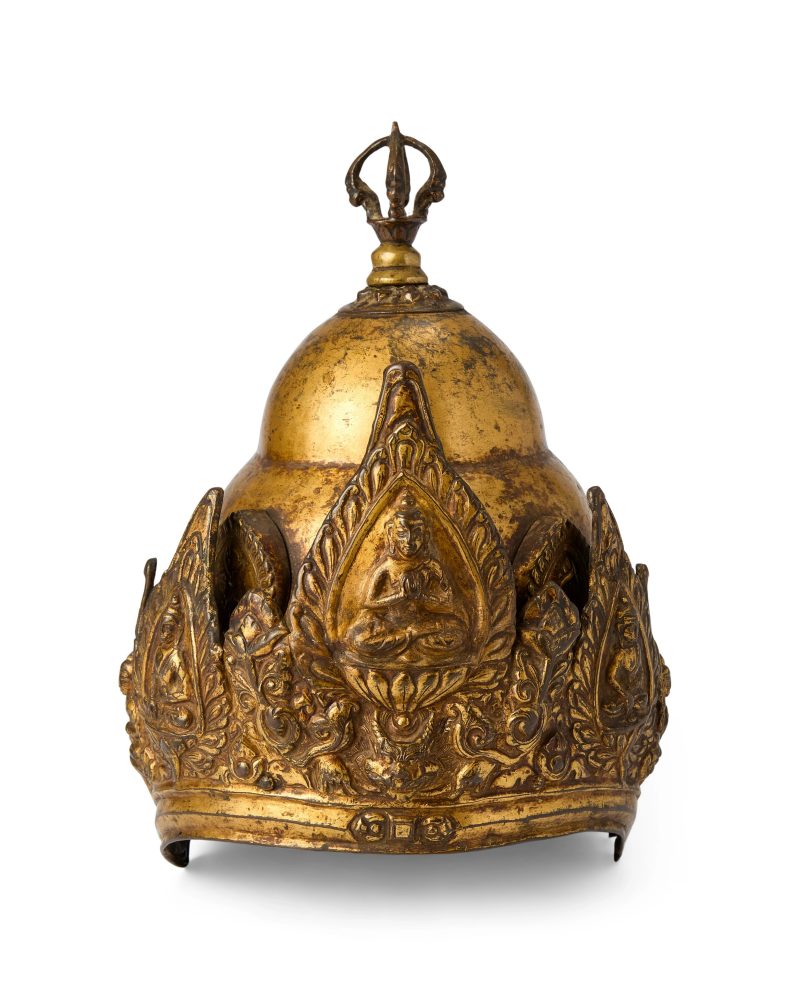

Lot 109 尼泊爾十五 - 十六世紀 銅鎏金金剛上師頭盔 | A Nepalese gilt-copper Vajracharya ritual crown
落槌价
预展中
成交价
预展中
| 拍卖公司 | Roseberys |
|---|---|
| 拍卖时间 | 2026年11月03日 |
拍品信息
拍品名称
尼泊爾十五 - 十六世紀 銅鎏金金剛上師頭盔 | A Nepalese gilt-copper Vajracharya ritual crown
年代
15th/16th century
起拍价
GBP 10,000
估值区间
Estimate: £15,000 - £20,000
尺寸
28.5cm high.
品相
Approx. weight: 911g.
Expected light wear with rubbing to gilt and a few minor scuffs and light dents to the repoussé elements, but otherwise generally reasonably good. One possible sensitive repair to a slight bruise to the back edge, with associated very fine hairline.
Expected light wear with rubbing to gilt and a few minor scuffs and light dents to the repoussé elements, but otherwise generally reasonably good. One possible sensitive repair to a slight bruise to the back edge, with associated very fine hairline.
更多信息
A Nepalese gilt-copper Vajracharya ritual crown
15th/16th century
The three-tiered helmet applied to the mid tier with four individually-cast, repoussé medallions of a lotus, vajra, triratna and third eye within a flaming border, and applied to the front with an elaborate, repoussé plaque with the Buddhas of the Five Directions, the helmet culminating in a vajra finial, 28.5cm high. (Import Duty Charged on the Hammer Price) 落槌價徵收進口關稅
尼泊爾十五 - 十六世紀 銅鎏金金剛上師頭盔
Himalayan Art resources Item no. 61905.
Elaborate crowns such as the present lot would have been worn by hereditary Vajracharyas, the Buddhist priests of the Kathmandu Valley who officiate at religious ceremonies in Nepal. Vajracharya, 'master of the thunderbolt', is both a caste and a family name, denoting those entitled to perform priestly functions. Originally celibate monks, they had by the early 15th century been brought within the prevailing Hindu caste structure of valley society, in which they hold one of the highest positions, equivalent to that of Brahmins in the Hindu context. In these rituals they typically use both a vajra (thunderbolt sceptre) and a ghanta (ritual bell).
The crown is oblong in form, composed of three hemispheres of decreasing size and surmounted by a vajra. In the Vajrayana tradition, such crowns present the core elements of a mandala, a cosmic diagram of symbols representing the entire universe. The mandala of the Five Cosmic Buddhas is among the most common, and the Vajracharya crown is a three-dimensional construction of this theme. The crown embodies Mount Meru, the fulcrum of the universe, while the four directional Buddhas, Akshobhya, Amitabha, Amoghasiddhi and Ratnasambhava, preside over pure realms and guide practitioners towards enlightenment. The fifth, Vairochana, the ultimate deity of the system, is placed at the centre of the frontal plaque and is also embodied by the vajra that surmounts the crown.
Cf. A related, but more elaborate crown, is in the collection of the Victoria and Albert Museum, Museum no. IS.5-1946; a later example, dated 1864, in The Metropolitan Museum of Art, New York (36.25.2979).
如本拍品般製作精巧、裝飾華麗的冠冕,應由世襲金剛阿闍梨(Vajracharya)佩戴。金剛阿闍梨是加德滿都谷地的佛教僧侶,負責主持尼泊爾的宗教儀式。「Vajracharya」意為「金剛上師」,既是種姓名稱,也是家族姓氏,專指有資格履行僧侶職責的人士。金剛阿闍梨最初是奉行獨身戒律的僧侶,但至15世紀初,他們已被納入當地盛行的印度教種姓制度之中,並在谷地社會中享有極高的地位,相當於印度教體系中的婆羅門。在宗教儀式中,他們通常會同時使用金剛杵(vajra,即象徵雷霆的法器)與金剛鈴(ghanta,即儀式用鈴)。
此冠呈長橢圓形,由三層大小依次遞減的半球形結構組成,頂部飾有一柄金剛杵。在金剛乘佛教傳統中,此類冠冕呈現了曼荼羅(mandala)的核心元素。曼荼羅是一種象徵宇宙整體的圖式,由各種象徵符號構成。「五方佛曼荼羅」是其中最常見的形式之一,而金剛阿闍梨所佩戴的冠冕,正是將這一主題以立體形式呈現。
冠冕象徵宇宙的中心支柱——須彌山(Mount Meru);四方佛,即阿閦佛(Akshobhya)、阿彌陀佛(Amitabha)、不空成就佛(Amoghasiddhi)及寶生佛(Ratnasambhava),分別坐鎮四方清淨佛土,引導修行者邁向覺悟。第五尊佛,即毘盧遮那佛(Vairochana),作為此體系中的核心本尊,被安置於冠冕正面飾板的中央,同時亦由冠頂所立的金剛杵象徵。
參閲:一件相關但裝飾更為繁複的冠冕,現藏於維多利亞與艾伯特博物館(Victoria and Albert Museum),館藏編號 IS.5-1946。另一件年代較晚、製作於1864年的同類作品,則收藏於紐約大都會藝術博物館(The Metropolitan Museum of Art),館藏編號 36.25.2979。
以下内容由AI翻译:
【名称】
尼泊爾十五 - 十六世紀 銅鎏金金剛上師頭盔
【年代】
十五/十六世纪
【品相】
重量約:911克。
預期輕微磨損,鎏金部分有擦痕,浮雕部分有少數小劃痕和輕微凹陷,但整體狀況良好。背面邊緣可能有一處細微修復,伴有非常細微的裂紋。
常见问题
这件尼泊爾十五 - 十六世紀 銅鎏金金剛上師頭盔 | A Nepalese gilt-copper Vajracharya ritual crown的成交价是多少?
落槌价为 预展中。 成交价为 预展中。
拍品的品相状况如何?
Approx. weight: 911g.
Expected light wear with rubbing to gilt and a few minor scuffs and light dents to the repoussé elements, but otherwise generally reasonably good. One possible sensitive repair to a slight bruise to the back edge, with associated very fine hairline.
Expected light wear with rubbing to gilt and a few minor scuffs and light dents to the repoussé elements, but otherwise generally reasonably good. One possible sensitive repair to a slight bruise to the back edge, with associated very fine hairline.
拍品的尺寸是多少?
28.5cm high.