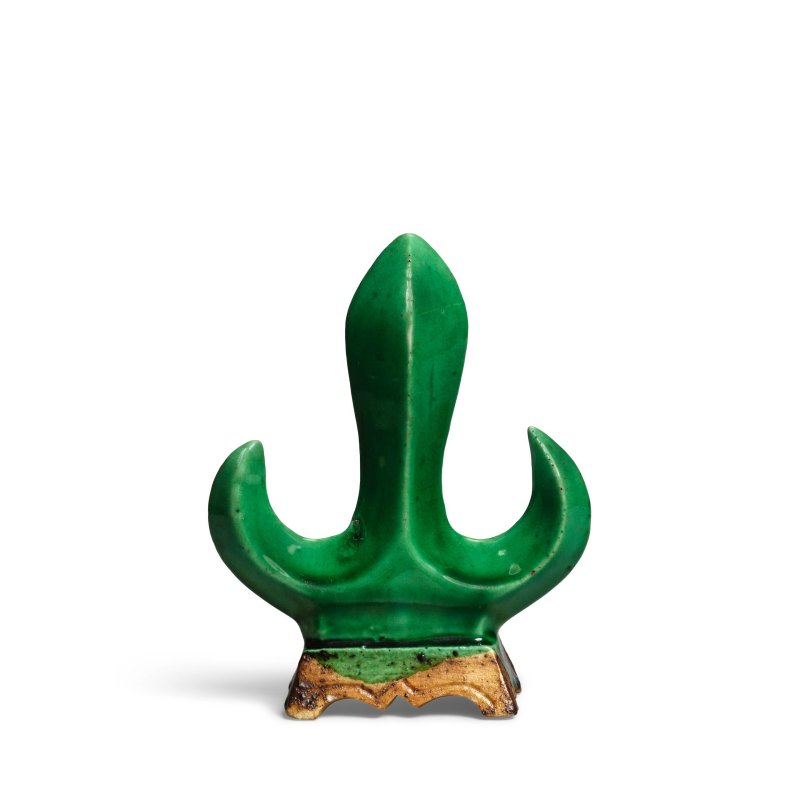

Lot 28 清康熙 綠釉山形筆擱 | A GREEN-GLAZED TRISULA-SHAPED BRUSHREST
落槌价
预展中
成交价
预展中
| 拍卖公司 | 邦瀚斯 |
|---|---|
| 拍卖时间 | 2026年11月05日 |
拍品信息
拍品名称
清康熙 綠釉山形筆擱 | A GREEN-GLAZED TRISULA-SHAPED BRUSHREST
年代
Kangxi
起拍价
GBP 1,000
估值区间
GBP 1000 - 1500
尺寸
未知
品相
未知
更多信息
Kangxi
Modelled as a trisula (trident), the three-pronged sacred emblem associated with divine power and protection, rising from a shaped four-footed stand, the surface enveloped in a vibrant green glaze. 11.5cm (4 1/2in) high.
Footnotes
清康熙 綠釉山形筆擱
Provenance:
A & J Speelman Oriental Art, London
Acquired from the above on 4 November 2015
來源:
倫敦古董商A & J Speelman Oriental Art
從上處獲得于2015年11月4日
The trisula (Sanskrit triśūla, 'three-pronged spear') is a sacred trident emblem found in Hindu and Buddhist iconography, most closely associated with the deity Shiva. It symbolises divine authority and cosmic power, with its three points commonly interpreted as representing the fundamental triad of creation, preservation and destruction, or alternatively past, present and future. In Buddhist contexts, particularly within Vajrayana traditions, it may also signify the overcoming of the 'three poisons' of desire, aversion and ignorance. Frequently depicted as both a ritual implement and an attribute of protective deities, the trisula functions as a potent symbol of spiritual force and transcendence, here adapted into a decorative form for a brushrest.
Compare with a very similar green-glazed brushrest, Qing dynasty, which was sold at Bonhams New York, 'Passion and Philanthropy: Chinese Art from the Metropolitan Museum of Art', 18 March 2024, lot 61.
Modelled as a trisula (trident), the three-pronged sacred emblem associated with divine power and protection, rising from a shaped four-footed stand, the surface enveloped in a vibrant green glaze. 11.5cm (4 1/2in) high.
Footnotes
清康熙 綠釉山形筆擱
Provenance:
A & J Speelman Oriental Art, London
Acquired from the above on 4 November 2015
來源:
倫敦古董商A & J Speelman Oriental Art
從上處獲得于2015年11月4日
The trisula (Sanskrit triśūla, 'three-pronged spear') is a sacred trident emblem found in Hindu and Buddhist iconography, most closely associated with the deity Shiva. It symbolises divine authority and cosmic power, with its three points commonly interpreted as representing the fundamental triad of creation, preservation and destruction, or alternatively past, present and future. In Buddhist contexts, particularly within Vajrayana traditions, it may also signify the overcoming of the 'three poisons' of desire, aversion and ignorance. Frequently depicted as both a ritual implement and an attribute of protective deities, the trisula functions as a potent symbol of spiritual force and transcendence, here adapted into a decorative form for a brushrest.
Compare with a very similar green-glazed brushrest, Qing dynasty, which was sold at Bonhams New York, 'Passion and Philanthropy: Chinese Art from the Metropolitan Museum of Art', 18 March 2024, lot 61.
常见问题
这件清康熙 綠釉山形筆擱 | A GREEN-GLAZED TRISULA-SHAPED BRUSHREST的成交价是多少?
落槌价为 预展中。 成交价为 预展中。