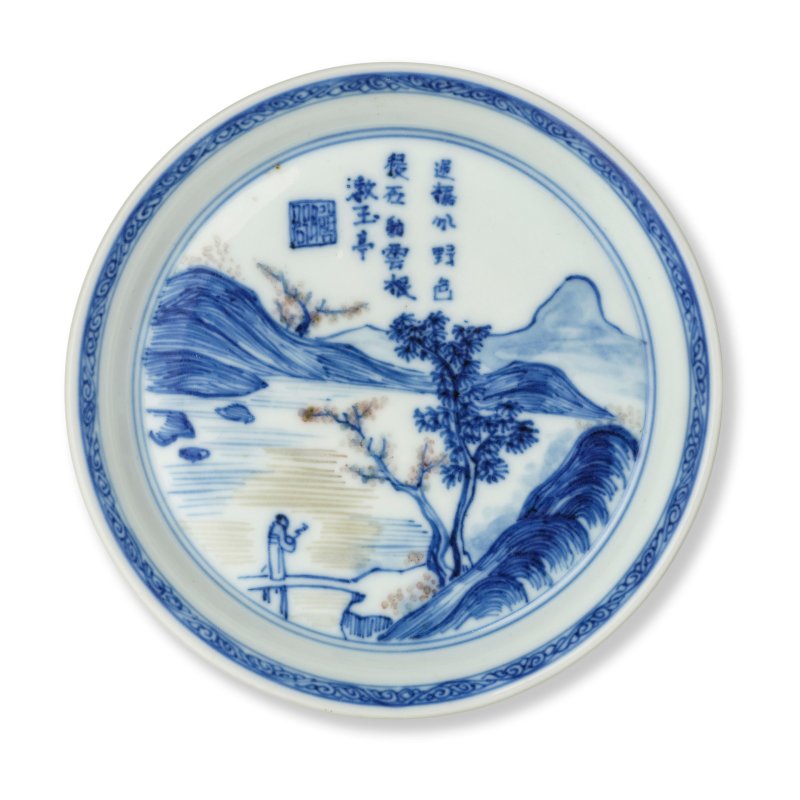

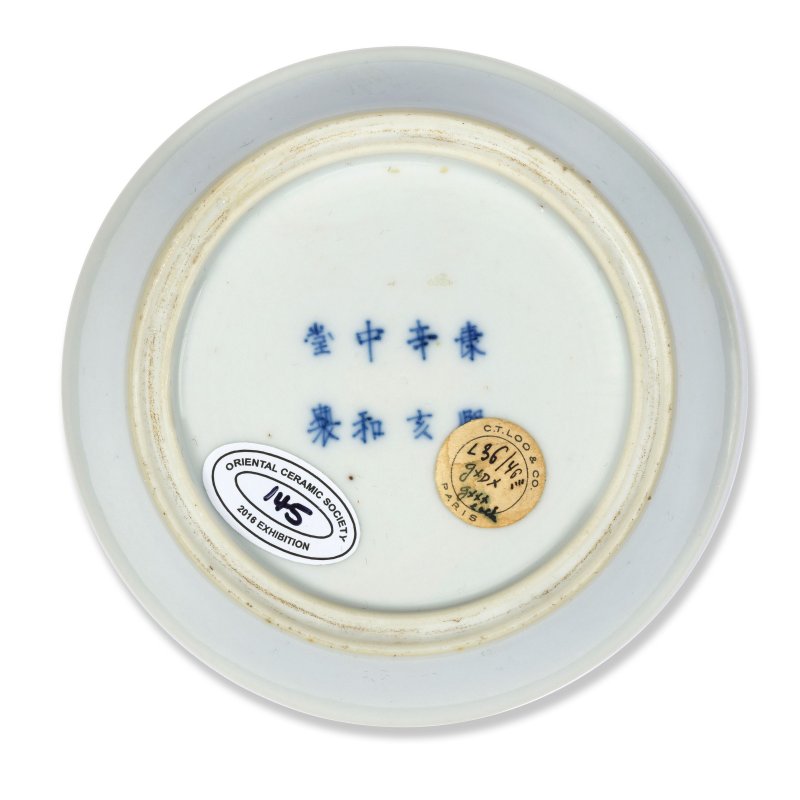
Lot 4 清康熙辛亥年(1671)青花釉裏紅詩文山水圖盤 | A SMALL BLUE AND WHITE AND COPPER-RED 'LANDSCAPE' DISH
落槌价
预展中
成交价
预展中
| 拍卖公司 | 邦瀚斯 |
|---|---|
| 拍卖时间 | 2026年11月05日 |
拍品信息
拍品名称
清康熙辛亥年(1671)青花釉裏紅詩文山水圖盤 | A SMALL BLUE AND WHITE AND COPPER-RED 'LANDSCAPE' DISH
年代
Kangxi Zhonghe Tang mark, cyclically dated to the Xinhai year, corresponding to 1671 and of the period
起拍价
GBP 15,000
估值区间
GBP 15000 - 20000
尺寸
未知
品相
未知
更多信息
Kangxi Zhonghe Tang mark, cyclically dated to the Xinhai year, corresponding to 1671 and of the period
Finely potted with slightly curved tapering sides, rising from a countersunk flat base with channelled foot ring, painted in the interior with a lone sage holding a staff walking across a bridge, all within a lakeside landscape with mountains rendered with 'hemp-fibre' brushstrokes, and trees, some dotted with copper-red leaves, a poetic inscription with seal mark above, a band of classic scroll just beneath the mouth rim. 11.1cm (4 3/8in) diam.
Footnotes
清康熙辛亥年(1671)青花釉裏紅詩文山水圖盤
青花「康熙辛亥中和堂製」楷書款
款識:過橋分野色,移石動雲根。漱玉亭
印:「瞻公」
Provenance:
C.T. Loo & Co., Paris (label)
Cohen collection, USA
Berwald Oriental Art, London, 27 November 1997
The Oriental Ceramic Society, , London, 2016, pp.240-241, no.145 (bottom dish)
盧吳公司,巴黎(標籤)
Cohen舊藏,美國
倫敦古董商Berwald Oriental Art,1997年11月27日
東方陶瓷學會,《龍隱:東方陶瓷學會會員稀珍藏品展》, 倫敦,2016年,第240-241頁,編號145(下側盤)
The present lot is of considerable documentary significance as one of the earliest Imperial porcelains of the Kangxi reign, produced in the aftermath of a prolonged period of upheaval, when Qing authority over Jingdezhen remained fragile and direct Court commissions were still uncommon. The base is inscribed , or 'made in the Xinhai year of Kangxi (1671) for the Hall of Central Harmony', connecting the piece with the earliest recorded kiln production undertaken for the Imperial Court during this reign. Only a small but highly important group of porcelains bearing this inscription survives today, of which the present dish is an example.
The Zhonghetang ('Hall of Central Harmony') inscription has long attracted scholarly attention, although its precise referent remains uncertain. One recent proposal suggests that it may relate to Fan Wenying (courtesy name Zhangong), a native of Fengtian who was appointed acting prefect of Raozhou, the prefecture encompassing Jingdezhen, in 1671; see , New Haven and London, 2021, p.321. Although the significance of the inscription remains debated, the dated Xinhai group constitutes the earliest securely datable Imperial Kangxi porcelains, preceding the standardised reign-marked production of the later Kangxi period.
Technically and stylistically, these early wares are distinguished by their restrained palette, most commonly combining underglaze cobalt-blue with copper-red, although a smaller number are known with rich monochrome glazes, including an unusual dark brown. Dishes of the present type are typically inscribed with a short poetic couplet, followed by the characters ('Clean Jade Pavilion') and the seal ('Master Zhan'), reflecting the cultivated literati aesthetic that informed the earliest Imperial commissions of the Kangxi reign.
The poem is attributed to the Tang dynasty poet Du Fu (712–770):
過橋分野色,
移石動雲根。
Which may be translated as:
The imagery is characteristic of Du Fu's poetry, presenting a landscape whose appearance shifts with the viewer's movement. Crossing a bridge changes the perceived divisions of the landscape, while the displacement of a single stone appears to disturb even the 'roots' of the clouds, conveying an intimate relationship between the visible world and the unseen forces that animate it. The inscription is entirely in keeping with the refined literary taste reflected in this early group of Imperial wares.
For related examples, see five comparable blue and white and copper-red dishes, three bearing the same Xinhai date of 1671 but with different poetic inscriptions and landscape compositions, illustrated by Wang Qingzheng, , Hong Kong, 1998, pls.1–5. Another closely related dish of the same date is illustrated in , Beijing, 2005, pl.6. Further comparisons include three Xinhai-dated dishes, illustrated by T.Canepa and K.Butler, , London, 2021, p.420.
Compare also a similar dish, Zhonghetang mark and cyclically dated to the Xinhai year (1671), formerly in the Marsh Collection, exhibited and published alongside the present lot, which was sold at Bonhams London, 6 November 2025, lot 9.
Finely potted with slightly curved tapering sides, rising from a countersunk flat base with channelled foot ring, painted in the interior with a lone sage holding a staff walking across a bridge, all within a lakeside landscape with mountains rendered with 'hemp-fibre' brushstrokes, and trees, some dotted with copper-red leaves, a poetic inscription with seal mark above, a band of classic scroll just beneath the mouth rim. 11.1cm (4 3/8in) diam.
Footnotes
清康熙辛亥年(1671)青花釉裏紅詩文山水圖盤
青花「康熙辛亥中和堂製」楷書款
款識:過橋分野色,移石動雲根。漱玉亭
印:「瞻公」
Provenance:
C.T. Loo & Co., Paris (label)
Cohen collection, USA
Berwald Oriental Art, London, 27 November 1997
The Oriental Ceramic Society, , London, 2016, pp.240-241, no.145 (bottom dish)
盧吳公司,巴黎(標籤)
Cohen舊藏,美國
倫敦古董商Berwald Oriental Art,1997年11月27日
東方陶瓷學會,《龍隱:東方陶瓷學會會員稀珍藏品展》, 倫敦,2016年,第240-241頁,編號145(下側盤)
The present lot is of considerable documentary significance as one of the earliest Imperial porcelains of the Kangxi reign, produced in the aftermath of a prolonged period of upheaval, when Qing authority over Jingdezhen remained fragile and direct Court commissions were still uncommon. The base is inscribed , or 'made in the Xinhai year of Kangxi (1671) for the Hall of Central Harmony', connecting the piece with the earliest recorded kiln production undertaken for the Imperial Court during this reign. Only a small but highly important group of porcelains bearing this inscription survives today, of which the present dish is an example.
The Zhonghetang ('Hall of Central Harmony') inscription has long attracted scholarly attention, although its precise referent remains uncertain. One recent proposal suggests that it may relate to Fan Wenying (courtesy name Zhangong), a native of Fengtian who was appointed acting prefect of Raozhou, the prefecture encompassing Jingdezhen, in 1671; see , New Haven and London, 2021, p.321. Although the significance of the inscription remains debated, the dated Xinhai group constitutes the earliest securely datable Imperial Kangxi porcelains, preceding the standardised reign-marked production of the later Kangxi period.
Technically and stylistically, these early wares are distinguished by their restrained palette, most commonly combining underglaze cobalt-blue with copper-red, although a smaller number are known with rich monochrome glazes, including an unusual dark brown. Dishes of the present type are typically inscribed with a short poetic couplet, followed by the characters ('Clean Jade Pavilion') and the seal ('Master Zhan'), reflecting the cultivated literati aesthetic that informed the earliest Imperial commissions of the Kangxi reign.
The poem is attributed to the Tang dynasty poet Du Fu (712–770):
過橋分野色,
移石動雲根。
Which may be translated as:
The imagery is characteristic of Du Fu's poetry, presenting a landscape whose appearance shifts with the viewer's movement. Crossing a bridge changes the perceived divisions of the landscape, while the displacement of a single stone appears to disturb even the 'roots' of the clouds, conveying an intimate relationship between the visible world and the unseen forces that animate it. The inscription is entirely in keeping with the refined literary taste reflected in this early group of Imperial wares.
For related examples, see five comparable blue and white and copper-red dishes, three bearing the same Xinhai date of 1671 but with different poetic inscriptions and landscape compositions, illustrated by Wang Qingzheng, , Hong Kong, 1998, pls.1–5. Another closely related dish of the same date is illustrated in , Beijing, 2005, pl.6. Further comparisons include three Xinhai-dated dishes, illustrated by T.Canepa and K.Butler, , London, 2021, p.420.
Compare also a similar dish, Zhonghetang mark and cyclically dated to the Xinhai year (1671), formerly in the Marsh Collection, exhibited and published alongside the present lot, which was sold at Bonhams London, 6 November 2025, lot 9.
常见问题
这件清康熙辛亥年(1671)青花釉裏紅詩文山水圖盤 | A SMALL BLUE AND WHITE AND COPPER-RED 'LANDSCAPE' DISH的成交价是多少?
落槌价为 预展中。 成交价为 预展中。