
拍品信息
拍品名称
西藏 十五世紀 銅鎏金宗喀巴像 | A GILT COPPER ALLOY FIGURE OF TSONGKHAPA
年代
TIBET, 15TH CENTURY
起拍价
HKD 250,000
估值区间
HKD 250000 - 350000
尺寸
未知
品相
未知
更多信息
TIBET, 15TH CENTURY
Himalayan Art Resources item no. 15704
14 cm (5 1/2 in.) high
Footnotes
西藏 十五世紀 銅鎏金宗喀巴像
Provenance
From a Distinguished German Private Collection
Nagel Auction, Stuttgart, 16 May 2008, lot 500
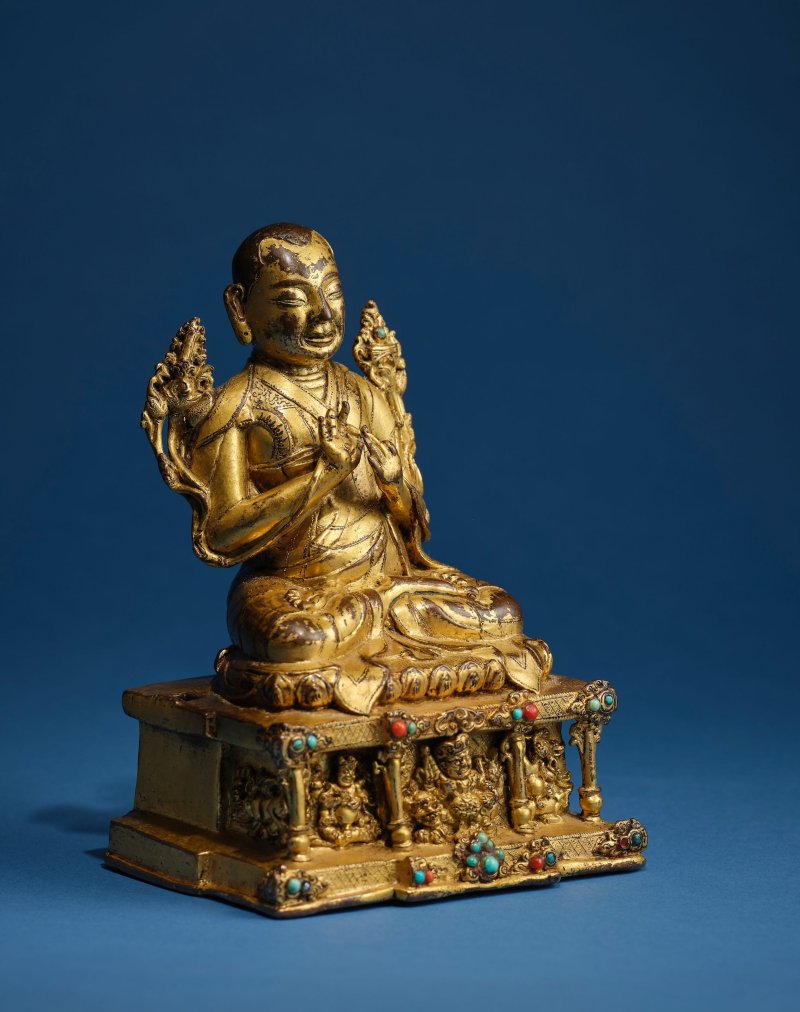
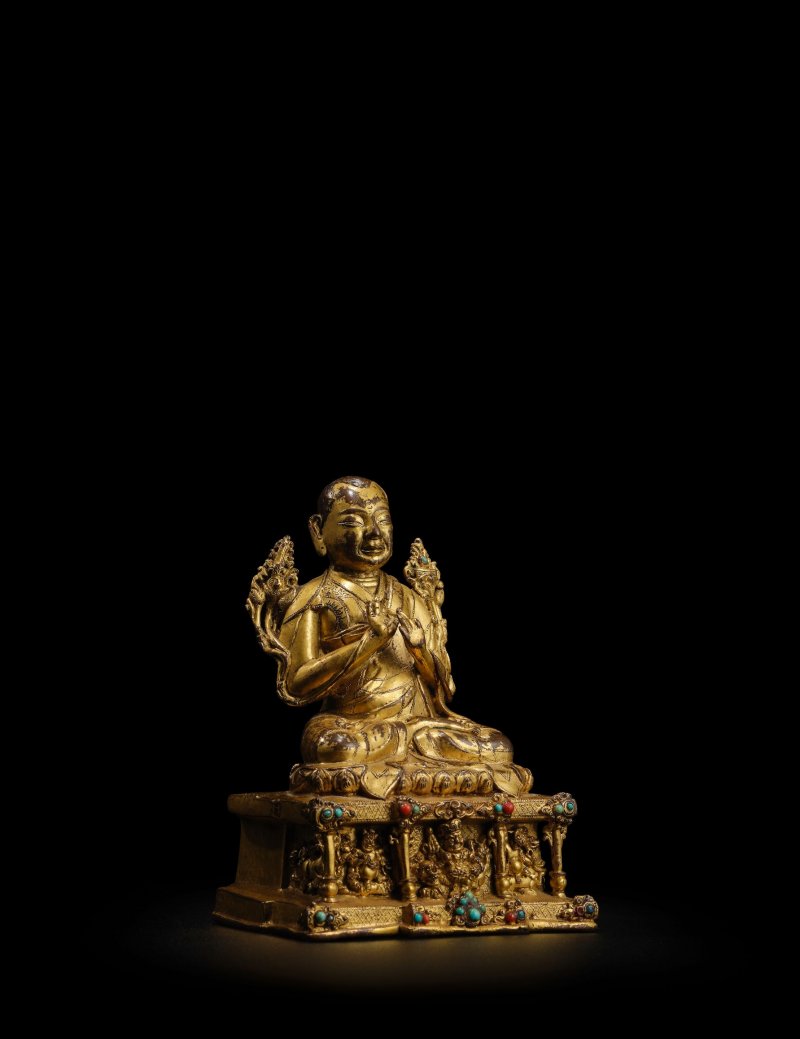
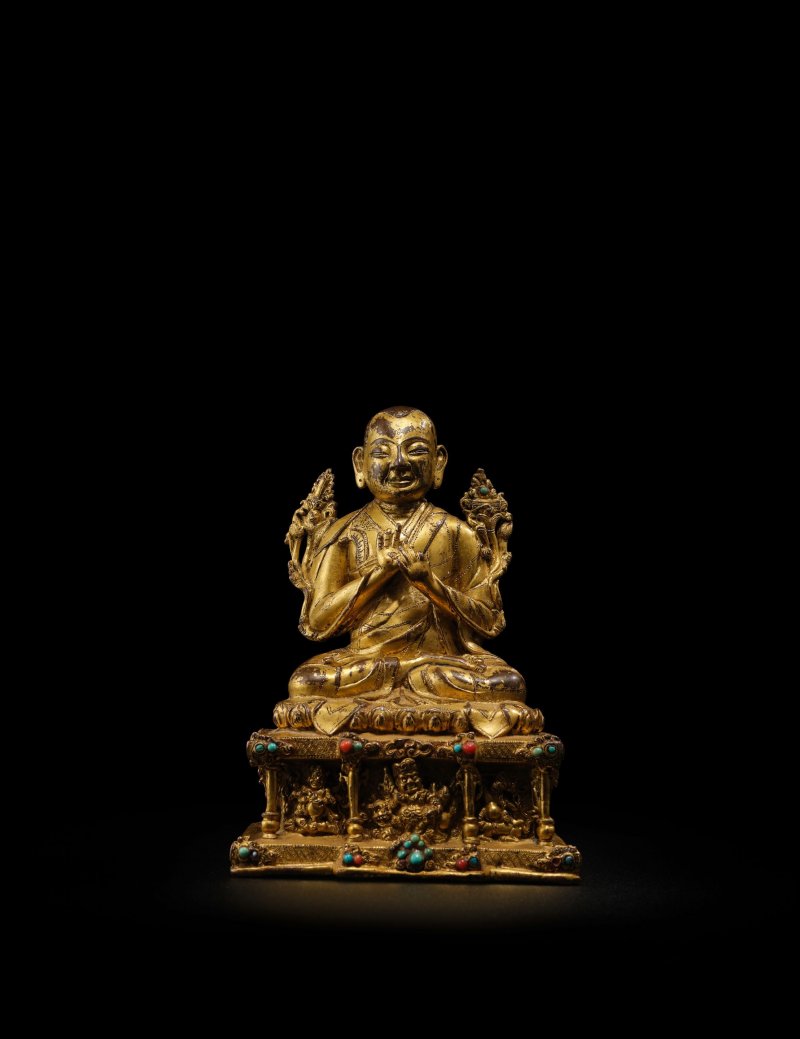
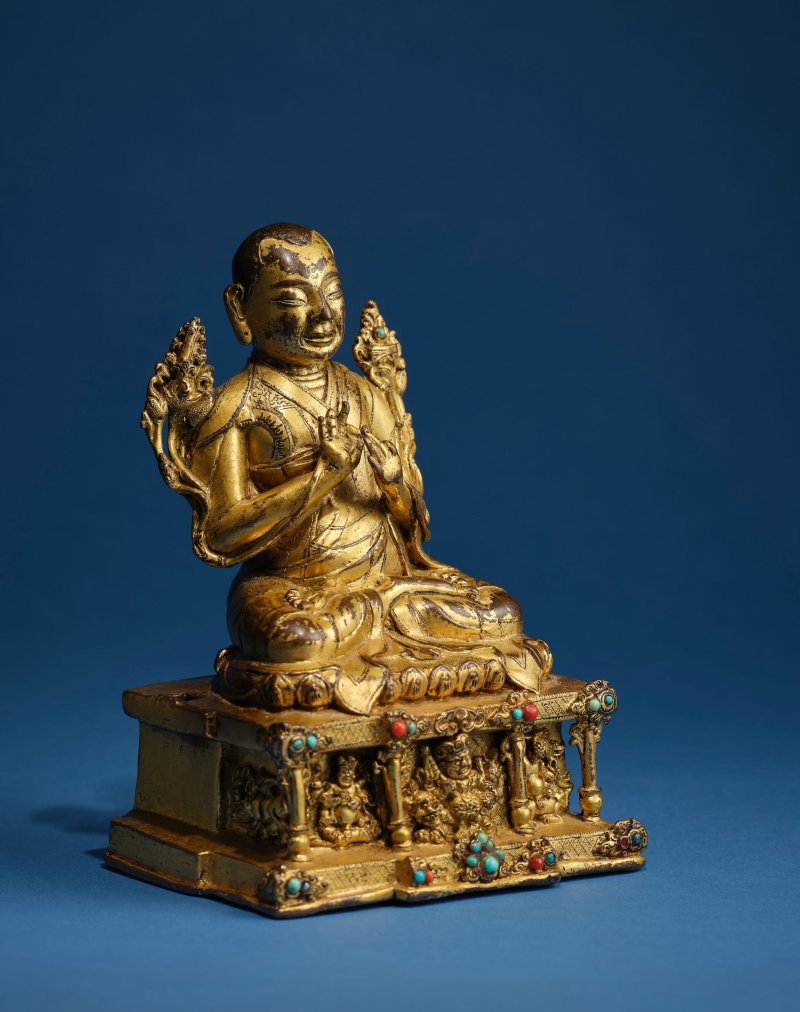
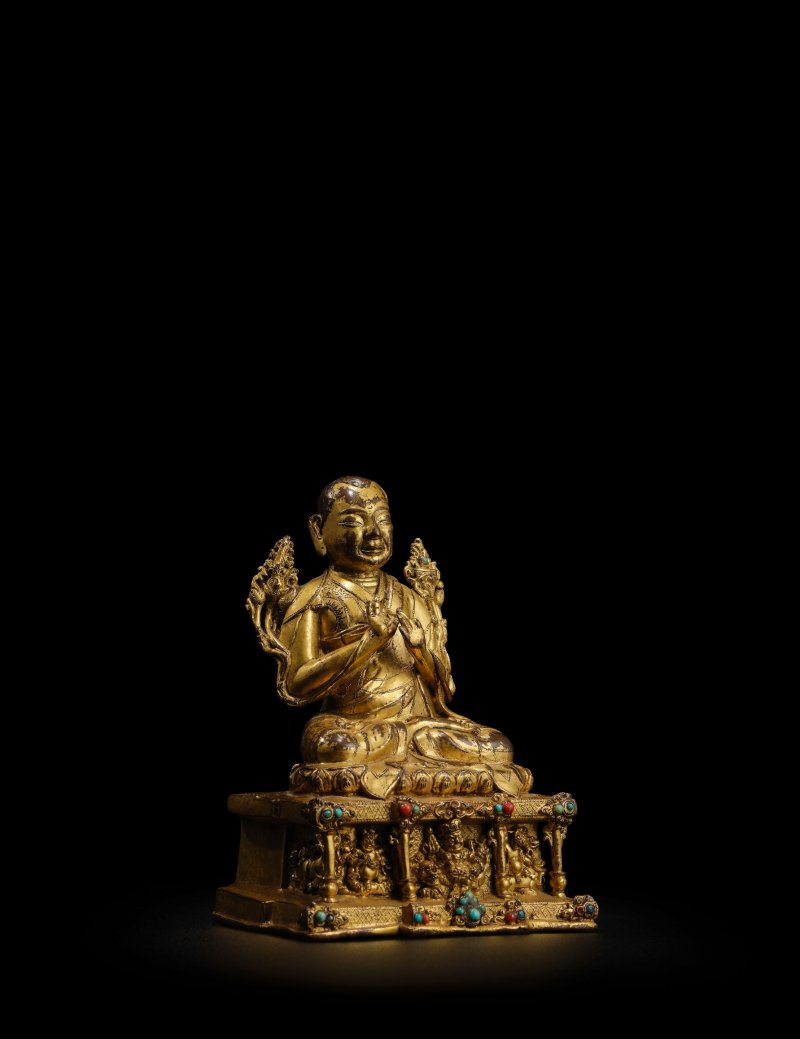
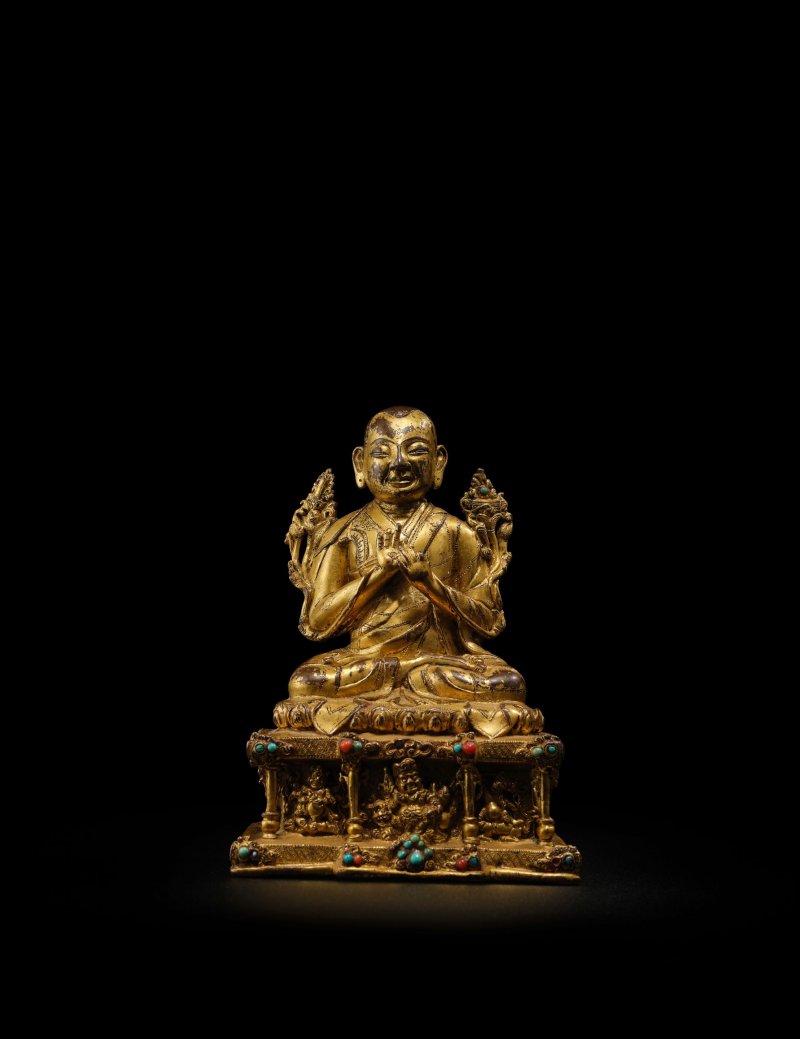
This finely cast and richly gilded portrait depicts Je Tsongkhapa Lobzang Drakpa (1357-1419), founder of the Gelug order and among the most influential figures in the history of Tibetan Buddhism, and is a rare early likeness that may well have been made during the master's own lifetime. He is seated in vajraparyankasana on a lotus base, his hands raised before the chest in dharmachakra mudra and holding the stems of two lotuses that rise to his shoulders to support a flaming sword and Prajnaparamita Sutra. These attributes of Manjushri, of whom Tsongkhapa was regarded as an emanation, are the standard identifiers of the master in Tibetan art.
Notably, Tsongkhapa is shown bare-headed, without the pointed hat that would later become the defining feature of his iconography and a near-universal element of his representations. The closely shaven head and plain monastic robes, their hems finely incised with foliate scrolls, present the master as a contemporary portrait rather than a codified icon. The face supports this reading: broad and fleshy, with full cheeks, a rounded chin, a wide, low-bridged nose and a gentle closed-lipped smile, it departs from the idealised features reserved for buddhas and bodhisattvas and records the physiognomy of an individual. Tibetan sources confirm that portraits of Tsongkhapa were made during his lifetime, most famously the statue at Ganden known as the Ngadrama ("resembling me"), which the master himself is said to have approved as a true likeness. The individualised features and pre-codified iconography of the present figure place it in this earliest phase of Tsongkhapa's portraiture: it was possibly executed while the master was still living, and in any case no later than the generation of disciples who had known him.
The throne confirms the sculpture's Gelug context. The lotus seat rests on a colonnaded plinth of the type used for lion thrones in this period: four columns support an entablature set with rosettes of turquoise and coral, repeated along the stepped foot. In place of the lions customarily housed between the columns, the niches contain three wrathful protectors: Shadbhuja Mahakala at the centre, flanked by Vaishravana and Yama Dharmaraja. Together these constitute the three principal Dharma protectors of the Gelug tradition, whose appointment is attributed to Tsongkhapa himself, each charged with guarding practitioners of one of the three scopes of the graded path set out in his Lamrim Chenmo.
The stepped, colonnaded throne with inlaid rosettes is characteristic of central Tibetan sculpture of the 14th and 15th centuries. Compare a 14th-century gilt copper throne base in the Koelz Collection, University of Michigan Museum of Anthropology (HAR 17002); and a 15th-century Avalokiteshvara Chittavishramana attributed to the atelier of Sonam Gyaltsen (HAR 34200), in which the same throne type is elaborated with scrolling back struts. The arrangement of the present lot, with the lotus seat placed directly on a rectangular colonnade filled with figures, is closely paralleled by a 15th-century portrait of an Indian pandita in the Jokhang, Lhasa (HAR 57294). For the figure itself, see the inscribed 15th-century portrait of Chogle Namgyal attributed to a Tsang workshop (HAR 68886), which shares the same teaching gesture with lotus-borne sword and book, comparably incised robes and a stone-set stepped throne, while wearing the hat that the present figure lacks.
Small in scale and lavish in execution, the present lot is a rare early image of the founder of the Gelug order, quite possibly made while he was still living, and preserves his likeness as it was known to his own disciples.
Himalayan Art Resources item no. 15704
14 cm (5 1/2 in.) high
Footnotes
西藏 十五世紀 銅鎏金宗喀巴像
Provenance
From a Distinguished German Private Collection
Nagel Auction, Stuttgart, 16 May 2008, lot 500
This finely cast and richly gilded portrait depicts Je Tsongkhapa Lobzang Drakpa (1357-1419), founder of the Gelug order and among the most influential figures in the history of Tibetan Buddhism, and is a rare early likeness that may well have been made during the master's own lifetime. He is seated in vajraparyankasana on a lotus base, his hands raised before the chest in dharmachakra mudra and holding the stems of two lotuses that rise to his shoulders to support a flaming sword and Prajnaparamita Sutra. These attributes of Manjushri, of whom Tsongkhapa was regarded as an emanation, are the standard identifiers of the master in Tibetan art.
Notably, Tsongkhapa is shown bare-headed, without the pointed hat that would later become the defining feature of his iconography and a near-universal element of his representations. The closely shaven head and plain monastic robes, their hems finely incised with foliate scrolls, present the master as a contemporary portrait rather than a codified icon. The face supports this reading: broad and fleshy, with full cheeks, a rounded chin, a wide, low-bridged nose and a gentle closed-lipped smile, it departs from the idealised features reserved for buddhas and bodhisattvas and records the physiognomy of an individual. Tibetan sources confirm that portraits of Tsongkhapa were made during his lifetime, most famously the statue at Ganden known as the Ngadrama ("resembling me"), which the master himself is said to have approved as a true likeness. The individualised features and pre-codified iconography of the present figure place it in this earliest phase of Tsongkhapa's portraiture: it was possibly executed while the master was still living, and in any case no later than the generation of disciples who had known him.
The throne confirms the sculpture's Gelug context. The lotus seat rests on a colonnaded plinth of the type used for lion thrones in this period: four columns support an entablature set with rosettes of turquoise and coral, repeated along the stepped foot. In place of the lions customarily housed between the columns, the niches contain three wrathful protectors: Shadbhuja Mahakala at the centre, flanked by Vaishravana and Yama Dharmaraja. Together these constitute the three principal Dharma protectors of the Gelug tradition, whose appointment is attributed to Tsongkhapa himself, each charged with guarding practitioners of one of the three scopes of the graded path set out in his Lamrim Chenmo.
The stepped, colonnaded throne with inlaid rosettes is characteristic of central Tibetan sculpture of the 14th and 15th centuries. Compare a 14th-century gilt copper throne base in the Koelz Collection, University of Michigan Museum of Anthropology (HAR 17002); and a 15th-century Avalokiteshvara Chittavishramana attributed to the atelier of Sonam Gyaltsen (HAR 34200), in which the same throne type is elaborated with scrolling back struts. The arrangement of the present lot, with the lotus seat placed directly on a rectangular colonnade filled with figures, is closely paralleled by a 15th-century portrait of an Indian pandita in the Jokhang, Lhasa (HAR 57294). For the figure itself, see the inscribed 15th-century portrait of Chogle Namgyal attributed to a Tsang workshop (HAR 68886), which shares the same teaching gesture with lotus-borne sword and book, comparably incised robes and a stone-set stepped throne, while wearing the hat that the present figure lacks.
Small in scale and lavish in execution, the present lot is a rare early image of the founder of the Gelug order, quite possibly made while he was still living, and preserves his likeness as it was known to his own disciples.
常见问题
这件西藏 十五世紀 銅鎏金宗喀巴像 | A GILT COPPER ALLOY FIGURE OF TSONGKHAPA的成交价是多少?
落槌价为 预展中。 成交价为 预展中。