
拍品信息
拍品名称
明/清 仿古玉佩飾 一組四件 | FOUR ARCHAISTIC JADE PENDANTS
年代
Ming/Qing Dynasty
起拍价
GBP 1,500
估值区间
GBP 1500 - 2000
尺寸
未知
品相
未知
更多信息
Ming/Qing Dynasty
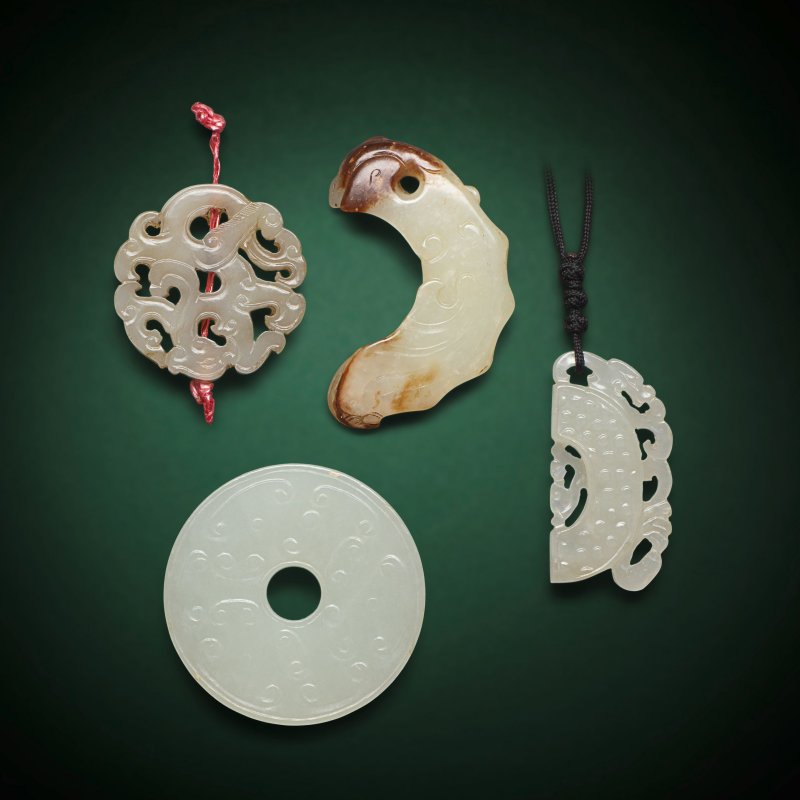
Comprising: a jade bi disc, one side decorated with raised bosses and the reverse with ruyi head motifs, the inner and outer rims bordered by narrow raised bands, the stone of pale green tone, 4.1cm (1 5/8in) diam.; a jade huang pendant of an elongated body, carved as a stylised dragon with its head turned back confronting a younger dragon, the stone of pale green tone with russet patches, 4.5cm (1 3/4in) wide; a pendant carved in openwork as a stylised sinuous dragon roundel, the stone of grey tone with minor russet inclusions, 3cm (1 1/4in) diam.; and a jade huang surmounted by a pair of stylised dragons, the stone of pale green tone, 3.7cm (1 1/2in) wide. (4).
Footnotes
明/清 仿古玉佩飾 一組四件
The term huang (璜) refers to a semi-circular jade ornament, hence the saying, 'a half bi is called a huang' (半璧曰璜). According to the Rites of Zhou (周禮), the huang was one of the Six Ritual Jades, and a dark-coloured huang was used in ceremonies to honour the north. Over time, the huang gradually evolved from a ceremonial ritual object into a decorative personal ornament.
During the Ming and Qing dynasties, the flourishing antiquarian movement among scholars inspired the production of archaistic jade ornaments, as seen in the present lot. See three archaistic jade pendants, late Qing dynasty, which were sold at Bonhams New York, 18 March 2024, lot 143. See also an archaistic white jade disc, , which was sold at Bonhams London, 27 February 2013, lot 288.
Comprising: a jade bi disc, one side decorated with raised bosses and the reverse with ruyi head motifs, the inner and outer rims bordered by narrow raised bands, the stone of pale green tone, 4.1cm (1 5/8in) diam.; a jade huang pendant of an elongated body, carved as a stylised dragon with its head turned back confronting a younger dragon, the stone of pale green tone with russet patches, 4.5cm (1 3/4in) wide; a pendant carved in openwork as a stylised sinuous dragon roundel, the stone of grey tone with minor russet inclusions, 3cm (1 1/4in) diam.; and a jade huang surmounted by a pair of stylised dragons, the stone of pale green tone, 3.7cm (1 1/2in) wide. (4).
Footnotes
明/清 仿古玉佩飾 一組四件
The term huang (璜) refers to a semi-circular jade ornament, hence the saying, 'a half bi is called a huang' (半璧曰璜). According to the Rites of Zhou (周禮), the huang was one of the Six Ritual Jades, and a dark-coloured huang was used in ceremonies to honour the north. Over time, the huang gradually evolved from a ceremonial ritual object into a decorative personal ornament.
During the Ming and Qing dynasties, the flourishing antiquarian movement among scholars inspired the production of archaistic jade ornaments, as seen in the present lot. See three archaistic jade pendants, late Qing dynasty, which were sold at Bonhams New York, 18 March 2024, lot 143. See also an archaistic white jade disc, , which was sold at Bonhams London, 27 February 2013, lot 288.
常见问题
这件明/清 仿古玉佩飾 一組四件 | FOUR ARCHAISTIC JADE PENDANTS的成交价是多少?
落槌价为 预展中。 成交价为 预展中。


