
拍品信息
拍品名称
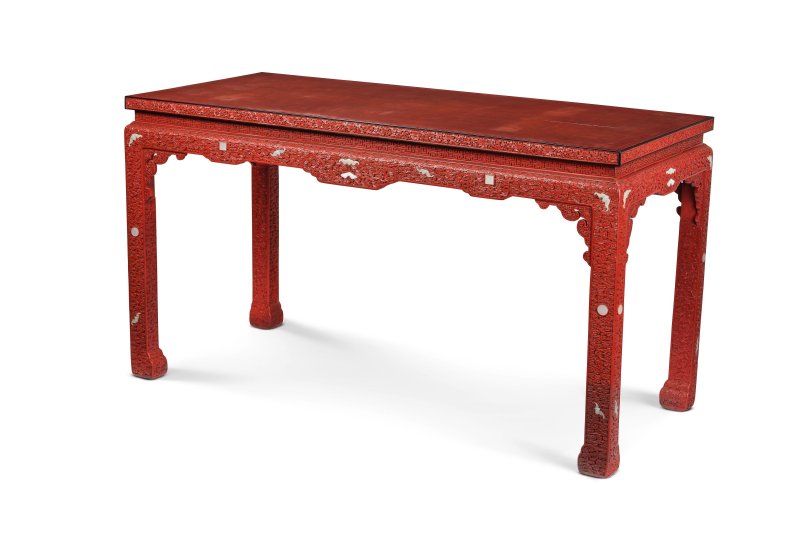
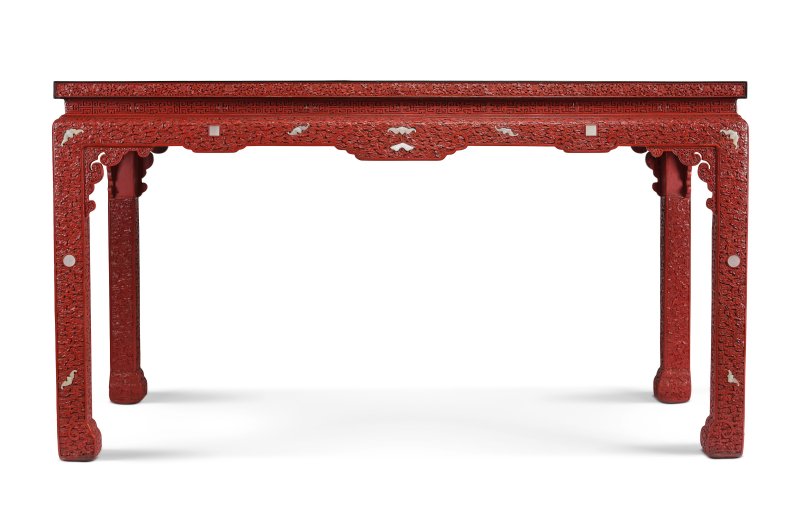
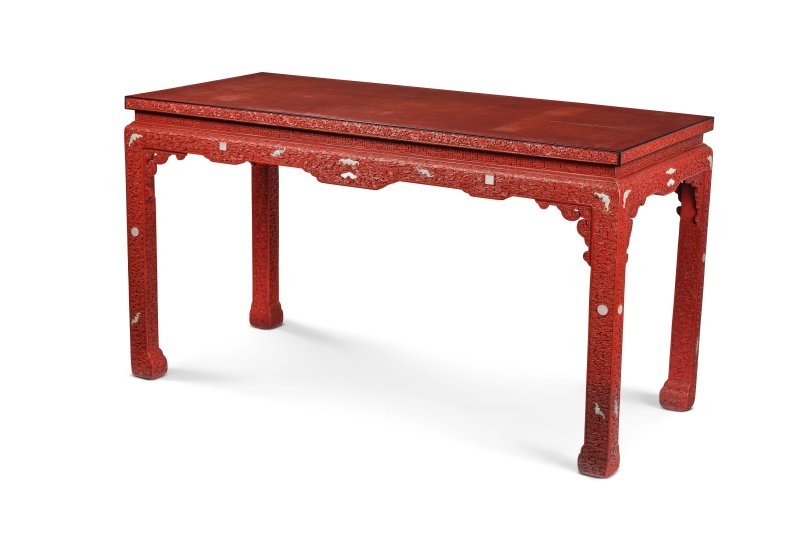
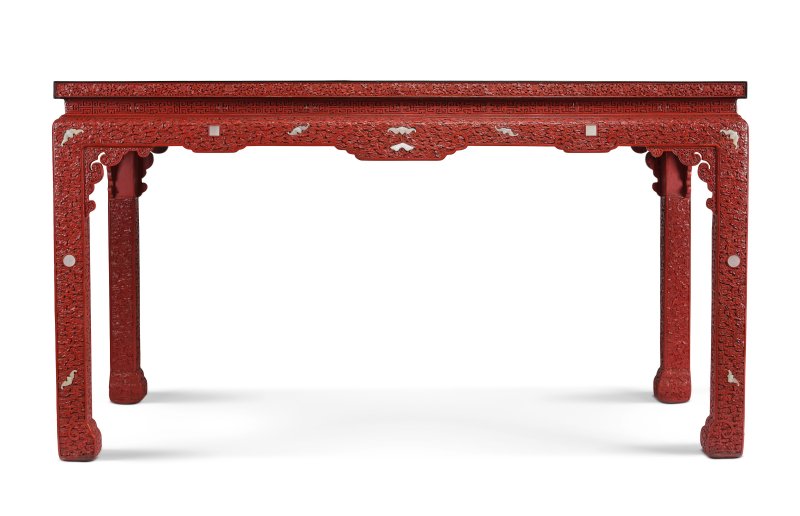
清乾隆 御製剔紅嵌玉束腰馬蹄足條桌 | AN EXCEPTIONALLY RARE IMPERIAL CARVED CINNABAR LACQUER JADE-INSET TABLE
年代
Qianlong
起拍价
HKD 2,000,000
估值区间
HKD 2000000 - 3000000
尺寸
未知
品相
未知
更多信息
Qianlong
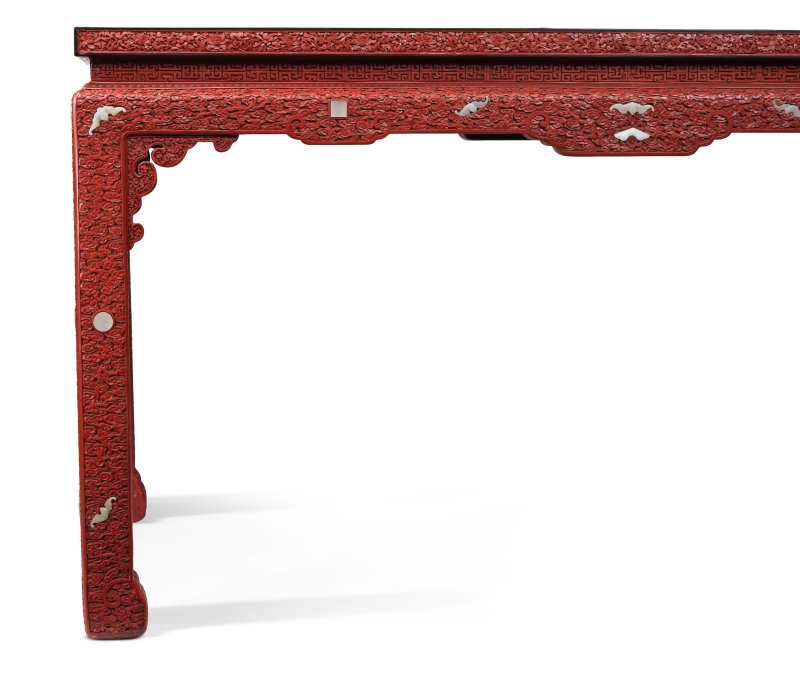
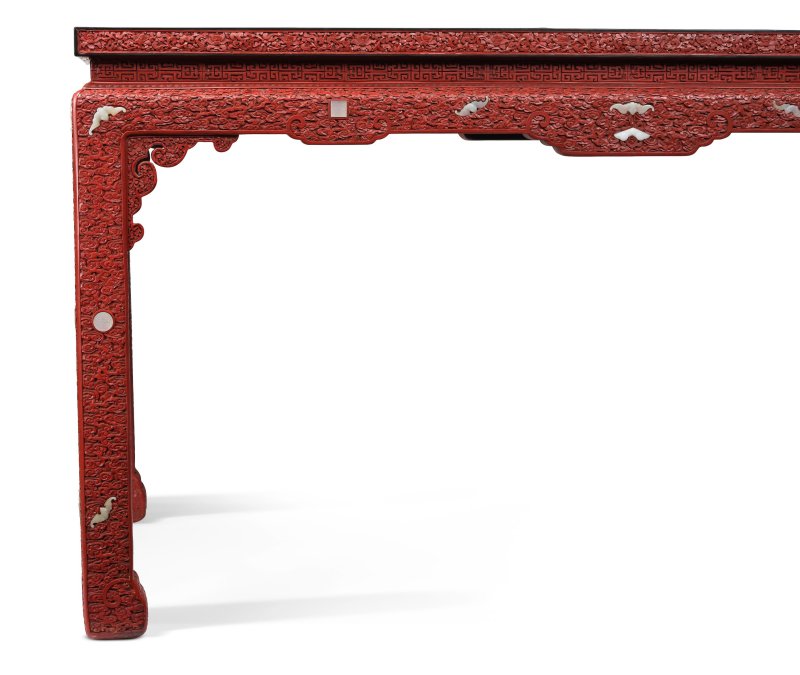
The rectangular top finely carved through layers of cinnabar with an intricate wan diaper ground surrounded by a narrow key-fret border along the edge, the sides carved with lotus flowers and scrolling leaves, supported on a waist decorated with a fret border, above a densely carved ruyi-shaped apron with scallop-shaped clouds continuing down all four sides of each leg terminating in hoofed feet, further embellished with white jade inlays of bats, shou characters, and chimes.
86.4cm (34in) high x 156.2cm (61 1/2in) wide x 68.6cm (27in) deep.
Footnotes
清乾隆 御製剔紅嵌玉束腰馬蹄足條桌
Provenance:
The Metropolitan Museum of Art, New York
Christie's New York, 29 March 2006, lot 265
來源:
大都會藝術博物館,紐約
紐約蘇富比,2006年3月29日,拍品編號265
The present table belongs to the distinguished tradition of carved cinnabar lacquer furniture, one of the most technically demanding forms of Qing decorative art. Large furniture in carved lacquer required the application of numerous layers of lacquer, built up to considerable thickness before being intricately carved through the surface to create the relief decoration. Such labour-intensive production, combined with the fragility and weight of large lacquered furnishings, resulted in relatively few surviving examples. Among the earliest and most celebrated examples is a carved red lacquer table, Xuande six-character mark and of the period, in the Victoria & Albert Museum, London, decorated with dragons among clouds illustrated by C.Clunas and J.Harrison-Hall, , London, 2014, pp.106-107. The table is an important precedent for the later Qing revival and development of carved lacquer furniture for the Imperial Court.
During the Qianlong reign, carved lacquer was employed for an increasingly wide range of Imperial furnishings, including tables, screens, cabinets, thrones and other ceremonial furniture. The surviving examples demonstrate the Court's particular appreciation for the rich relief and deep, lustrous surfaces that could be achieved through cinnabar lacquer. Particularly impressive are the large carved lacquer thrones made for the Qianlong Emperor, which combine elaborate figural and floral decoration with auspicious motifs and architectural forms. See for example a cinnabar lacquer throne, Qianlong, in the Victoria & Albert Museum, London, illustrated by C.Clunas, 'Whose Throne is it Anyway? The Qianlong Throne in the T.T. Tsui Gallery.' , July 1991, pp.44-50.
See also a rectangular carved red lacquer table decorated with dragons and clouds, Qianlong, in the Qing Court Collection, illustrated in , Hong Kong, 2002, p.107, no.95, while another Qianlong cinnabar lacquer table, in the Qing Court Collection, is illustrated in ., p.122, no.107.
The incorporation of jade inlay further distinguishes the present table within this tradition. The combination of carved cinnabar lacquer with precious hardstone was particularly suited to the Qianlong Emperor's taste for the synthesis of different materials and techniques, allowing the richness of the lacquer relief to be contrasted with the polished surfaces and varied colours of jade. Such elaborate composite furnishings are considerably less frequently encountered than lacquer furniture decorated solely in carved lacquer. See a wood incense stand inlaid with bamboo and jade, Qianlong, in the Qing Court Collection, illustrated in ., no.150.
The decoration of the present table further reflects the highly auspicious visual language favoured by the Qianlong Court. Bats, -clouds and medallions are combined to convey blessings, wish-fulfilment and longevity. The bat ( 蝠), through its homophony with 福 ('blessing' or 'good fortune'), is conventionally associated with happiness and prosperity and may be multiplied to evoke the Five Blessings ( 五福). The -clouds refer to the auspicious expression 如意 ('as desired' or 'may all be as you wish'), while the 壽 character signifies longevity. Their combination on the present table creates a concentrated programme of auspicious symbolism appropriate to an Imperial furnishing.
See a rare and magnificent Imperial three-colour carved 'nine' dragon lacquer throne, Qianlong, which was sold at Christie's London, 14 May 2019, lot 60.
此長方條桌體量宏偉,製作精細。桌面側沿與四腿滿飾花卉、如意雲紋,間嵌玉雕蝙蝠及壽字紋飾,桌面則飾萬字錦地,紋飾繁麗,氣韻雍容,盡顯華貴之態。此桌屬清代漆藝家具之精品,剔紅一向為宮廷藝術中技術要求最高之門類。大型剔紅家具需反覆髹漆達一定厚度,始能雕琢繁複紋飾,製作耗時費工,且大型漆器易損難移,故傳世數量甚少。最早例子,應為倫敦維多利亞與艾伯特博物館所藏一件宣德款剔紅雲龍紋桌,見柯律格與霍吉淑編,《Ming: 50 years that Changed China》,倫敦,2014年,頁106至107,此桌為清代宮廷剔紅家具之復興與發展提供了重要參考。
乾隆朝,剔紅之藝廣施於宮廷諸器,包括桌案、屏風、櫃格、寶座及禮儀用器。傳世之作足見清室尤愛其浮雕深邃、光影粲然,特別是乾隆帝之剔紅寶座,其裝飾結合人物花卉、吉祥紋樣與建築元素,工藝精絕。比較倫敦維多利亞與艾伯特博物館藏一件乾隆朝剔紅寶座,見柯律格〈Whose Throne is it Anyway? The Qianlong Throne in the T.T. Tsui Gallery〉,《Orientations》,1991年7月,頁44至50。
比較清宮舊藏一件乾隆時期剔紅雲龍紋委角長桌,見《故宮博物院藏文物珍品全集:明清家具(下)》,香港,2002年,頁107,編號95;同書另有清宮舊藏一件乾隆時期剔紅雲龍紋條桌,頁122,編號107,可資參照。本品更以嵌玉工藝增其華彩,剔紅與玉石相映,深契乾隆帝雅好。漆面浮雕與玉質瑩潤互襯,意趣盎然。此類家具,傳世遠較純剔紅者為稀,參考清宮舊藏一件乾隆朝楠木嵌竹絲及嵌玉回紋香几,見同書,編號150。
本品所飾蝙蝠、如意雲紋與壽字紋,寓意吉祥長壽。蝠諧「福」,多隻出現象徵五福,即長壽、富貴、康寧、好德、善終。如意雲紋寄寓順遂心願,雲形則喻天降祥瑞、福澤連綿。壽字紋既表長壽,復以圓形象徵圓滿與生命之永續。三者交織,藉諧音與象徵,層層寄託富貴、如意與長壽之祝願。
參考一件乾隆時期御製剔彩雲龍福慶有餘紋寶座,售於倫敦佳士得,2019年5月14日,拍品編號60。
The rectangular top finely carved through layers of cinnabar with an intricate wan diaper ground surrounded by a narrow key-fret border along the edge, the sides carved with lotus flowers and scrolling leaves, supported on a waist decorated with a fret border, above a densely carved ruyi-shaped apron with scallop-shaped clouds continuing down all four sides of each leg terminating in hoofed feet, further embellished with white jade inlays of bats, shou characters, and chimes.
86.4cm (34in) high x 156.2cm (61 1/2in) wide x 68.6cm (27in) deep.
Footnotes
清乾隆 御製剔紅嵌玉束腰馬蹄足條桌
Provenance:
The Metropolitan Museum of Art, New York
Christie's New York, 29 March 2006, lot 265
來源:
大都會藝術博物館,紐約
紐約蘇富比,2006年3月29日,拍品編號265
The present table belongs to the distinguished tradition of carved cinnabar lacquer furniture, one of the most technically demanding forms of Qing decorative art. Large furniture in carved lacquer required the application of numerous layers of lacquer, built up to considerable thickness before being intricately carved through the surface to create the relief decoration. Such labour-intensive production, combined with the fragility and weight of large lacquered furnishings, resulted in relatively few surviving examples. Among the earliest and most celebrated examples is a carved red lacquer table, Xuande six-character mark and of the period, in the Victoria & Albert Museum, London, decorated with dragons among clouds illustrated by C.Clunas and J.Harrison-Hall, , London, 2014, pp.106-107. The table is an important precedent for the later Qing revival and development of carved lacquer furniture for the Imperial Court.
During the Qianlong reign, carved lacquer was employed for an increasingly wide range of Imperial furnishings, including tables, screens, cabinets, thrones and other ceremonial furniture. The surviving examples demonstrate the Court's particular appreciation for the rich relief and deep, lustrous surfaces that could be achieved through cinnabar lacquer. Particularly impressive are the large carved lacquer thrones made for the Qianlong Emperor, which combine elaborate figural and floral decoration with auspicious motifs and architectural forms. See for example a cinnabar lacquer throne, Qianlong, in the Victoria & Albert Museum, London, illustrated by C.Clunas, 'Whose Throne is it Anyway? The Qianlong Throne in the T.T. Tsui Gallery.' , July 1991, pp.44-50.
See also a rectangular carved red lacquer table decorated with dragons and clouds, Qianlong, in the Qing Court Collection, illustrated in , Hong Kong, 2002, p.107, no.95, while another Qianlong cinnabar lacquer table, in the Qing Court Collection, is illustrated in ., p.122, no.107.
The incorporation of jade inlay further distinguishes the present table within this tradition. The combination of carved cinnabar lacquer with precious hardstone was particularly suited to the Qianlong Emperor's taste for the synthesis of different materials and techniques, allowing the richness of the lacquer relief to be contrasted with the polished surfaces and varied colours of jade. Such elaborate composite furnishings are considerably less frequently encountered than lacquer furniture decorated solely in carved lacquer. See a wood incense stand inlaid with bamboo and jade, Qianlong, in the Qing Court Collection, illustrated in ., no.150.
The decoration of the present table further reflects the highly auspicious visual language favoured by the Qianlong Court. Bats, -clouds and medallions are combined to convey blessings, wish-fulfilment and longevity. The bat ( 蝠), through its homophony with 福 ('blessing' or 'good fortune'), is conventionally associated with happiness and prosperity and may be multiplied to evoke the Five Blessings ( 五福). The -clouds refer to the auspicious expression 如意 ('as desired' or 'may all be as you wish'), while the 壽 character signifies longevity. Their combination on the present table creates a concentrated programme of auspicious symbolism appropriate to an Imperial furnishing.
See a rare and magnificent Imperial three-colour carved 'nine' dragon lacquer throne, Qianlong, which was sold at Christie's London, 14 May 2019, lot 60.
此長方條桌體量宏偉,製作精細。桌面側沿與四腿滿飾花卉、如意雲紋,間嵌玉雕蝙蝠及壽字紋飾,桌面則飾萬字錦地,紋飾繁麗,氣韻雍容,盡顯華貴之態。此桌屬清代漆藝家具之精品,剔紅一向為宮廷藝術中技術要求最高之門類。大型剔紅家具需反覆髹漆達一定厚度,始能雕琢繁複紋飾,製作耗時費工,且大型漆器易損難移,故傳世數量甚少。最早例子,應為倫敦維多利亞與艾伯特博物館所藏一件宣德款剔紅雲龍紋桌,見柯律格與霍吉淑編,《Ming: 50 years that Changed China》,倫敦,2014年,頁106至107,此桌為清代宮廷剔紅家具之復興與發展提供了重要參考。
乾隆朝,剔紅之藝廣施於宮廷諸器,包括桌案、屏風、櫃格、寶座及禮儀用器。傳世之作足見清室尤愛其浮雕深邃、光影粲然,特別是乾隆帝之剔紅寶座,其裝飾結合人物花卉、吉祥紋樣與建築元素,工藝精絕。比較倫敦維多利亞與艾伯特博物館藏一件乾隆朝剔紅寶座,見柯律格〈Whose Throne is it Anyway? The Qianlong Throne in the T.T. Tsui Gallery〉,《Orientations》,1991年7月,頁44至50。
比較清宮舊藏一件乾隆時期剔紅雲龍紋委角長桌,見《故宮博物院藏文物珍品全集:明清家具(下)》,香港,2002年,頁107,編號95;同書另有清宮舊藏一件乾隆時期剔紅雲龍紋條桌,頁122,編號107,可資參照。本品更以嵌玉工藝增其華彩,剔紅與玉石相映,深契乾隆帝雅好。漆面浮雕與玉質瑩潤互襯,意趣盎然。此類家具,傳世遠較純剔紅者為稀,參考清宮舊藏一件乾隆朝楠木嵌竹絲及嵌玉回紋香几,見同書,編號150。
本品所飾蝙蝠、如意雲紋與壽字紋,寓意吉祥長壽。蝠諧「福」,多隻出現象徵五福,即長壽、富貴、康寧、好德、善終。如意雲紋寄寓順遂心願,雲形則喻天降祥瑞、福澤連綿。壽字紋既表長壽,復以圓形象徵圓滿與生命之永續。三者交織,藉諧音與象徵,層層寄託富貴、如意與長壽之祝願。
參考一件乾隆時期御製剔彩雲龍福慶有餘紋寶座,售於倫敦佳士得,2019年5月14日,拍品編號60。
常见问题
这件清乾隆 御製剔紅嵌玉束腰馬蹄足條桌 | AN EXCEPTIONALLY RARE IMPERIAL CARVED CINNABAR LACQUER JADE-INSET TABLE的成交价是多少?
落槌价为 预展中。 成交价为 预展中。