


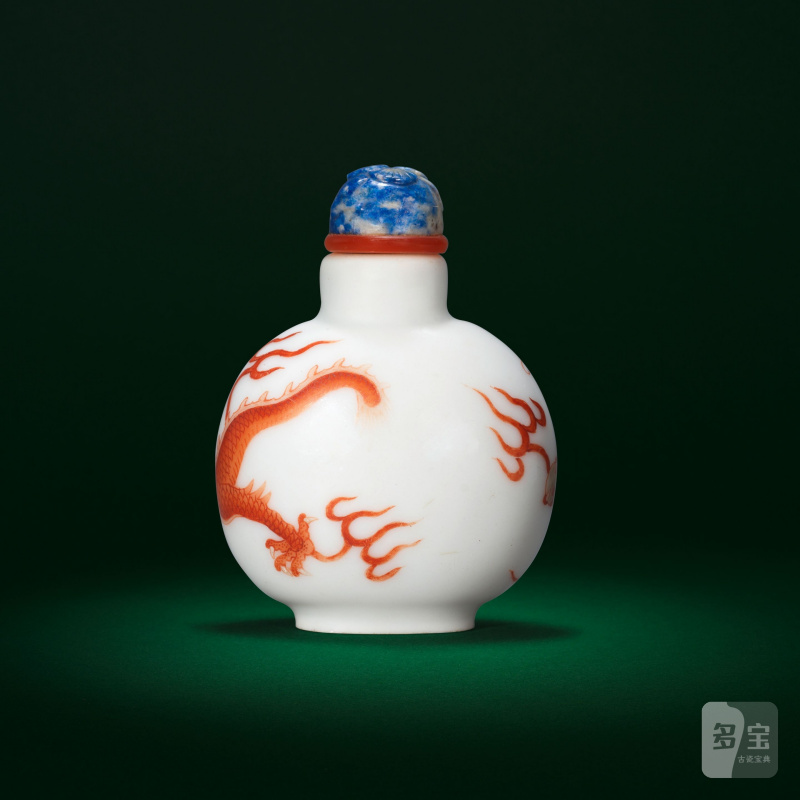
Lot 334Y 清道光 礬紅彩龍紋鼻烟壺 | AN IRON-RED 'DRAGON AND PEARL' SNUFF BOTTLE
落槌价
****
成交价
****
| 拍卖公司 | 邦瀚斯 |
|---|---|
| 拍卖时间 | 2026年05月18日 |
请安装多宝古瓷宝典APP,查看高清无损大图
拍品信息
拍品名称
清道光 礬紅彩龍紋鼻烟壺 | AN IRON-RED 'DRAGON AND PEARL' SNUFF BOTTLE
起拍价
GBP 2,000
估值区间
未知
尺寸
未知
品相
未知
更多信息
Daoguang seal mark and of the period
The rounded sides rising from a recessed foot to a cylindrical neck, painted in iron-red enamels around the flattened body with a striding four-clawed dragon, its scaly body finely detailed and its expression fierce, clutching a pearl in one of its paws, stopper. 5.7cm (2 1/4in) high. (2).
Footnotes
The item within this lot containing ivory has been registered in accordance with the Ivory Act (Section 10). Ref.9NZKNDN5
該批次中含有象牙的物品已根據《象牙法案》(章節10)註冊Ref.9NZKNDN5
清道光 礬紅彩龍紋鼻烟壺
礬紅「道光年製」篆書款
Provenance: Sotheby's London, 11 October 1974, lot 95
Trudy and John Cohen, collection no.B74
倫敦蘇富比,1974年10月11日,拍品編號95
Trudy及John Cohen伉儷,藏品編號B74
During the Daoguang reign (1820-1850), the majority of snuff bottles were produced in porcelain. An apparent rise in production was largely supported by the Imperial kilns at Jingdezhen, instead of relying exclusively on the Palace Workshops in Beijing.
Amongst the designs regularly appearing on the snuff bottles during this period, many feature the four-clawed dragon . In terms of style, enamelling and reign marks, these bottles closely resemble pieces made for Imperial use. However, whereas the Imperial bottles bore the five-clawed dragon symbolising the Emperor, the four-clawed one was associated with the three highest ranks of nobility. Bottles such as the present lot would therefore probably have been produced for the Court, to be bestowed upon nobles or newly ennobled officials.
A related snuff bottle featuring the four-clawed dragon, Daoguang seal mark and of the period, is illustrated by H.Moss, V.Graham and K.B.Tsang, , vol.6.3, Hong Kong, 2007, no.1321, and was later sold at Bonhams Hong Kong, 23 November 2010, lot 4.
The rounded sides rising from a recessed foot to a cylindrical neck, painted in iron-red enamels around the flattened body with a striding four-clawed dragon, its scaly body finely detailed and its expression fierce, clutching a pearl in one of its paws, stopper. 5.7cm (2 1/4in) high. (2).
Footnotes
The item within this lot containing ivory has been registered in accordance with the Ivory Act (Section 10). Ref.9NZKNDN5
該批次中含有象牙的物品已根據《象牙法案》(章節10)註冊Ref.9NZKNDN5
清道光 礬紅彩龍紋鼻烟壺
礬紅「道光年製」篆書款
Provenance: Sotheby's London, 11 October 1974, lot 95
Trudy and John Cohen, collection no.B74
倫敦蘇富比,1974年10月11日,拍品編號95
Trudy及John Cohen伉儷,藏品編號B74
During the Daoguang reign (1820-1850), the majority of snuff bottles were produced in porcelain. An apparent rise in production was largely supported by the Imperial kilns at Jingdezhen, instead of relying exclusively on the Palace Workshops in Beijing.
Amongst the designs regularly appearing on the snuff bottles during this period, many feature the four-clawed dragon . In terms of style, enamelling and reign marks, these bottles closely resemble pieces made for Imperial use. However, whereas the Imperial bottles bore the five-clawed dragon symbolising the Emperor, the four-clawed one was associated with the three highest ranks of nobility. Bottles such as the present lot would therefore probably have been produced for the Court, to be bestowed upon nobles or newly ennobled officials.
A related snuff bottle featuring the four-clawed dragon, Daoguang seal mark and of the period, is illustrated by H.Moss, V.Graham and K.B.Tsang, , vol.6.3, Hong Kong, 2007, no.1321, and was later sold at Bonhams Hong Kong, 23 November 2010, lot 4.