

拍品信息
拍品名称
扎什倫布 藏中 十七世紀 銅鎏金空行母像 | A GILT COPPER ALLOY FIGURE OF A DAKINI
年代
TASHI LHUNPO, CENTRAL TIBET, 17TH CENTURY
起拍价
HKD 3,500,000
估值区间
HKD 3500000 - 4500000
尺寸
未知
品相
未知
更多信息
TASHI LHUNPO, CENTRAL TIBET, 17TH CENTURY
Himalayan Art Resources item no. 13062
19.7 cm (7 3/4 in.) high
Footnotes
扎什倫布 藏中 十七世紀 銅鎏金空行母像
Provenance
Sotheby's, New York, 30 November 1994, lot 66
Sotheby's, New York, 16 March 2016, lot 721
Prominent Private Collection
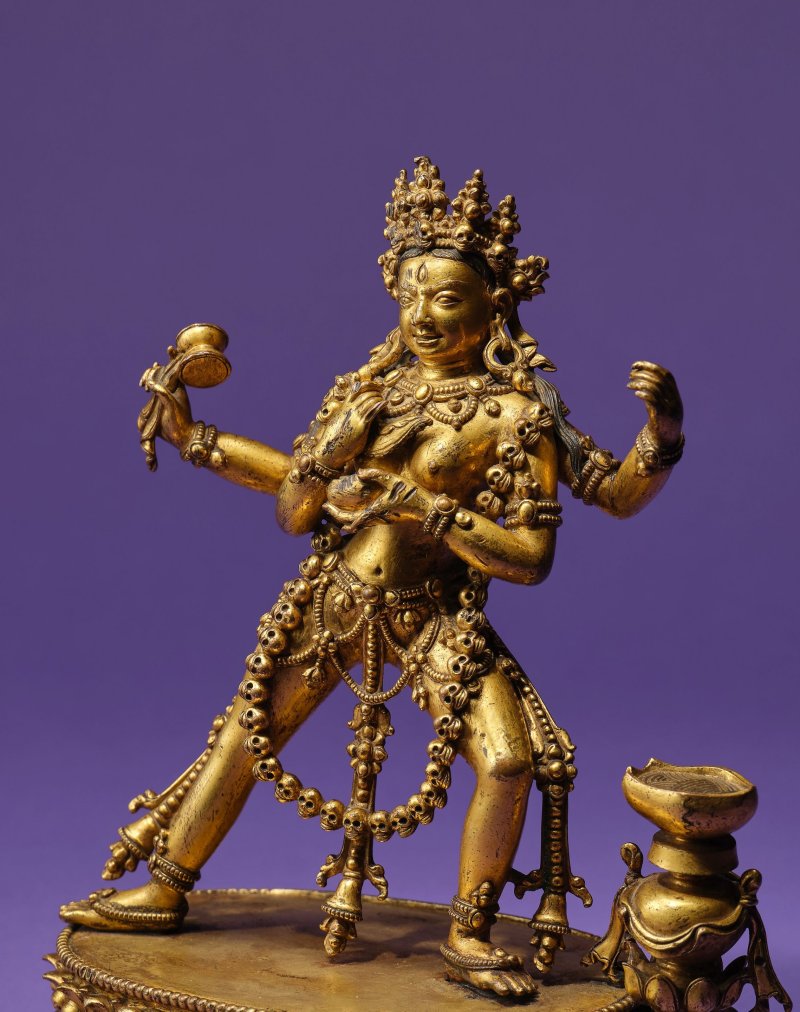
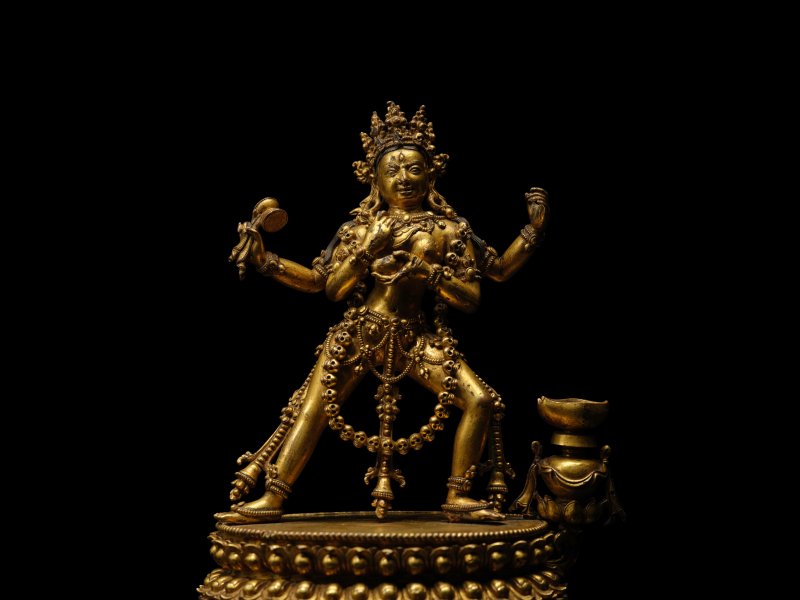
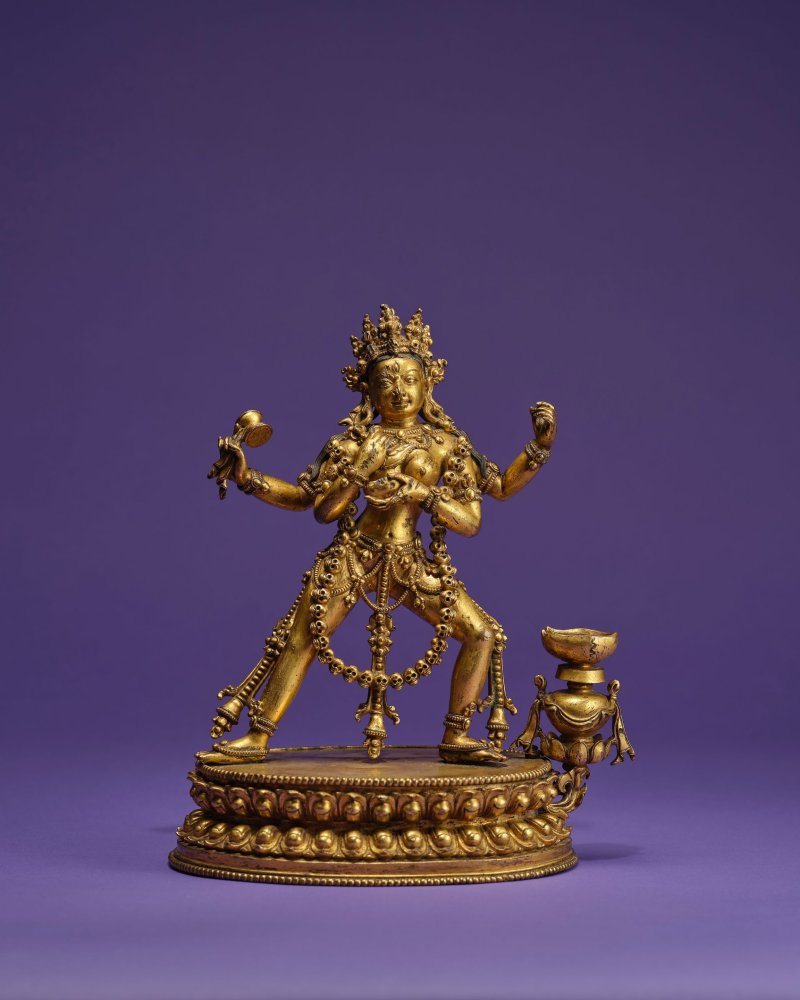
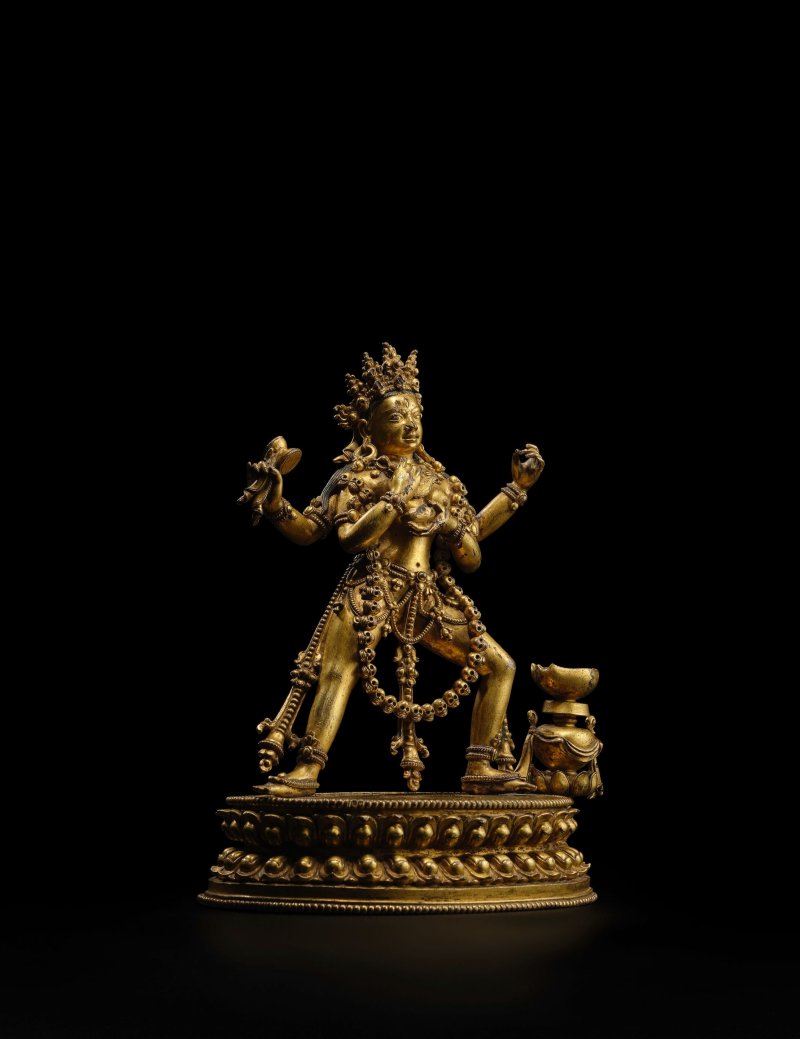
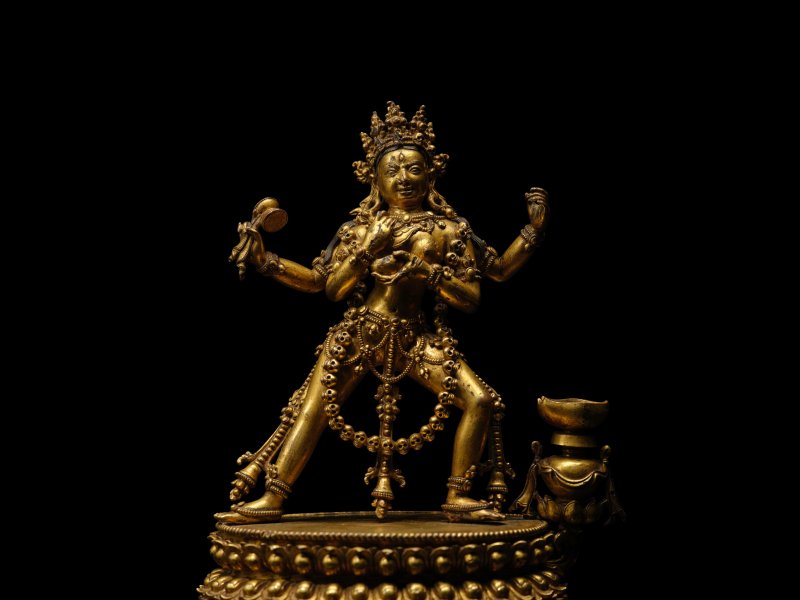
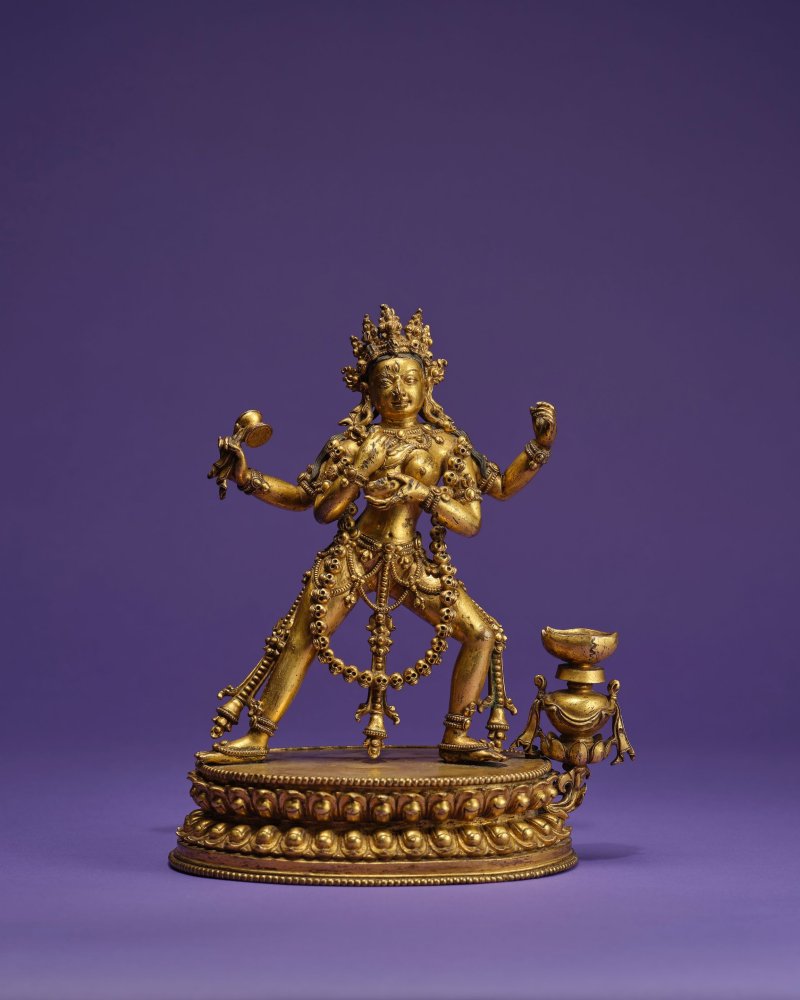
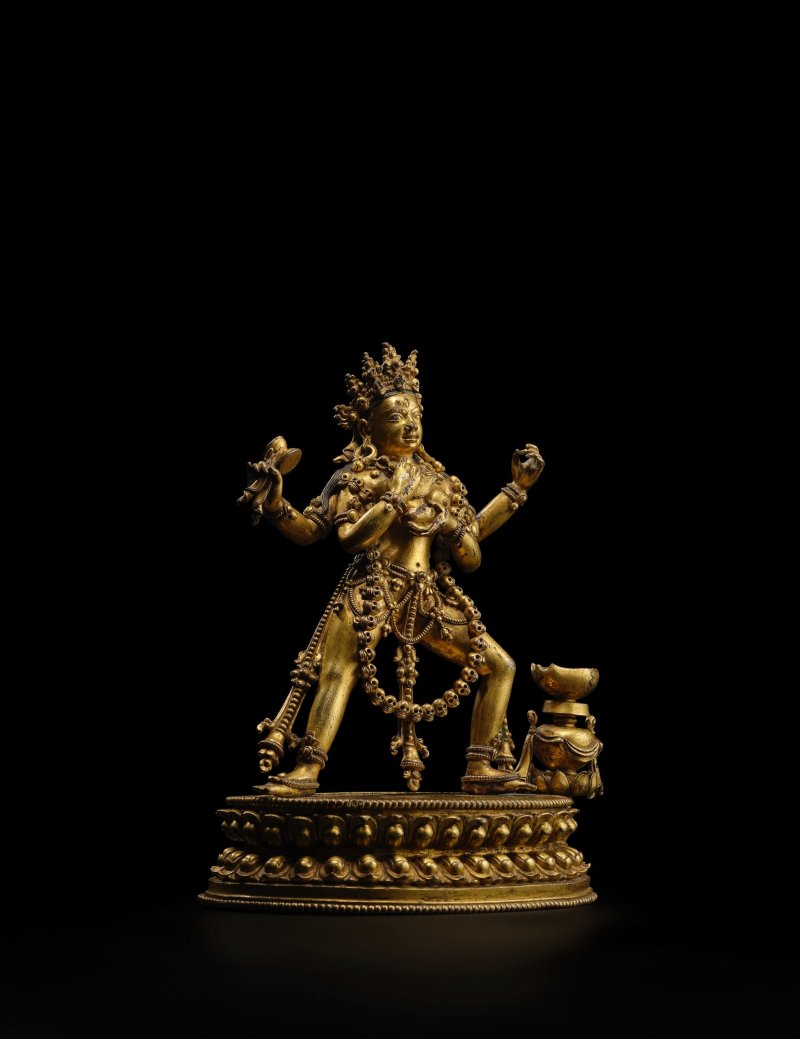
Among the most accomplished figures to survive from the sculptural mandalas commissioned for Tashi Lhunpo monastery at its height, this goddess is a masterpiece uniting style and strength, aesthetic ambition and religious devotion. She belongs to the mandala of Chakrasamvara (lit. 'the Wheel of Supreme Bliss'), the sacred assembly symbolising the transcendent bliss that accomplished practitioners attain through the Chakrasamvara Tantra. Conceived as an athletic young girl, she lunges across an oval lotus base in a warrior's stride, her weight thrown forward yet perfectly poised. Her moon-like face, with its third eye and faint smile, is framed by a floral tiara, fluttering ribbons, and prominent earrings that brush the shoulders. Four arms fan out with the full movement and perfect control of a celestial dancer, the upper pair modelled with particular energy, the right still shaking its drum.
Her origin at Tashi Lhunpo is established by a figure of Chakrasamvara embracing his consort Vajravarahi that bears a 'Tashilima' inscription (fig. 1; formerly in the Claude de Marteau Collection; sold at Bonhams, Paris, 4 October 2022, lot 36). That bronze and the present Dakini are demonstrably by the same hand. The beaded lotus base is identical, its long, supple petals each enclosing a plump inner layer that curls up at the tip. So too is the beaded and floral regalia, in which a small triangular floret of four tiny petals adorns the girdles, bracelets, armbands, and anklets of both figures. Vajravarahi's exquisite tiara is likewise identical to the one worn by the Dakini. In each, the skulls are linked by double beaded rings, and every leaf is set with a central bead surrounded by four larger petals and four smaller pointed ones, crowned by the same triangular floret. Even the terminals of the ribbons above the ears are the same. If anything the Dakini is the more finely finished of the two, since as a separately cast figure she afforded the artist greater room to refine the smallest details.
Tashi Lhunpo monastery in Shigatse, Central Tibet, is the traditional seat of the Panchen Lama, the second-highest hierarch of the Gelug order, and maintained a particularly close relationship with the Qing court during the reign of the Kangxi Emperor (1662-1722) (see Luo, "Tashi Lhunpo Statuary: Karma and Mt Meru", in Bonhams, Hong Kong, 26 November 2019). When the Fourth Panchen Lama, Lobsang Chökyi Gyaltsen (1570-1662), became abbot in 1601, he enlisted artisans to found a settlement near the monastery. Known as Tashikitsel, this village of specialised workshops supplied Tashi Lhunpo with a steady stream of building materials, textiles, paintings, and gilt bronzes for much of the seventeenth and eighteenth centuries. Other products of these workshops confirm the attribution: a seated Vajrapani in the Palace Museum, Beijing (故201961), has the same design of crown and similar lotus base (, 2020, pp. 376-9, pl. 139), and a Prajnaparamita the same crown and earrings (, pp. 424-5, pl. 153).
The sophistication of the casting betrays a Newar master in the service of these Tibetan patrons. Painstaking care has been lavished on every jewel-like element, from the floral tiara to the armbands, anklets, and girdle; even the short ribbons above the ears are shaped like tongues of flame. The four-petalled flower that recurs across the ornaments is rendered with an almost naturalistic sense of the thickness of each petal and the softness of its curling tip. Her garland of deeply carved skulls, as lustrous as polished pearls, is worn not close to the neck but slipping from the shoulders in a long loop that swings below the knees, its rounded forms complementing the soft contours of the body. Beaded strands set with large rosettes fall at either side of the legs, and another hangs at the centre, terminating in a finely detailed bell with flowers. The repetition of these floral motifs brings the whole composition into harmony, heightened by the rich, warm gilding that unifies figure and base. The preference for boldly modelled, highly polished detail in high relief recalls the Densatil style of the fourteenth century, and demonstrates the lasting influence and continued excellence of Newar craftsmanship in Tibet.
The set to which both sculptures belonged was a mandala realised in three dimensions. The Sixty-two Deity Chakrasamvara Mandala is arranged in five concentric circles. In the innermost, the Great Bliss Wheel, stands the four-headed, twelve-armed Chakrasamvara embracing Vajravarahi, his principal hands clasping the thunderbolt sceptre () and ritual bell (), with four-armed dakinis at the cardinal directions. Around them radiate four further circles of variously coloured retinue figures. Each dakini is bound to the central couple through her attributes: the curved knife and skull cup () in her primary hands are those of Vajravarahi, while the drum and staff in her upper hands appear among the implements of Chakrasamvara. Of the three principal lineages of the mandala, both the Krishnacharin and Luipa traditions include the four four-armed dakinis in their sixty-two deity assemblies. In the Krishnacharin tradition Vajravarahi rests one leg on the ground, whereas in the Luipa tradition both her legs encircle Chakrasamvara's waist. As the Luipa tradition is fundamental to the Gelug school, it is fitting that the de Marteau bronze shows Vajravarahi with both legs wrapped around her consort. While paintings of many periods survive to record the mandala as a two-dimensional diagram, sculptural mandalas with their full assembly of gilt-bronze deities have rarely survived intact, and most are known today only through dispersed individual figures. A set of Chakrasamvara and four dakinis, illustrating the same concept on a smaller scale and all labelled as Tashikitsel, was displayed in the Wujuanzhai, where the Qianlong Emperor practise the (, pp. 490-1 & 500-7, pls. 179 & 186-190).
The most remarkable feature of the bronze is the scrolling lotus stem that rises from the side of the base to support a ritual vase (), hung with swags of cloth and fluttering ribbons and surmounted by a brimming with nectar. Its presence is extremely rare in figural sculpture. It corresponds to a sixteenth-century mandala thangka in the Museum of Fine Arts, Boston (65.616; HAR 87239), in which the four dakinis alternate with four lotuses bearing vases topped with . The vase points to the offering () that forms part of the rites of Chakrasamvara, among the most profound and widely practised cycles of the Highest Yoga Tantras. Revered across the Himalayas from the Kathmandu Valley to the great monasteries of Tibet, Chakrasamvara is one of the three principal meditational deities of the Gelug order, and his mandala would have held a central place at Tashi Lhunpo. The design of the base is equally telling. The goddess is set deliberately to one side to leave room for the vase, and the compact oval footprint allowed many such sculptures to be assembled closely around the central couple. This may well be a solution devised for a figure within a mandala rather than for an independent image, and it is consistent with her identification as one of the four dakinis.
Himalayan Art Resources item no. 13062
19.7 cm (7 3/4 in.) high
Footnotes
扎什倫布 藏中 十七世紀 銅鎏金空行母像
Provenance
Sotheby's, New York, 30 November 1994, lot 66
Sotheby's, New York, 16 March 2016, lot 721
Prominent Private Collection
Among the most accomplished figures to survive from the sculptural mandalas commissioned for Tashi Lhunpo monastery at its height, this goddess is a masterpiece uniting style and strength, aesthetic ambition and religious devotion. She belongs to the mandala of Chakrasamvara (lit. 'the Wheel of Supreme Bliss'), the sacred assembly symbolising the transcendent bliss that accomplished practitioners attain through the Chakrasamvara Tantra. Conceived as an athletic young girl, she lunges across an oval lotus base in a warrior's stride, her weight thrown forward yet perfectly poised. Her moon-like face, with its third eye and faint smile, is framed by a floral tiara, fluttering ribbons, and prominent earrings that brush the shoulders. Four arms fan out with the full movement and perfect control of a celestial dancer, the upper pair modelled with particular energy, the right still shaking its drum.
Her origin at Tashi Lhunpo is established by a figure of Chakrasamvara embracing his consort Vajravarahi that bears a 'Tashilima' inscription (fig. 1; formerly in the Claude de Marteau Collection; sold at Bonhams, Paris, 4 October 2022, lot 36). That bronze and the present Dakini are demonstrably by the same hand. The beaded lotus base is identical, its long, supple petals each enclosing a plump inner layer that curls up at the tip. So too is the beaded and floral regalia, in which a small triangular floret of four tiny petals adorns the girdles, bracelets, armbands, and anklets of both figures. Vajravarahi's exquisite tiara is likewise identical to the one worn by the Dakini. In each, the skulls are linked by double beaded rings, and every leaf is set with a central bead surrounded by four larger petals and four smaller pointed ones, crowned by the same triangular floret. Even the terminals of the ribbons above the ears are the same. If anything the Dakini is the more finely finished of the two, since as a separately cast figure she afforded the artist greater room to refine the smallest details.
Tashi Lhunpo monastery in Shigatse, Central Tibet, is the traditional seat of the Panchen Lama, the second-highest hierarch of the Gelug order, and maintained a particularly close relationship with the Qing court during the reign of the Kangxi Emperor (1662-1722) (see Luo, "Tashi Lhunpo Statuary: Karma and Mt Meru", in Bonhams, Hong Kong, 26 November 2019). When the Fourth Panchen Lama, Lobsang Chökyi Gyaltsen (1570-1662), became abbot in 1601, he enlisted artisans to found a settlement near the monastery. Known as Tashikitsel, this village of specialised workshops supplied Tashi Lhunpo with a steady stream of building materials, textiles, paintings, and gilt bronzes for much of the seventeenth and eighteenth centuries. Other products of these workshops confirm the attribution: a seated Vajrapani in the Palace Museum, Beijing (故201961), has the same design of crown and similar lotus base (, 2020, pp. 376-9, pl. 139), and a Prajnaparamita the same crown and earrings (, pp. 424-5, pl. 153).
The sophistication of the casting betrays a Newar master in the service of these Tibetan patrons. Painstaking care has been lavished on every jewel-like element, from the floral tiara to the armbands, anklets, and girdle; even the short ribbons above the ears are shaped like tongues of flame. The four-petalled flower that recurs across the ornaments is rendered with an almost naturalistic sense of the thickness of each petal and the softness of its curling tip. Her garland of deeply carved skulls, as lustrous as polished pearls, is worn not close to the neck but slipping from the shoulders in a long loop that swings below the knees, its rounded forms complementing the soft contours of the body. Beaded strands set with large rosettes fall at either side of the legs, and another hangs at the centre, terminating in a finely detailed bell with flowers. The repetition of these floral motifs brings the whole composition into harmony, heightened by the rich, warm gilding that unifies figure and base. The preference for boldly modelled, highly polished detail in high relief recalls the Densatil style of the fourteenth century, and demonstrates the lasting influence and continued excellence of Newar craftsmanship in Tibet.
The set to which both sculptures belonged was a mandala realised in three dimensions. The Sixty-two Deity Chakrasamvara Mandala is arranged in five concentric circles. In the innermost, the Great Bliss Wheel, stands the four-headed, twelve-armed Chakrasamvara embracing Vajravarahi, his principal hands clasping the thunderbolt sceptre () and ritual bell (), with four-armed dakinis at the cardinal directions. Around them radiate four further circles of variously coloured retinue figures. Each dakini is bound to the central couple through her attributes: the curved knife and skull cup () in her primary hands are those of Vajravarahi, while the drum and staff in her upper hands appear among the implements of Chakrasamvara. Of the three principal lineages of the mandala, both the Krishnacharin and Luipa traditions include the four four-armed dakinis in their sixty-two deity assemblies. In the Krishnacharin tradition Vajravarahi rests one leg on the ground, whereas in the Luipa tradition both her legs encircle Chakrasamvara's waist. As the Luipa tradition is fundamental to the Gelug school, it is fitting that the de Marteau bronze shows Vajravarahi with both legs wrapped around her consort. While paintings of many periods survive to record the mandala as a two-dimensional diagram, sculptural mandalas with their full assembly of gilt-bronze deities have rarely survived intact, and most are known today only through dispersed individual figures. A set of Chakrasamvara and four dakinis, illustrating the same concept on a smaller scale and all labelled as Tashikitsel, was displayed in the Wujuanzhai, where the Qianlong Emperor practise the (, pp. 490-1 & 500-7, pls. 179 & 186-190).
The most remarkable feature of the bronze is the scrolling lotus stem that rises from the side of the base to support a ritual vase (), hung with swags of cloth and fluttering ribbons and surmounted by a brimming with nectar. Its presence is extremely rare in figural sculpture. It corresponds to a sixteenth-century mandala thangka in the Museum of Fine Arts, Boston (65.616; HAR 87239), in which the four dakinis alternate with four lotuses bearing vases topped with . The vase points to the offering () that forms part of the rites of Chakrasamvara, among the most profound and widely practised cycles of the Highest Yoga Tantras. Revered across the Himalayas from the Kathmandu Valley to the great monasteries of Tibet, Chakrasamvara is one of the three principal meditational deities of the Gelug order, and his mandala would have held a central place at Tashi Lhunpo. The design of the base is equally telling. The goddess is set deliberately to one side to leave room for the vase, and the compact oval footprint allowed many such sculptures to be assembled closely around the central couple. This may well be a solution devised for a figure within a mandala rather than for an independent image, and it is consistent with her identification as one of the four dakinis.
常见问题
这件扎什倫布 藏中 十七世紀 銅鎏金空行母像 | A GILT COPPER ALLOY FIGURE OF A DAKINI的成交价是多少?
落槌价为 预展中。 成交价为 预展中。