
拍品信息
拍品名称
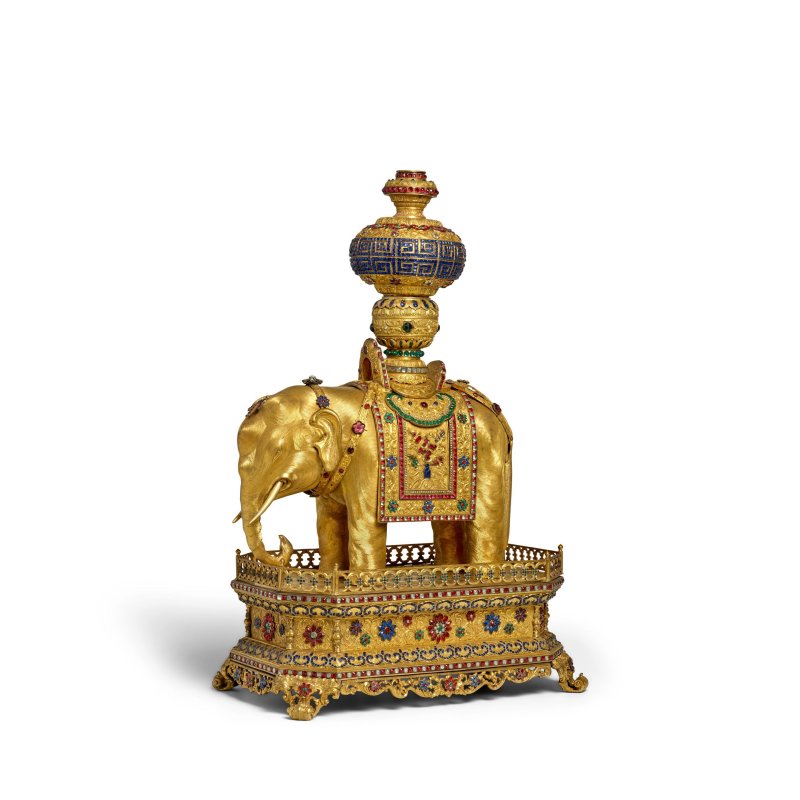
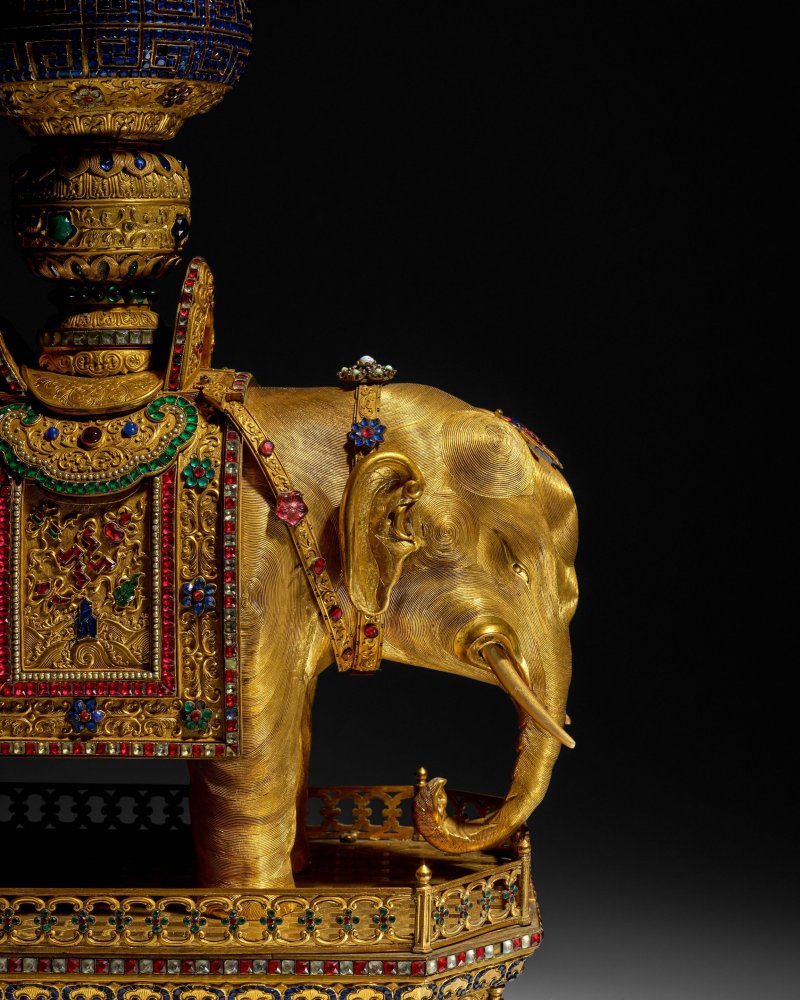
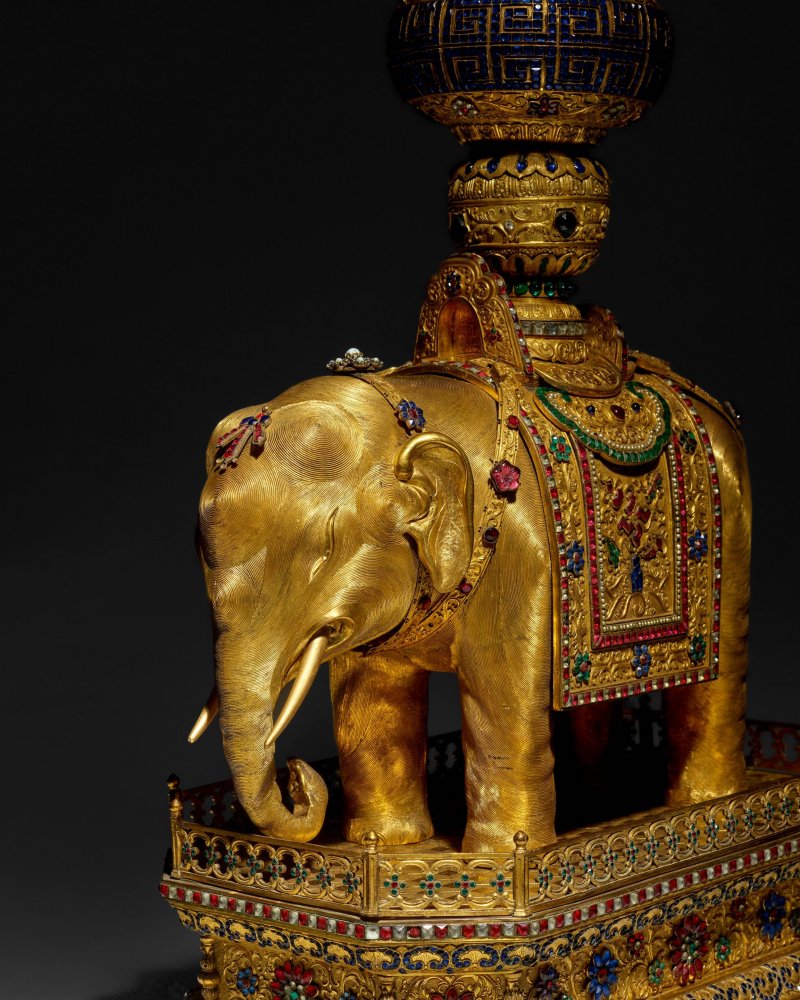
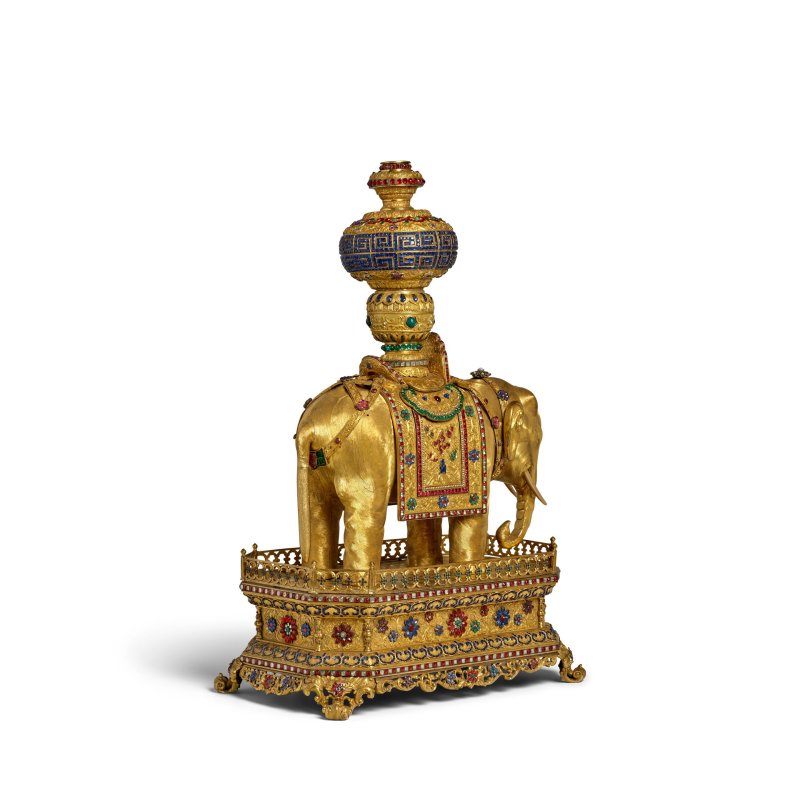
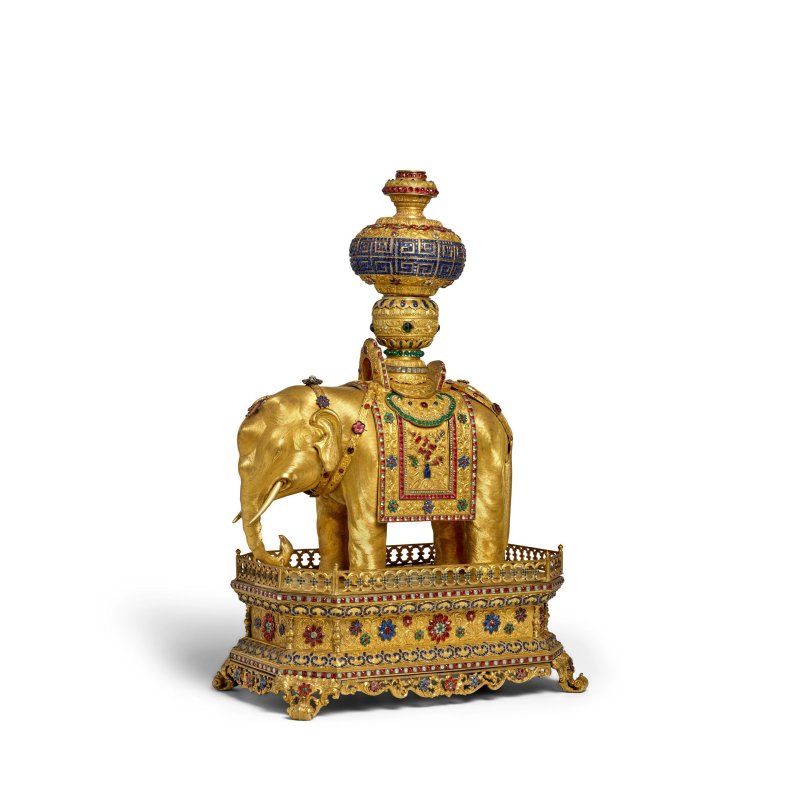
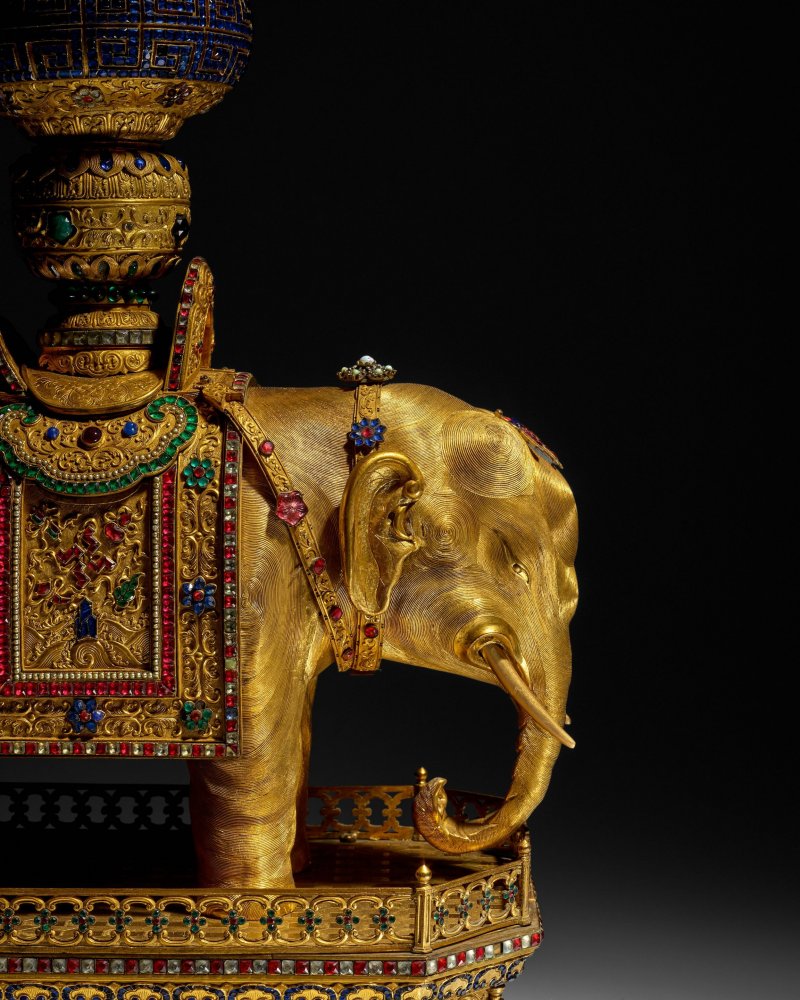
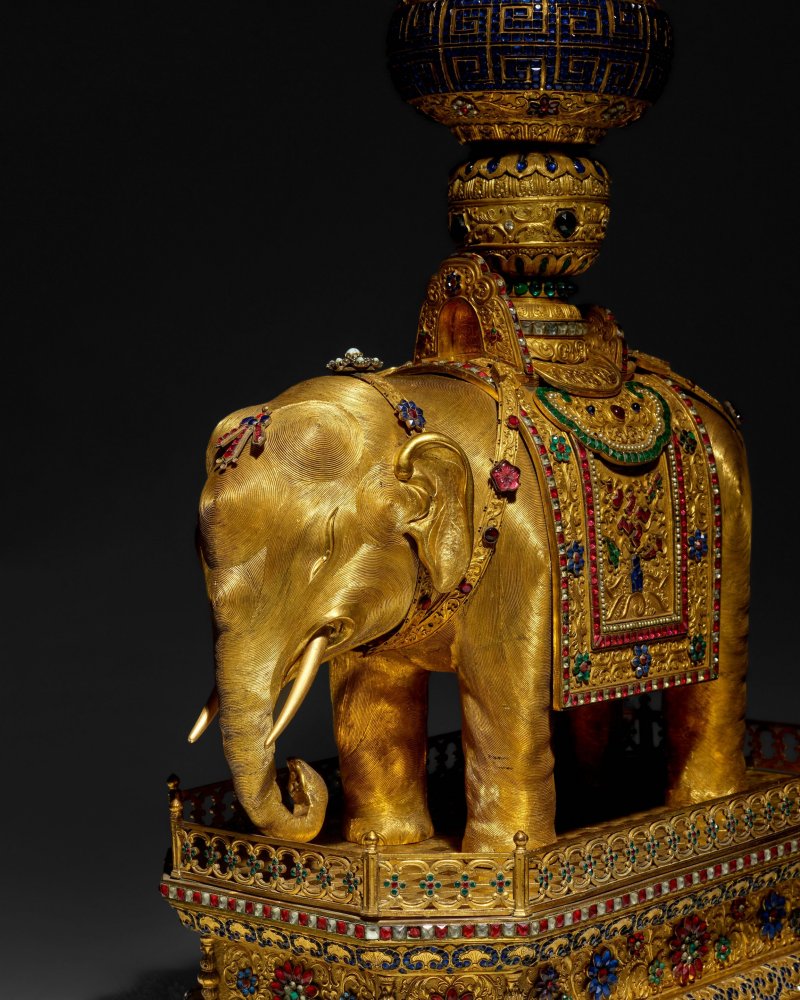
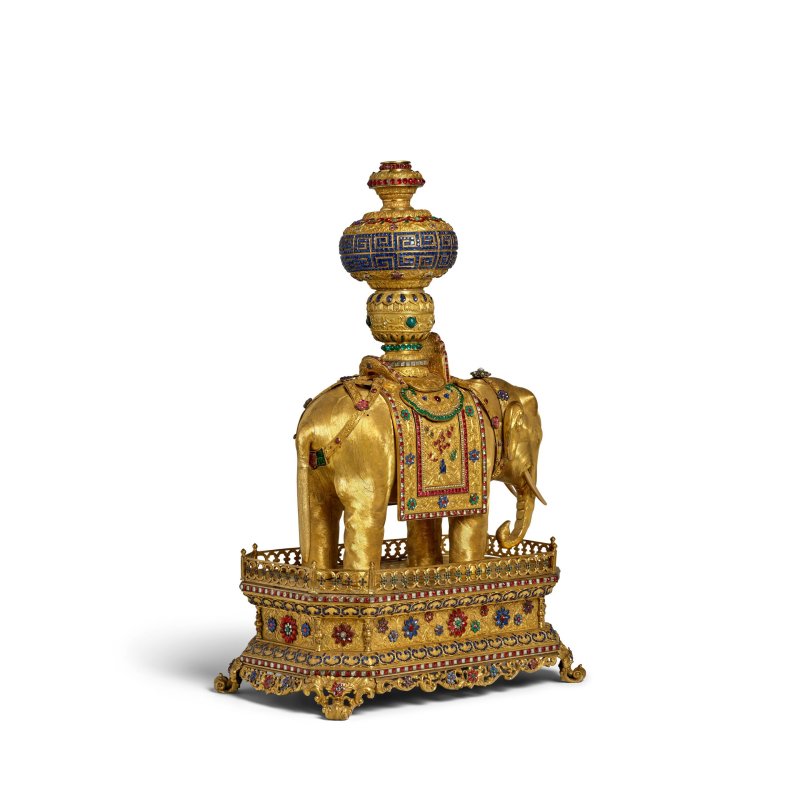
清乾隆/嘉慶 銅鎏金嵌料石太平有象托架 | A MAGNIFICENT GILT COPPER ALLOY GLASS-EMBELLISHED ELEPHANT STAND
年代
Qianlong/Jiaqing period
起拍价
USD 150,000
估值区间
未知
尺寸
未知
品相
未知
更多信息
Qianlong/Jiaqing period
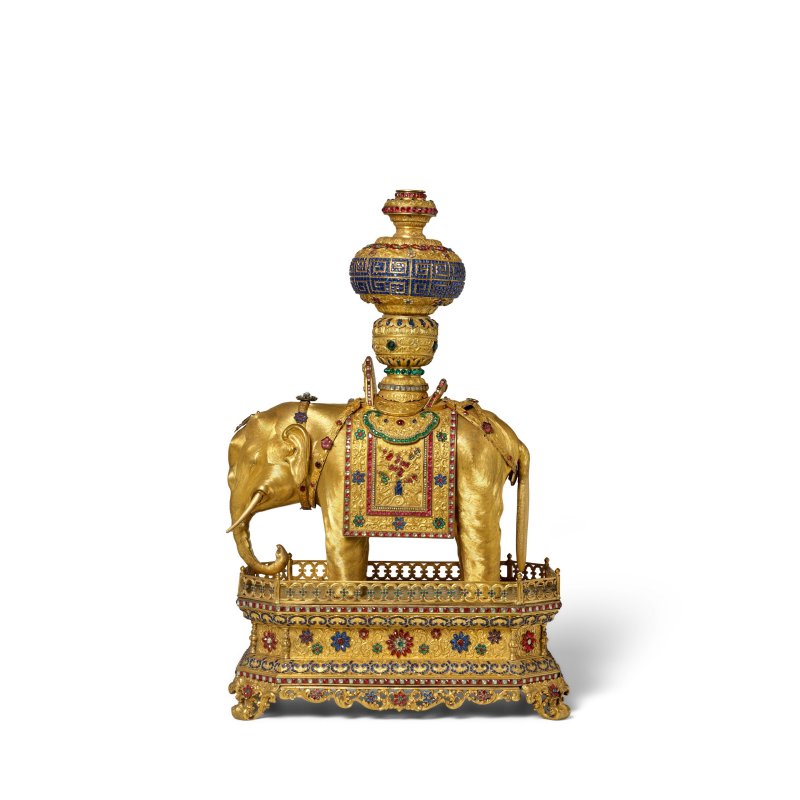
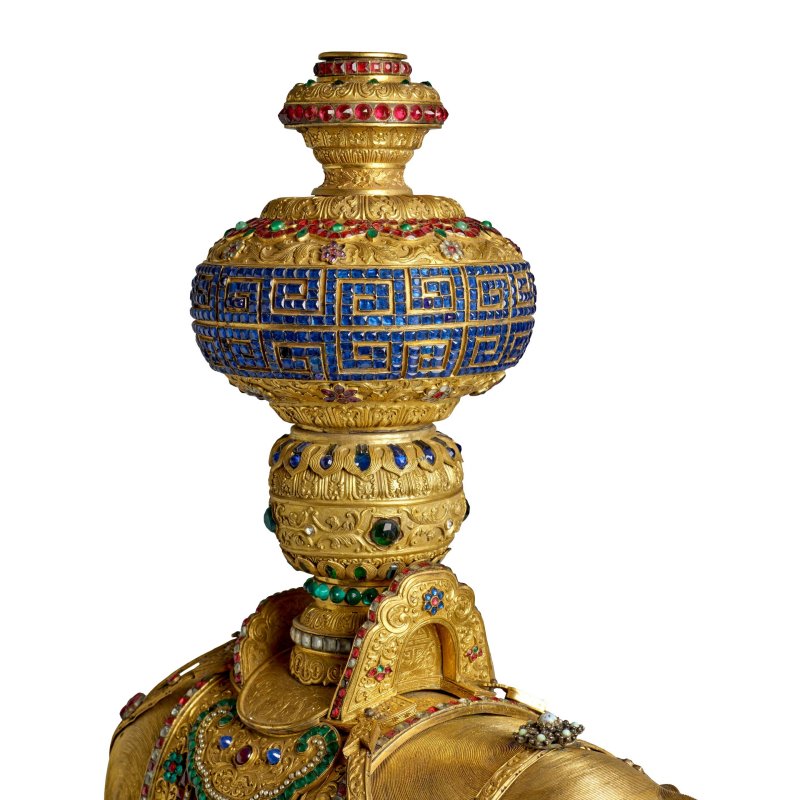
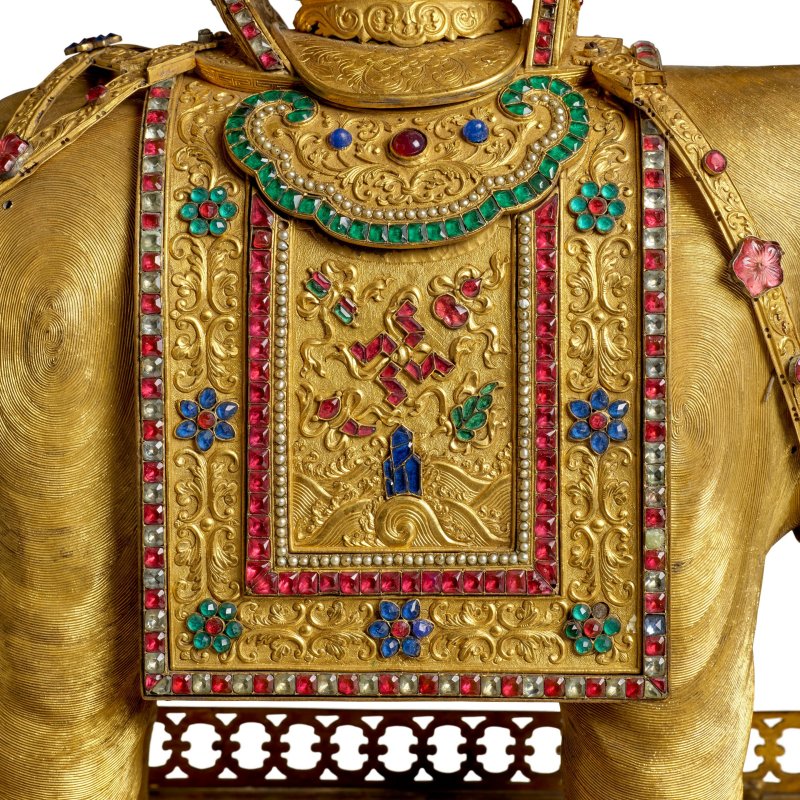
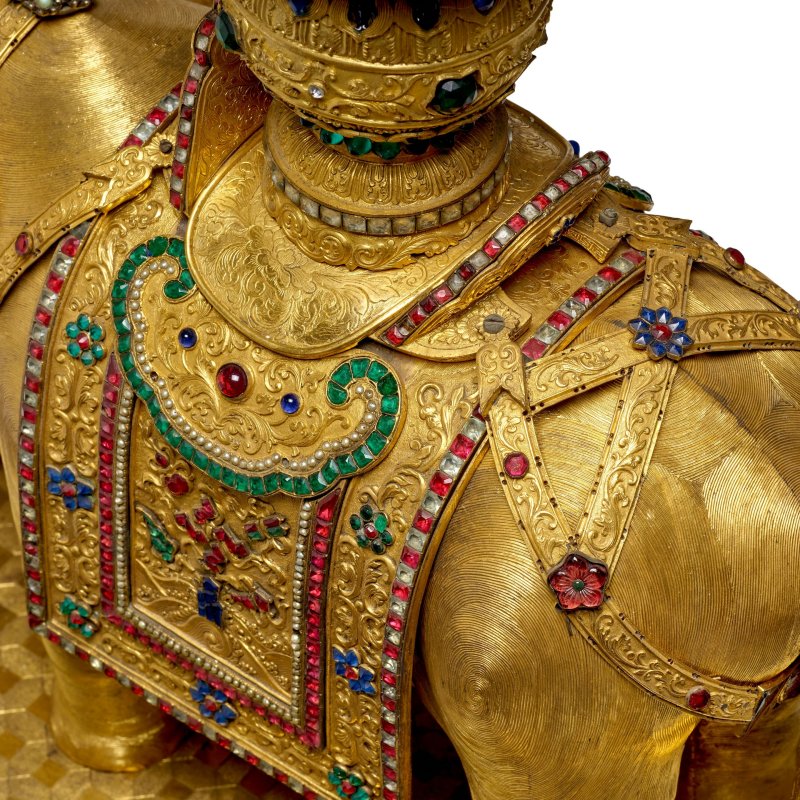
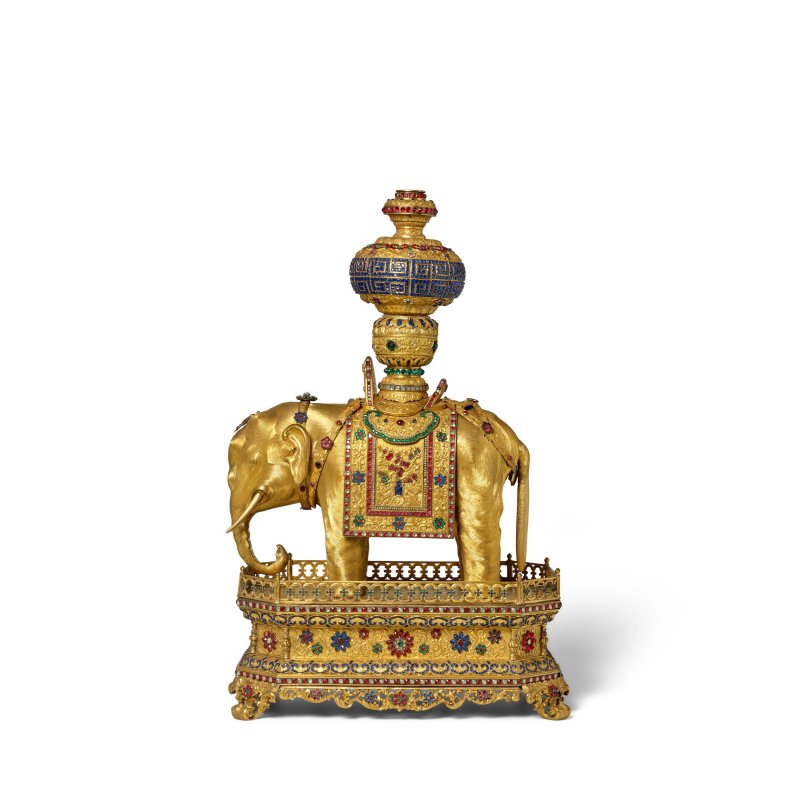
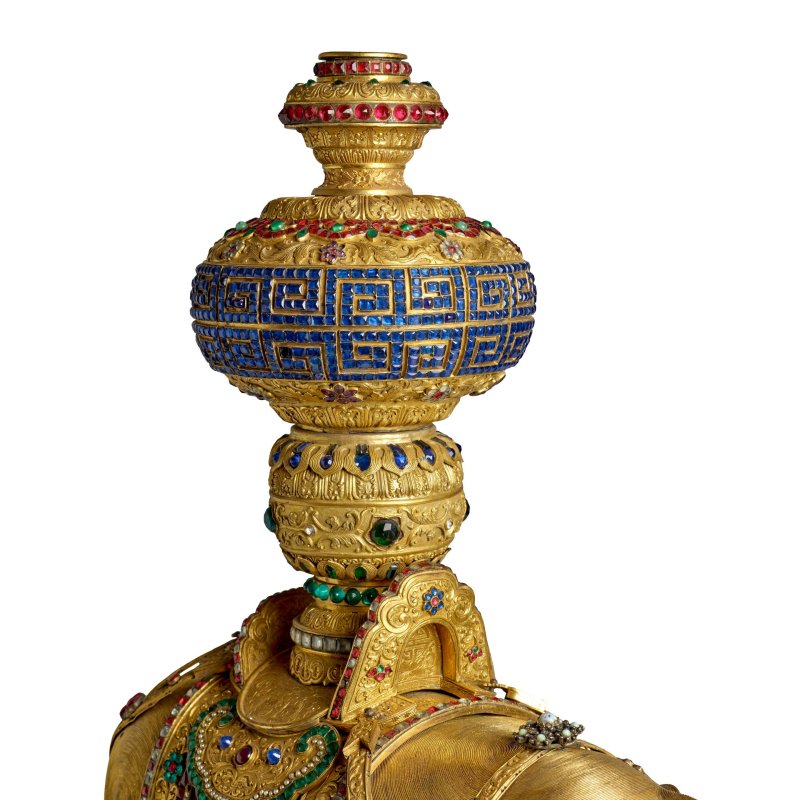
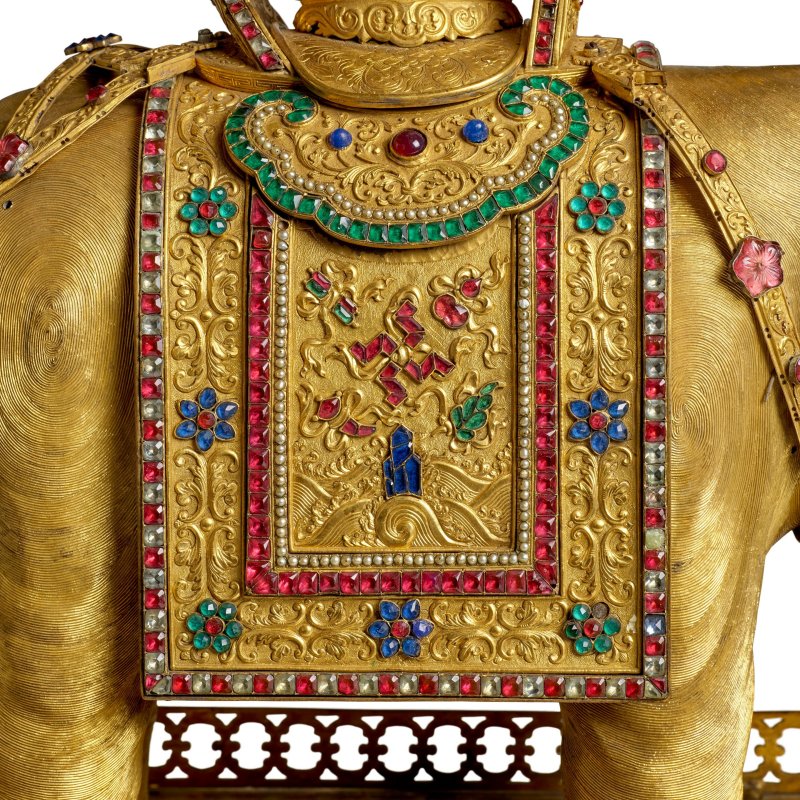
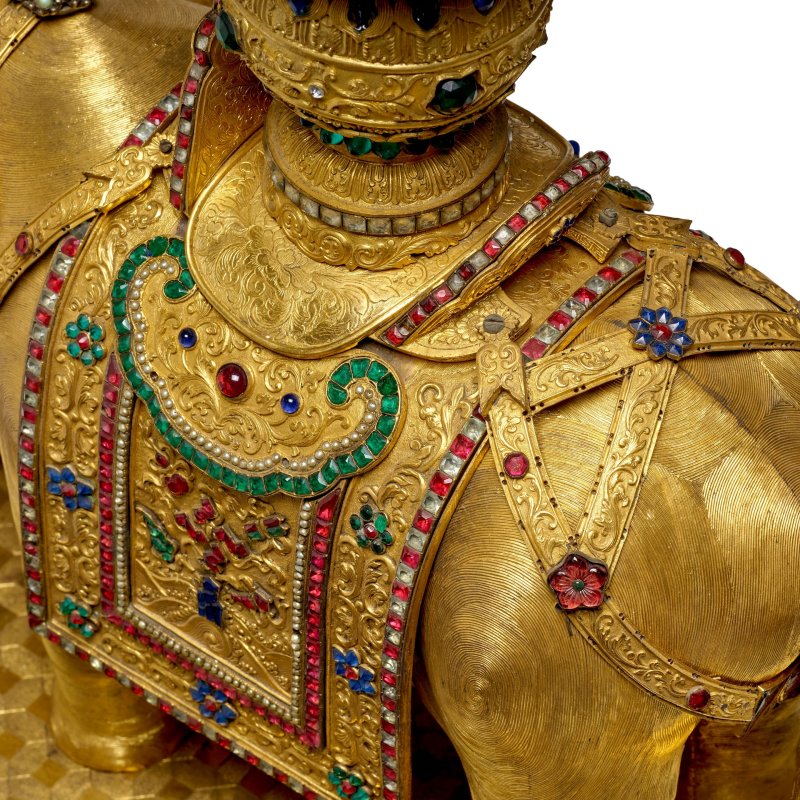
Exquisitely cast and assembled from numerous elements and lavishly inlaid throughout with brightly colored glass, the caparisoned elephant, naturalistically modelled with long tusks, almond-shaped eyes and finely veined ears, the meticulously textured hide defined by swirling wrinkles, the elaborate saddlecloth decorated with a central panel of the bajixiang above cresting waves, enclosed by borders of floral scrolls, supporting a saddle surmounted by a sumptuous multi-lobed vase, richly embellished with bands of lotus petals and a broad blue-glass-inlaid leiwen border encircling the principal lobe, all supported on a stand raised on four cabriole legs linked by an intricately pierced apron beneath a waisted plinth decorated with a band of ruyi-heads and scrolling flowering vines, surmounted by an elegant openwork balustrade.
22 3/4in (57.8cm) high overall;
14 5/8in (37.1cm) length;
5 3/8in (13.7cm) width
Footnotes
清乾隆/嘉慶 銅鎏金嵌料石太平有象托架
The present lot is a remarkable testament to the extraordinary technical accomplishments of Qing Court craftsmen. Executed with exceptional precision, it is constructed from numerous individually cast and chased gilt-bronze components, lavishly enriched with brilliantly colored glass inlay, each element demonstrating the painstaking attention to detail characteristic of the finest Imperial works of the eighteenth century. Particularly noteworthy is the superb modelling of the caparisoned elephant, whose hide is rendered with an intricate network of finely chased whorled wrinkles, imparting an extraordinary sense of texture and vitality. The present lot may have been part of a set of auspicious symbols used in religious rituals. Compare with a related set of Seven Royal Treasures, including an Elephant, 18th century, illustrated in , London, 2005, p.140.
The elephant occupies a particularly auspicious place in the visual language of the Qing Court. Long associated with strength, wisdom and stability, it was regarded as a noble beast worthy of Imperial ceremony. When paired with a vase ( 瓶), as in the present lot, it forms the rebus (太平有象), literally 'Great peace is manifested by the elephant', conveying the wish for universal peace and prosperity throughout the empire. The motif became especially popular during the Qing dynasty and appears across a wide range of Imperial decorative arts, including cloisonné enamels, jade carvings, porcelain and textiles. As with many Qing decorative motifs, the composition combines visual splendor with an auspicious message, making it particularly appropriate for objects intended to furnish the Imperial palaces. See for example, a cloisonné enamel elephant and vase on stand, Qianlong, in the Qing Court Collection (accession no. 故00201339, 故00201340).
Although elephants are today associated primarily with South and Southeast Asia, archaeological evidence indicates that they once inhabited much of China during antiquity before gradually retreating southwards as a result of climatic change and expanding human settlement; for a lengthy study on this, see M. Elvin, , 2004, New Haven. By the Ming dynasty, elephants had long ceased to exist in northern China and instead entered the Imperial Court principally as diplomatic tribute from kingdoms including Siam, Burma and other states of Southeast Asia. They were housed in the Imperial Elephant Stables (象房) situated outside Xuanwumen in Beijing, where they were carefully maintained for ceremonial occasions. Their life in the stables mirrored the ups and downs of officialdom, with well-behaved elephants increasing in rank and rations, while a badly behaved elephant might be demoted and punished with lower grade feed. Trained elephants played an important role in state processions, sacrificial rites and other court ceremonies, becoming familiar symbols of Imperial authority. See the court painting dating to the Qianlong reign, 'Ten Thousand Envoys Come to Pay Tribute' depicts an elephant carrying a vase as part of a tribute procession, illustrated by C.Ho and B.Bronson, , London, 2004, pls. 80-82.
Following the Qianlong Emperor's successful Gurkha campaigns in Nepal, two elephants were presented to the Qing Court as tribute, and were immortalized by the Jesuit court artists Louis Antoine de Poirot (1735-1814) and Giuseppe Panzi (d.1812) in a remarkably naturalistic painting, see , Hong Kong, 2022, pp. 132-133. Compared with the more stylized depictions found in earlier Chinese art, these eighteenth-century representations display a heightened attention to anatomy, proportion and texture. The extraordinarily detailed modelling of the present elephant, particularly the intricate network of whorled folds defining its hide, may reflect this broader courtly interest in direct observation of living animals, encouraged in part by the naturalistic conventions introduced by the Jesuit painters working at the Qing Court.
Some of the closest surviving parallels to the present lot are found among the celebrated elephant-form clocks in the Palace Museum, Beijing. Although differing in function, these magnificent objects share a remarkably similar compositional scheme, employing a richly caparisoned elephant as the principal structural support for an elaborate superstructure of gilt-bronze architectural elements lavishly embellished with brightly colored glass inlay. In many examples the elephant bears either a clock case or an ornamental vase, closely recalling the arrangement seen on the present lot. Their combination of sculptural naturalism, sumptuous ornament and technical virtuosity finds an especially close correspondence here. Compare, for example, the elephant clocks illustrated by Liao Pin, , Beijing, 2002, pls. 40 and 71, and Ian White, , Ticehurst, 2012, figs. 7.32 and 7.36–7. While those examples incorporate European clock movements, the present stand demonstrates that the same highly sophisticated design vocabulary was also employed in the creation of other luxurious furnishing objects for the Qing Court.
A very similar gilt-copper alloy and colored glass model of an elephant was sold at Bonhams San Francisco, 13 December 2010, lot 5154. See also a rare Imperial gilt-bronze, cloisonné and champlevé enamel ivory-inlaid 'elephant and vase Guanyin and Skanda' emblem, Qianlong, which was sold at Bonhams Hong Kong, 1 December 2020, lot 141.
Exquisitely cast and assembled from numerous elements and lavishly inlaid throughout with brightly colored glass, the caparisoned elephant, naturalistically modelled with long tusks, almond-shaped eyes and finely veined ears, the meticulously textured hide defined by swirling wrinkles, the elaborate saddlecloth decorated with a central panel of the bajixiang above cresting waves, enclosed by borders of floral scrolls, supporting a saddle surmounted by a sumptuous multi-lobed vase, richly embellished with bands of lotus petals and a broad blue-glass-inlaid leiwen border encircling the principal lobe, all supported on a stand raised on four cabriole legs linked by an intricately pierced apron beneath a waisted plinth decorated with a band of ruyi-heads and scrolling flowering vines, surmounted by an elegant openwork balustrade.
22 3/4in (57.8cm) high overall;
14 5/8in (37.1cm) length;
5 3/8in (13.7cm) width
Footnotes
清乾隆/嘉慶 銅鎏金嵌料石太平有象托架
The present lot is a remarkable testament to the extraordinary technical accomplishments of Qing Court craftsmen. Executed with exceptional precision, it is constructed from numerous individually cast and chased gilt-bronze components, lavishly enriched with brilliantly colored glass inlay, each element demonstrating the painstaking attention to detail characteristic of the finest Imperial works of the eighteenth century. Particularly noteworthy is the superb modelling of the caparisoned elephant, whose hide is rendered with an intricate network of finely chased whorled wrinkles, imparting an extraordinary sense of texture and vitality. The present lot may have been part of a set of auspicious symbols used in religious rituals. Compare with a related set of Seven Royal Treasures, including an Elephant, 18th century, illustrated in , London, 2005, p.140.
The elephant occupies a particularly auspicious place in the visual language of the Qing Court. Long associated with strength, wisdom and stability, it was regarded as a noble beast worthy of Imperial ceremony. When paired with a vase ( 瓶), as in the present lot, it forms the rebus (太平有象), literally 'Great peace is manifested by the elephant', conveying the wish for universal peace and prosperity throughout the empire. The motif became especially popular during the Qing dynasty and appears across a wide range of Imperial decorative arts, including cloisonné enamels, jade carvings, porcelain and textiles. As with many Qing decorative motifs, the composition combines visual splendor with an auspicious message, making it particularly appropriate for objects intended to furnish the Imperial palaces. See for example, a cloisonné enamel elephant and vase on stand, Qianlong, in the Qing Court Collection (accession no. 故00201339, 故00201340).
Although elephants are today associated primarily with South and Southeast Asia, archaeological evidence indicates that they once inhabited much of China during antiquity before gradually retreating southwards as a result of climatic change and expanding human settlement; for a lengthy study on this, see M. Elvin, , 2004, New Haven. By the Ming dynasty, elephants had long ceased to exist in northern China and instead entered the Imperial Court principally as diplomatic tribute from kingdoms including Siam, Burma and other states of Southeast Asia. They were housed in the Imperial Elephant Stables (象房) situated outside Xuanwumen in Beijing, where they were carefully maintained for ceremonial occasions. Their life in the stables mirrored the ups and downs of officialdom, with well-behaved elephants increasing in rank and rations, while a badly behaved elephant might be demoted and punished with lower grade feed. Trained elephants played an important role in state processions, sacrificial rites and other court ceremonies, becoming familiar symbols of Imperial authority. See the court painting dating to the Qianlong reign, 'Ten Thousand Envoys Come to Pay Tribute' depicts an elephant carrying a vase as part of a tribute procession, illustrated by C.Ho and B.Bronson, , London, 2004, pls. 80-82.
Following the Qianlong Emperor's successful Gurkha campaigns in Nepal, two elephants were presented to the Qing Court as tribute, and were immortalized by the Jesuit court artists Louis Antoine de Poirot (1735-1814) and Giuseppe Panzi (d.1812) in a remarkably naturalistic painting, see , Hong Kong, 2022, pp. 132-133. Compared with the more stylized depictions found in earlier Chinese art, these eighteenth-century representations display a heightened attention to anatomy, proportion and texture. The extraordinarily detailed modelling of the present elephant, particularly the intricate network of whorled folds defining its hide, may reflect this broader courtly interest in direct observation of living animals, encouraged in part by the naturalistic conventions introduced by the Jesuit painters working at the Qing Court.
Some of the closest surviving parallels to the present lot are found among the celebrated elephant-form clocks in the Palace Museum, Beijing. Although differing in function, these magnificent objects share a remarkably similar compositional scheme, employing a richly caparisoned elephant as the principal structural support for an elaborate superstructure of gilt-bronze architectural elements lavishly embellished with brightly colored glass inlay. In many examples the elephant bears either a clock case or an ornamental vase, closely recalling the arrangement seen on the present lot. Their combination of sculptural naturalism, sumptuous ornament and technical virtuosity finds an especially close correspondence here. Compare, for example, the elephant clocks illustrated by Liao Pin, , Beijing, 2002, pls. 40 and 71, and Ian White, , Ticehurst, 2012, figs. 7.32 and 7.36–7. While those examples incorporate European clock movements, the present stand demonstrates that the same highly sophisticated design vocabulary was also employed in the creation of other luxurious furnishing objects for the Qing Court.
A very similar gilt-copper alloy and colored glass model of an elephant was sold at Bonhams San Francisco, 13 December 2010, lot 5154. See also a rare Imperial gilt-bronze, cloisonné and champlevé enamel ivory-inlaid 'elephant and vase Guanyin and Skanda' emblem, Qianlong, which was sold at Bonhams Hong Kong, 1 December 2020, lot 141.