
Lot 8012 The Duanfang jade cong, Neolithic period, Liangzhu culture | 新石器時代 良渚文化 神人紋玉琮
落槌价
预展中
成交价
预展中
| 拍卖公司 | 苏富比 |
|---|---|
| 拍卖时间 | 2026年10月30日 |
拍品信息
拍品名称
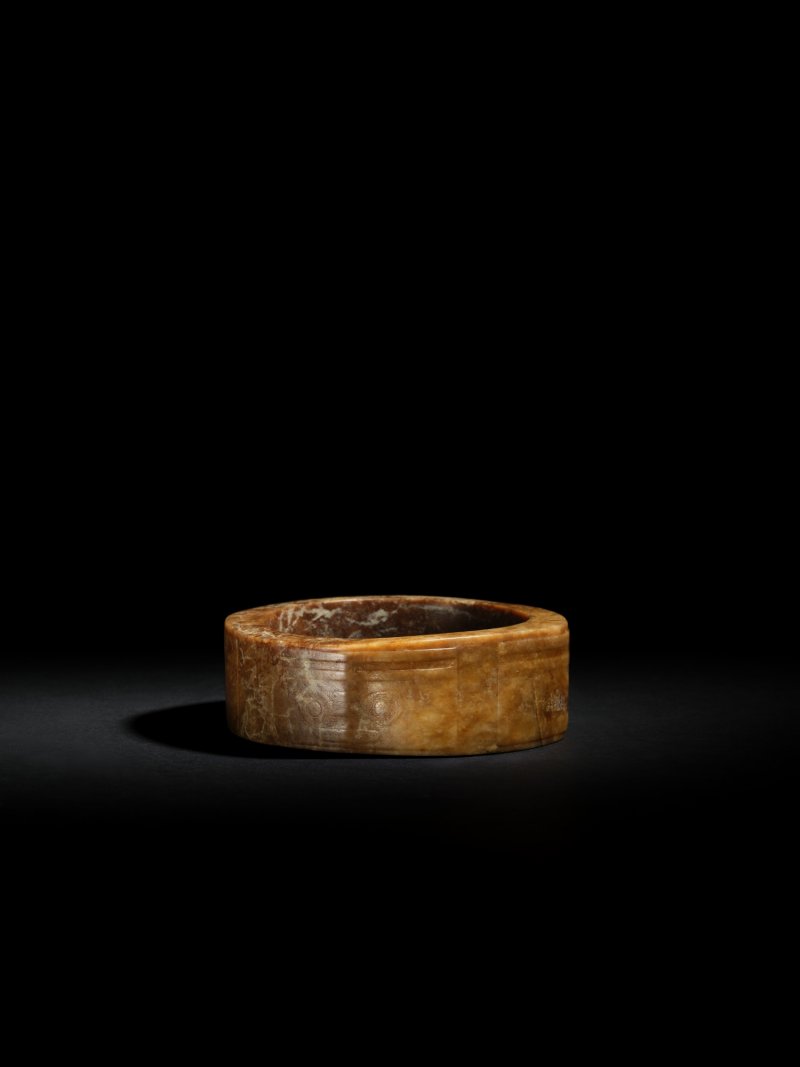
The Duanfang jade cong, Neolithic period, Liangzhu culture | 新石器時代 良渚文化 神人紋玉琮
起拍价
HKD 10,000,000
估值区间
10,000,000 - 20,000,000 HKD
尺寸
未知
品相
如欲了解本拍品狀況的更多資訊,請聯絡 Rubie.Fong@sothebys.com
更多信息
10 cm
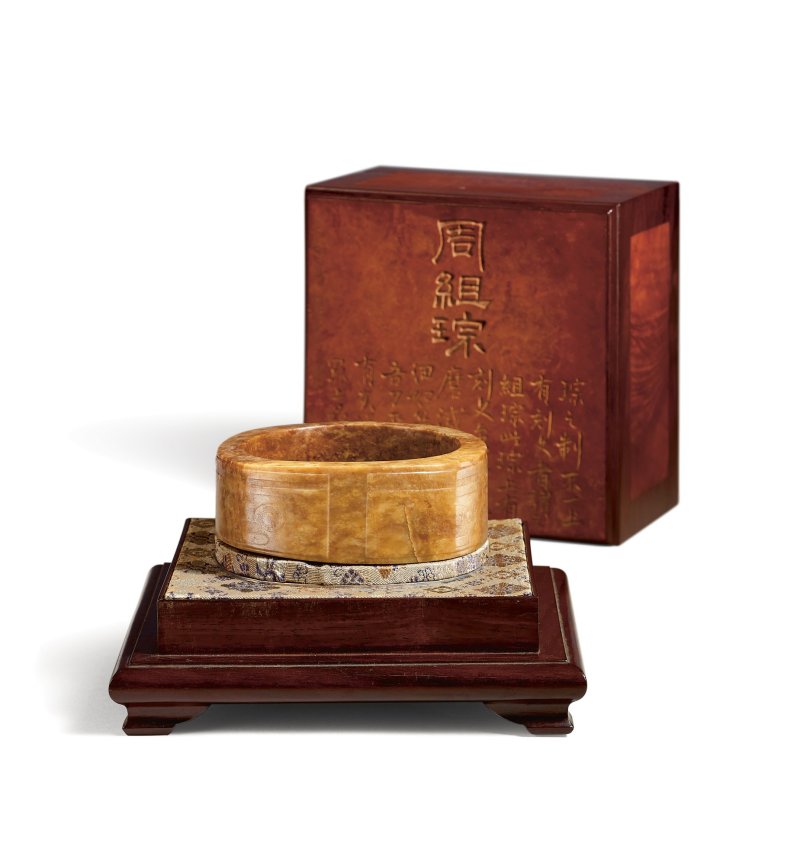
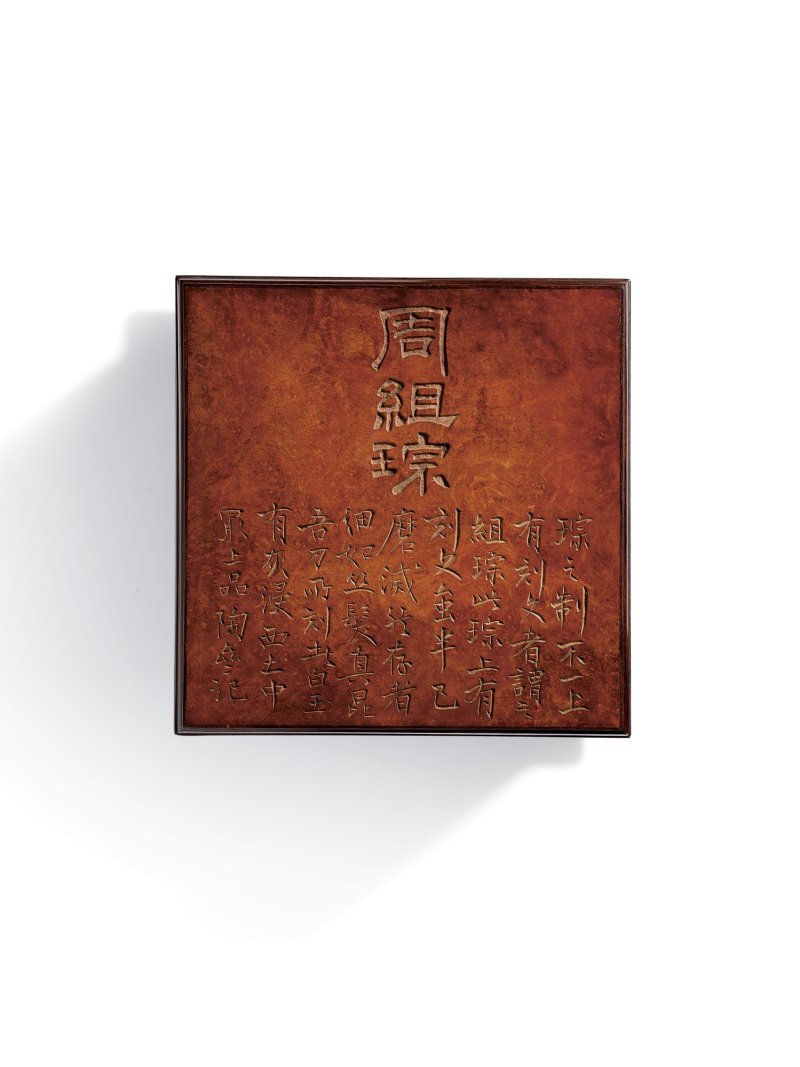
盒蓋題識:
周組琮。
琮之制不一,上有刻文者謂之組琮。
此琮上有刻文,雖半已磨滅,能存者細如絲髮,
真昆吾刀所刻,此白玉有灰浸,西土中最上品。
陶齋記。
Inscription on the wooden box:
Zhou zucong. There are different types of cong, and those that are incised with patterns are called zucong. Although half of the pattern on this cong has been worn off, [it can still be observed that] each line of the remaining decoration is as fine as a single hair, implying that it was incised with a kunwu knife. This white jade, slightly discoloured and tinged with grey, is considered the best type in the Western lands. Recorded by Taozhai.
来源:Collection of Duanfang (1861-1911).
Sotheby's Hong Kong, 1st April 2019, lot 3020.
展览:Kodai Shina bijutsu tenkan [Exhibition of ancient Chinese art], Yamanaka, Osaka, 1923, cat. no. 29, exhibited as part of a group of Zhou jades from the collection of Duanfang.
著录:Seigai Ōmura ed., Shina kobijutsu zufu [Illustrations of ancient Chinese art], vol. 1, Tokyo, 1932, no. 95.
图录
说明:來源
晚清直隸總督端方(1861–1911年)舊藏
香港蘇富比2019年4月1日,編號3020
展覽
《古代中國美術展觀》,山中商會,大阪,1923年,編號29,列為端方珍藏周朝玉器
出版
大村西崖編,《中國古美術圖譜》,上冊,東京,1932年,編號95
The Duanfang cong
Regina Krahl
The creation of artefacts such as this jade at prehistoric times, when writing was not yet established and metal was not yet utilized, may be seen as one of the wonders of mankind. The advanced jade masterpieces Neolithic craftsmen fashioned with their primitive tools can hardly be admired enough. While the term Stone Age in most regions simply designates an age where tools and weapons were fashioned from stone, in China it has a very special meaning, since the stones in question included this particularly hard and beautiful material, jade, that is extremely laborious to work, but can be turned into veritable gems. It was undoubtedly not only its attractive colouration and sheen that contributed to the high esteem and value of jade items, but also the fact that they were most difficult to manufacture, and thus hard to come by and prestigious to own.
China’s most important Neolithic jade cultures are Hongshan in the Liaoning region and Liangzhu in the region around Jiangsu and Zhejiang. The Liangzhu culture, which is named after a village near Hangzhou in Zhejiang, flourished from the late 4th to the end of the 3rd millennium BC and has brought about a large variety of jade forms, foremost among them bi (discs) and cong. Cong remain among the most enigmatic objects of early Chinese cultures. Generally shaped as cylinders that are round on the inside and square on the outside, they can vary enormously in height and diameter, ranging from wide, shallow bracelets to tall, narrow tubes. Lianzhu cong are distinguished by finely engraved anthropomorphic or zoomorphic faces with highly stylized but distinctive features.
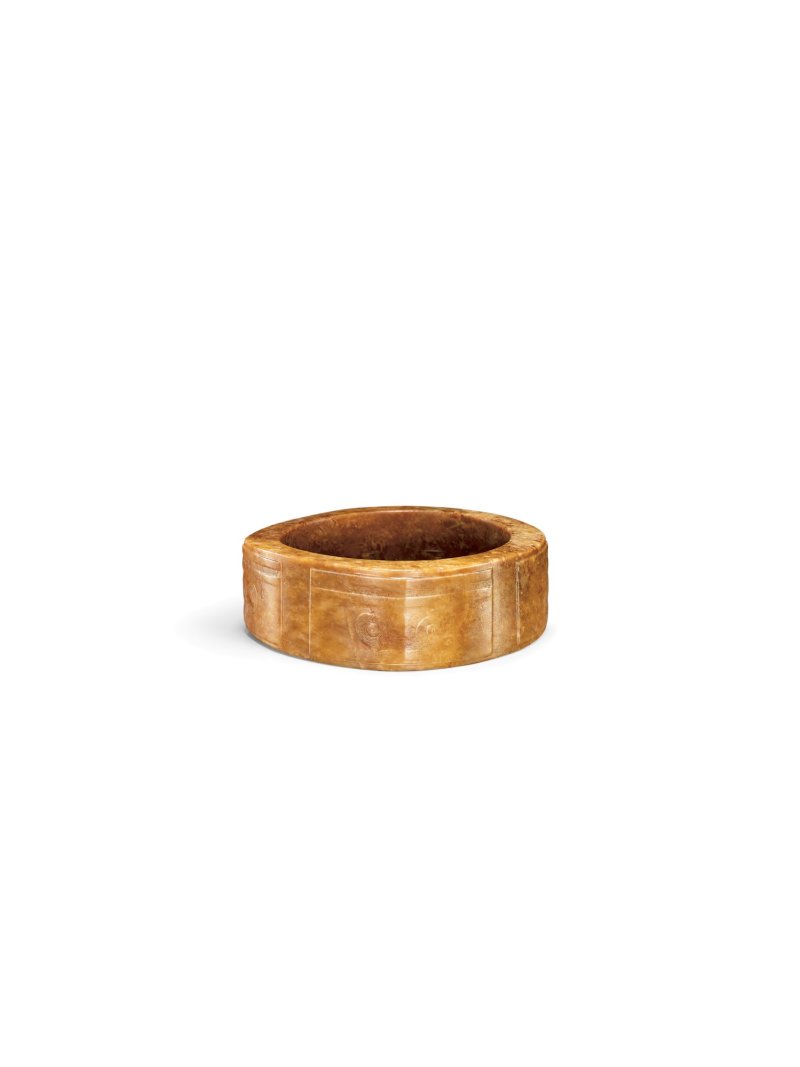
Bracelet-shaped cong like the present piece, also known as zhuo, appeared among the earliest Liangzhu jades and were apparently worn by both sexes. Their round shape, intersected in four places by prominent raised masks, often approaches a square section on the outside, and cannot be separated from the more sharply angled, square cong, as intermediaries exist of all shapes and sizes. Tubular examples, which mostly are too narrow to be worn, appeared somewhat later than zhuo-shaped cong and are considered to have developed from the bracelet shape. The present piece, with the outer sides angled to form a rounded square, with a recessed vertical band in the centre of each side, dividing masks that are straddling the four corners, illustrates this development, which appears to have taken place in the middle Liangzhu period.
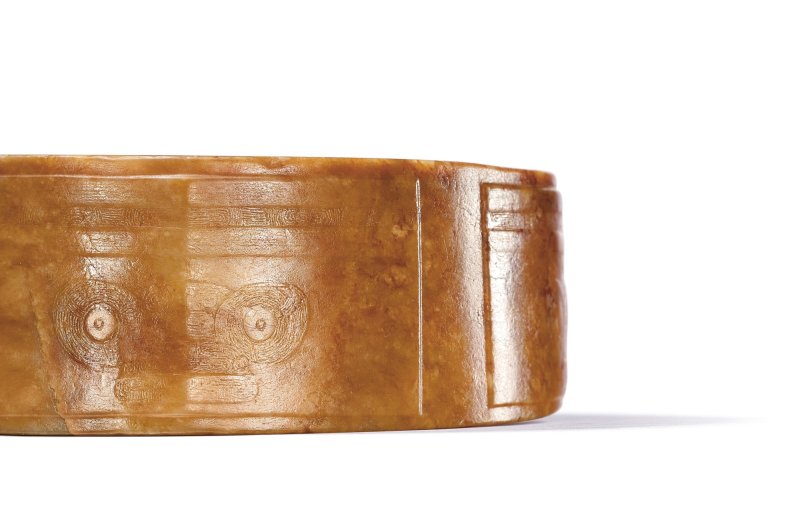
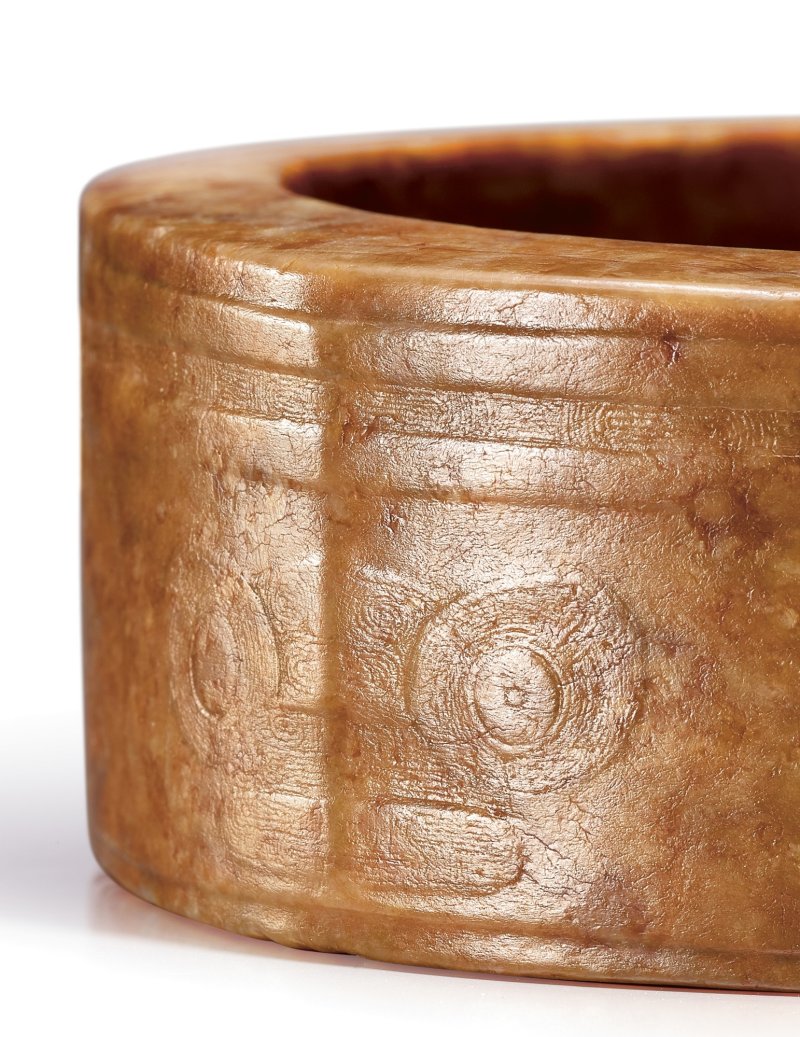
The faces on this piece are carved with the characteristic Liangzhu features of two prominent eyes, widening towards the temples and enclosing circular pupils, a narrow horizontal bar indicating the mouth, and two horizontal bands across the top, suggesting the forehead or hairline. Remarkable here are the extremely finely incised scroll bands also marvelled at by Duanfang in his inscription on the box of the piece, which are made up of hair-fine parallel lines. Sun Zhixin, ‘A Chronology of the Decoration of Liangzhu Jades’, in Rosemary E. Scott, ed., Chinese Jades. Colloquies on Art & Archaeology in Asia, no. 18, Percival David Foundation of Chinese Art, London, 1997, states, p. 53, that scrolls were being introduced around 2800 BC, around the beginning of the middle Liangzhu phase, although related monster faces probably date from slightly later in this period, around 2600-2400 BC.
With no obvious usage explaining their shape and no clearly understandable meaning legible in their decoration, Liangzhu cong have provided fertile grounds for interpretation (K.C. Chang, ‘An Essay on Cong’, and Jean M. James, ‘Images of Power: Masks of the Liangzhu Culture’, in Chinese Jade. Selected Articles from Orientations 1983-2003, Hong Kong, 2005, pp. 70-76 and 101-110). Given their common appearence in Liangzhu burials, their extremely complex and time-consuming workmanship, and their mysterious form and ornamentation, it is likely that they served some important ritual or ceremonial purpose among the elites of this early society, but any more specific interpretation has to await further archaeological or historical studies. As simple works of art handed down to us from a society that flourished over four millennia ago, the present jade and its companion pieces fascinate by their imaginative concept, distinctive style and superb control of the medium.
Although Liangzhu cong are unmistakeable, being composed of a number of recurring elements, individual examples nevertheless vary greatly. Zhuo-shaped cong are particularly rare and it is difficult to find close counterparts to the present piece. A smaller, but otherwise quite similar carving was included in the exhibition Jing tian ge wu. Zhongguo lidai yuqi daodu/Art in Quest of Heaven and Truth. Chinese Jades through the Ages, Palace Museum, Taipei, 2011, pl. 4-4-9. A large range of examples in many different shapes and sizes, but none very close to the present piece, is illustrated in Liangzhu wenhua yuqi [Jades from the Liangzhu Culture], n.p., 1989, pls 6-58; and in Jessica Rawson, Chinese Jade: From the Neolithic to the Qing, London, 1995, p. 34 and pp. 124-129.
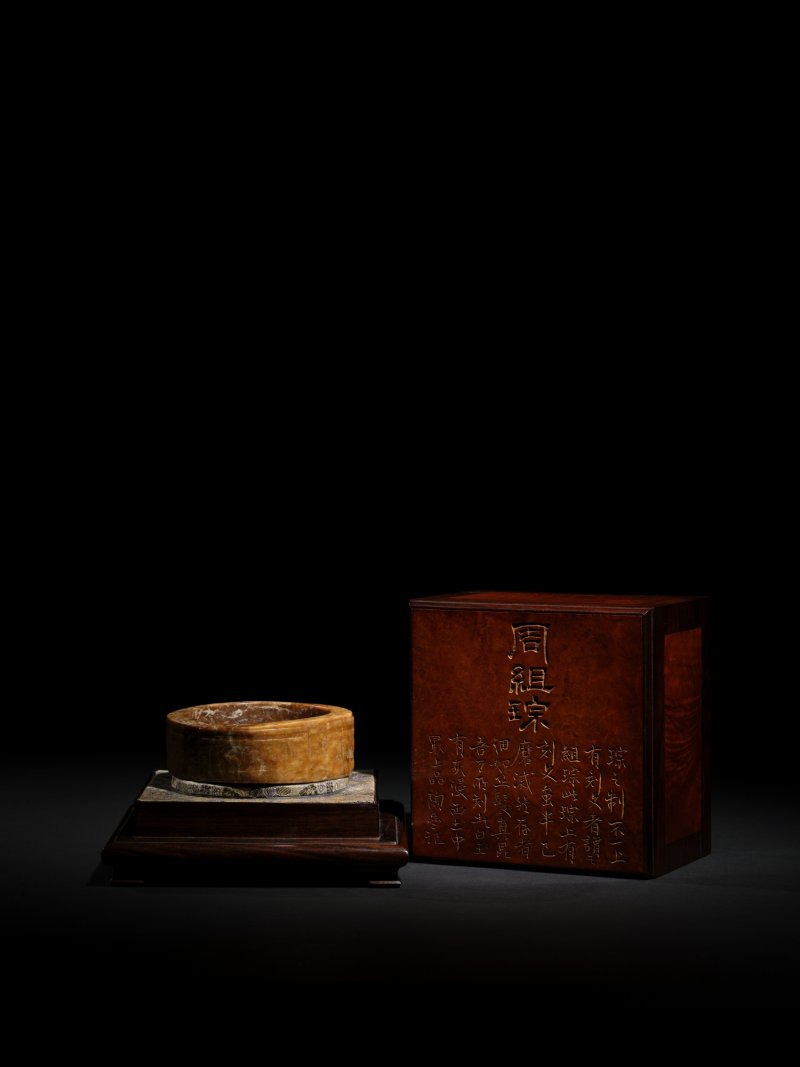
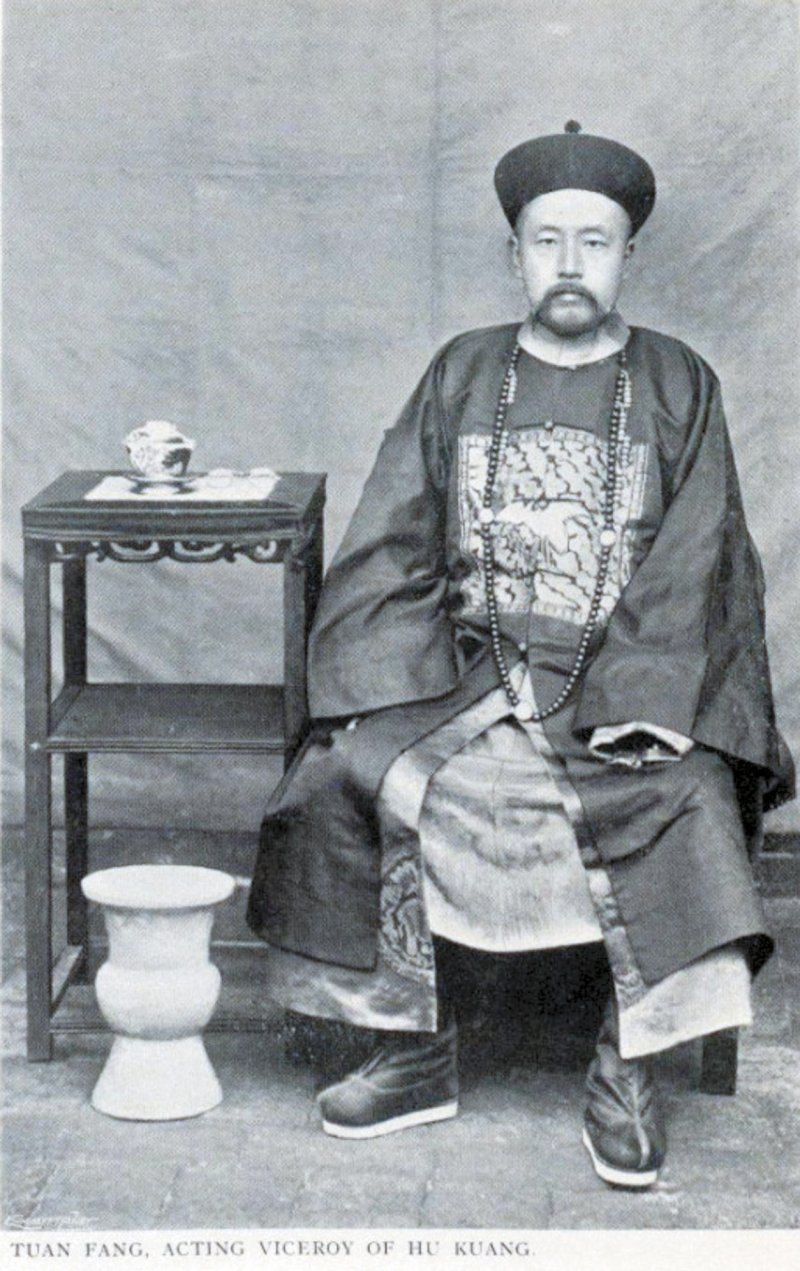
The present cong formed part of the fabled collection of Duanfang (1861-1911), one of the most famous Qing dynasty collectors and connoisseurs of ancient Chinese artefacts (fig. 1). It comes in a wooden box with an inscription signed Taozhai, a sobriquet used by Duanfang. In the West, Duanfang is probably best known as the former owner of the unique Western Zhou bronze altar set in the Metropolitan Museum of Art, New York (Zhixin Jason Sun, ‘A Legend Retold: The Duanfang Bronzes’ Journey to the Metropolitan Museum of Art’, Mirroring China’s Past. Emperors, Scholars, and Their Bronzes, The Art Institute of Chicago, 2018, pp. 198-203). A Han Chinese official and member of the Manchu Plain White Banner, Duanfang served the Qing government in many different posts and places and was renowned as a far-sighted and influential politician. He travelled widely, visiting the United States and many countries of Western Europe, to study Western constitutions, educational systems and museums with the aim of modernizing China’s institutions. (The ‘Western lands’ mentioned in the inscription of the present piece’s box may, however, not stand in direct relation to this.) His collection of ancient bronzes, jades, paintings, calligraphies and other works was largely sold by his family in the decades following his death and the demise of the Qing dynasty.
端方舊藏良渚玉琮
康蕊君
史前時代,尚無文字亦無金屬器具,何以琢玉似此,實為難解之謎。新石器時代匠人,簡就原始工具,竟能巧奪天工,雕琢如此精湛玉器,廣得後世仰慕。石器時代文化,通以石材作工具、武器,然中國的石器時代文化獨特之處,在於所用石材已包含玉石,其質地堅硬,雖艱澀費琢,所得成品通透輝耀,色澤華美,製作過程艱辛不易,更顯珍貴非凡。
中國最負盛名的新石器文化要屬遼寧之紅山文化,與江蘇、浙江一代的良渚文化。良渚遺址近浙江杭州, 鼎盛期約公元前三千多年至二千年間,遺址出土大量玉器,以璧、琮為多,琮乃最具代表性之中國高古玉器,多為柱形,內圓外方,高度、尺寸變化甚鉅,可見寬、淺似臂釧者,亦有高、窄如管例,良渚玉琮常綴抽象類獸面紋於側,乃其最大特色之一。
此件玉琮,形似臂釧,又稱「鐲」,男女皆見配戴,屬良渚早期玉器。此類玉琮造形圓潤,外壁琢四組陽刻獸面紋,獸面中線起棱,象徵四角,與方正直角之玉琮相異。高窄如管形的玉琮,不適合佩戴,年代多晚於鐲形玉琮,其造形應由鐲形發展而來。本品外壁承圓弧四角形,四面中段凹陷,分隔四長方形獸面紋,應屬良渚中期之作。
此琮之獸面紋,雙目圓睜,眼角上揚,乃良渚經典,細扁方形為口,上端二段水平邊線或為前額,或髮際,邊線綴淺陰刻紋飾,宛若髮絲,精細至極,端方亦於玉琮木盒刻銘頌讚如此鬼斧神工。孫志新於專文,〈A Chronology of the Decoration of Liangzhu Jades〉,蘇玫瑰編,《Chinese Jades. Colloquies on Art & Archaeology in Asia》,18號,大維德中國藝術基金會,倫敦,1997年,頁53,述此類紋飾始見於約公元前2800年,良渚文化中期初始,相類獸面紋則年代或稍晚,約公元前2600至2400年。
玉琮之用途、紋飾意義均未明,多位學者曾提出假說(張光直,〈An Essay on Cong〉,及 Jean M. James,〈Images of Power: Masks of the Liangzhu Culture〉,《Chinese Jade. Selected Articles from Orientations 1983-2003》,香港,2005年,頁70-76、101-110)。考慮其普遍用於良渚墓葬,製作精美費時,且造形紋飾獨特神秘,應屬早期社會中,權貴階級特有的重要祭祀禮器,然而仍待進一步考古研究提供更為精確之解答。逾四千多載,遞傳至今,良渚玉琮之精美工藝、獨特風格,依舊深切觸動人心,激發無窮想像。
良渚玉琮特色鮮明,各例之間差別甚廣,鐲形玉琮數量鮮少,存世與本品相類者幾無。參考一件尺寸較小,紋飾與本器相似玉琮,展出於《敬天格物:中國歷代玉器導讀》,故宮博物院,台北,2011年,圖版4-4-9。其他玉琮雖形狀、尺寸各異,卻無近似本品者,參考《良渚文化玉器》,1989年,圖版6-58,及羅森,《Chinese Jade: From the Neolithic to the Qing》,倫敦,1995年,頁34、124-129。
此件玉琮曾為晚清盛名金石鑑藏家端方(1861-1911年,圖一)所藏,玉琮木盒銘文落款「陶齋」,為端氏號。於西方,端氏收藏最廣為人知者,要屬紐約大都會藝術博物館藏西周青銅柉禁器組(孫志新,〈A Legend Retold: The Duanfang Bronzes’ Journey to the Metropolitan Museum of Art〉,《Mirroring China’s Past. Emperors, Scholars, and Their Bronzes》,芝加哥藝術學院,芝加哥,2018年,頁198-203)。端氏出身滿洲正白旗,曾出任多項朝廷要職,富遠見且甚具影響力,曾出訪美國及西歐多國,考查各國體制、教育機構、博物館等,以求推動清國現代化(此木盒銘文述「西土」,或與此無直接關聯)。滿清覆亡後,端氏遭軍變而歿,其珍藏多數高古青銅器、玉器、書畫遂由其族人變賣流散。
常见问题
这件The Duanfang jade cong, Neolithic period, Liangzhu culture | 新石器時代 良渚文化 神人紋玉琮的成交价是多少?
落槌价为 预展中。 成交价为 预展中。
拍品的品相状况如何?
如欲了解本拍品狀況的更多資訊,請聯絡 Rubie.Fong@sothebys.com
这件拍品的流传来源是什么?
Collection of Duanfang (1861-1911).
Sotheby's Hong Kong, 1st April 2019, lot 3020.
Sotheby's Hong Kong, 1st April 2019, lot 3020.
这件拍品曾在哪些展览中展出过?
Kodai Shina bijutsu tenkan [Exhibition of ancient Chinese art], Yamanaka, Osaka, 1923, cat. no. 29, exhibited as part of a group of Zhou jades from the collection of Duanfang.
这件拍品被哪些著录书籍记载?
Seigai Ōmura ed., Shina kobijutsu zufu [Illustrations of ancient Chinese art], vol. 1, Tokyo, 1932, no. 95.
图录
图录