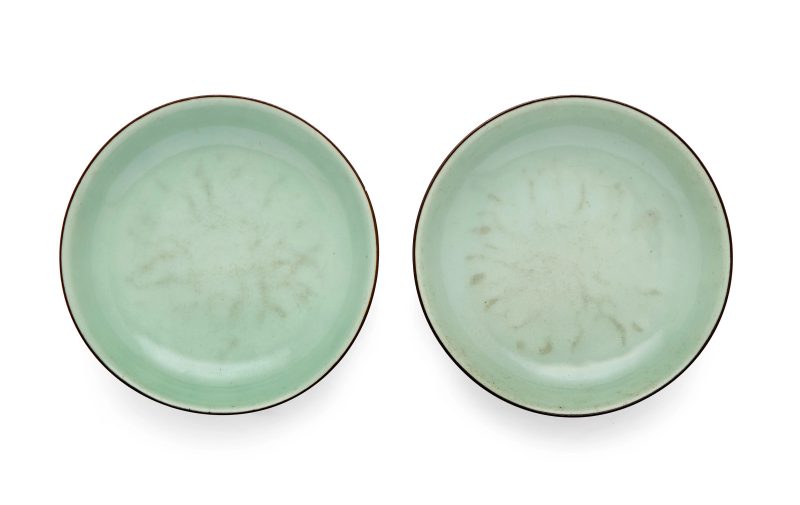

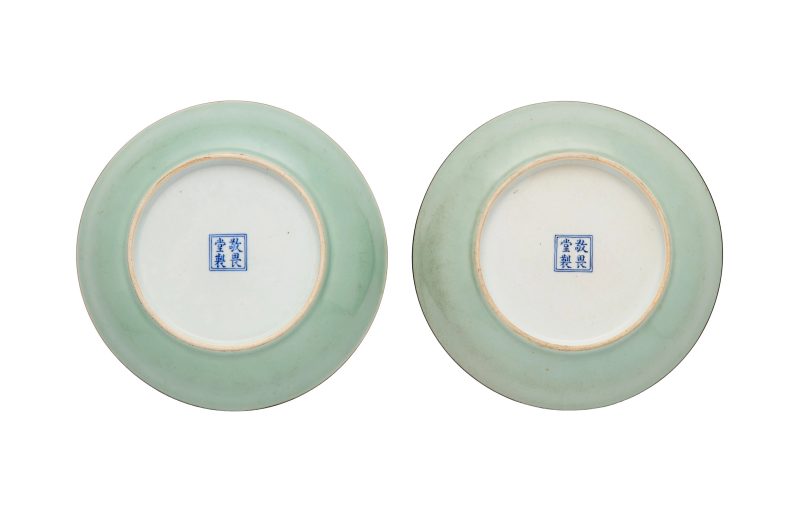
Lot 467 清乾隆 青釉醬口盤一對 「敬畏堂製」款 | A pair of Chinese celadon glazed dishes
落槌价
****
成交价
****
拍品信息
拍品名称
清乾隆 青釉醬口盤一對 「敬畏堂製」款 | A pair of Chinese celadon glazed dishes
年代
Qing dynasty, Qianlong period
起拍价
GBP 5,500
估值区间
Estimate: £8,000 - £12,000
尺寸
16.3cm diameter
品相
Some surface wear to the interior and a couple of minuscule nibbles to the edges of rims, otherwise good.
更多信息
A pair of Chinese celadon glazed dishes
Qing dynasty, Qianlong period
Each covered in a pale sea-green glaze to the exterior and with a brown-glazed rim, the base left white and inscribed in underglaze blue with a four-character mark reading Jingweitang zhi ('Made for the Hall of Veneration of Respect') within a double square, 16.3cm diameter (2).
清乾隆 青釉醬口盤一對 「敬畏堂製」款
The Kaogong ji (Record of the Artificers), in the Dongguan section of the Zhouli (Rites of Zhou), states: “The East is qing; the South, red; the West, white; the North, black; Heaven, xuan; and Earth, yellow.” Liu Xi of the Eastern Han writes in the Shiming: “Qing means ‘growth’; it resembles the colour of things as they come into being.” Huang Kan of the Liang dynasty, in his Lunyu Yishu (Elucidation of the Meaning of the Analects), distinguishes the orthodox from the intermediary colours, naming qing, red, white, black and yellow as the five orthodox colours. As the sun rises in the East, qing came to evoke the first light of morning. The East is also associated with spring, the season of new growth and returning life; qing thus came to embody vitality and renewal.
Celadon glaze (qingyou) is coloured by a small amount of iron oxide, with calcium oxide as the principal flux. At high temperature it first fires yellowish in an oxidising atmosphere, then develops its characteristic blue-green tone under reducing conditions.
Celadon is one of the major monochrome glaze traditions of Chinese ceramics. Originating in southern China, it can be traced to the mid-Shang period. From the Six Dynasties through the Song, it remained a defining glaze of Chinese ceramics; by the Southern Song, Longquan celadon had reached a high level of technical refinement. From the Yuan and Ming onward, blue-and-white, underglaze copper-red and overglaze enamels broadened the decorative repertoire, while celadon declined somewhat. It revived under the Qing. Interest returned in the Kangxi reign, and under Yongzheng the imperial kilns at Jingdezhen achieved exceptional control of celadon firing. Without modern chemical analysis or instrumental temperature control, potters relied on accumulated experience to regulate iron content and kiln atmosphere, producing more stable and even glaze colours.
Under Qianlong, these techniques were further refined, producing celadon glazes of greater subtlety and elegance. The main tones include fenqing (soft green), dongqing (winter green) and douqing (bean green). Though not rigid categories, they generally share a smooth, lustrous surface, dense body and even, pure tone. Jingweitang marked celadons are especially admired for their restrained colour and soft lustre. Chen Liu (Jiyuan Sou) writes in Taoya (Ceramic Elegances), vol. I, section 32: “The vessels made for Jingweitang are all douqing; compared with Xiezhu polychrome wares, they are more elegant and refined.”
The late-Qing writer Xu Zhiheng writes in Yinliuzhai shuoci: “The Kangxi and Qianlong emperors both favoured Neo-Confucian learning, and many hall names therefore drew on its language … Princes and imperial nobles followed suit, making it a fashion of the age. ‘Zhuocun Zhai’ and ‘Shaowen Tang’ date to the Kangxi reign; ‘Jingwei Tang’ and ‘Zhengyi Shuwu’ to the Qianlong reign … Most such wares were made for princes and imperial nobles.”
In Rare Marks on Chinese Ceramics, published by the Victoria and Albert Museum in 1998, Ming Wilson cites Wang Qingzheng’s suggestion that Jingweitang-marked porcelains may once have belonged to the high-ranking Manchu official Agedunbu.
Cf. A comparable celadon-glazed dish is in the Sir Percival David Collection at the British Museum, registration no. PDF,A.568. Another is held by the Zhejiang Provincial Museum, inventory no. 22760.
《周禮·冬官考工記》畫繢之事载:「東方謂之青,南方謂之赤,西方謂之白,北方謂之黑,天謂之玄,地謂之黃。」 東漢經學家劉熙於《釋名》中云:「青,生也,象萬物初生之色也。」南梁皇侃於《論語義疏》中,依次明定正色、間色之說,以為「青、赤、白、黑、黃」者,乃五色之正色也。日出於東,故青象徵朝陽之始;又當春令,萬物萌發,草木滋榮,乃生機勃勃、新命肇始之徵。
青釉,以微量氧化鐵為發色之劑,以氧化鈣為主要助熔之材,經高溫而於氧化焰中燔之,其色初呈黃;復以還原之焰煅燒,遂化而為青。
青釉為中國陶瓷傳統色釉之一,肇始於南方,約見於商代中期。自六朝以降,歷宋近千年之久,青釉始終為陶瓷燒造中極具代表性之釉色。至南宋,龍泉窯青釉工藝日臻成熟,可謂其發展之盛期。元、明以後,青花、釉裏紅及諸般釉上彩繪技藝漸次興盛,陶瓷裝飾日益多元,青釉燒製亦隨之稍見式微。入清以後,青釉復漸興起。康熙朝時已有所振興,至雍正一朝,景德鎮御窯廠匠師對青釉燒造之法日益純熟,雖當時尚無化學分析、科學配比與儀器控溫技術,然憑藉歷久積累之經驗,對釉料中氧化鐵之含量及燒成時窯內氣氛皆能細加掌握,使青釉發色趨於穩定,釉色亦較為均一。
乾隆時期承襲前朝工藝,並有所精進,釉色較前更為雅緻。其青釉大致可分為粉青、冬青與豆青諸色,彼此之間雖無絕對分明之界限,然多具有釉面細潤、質地堅緻、色調均勻而純淨等特徵。其中,敬畏堂所製青釉器,以釉色清雅含蓄、質地溫潤見長,素以雅致秀逸著稱。清末學者陳浏(號寂園叟)於《陶雅·上卷·三十二》中記載:「敬畏堂所製器皿,俱係豆青。以視薢竹彩瓷,較為雅飭。」
清末許之衡《飲流齋說瓷》曰:「有清仁廟、純廟兩代君主好講理學,故所命堂名多理學語……由是親貴諸王亦趨重理學,遂成一時風氣。如『拙存齋』『紹聞堂』,在康熙朝;『敬畏堂』『正誼書屋』,在乾隆間……大抵多屬親貴諸王之製品。」
Ming Wilson 在倫敦維多利亞與阿爾伯特博物館(Victoria and Albert Museum)1998年出版的展覽圖錄《Rare Marks on Chinese Ceramics》中,引用 汪慶正的觀點,指「敬畏堂」堂號應屬滿族高官阿格敦布之物。
參閲:一件相似青釉盤請見大英博物館(The British Museum)戴維德爵士基金會(The Percival David Foundation of Chinese Art)所藏,館藏編號PDF, A.568。另一件可參見浙江省博物館收藏,館藏編號22760。
以下内容由AI翻译:
【名称】
清乾隆 青釉醬口盤一對 「敬畏堂製」款
【年代】
清乾隆
【描述】
每件外部覆盖淡海绿色釉,边缘为酱色釉,底部留白,并以青花书写四字款“敬畏堂製”于双重方框内,直径16.3厘米(一对)。
【品相】
内部有一些表面磨损,边缘有几处极小的磕碰,其他状况良好。
常见问题
拍品的品相状况如何?
Some surface wear to the interior and a couple of minuscule nibbles to the edges of rims, otherwise good.
拍品的尺寸是多少?
16.3cm diameter