
Lot 38 漢代 青銅人物神獸紋樽及承盤 | TRÈS RARE RÉCIPIENT COUVERT ZUN ET SON PLATEAU CHENGPAN EN BRONZE
落槌价
预展中
成交价
预展中
| 拍卖公司 | 邦瀚斯 |
|---|---|
| 拍卖时间 | 2026年12月10日 |
拍品信息
拍品名称
漢代 青銅人物神獸紋樽及承盤 | TRÈS RARE RÉCIPIENT COUVERT ZUN ET SON PLATEAU CHENGPAN EN BRONZE
年代
漢代
起拍价
未知
估值区间
EUR 40,000–60,000
尺寸
The censer and cover: 33 cm overall high; the stand: 40 cm diam.
品相
未知
更多信息
TRÈS RARE RÉCIPIENT COUVERT ZUN ET SON PLATEAU CHENGPAN EN BRONZE
Dynastie Han (206 av. J.-C. - 220 ap. J.-C.)
A VERY RARE BRONZE WINE VESSEL AND COVER, ZUN AND STAND, CHENGPAN
Han Dynasty
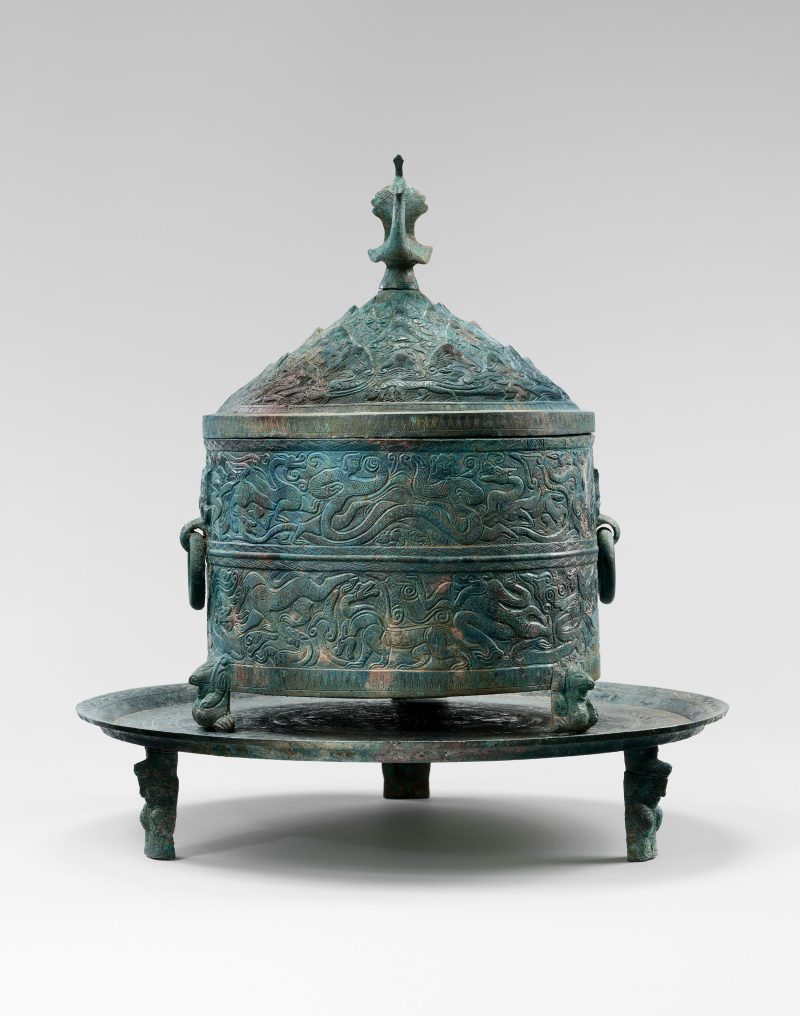
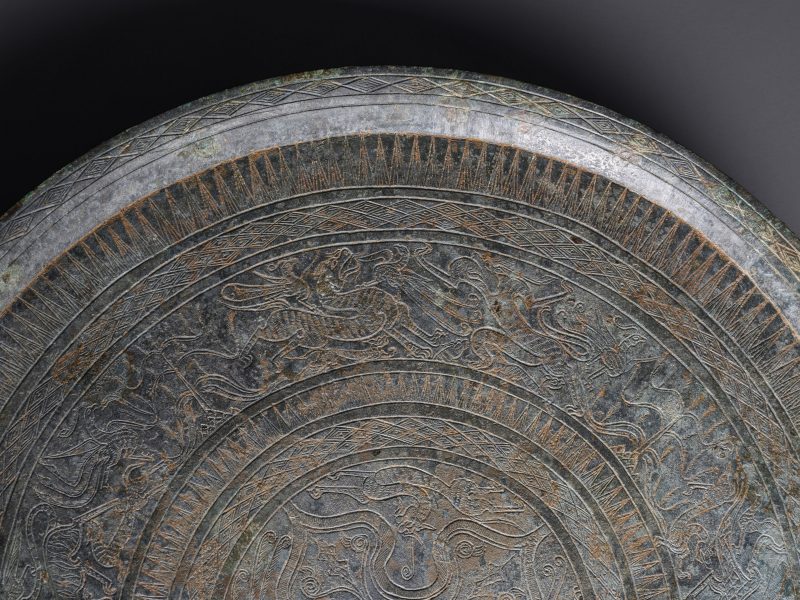
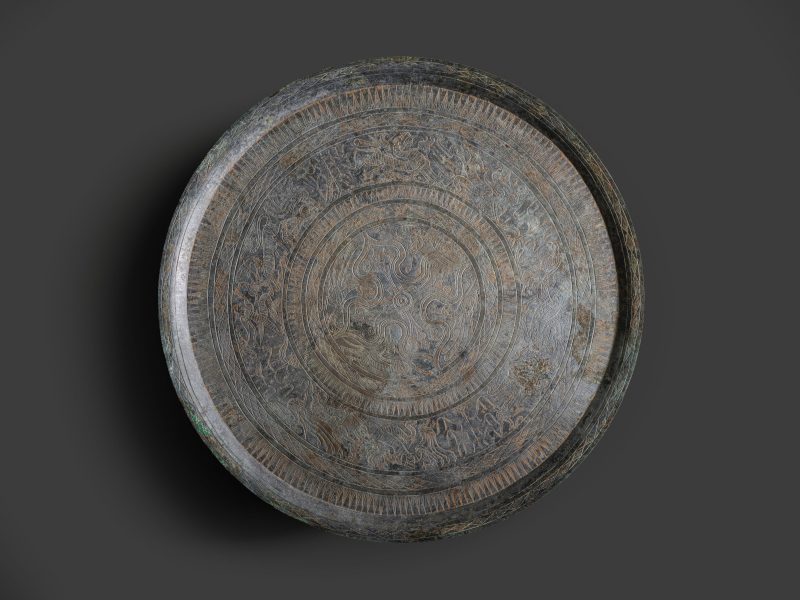
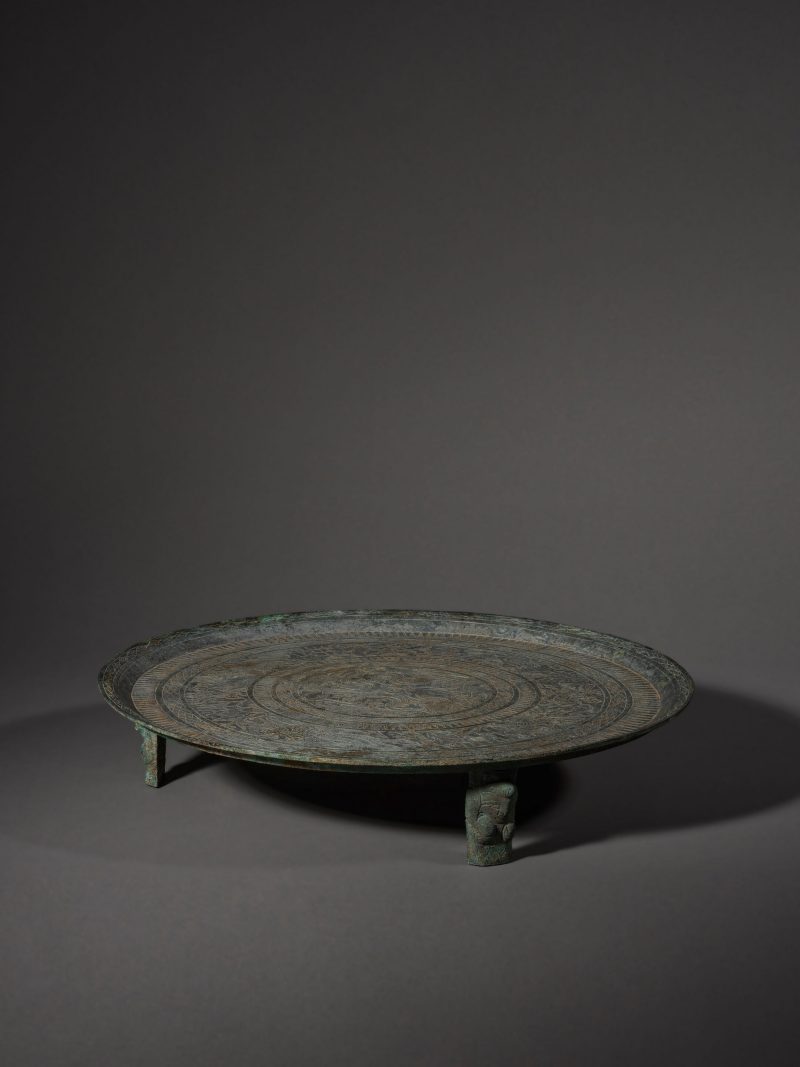
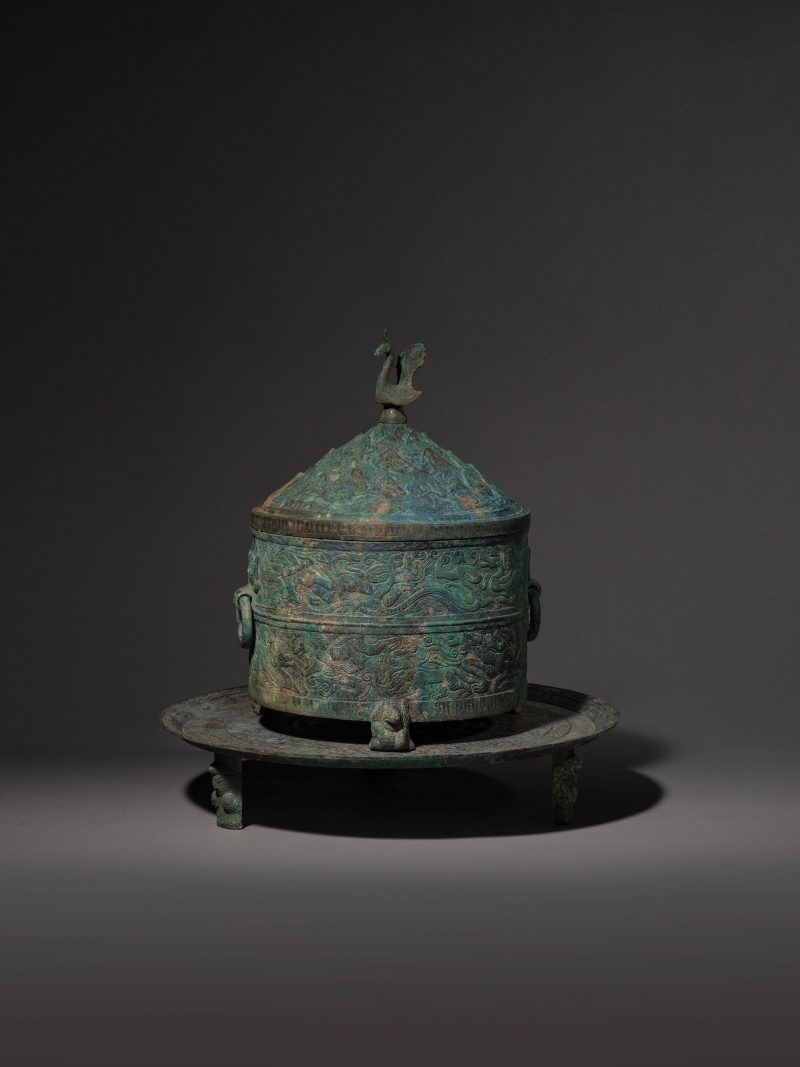
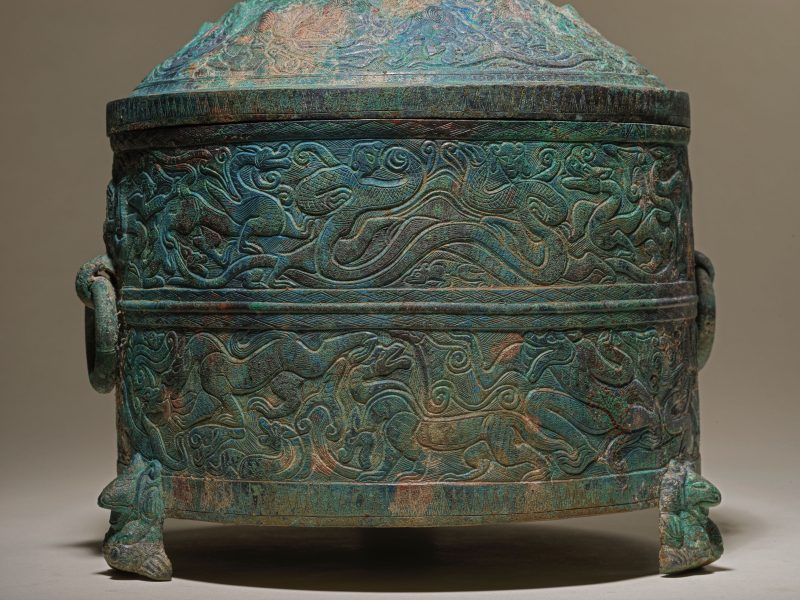
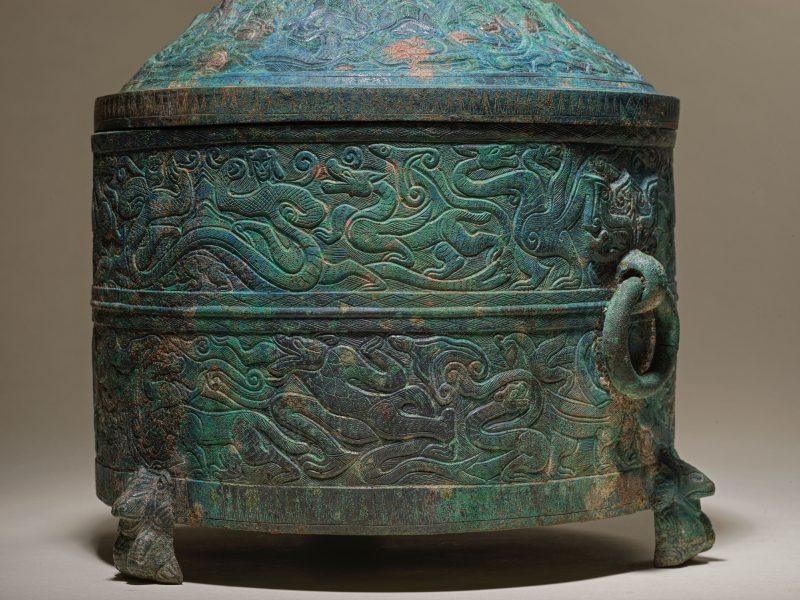
The censer of circular shape, with straight sides raised on three bear-form feet, set with a pair of taotie masks suspending loose ring handles, cast around the body in low relief with two bands separated by a raised bowstring, the lower band depicting an array of fabulous creatures including bears, birds, foxes, tigers and winged figures in a mountainous landscape, the upper band featuring the Queen Mother of the West and the King Father of the East flanked by a dragon and a tiger, the conical cover similarly decorated and crowned by a finial in the form of a peacock, the circular stand raised on three anthropomorphic feet and incised with a circular band of mythical figures in a mountainous landscape, the censer with a vibrant green patina, the stand with a smooth surface.
The censer and cover: 33 cm overall high; the stand: 40 cm diam. (3).
漢代 青銅人物神獸紋樽及承盤
Provenance:
Gisèle Croës Arts d'Extrême Orient, Brussels
來源:
Gisèle Croës Arts d'Extrême Orient,布魯塞爾
The present vessel belongs to a distinctive group of Western Han dynasty bronze tripod wine vessels known as zun, characterised by cylindrical bodies, bear-form feet, monster-mask handles suspending loose rings and covers surmounted by bird-form fittings. Inscriptions on related vessels identify this form as zun, or more specifically wenjiuzun, a vessel associated with the storage or warming of wine.
A related gilt-silvered bronze zun, Western Han dynasty, decorated in two registers with clouds and mythical animals and supported on bear-form feet, is illustrated in Age of Empires: Art of the Qin and Han Dynasties, New York, 2017, p. 145, no. 68. A related gilt vessel excavated from a later Western Han tomb at Changsha, late second to first century BC, is illustrated in Changsha fajue baogao [A report on the archaeological excavations in Changsha], Beijing, 1957, pp. 112-113. Compare also with a gilt bronze wine vessel and cover, zun, dated to the Western Han dynasty, in the collection of the Nelson Atkins Museum of Art, Kansas City (accession no.46-91).
A particularly close parallel is the inscribed gilt-and-silvered bronze wine vessel and stand excavated in 1972 at Zhangzhuangqiao, Handan, now in the Handan Museum. Dated by inscription to AD 47, this Eastern Han dynasty vessel shares the cylindrical body, bear-form feet, mask-and-ring handles and elaborate decoration of clouds, animals and winged immortals. Its identification as an Imperial wine vessel provides important evidence for the function of this distinctive group. See Gaofeng, 'Jinyin tu chengyu dajue jiuzun jiqi shidai beijing' (金銀塗乘輿大爵酒樽及其時代背景), in Culture Relics World, 2019 (8), pp. 76-78.
The elaborate decoration of the present vessel, including mythical creatures and winged figures within a mountainous landscape, reflects the supernatural imagery associated with Han beliefs in Immortality and ascent to Heaven. The identification of the Queen Mother of the West (Xiwangmu) and King Father of the East (Dongwanggong) is particularly significant. Xiwangmu was associated with the land of the Immortals and was frequently depicted beneath a canopy, flanked by a dragon and tiger and attended by auspicious animals and winged Immortals. Such imagery gave visual form to the celestial realm and the hope of transcending mortality. For a discussion of Immortality imagery and the representation of the heavenly domain in Han art, see Age of Empires: Art of the Qin and Han Dynasties, New York, 2017, pp.58-61.
以下内容由AI翻译:
【描述】
香炉呈圆形,直壁,三熊形足支撑,两侧饰有饕餮面具悬挂环耳,器身低浮雕两圈纹饰,中间以凸弦纹分隔。下圈描绘了包括熊、鸟、狐狸、虎和带翼人物在内的各种神兽在山景中,上圈则描绘了西王母和东王公,龙、虎分列两侧。锥形盖施以同类纹样,盖顶为孔雀形钮。圆形底座由三个拟人形足支撑,刻有一圈神话人物在山景中的图案。香炉表面有鲜艳的绿色铜锈,底座表面光滑。
此件器物属于西汉时期的一类独特的青铜三足酒器,称为樽。这类器物的特点是圆筒形器身、熊形足、怪兽面具环耳和鸟形顶钮。相关器物上的铭文表明这种形式被称为樽,更具体地说是温酒樽,与贮酒或温酒相关。
一件相关的鎏金银青铜樽,西汉时期,装饰有云纹和神兽,熊形足支撑,见于《帝国时代:秦汉艺术》,纽约,2017年,第145页,编号68。另一件出自长沙西汉晚期墓葬的鎏金器物(公元前二世纪末至一世纪),见于《长沙发掘报告》,北京,1957年,第112-113页。堪萨斯城纳尔逊-阿特金斯艺术博物馆收藏的一件西汉时期的鎏金青铜酒器和盖子(馆藏编号46-91)也与此相似。
特别相近的例子是一件1972年在邯郸张庄桥出土的铭文鎏金银青铜酒器和底座,现藏于邯郸博物馆。根据铭文,这件东汉时期的器物年代为公元47年,它具有圆筒形器身、熊形足、面具环耳和复杂的云纹、动物和带翼仙人的装饰。其作为皇家酒器的身份提供了这一独特群体功能的重要证据。参见高锋,《金银涂乘舆大爵酒樽及其时代背景》,载于《文物世界》,2019年第8期,第76-78页。
此件器物上精细的装饰,包括山景中的神兽和带翼人物,反映了汉代对长生不老和升天的信仰。辨识出西王母与东王公尤为重要。西王母与仙境相关,常被描绘在华盖下,两侧有龙和虎,并伴有吉祥动物和带翼仙人。这种图像赋予了天界视觉形式,并表达了超越凡俗的愿望。关于长生不老图像和天界表现在汉代艺术中的讨论,见《帝国时代:秦汉艺术》,纽约,2017年,第58-61页。
常见问题
这件漢代 青銅人物神獸紋樽及承盤 | TRÈS RARE RÉCIPIENT COUVERT ZUN ET SON PLATEAU CHENGPAN EN BRONZE的成交价是多少?
落槌价为 预展中。 成交价为 预展中。
拍品的尺寸是多少?
The censer and cover: 33 cm overall high; the stand: 40 cm diam.