
拍品信息
拍品名称
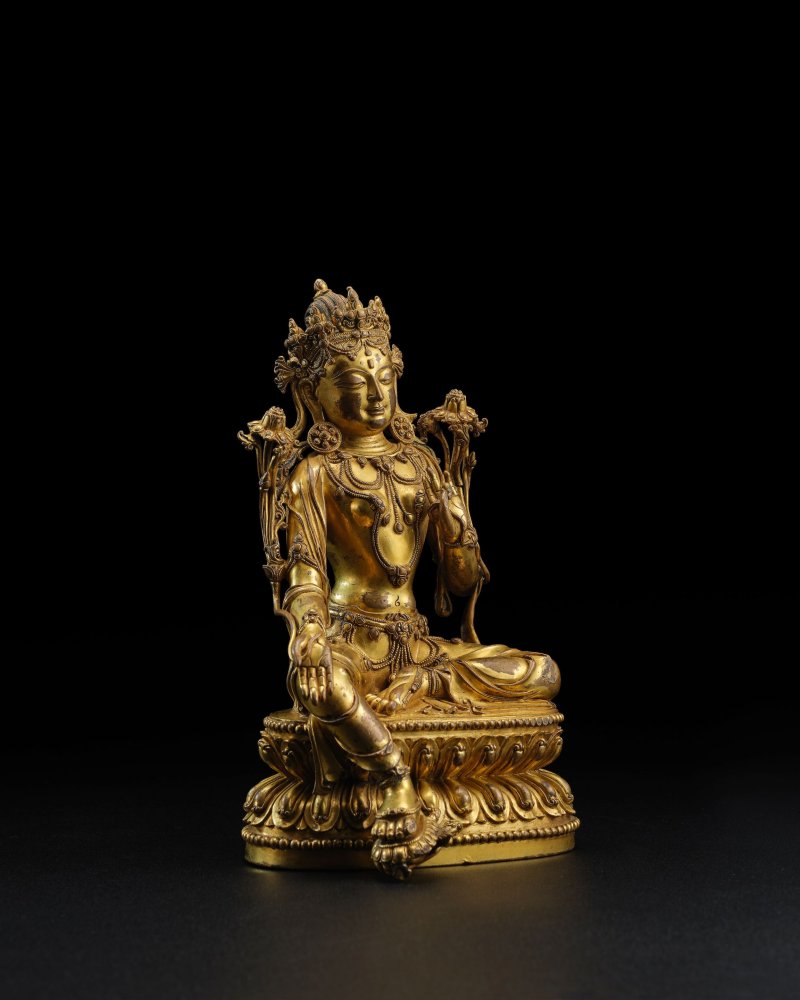
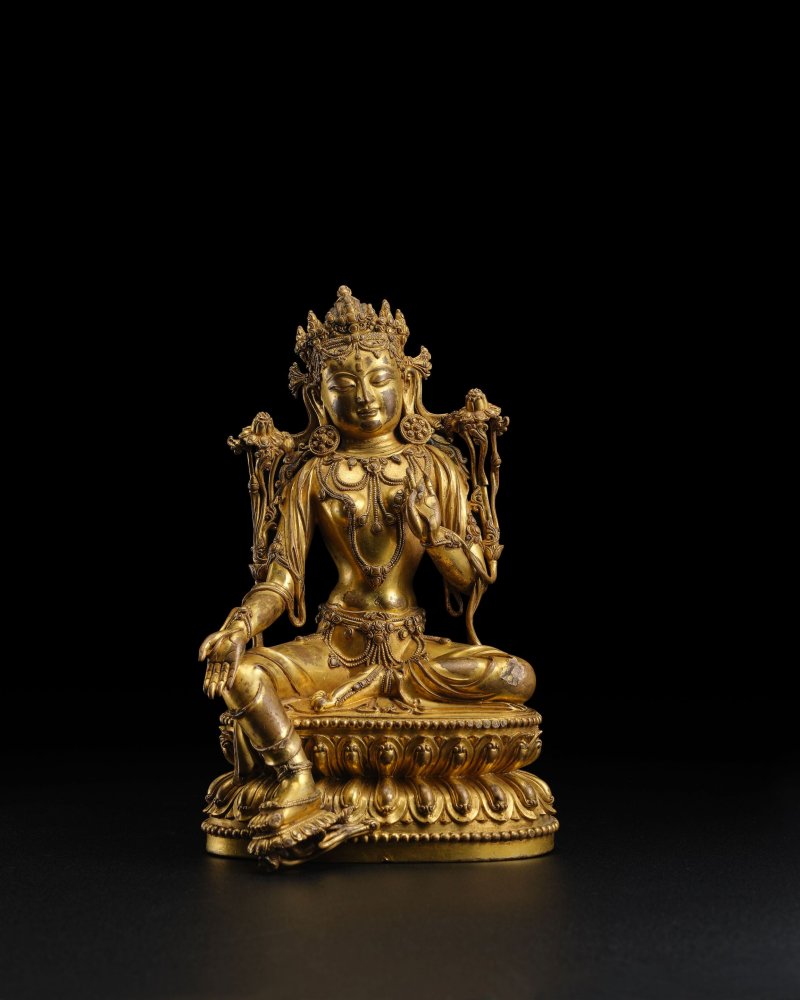
明 永樂(1403-24年)銅鎏金綠度母像 | A GILT COPPER ALLOY FIGURE OF GREEN TARA
年代
MING DYNASTY, YONGLE SIX-CHARACTER MARK AND OF THE PERIOD (1403-24)
起拍价
HKD 2,500,000
估值区间
HKD 2500000 - 3500000
尺寸
未知
品相
未知
更多信息
MING DYNASTY, YONGLE SIX-CHARACTER MARK AND OF THE PERIOD (1403-24)
Himalayan Art Resources item no. 207022
20.5 cm (8 in.) high
Footnotes
明 永樂(1403-24年)銅鎏金綠度母像
「大明永樂年施」刻款
Provenance
Private European Collection
Green Tara is revered as the "Mother of the Victorious Ones" and is often regarded as the "Mother of All Buddhas". This beautifully cast figure exemplifies the pinnacle of Chinese Buddhist art, produced in the imperial workshops of the Ming dynasty (1368–1644).
The Ming court actively cultivated relations with Tibet and supported a range of Tibetan Buddhist traditions, replacing the predominantly Sakya-centred patronage of the Yuan dynasty with a broader policy of engagement with different religious lineages. The Yongle Emperor actively promoted the development of Tibetan religion, conferring titles on religious leaders, inviting living Buddhas to the court, and bestowing generous gifts. As a result, exchanges between the Ming court and Tibet became increasingly frequent, and cultural interaction grew accordingly. These political policies also substantially advanced the development and refinement of court sculpture in both subject matter and technique. Following the Yongle Emperor's accession, court sculpture proliferated on an unprecedented scale, with the majority of surviving Yongle and Xuande court sculptures dating to the Yongle period.
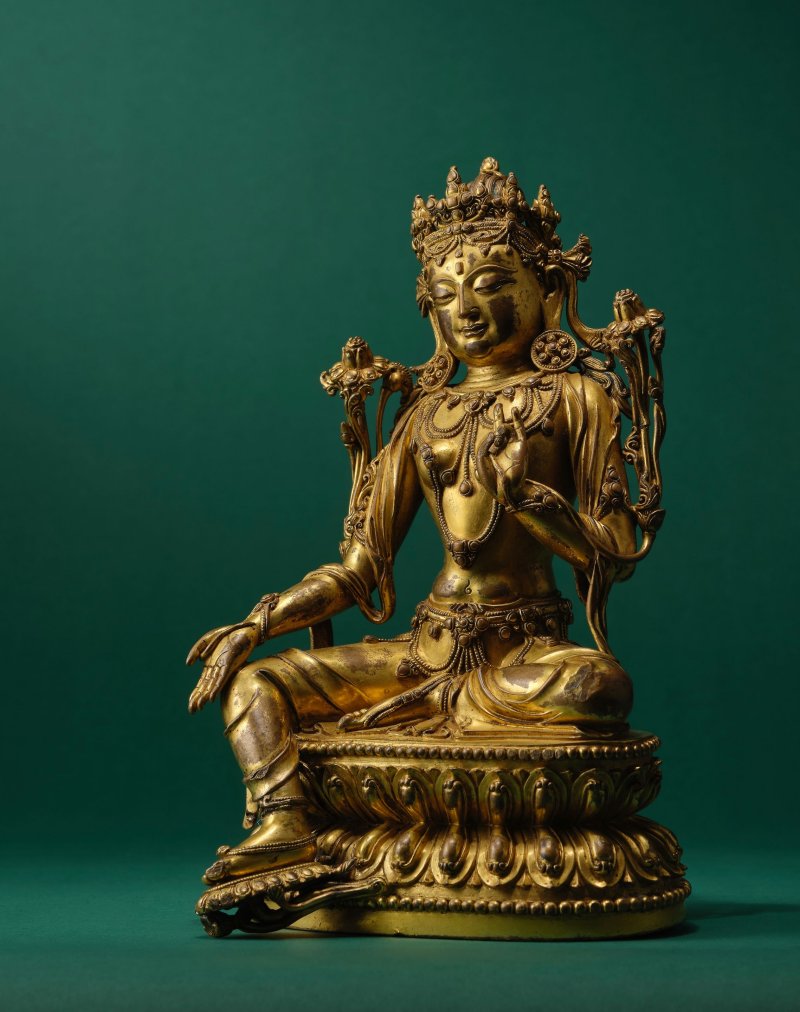
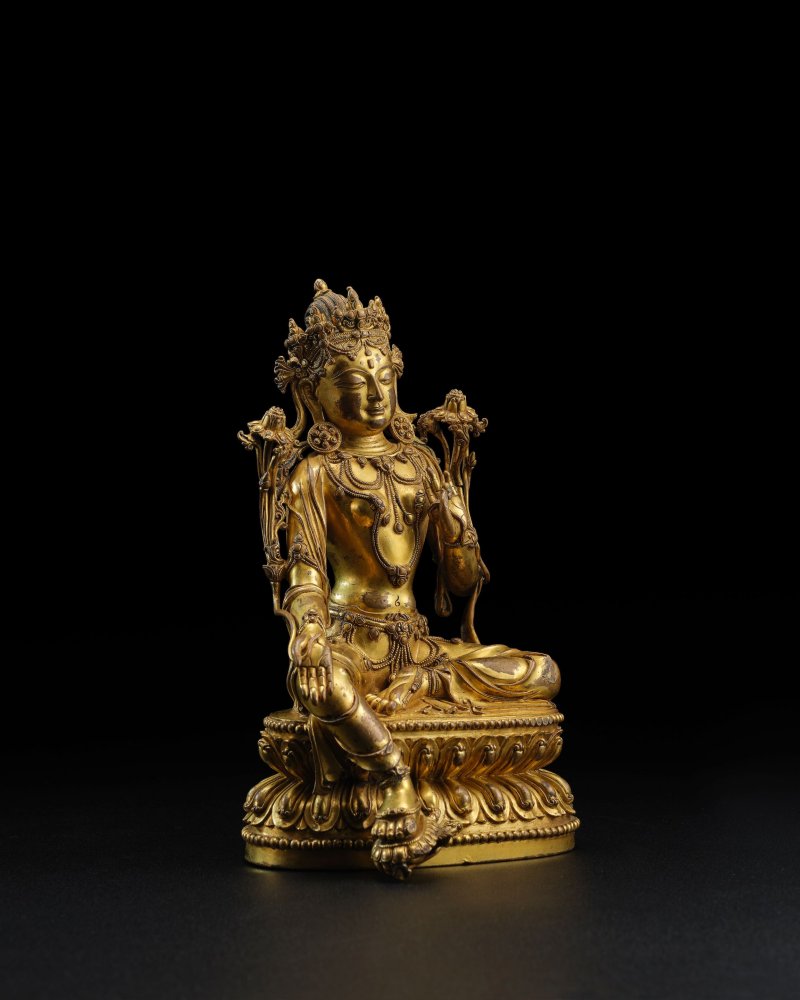
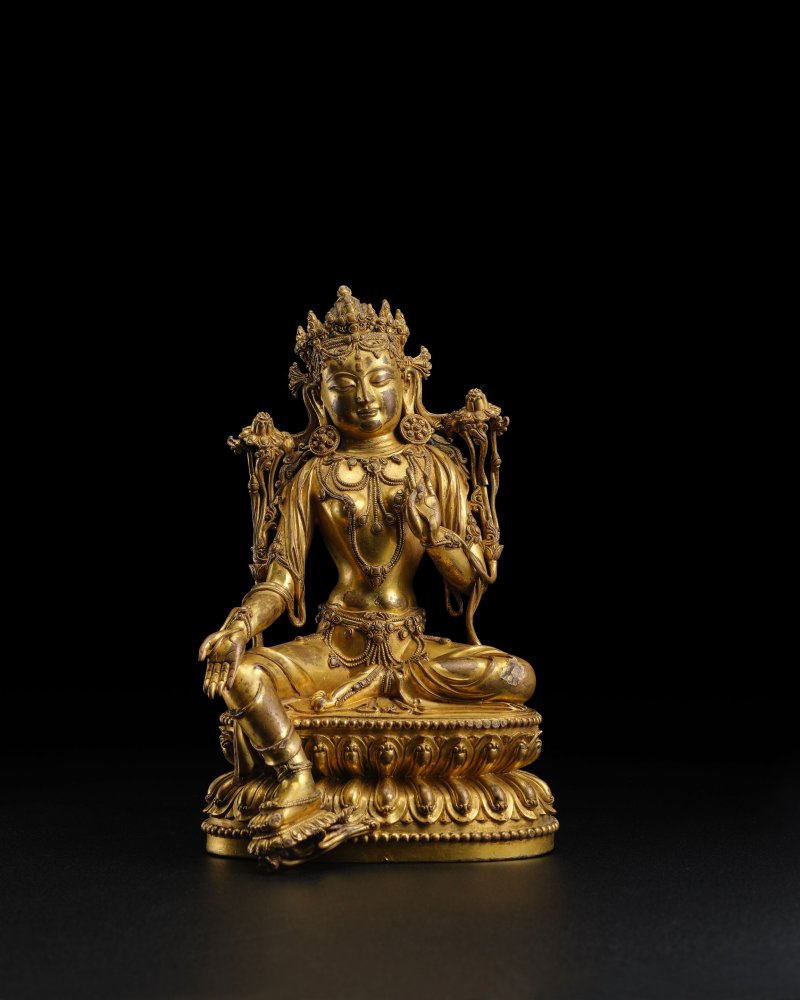
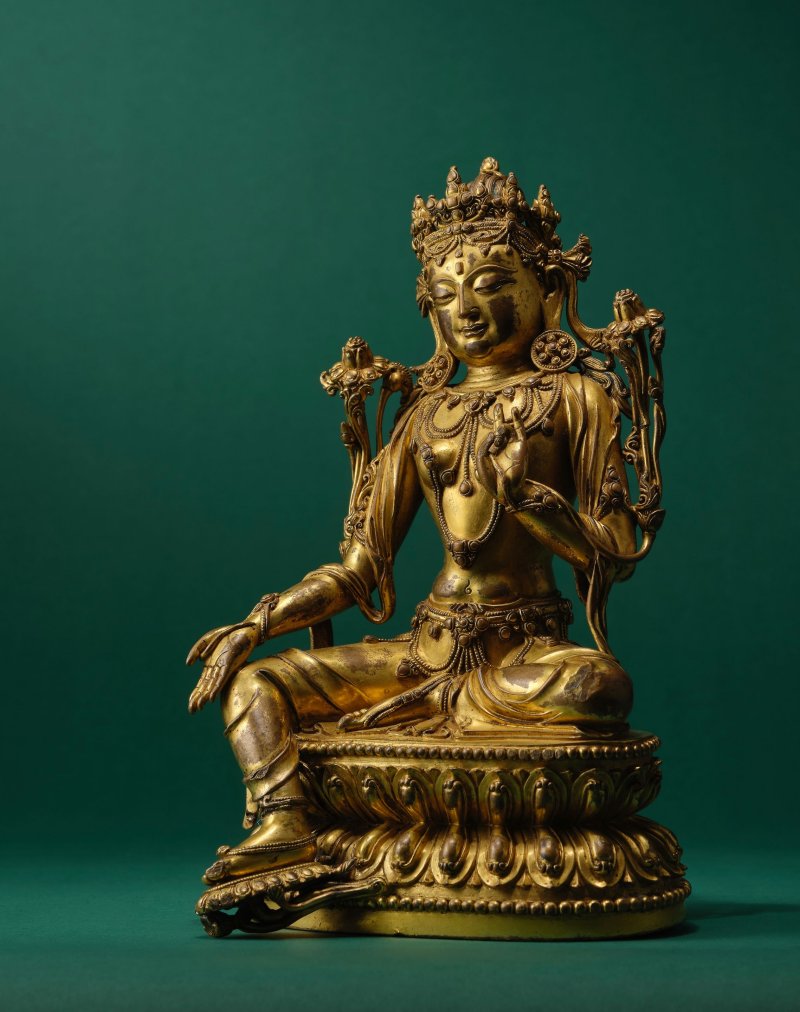
Tara is depicted in her principal form with one face and two arms. She is seated in the posture of royal ease () upon a lotus base, her right foot resting on a small lotus pedestal rising from the centre of the base, a sign that she is ever ready to rise and come to the aid of suffering beings. She rests her right hand on her right knee, palm outward, in the gesture of wish-granting (). Her left hand is held before her chest in , with the three extended fingers symbolizing the Three Jewels. Both hands lightly hold lotus stems, from which a blossoming lotus flower rises at each shoulder.
The figure is distinguished by its slender proportions and graceful, elongated modelling. Her face is full and rounded, the head tilted slightly backward, the eyes soft and downcast. Crescent-shaped brows arch across the forehead, above a straight, finely formed nose, and the corners of the mouth lift into a warm smile. Her hair is gathered into a high topknot, each strand carefully articulated. The horizontally coiled arrangement recalls the coiffures of women of the Ming period and is characteristic of Yongle-period imperial sculpture.
At the hairline sits a small five-Buddha jeweled crown, each leaf inset with a drop-shaped jewel. From the rim of the crown hangs a U-shaped fringed garland of small beads, rich and ornate. The crown ribbons are tied in a knot at the top of each ear, the lower ends fluttering as if caught in the wind. She wears large circular earrings, and fine, long braids fall naturally down either side behind the ears. Elaborate jeweled pendants adorn both the chest and the waist, and she is further adorned with bracelets, armlets, and anklets. A scarf drapes over the shoulders, and slender ribbons flutter down from both shoulders, winding gracefully around the arms, conveying the soft, flowing texture of real fabric.
The whole rests upon a double-layered, waisted lotus base in the inverted-and-upright form. The lotus petals are long, with the tip of each petal ornamented with three small beads; the upper and lower rims of the base are edged with a continuous row of bean-shaped beads. On the surface of the base is incised a six-character inscription in regular script: "Bestowed in the Yongle reign of the Great Ming" (大明永樂年施). The inscription is read from left to right, rather than the traditional Chinese practice of reading from right to left; a feature often associated with the strong Tibetan Buddhist influence evident in Yongle imperial Buddhist sculpture. See a very similar Yongle Green Tara sold at Sotheby's, Hong Kong, 7 October 2006, lot 807.
Himalayan Art Resources item no. 207022
20.5 cm (8 in.) high
Footnotes
明 永樂(1403-24年)銅鎏金綠度母像
「大明永樂年施」刻款
Provenance
Private European Collection
Green Tara is revered as the "Mother of the Victorious Ones" and is often regarded as the "Mother of All Buddhas". This beautifully cast figure exemplifies the pinnacle of Chinese Buddhist art, produced in the imperial workshops of the Ming dynasty (1368–1644).
The Ming court actively cultivated relations with Tibet and supported a range of Tibetan Buddhist traditions, replacing the predominantly Sakya-centred patronage of the Yuan dynasty with a broader policy of engagement with different religious lineages. The Yongle Emperor actively promoted the development of Tibetan religion, conferring titles on religious leaders, inviting living Buddhas to the court, and bestowing generous gifts. As a result, exchanges between the Ming court and Tibet became increasingly frequent, and cultural interaction grew accordingly. These political policies also substantially advanced the development and refinement of court sculpture in both subject matter and technique. Following the Yongle Emperor's accession, court sculpture proliferated on an unprecedented scale, with the majority of surviving Yongle and Xuande court sculptures dating to the Yongle period.
Tara is depicted in her principal form with one face and two arms. She is seated in the posture of royal ease () upon a lotus base, her right foot resting on a small lotus pedestal rising from the centre of the base, a sign that she is ever ready to rise and come to the aid of suffering beings. She rests her right hand on her right knee, palm outward, in the gesture of wish-granting (). Her left hand is held before her chest in , with the three extended fingers symbolizing the Three Jewels. Both hands lightly hold lotus stems, from which a blossoming lotus flower rises at each shoulder.
The figure is distinguished by its slender proportions and graceful, elongated modelling. Her face is full and rounded, the head tilted slightly backward, the eyes soft and downcast. Crescent-shaped brows arch across the forehead, above a straight, finely formed nose, and the corners of the mouth lift into a warm smile. Her hair is gathered into a high topknot, each strand carefully articulated. The horizontally coiled arrangement recalls the coiffures of women of the Ming period and is characteristic of Yongle-period imperial sculpture.
At the hairline sits a small five-Buddha jeweled crown, each leaf inset with a drop-shaped jewel. From the rim of the crown hangs a U-shaped fringed garland of small beads, rich and ornate. The crown ribbons are tied in a knot at the top of each ear, the lower ends fluttering as if caught in the wind. She wears large circular earrings, and fine, long braids fall naturally down either side behind the ears. Elaborate jeweled pendants adorn both the chest and the waist, and she is further adorned with bracelets, armlets, and anklets. A scarf drapes over the shoulders, and slender ribbons flutter down from both shoulders, winding gracefully around the arms, conveying the soft, flowing texture of real fabric.
The whole rests upon a double-layered, waisted lotus base in the inverted-and-upright form. The lotus petals are long, with the tip of each petal ornamented with three small beads; the upper and lower rims of the base are edged with a continuous row of bean-shaped beads. On the surface of the base is incised a six-character inscription in regular script: "Bestowed in the Yongle reign of the Great Ming" (大明永樂年施). The inscription is read from left to right, rather than the traditional Chinese practice of reading from right to left; a feature often associated with the strong Tibetan Buddhist influence evident in Yongle imperial Buddhist sculpture. See a very similar Yongle Green Tara sold at Sotheby's, Hong Kong, 7 October 2006, lot 807.
常见问题
这件明 永樂(1403-24年)銅鎏金綠度母像 | A GILT COPPER ALLOY FIGURE OF GREEN TARA的成交价是多少?
落槌价为 预展中。 成交价为 预展中。