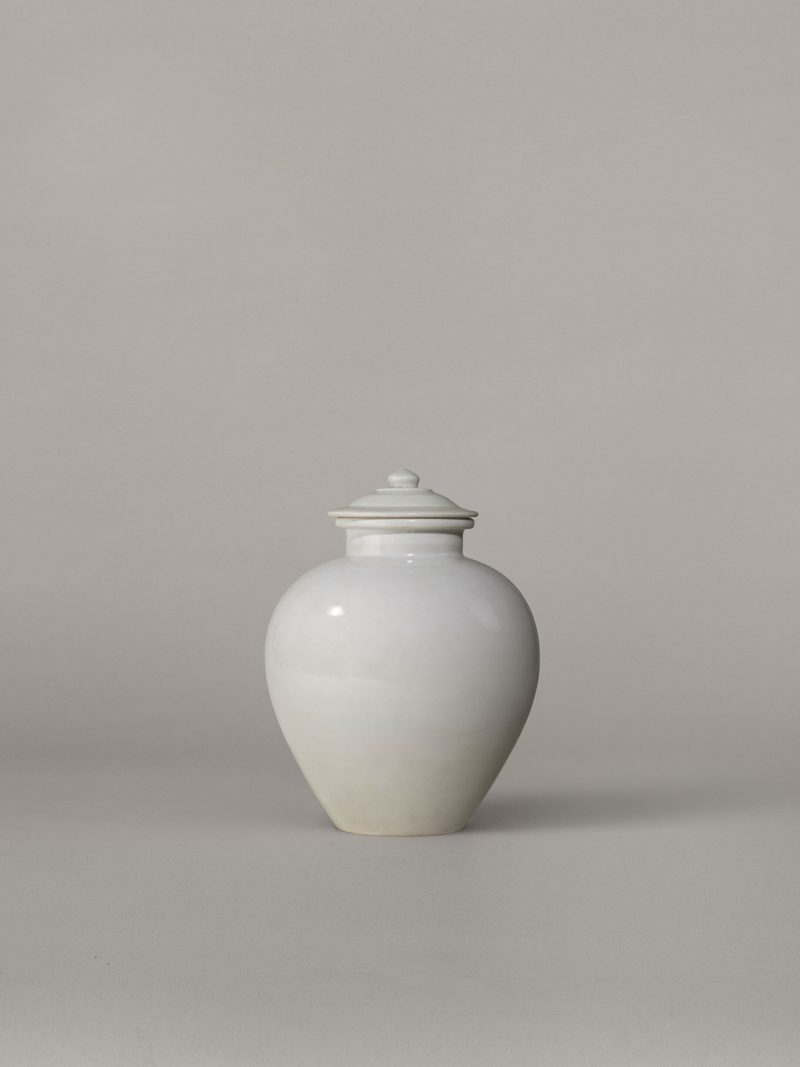

Lot 48 唐晚期 約九世紀 邢窯白釉蓋罐 | RARE VASE COUVERT À GLAÇURE BLANCHE DE TYPE, XING
落槌价
预展中
成交价
预展中
| 拍卖公司 | 邦瀚斯 |
|---|---|
| 拍卖时间 | 2026年12月10日 |
拍品信息
拍品名称
唐晚期 約九世紀 邢窯白釉蓋罐 | RARE VASE COUVERT À GLAÇURE BLANCHE DE TYPE, XING
年代
唐晚期 約九世紀
起拍价
未知
估值区间
EUR 30,000–50,000
尺寸
27 cm (10 5/8 in.) high x 19.5 cm (7 5/8 in.) wide
品相
未知
更多信息
RARE VASE COUVERT À GLAÇURE BLANCHE DE TYPE, XING
Marque incisée 'Ying', Fin de la dynastie Tang, vers IXe siècle
A RARE WHITE-GLAZED STONEWARE VASE AND COVER, XING
Ying incised character, Late Tang Dynasty, ca. 9th century
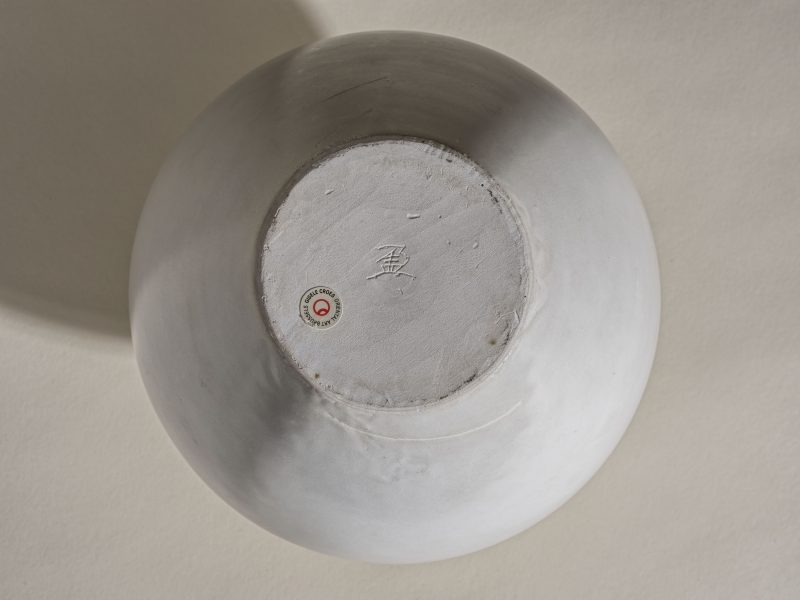
Exquisitely potted, the ovoid body tapering to a flat base, with generously rounded shoulders and a short, slightly concave neck, the wide mouth with a lipped rim, the cover of corresponding form with a flat rim and bud-form finial, covered all over with a transparent ivory-white glaze falling in a straight line around the unglazed base revealing the fine white porcelaneous body, incised to the centre with the single character 'ying '.
27 cm (10 5/8 in.) high x 19.5 cm (7 5/8 in.) wide (2).
唐晚期 約九世紀 邢窯白釉蓋罐
「盈」字款
Provenance:
Gisèle Croës Arts d'Extrême Orient, Brussels, 2013
Published, Illustrated and Exhibited:
K. Y. Fine Art, Hong Kong, Like Snow, Like Silver: The Luminous Xing Wares, Hong Kong, 22 - 29 May 2013, cover
Gisèle Croës Arts d'Extrême Orient, Matter and Memory II, New York, March 2014, pp.128-129
來源:
Gisèle Croës Arts d'Extrême Orient,布魯塞爾,2013年
展覽著錄:
繼遠美術,香港,《Like Snow, Like Silver: The Luminous Xing Wares》,2013年5月22-29日,封面
Gisèle Croës Arts d'Extrême Orient,《Matter and Memory II》,紐約,2014年3月,第128-129頁
This vase stands out for its minimalist lines and pure white glaze. Wares made with an almost pure white body covered with an ivory-white glaze were made in the 'Xing' kilns in Hebei province during the Tang dynasty. Here, potters were able to produce a type of porcelaneous body that is today considered as one of the earliest porcelains. The dazzlingly white body and lustrous, pure white glaze evoked contemporaneous silverware and 'Xing' wares were often described as 'white as silver' by contemporary literati.
The single character ying on the base of this vase can be translated as abundant. It can be found on a small number of vessels including bowls, boxes, ewers and vases, all characterised by the same refined quality as the present example. Research suggests that 'Xing' wares inscribed with the character ying were made exclusively for Imperial use from the Tianbao reign (743-756 AD) of the Xuanzong Emperor. In 1992, a group of 'Xing' porcelains inscribed with this character was discovered on the former site of the Qinglong Buddhist temple in Xi'an, Shaanxi province which during the Tang dynasty enjoyed Imperial patronage. Scholars have suggested that white porcelains inscribed with the ying character may have been made for the Baibao da ying ku, the Imperial treasury known as the 'Grand Surplus Depository of a Hundred Treasures' or simply 'Storeroom of Great Abundance', and may have constituted a pious gift to the Qinglong temple Emperor, see Xing yao yanjiu, Beijing, 2007, pp. 332-337, and pp. 474-480.
Compare this vase with a vase of similar size and shape, without a cover, excavated in Hebei province, published in Series of China's Ancient Porcelain Kiln Sites: Xing Kiln of China, Beijing, 2012, no. 102. Another inscribed vase of this shape, formerly in the Longsdorf collection, is illustrated in J.J. Lally & Co., Early Chinese White Wares. The Ronald W. Longsdorf Collection, New York, 2015, cat.no. 4. Compare also with a vase and cover published in J.J. Lally & Co., Chinese Ceramics in Black and White, New York, 2010, cat.no. 9. For other examples of white wares inscribed with the character xing, see a bowl sold at Christie's Hong Kong, 1 May 1995, lot 633, and a dish, published by Regina Krahl in 'Chinese Ceramics from the Meiyintang Collection, vol. three (II), London, 2006, cat.no. 1420.
Compare with a xing white-glazed vase with a Ying incised character, Tang dynasty, which was sold at Bonhams London, Priestley & Ferraro: Three Decades of Chinese Art (1994-2025), 6 November 2025, lot 120.
以下内容由AI翻译:
【描述】
造型精美,卵圆形器身渐收至平底,肩部圆润饱满,短颈微凹,宽口带唇沿,盖子与之相配,边缘平坦,顶饰为花蕾形,通体施透明象牙白釉,釉层在未施釉的底部呈直线状,露出细腻的白色瓷胎,底部中央刻有单字“盈”。
此罐以其简约的线条和纯净的白釉脱颖而出。这种几乎纯白色的胎体上覆盖象牙白釉的器物是在唐代河北邢窑制作的。在这里,陶工能够生产出一种今天被认为是最早的瓷器之一的瓷质胎体。耀眼的白色胎体和光泽纯净的白釉让人联想到当时的银器,邢窑器物常被当时的文人描述为“白如银”。
罐底的单字“盈”可以译为丰盈。这个字可以在少数碗、盒、执壶和罐等器物上找到,这些器物都具有同样的精致品质。研究推测,刻有“盈”字的邢窑器物自唐玄宗天宝年间(公元743-756年)起专为皇家制作。1992年,在陕西西安青龙寺遗址发现了一组刻有“盈”字的邢窑瓷器,该寺在唐代享有皇室资助。学者们认为,刻有“盈”字的白瓷可能是为皇家府库“百宝大盈库”(简称“大盈库”)制作的。关于奉献对象,图录原文为“may have constituted a pious gift to the Qinglong temple Emperor”,参见《邢窑研究》,北京,2007年,第332-337页和第474-480页。
与此罐相比,有一件尺寸和形状相似但无盖的罐,在河北省出土,发表于《中国古瓷窑址系列:中国邢窑》,北京,2012年,编号102。另一件刻有“盈”字的类似形状的罐,曾为朗斯多夫收藏,见J.J. Lally & Co.,《早期中国白瓷:罗纳德·W·朗斯多夫收藏》,纽约,2015年,图录编号4。另见J.J. Lally & Co.,《黑白中国陶瓷》,纽约,2010年,图录编号9。其他刻有“邢”字的白瓷例子,见一件碗在佳士得香港1995年5月1日拍卖,拍品编号633,以及一件盘,由Regina Krahl发表于《玫茵堂藏中国陶瓷》第三卷(II),伦敦,2006年,图录编号1420。
比较一件刻有“盈”字的唐代邢窑白釉罐,在邦瀚斯伦敦,普里斯特利与费拉罗:三十年中国艺术(1994-2025),2025年11月6日,拍品编号120。
常见问题
这件唐晚期 約九世紀 邢窯白釉蓋罐 | RARE VASE COUVERT À GLAÇURE BLANCHE DE TYPE, XING的成交价是多少?
落槌价为 预展中。 成交价为 预展中。
拍品的尺寸是多少?
27 cm (10 5/8 in.) high x 19.5 cm (7 5/8 in.) wide