
拍品信息
拍品名称
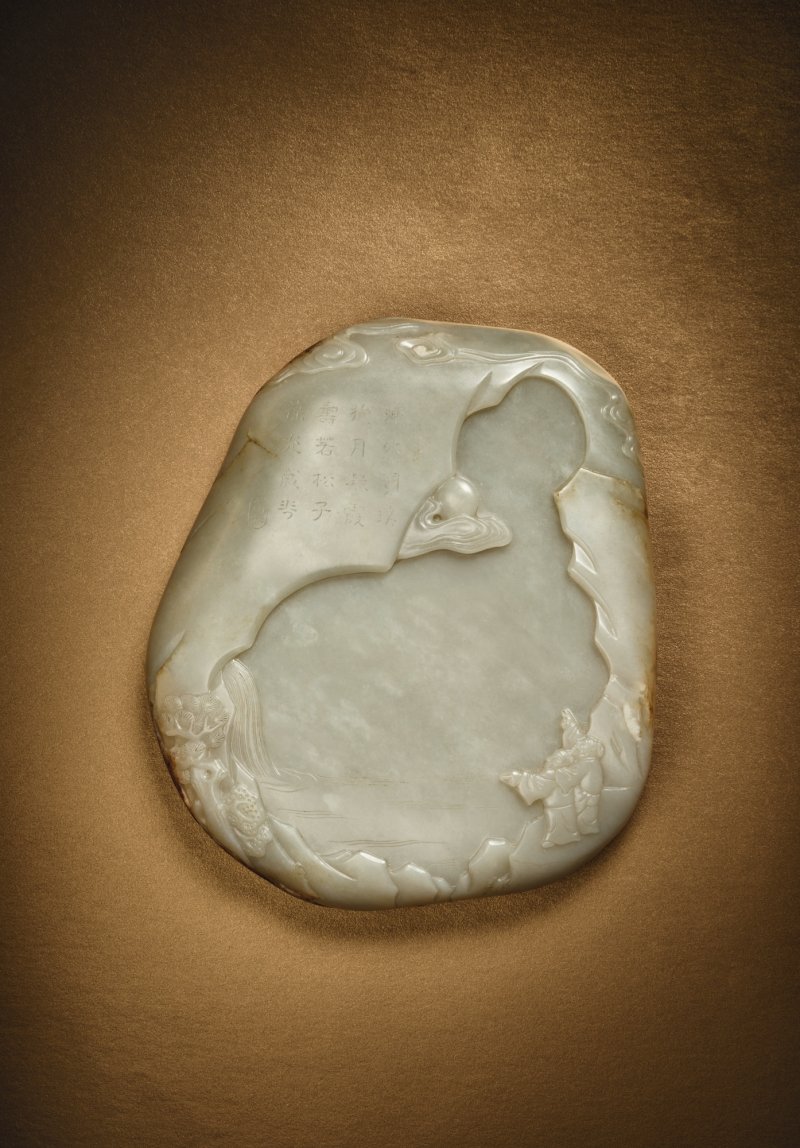
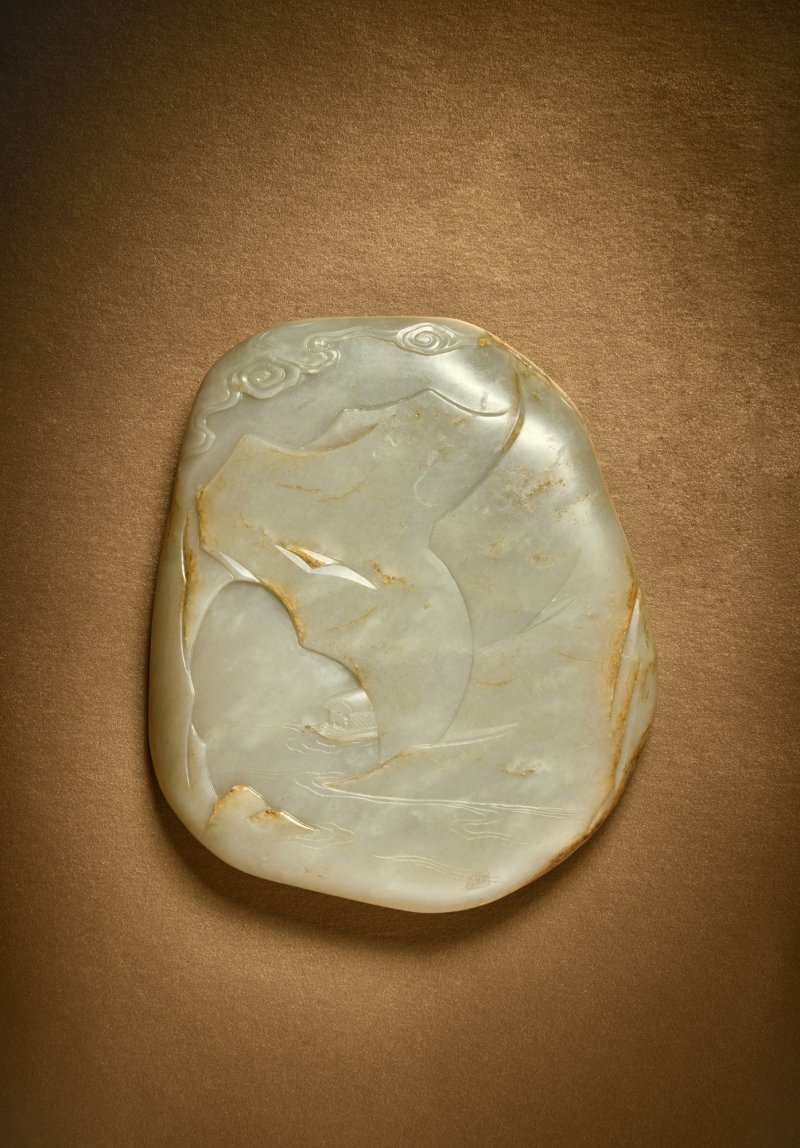
清雍正 / 乾隆初 青白玉詩文高士圖硯
起拍价
USD 80,000
估值区间
80,000 - 120,000 USD
尺寸
未知
品相
如欲了解本拍品狀況的更多資訊,請聯絡 Drew.Lerner@sothebys.com
更多信息
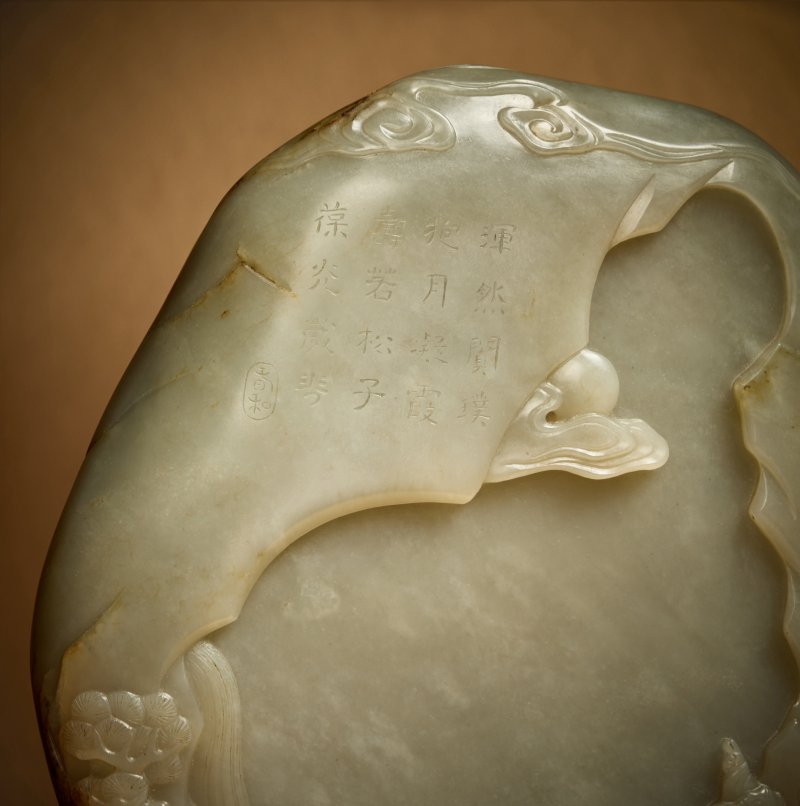
詩文:渾然闐璞 抱月凝霞 壽若松子 葆光歲華,《春和》款
来源:Angus Forsyth 收藏,1994年之前
Anthony Carter Ltd.,倫敦
展览:Angus Forsyth 及 Brian McElney,《Jades from China》,東亞藝術博物館,巴斯,1994年,編號346
图录
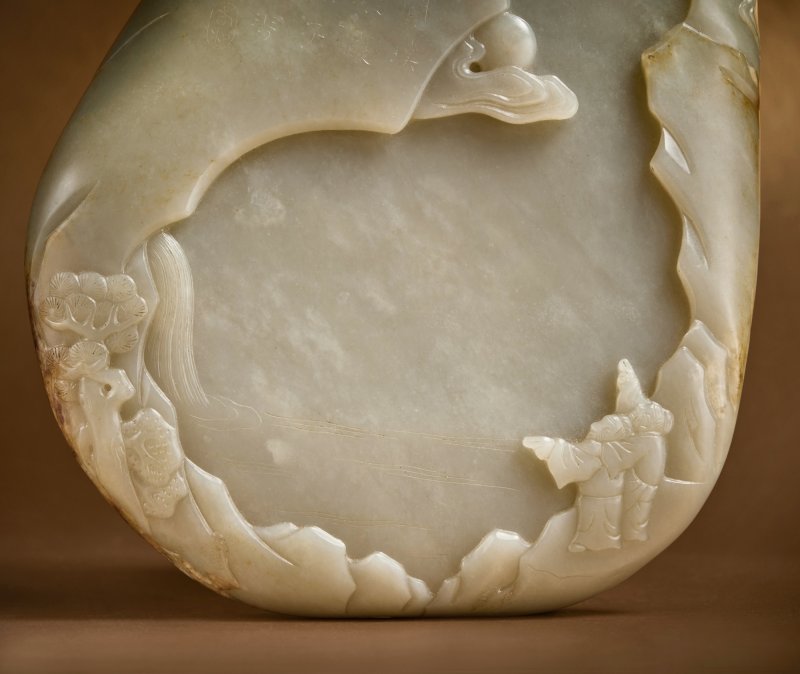
说明:A bold expanse of pure grey-green stone, disrupted by the subtlest ripples of russet; the present inkstone is an imperial delight. Hewn in varied relief – from the fine linework of the rippling waters to the expressive depth of the floating clouds and flowing waterfalls, from the soft yet dramatic edges of the cliffs to the delicate robes of the two scholars immersed in the scene — the present inkstone embodies the refined aesthetic in vogue among scholars, particularly in the Qing imperial court.
Beyond the quality of the carving, the present inkstone is also remarkable for its inscription and imperial provenance. Following a poem celebrating the clarity of jade and comparing it with a clear moonlit night, the inkstone is inscribed with seal mark chun he (‘peaceful spring’). This sobriquet refers to the Master of Peaceful Spring (chunhe zhuren), a style name adopted by none other than Aisin-Gioro Yunli (1697–1738).
Seventeenth son of the Kangxi Emperor and loyal brother of Yinzhen, the Yongzheng Emperor, Yunli (originally named Yinli) was the first to bear the title of Prince Gong and continued to serve the court under the Qianlong Emperor until his passing in 1738. Frequently depicted sat at ease in his studio surrounded by beloved scholars’ objects like the present, Yunli was a devoted public servant but is most famous as a scholar and poet, compiling his poems in the compendia Jingyuanzhai shiji [Poetry from the Calm and Distant Study] and Chunhetang ji [Writings from the Hall of Peaceful Spring]; see one such portrait of the young prince at leisure sold in these rooms, 25th March 2026, lot 182 (Fig. 1).
Surviving jades bearing the imperial hall marks of Prince Yunli are rare. Compare four jade paper weights of chun he seal mark and very similar stone, preserved in the Museum of East Asian Art, Bath (accession no. BATEA:528), which may have produced as part of the same set of scholar’s objects as the present inkstone, with one weight bearing an identical inscription to the present; see Angus Forsyth and Brian McElney, Jades from China, Museum of East Asian Art, Bath, 1994, pl. 345. Also compare a melon-form pebble sold in our Hong Kong rooms, 8th April 2010, lot 1838; and a boulder sold at Bonhams Hong Kong, 28th November 2017, lot 10, featuring a similar obliquely carved design of rockwork, waves and a waterfall.
The scene depicted here of two scholars sailing among the Red Cliffs and stopping to admire the full moon is among the most beloved of the Chinese canon. Particularly associated with the Mid-Autumn Festival, the practice of admiring the moon in self-reflection appears to have ancient origins and was a frequent motif used among literati poets from at least the eleventh century. As the scholar Lu You (1125–1210) recalled of his Journey to Sichuan (Ru Chu ji, vol. 4) along the Yangtze, “[On the night of the fifteenth] I went ashore with my sons to view the moon over the great river. The river surface met the sky, and the moon's reflection in the water swayed and undulated, like a golden dragon, which was awe-inspiring and startling.”
In its embrace of negative space, celebrating the extraordinary beauty of the stone, the present inkstone is perhaps best compared to the famous imperially inscribed boulder depicting Two Women at the Moon Gate, preserved in the Palace Museum, Beijing and widely published including in Zhongguo meishu quanji. Gongyi meishu bian [Complete collection of Chinese art. Arts and crafts edition], vol. 9: yuqi [Jade], Beijing, 1991, pl. 322. For a boulder depicting a related scene of scholars admiring a moon-lit lake, compare one in the Tianjin City Art Museum, illustrated in Tianjin shi Yishu Bowuguan cang yu [Jades in the Tianjin City Art Museum], Hong Kong, 1993, pl. 226.
来源:Angus Forsyth 收藏,1994年之前
Anthony Carter Ltd.,倫敦
展览:Angus Forsyth 及 Brian McElney,《Jades from China》,東亞藝術博物館,巴斯,1994年,編號346
图录
说明:A bold expanse of pure grey-green stone, disrupted by the subtlest ripples of russet; the present inkstone is an imperial delight. Hewn in varied relief – from the fine linework of the rippling waters to the expressive depth of the floating clouds and flowing waterfalls, from the soft yet dramatic edges of the cliffs to the delicate robes of the two scholars immersed in the scene — the present inkstone embodies the refined aesthetic in vogue among scholars, particularly in the Qing imperial court.
Beyond the quality of the carving, the present inkstone is also remarkable for its inscription and imperial provenance. Following a poem celebrating the clarity of jade and comparing it with a clear moonlit night, the inkstone is inscribed with seal mark chun he (‘peaceful spring’). This sobriquet refers to the Master of Peaceful Spring (chunhe zhuren), a style name adopted by none other than Aisin-Gioro Yunli (1697–1738).
Seventeenth son of the Kangxi Emperor and loyal brother of Yinzhen, the Yongzheng Emperor, Yunli (originally named Yinli) was the first to bear the title of Prince Gong and continued to serve the court under the Qianlong Emperor until his passing in 1738. Frequently depicted sat at ease in his studio surrounded by beloved scholars’ objects like the present, Yunli was a devoted public servant but is most famous as a scholar and poet, compiling his poems in the compendia Jingyuanzhai shiji [Poetry from the Calm and Distant Study] and Chunhetang ji [Writings from the Hall of Peaceful Spring]; see one such portrait of the young prince at leisure sold in these rooms, 25th March 2026, lot 182 (Fig. 1).
Surviving jades bearing the imperial hall marks of Prince Yunli are rare. Compare four jade paper weights of chun he seal mark and very similar stone, preserved in the Museum of East Asian Art, Bath (accession no. BATEA:528), which may have produced as part of the same set of scholar’s objects as the present inkstone, with one weight bearing an identical inscription to the present; see Angus Forsyth and Brian McElney, Jades from China, Museum of East Asian Art, Bath, 1994, pl. 345. Also compare a melon-form pebble sold in our Hong Kong rooms, 8th April 2010, lot 1838; and a boulder sold at Bonhams Hong Kong, 28th November 2017, lot 10, featuring a similar obliquely carved design of rockwork, waves and a waterfall.
The scene depicted here of two scholars sailing among the Red Cliffs and stopping to admire the full moon is among the most beloved of the Chinese canon. Particularly associated with the Mid-Autumn Festival, the practice of admiring the moon in self-reflection appears to have ancient origins and was a frequent motif used among literati poets from at least the eleventh century. As the scholar Lu You (1125–1210) recalled of his Journey to Sichuan (Ru Chu ji, vol. 4) along the Yangtze, “[On the night of the fifteenth] I went ashore with my sons to view the moon over the great river. The river surface met the sky, and the moon's reflection in the water swayed and undulated, like a golden dragon, which was awe-inspiring and startling.”
In its embrace of negative space, celebrating the extraordinary beauty of the stone, the present inkstone is perhaps best compared to the famous imperially inscribed boulder depicting Two Women at the Moon Gate, preserved in the Palace Museum, Beijing and widely published including in Zhongguo meishu quanji. Gongyi meishu bian [Complete collection of Chinese art. Arts and crafts edition], vol. 9: yuqi [Jade], Beijing, 1991, pl. 322. For a boulder depicting a related scene of scholars admiring a moon-lit lake, compare one in the Tianjin City Art Museum, illustrated in Tianjin shi Yishu Bowuguan cang yu [Jades in the Tianjin City Art Museum], Hong Kong, 1993, pl. 226.
常见问题
拍品的品相状况如何?
如欲了解本拍品狀況的更多資訊,請聯絡 Drew.Lerner@sothebys.com
这件拍品的流传来源是什么?
Angus Forsyth 收藏,1994年之前
Anthony Carter Ltd.,倫敦
Anthony Carter Ltd.,倫敦
这件拍品曾在哪些展览中展出过?
Angus Forsyth 及 Brian McElney,《Jades from China》,東亞藝術博物館,巴斯,1994年,編號346
图录
图录