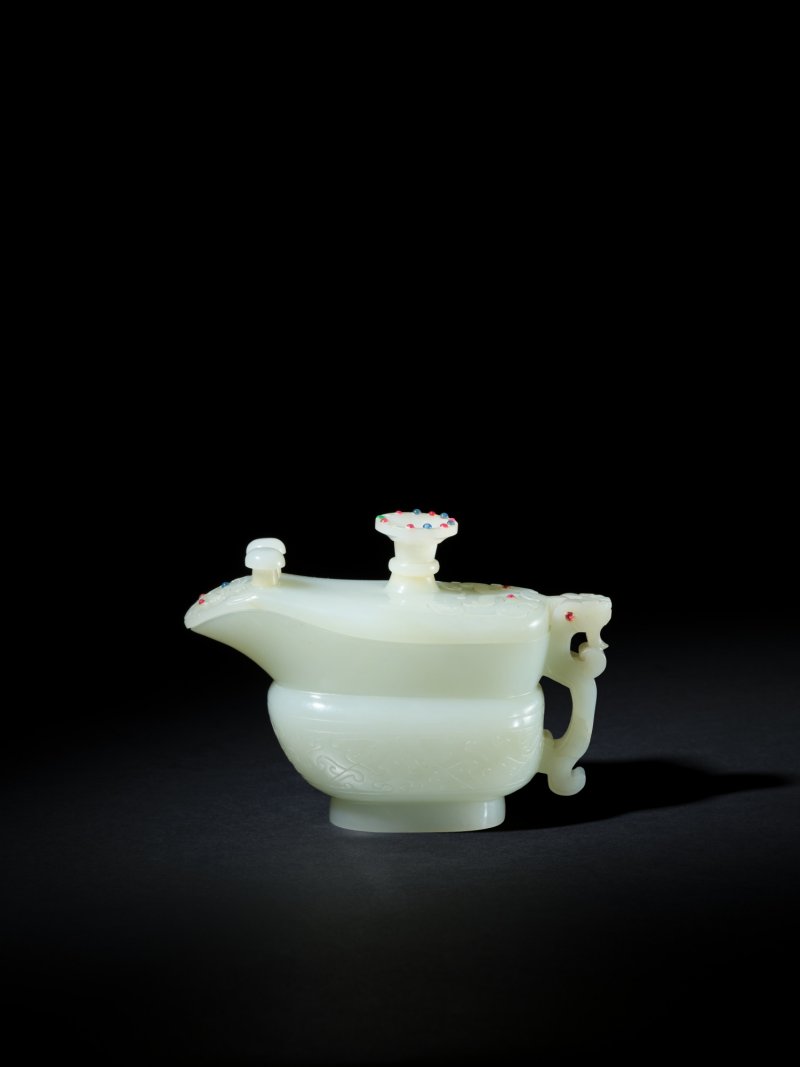
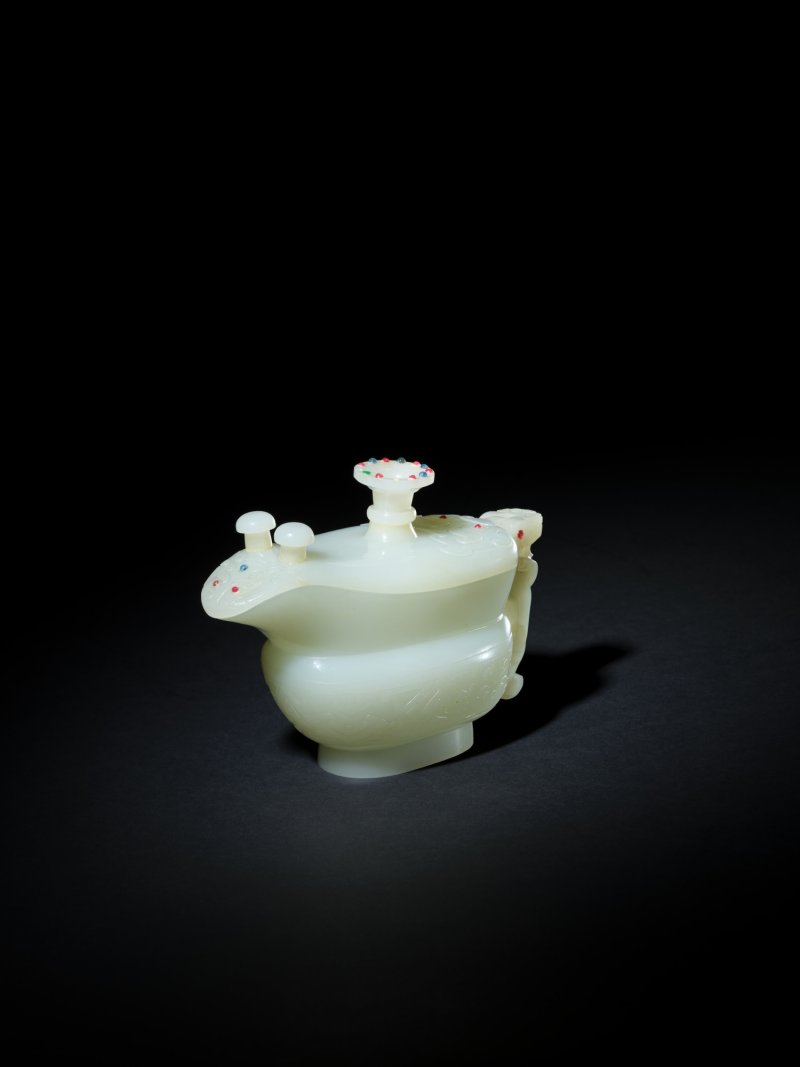
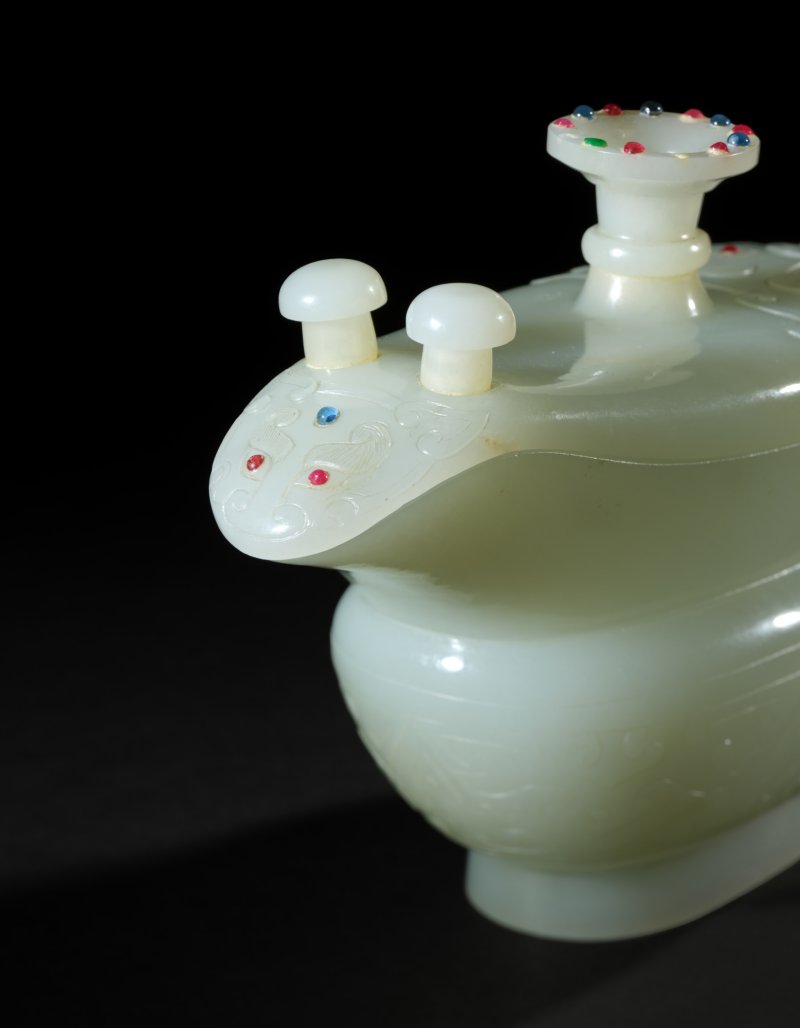
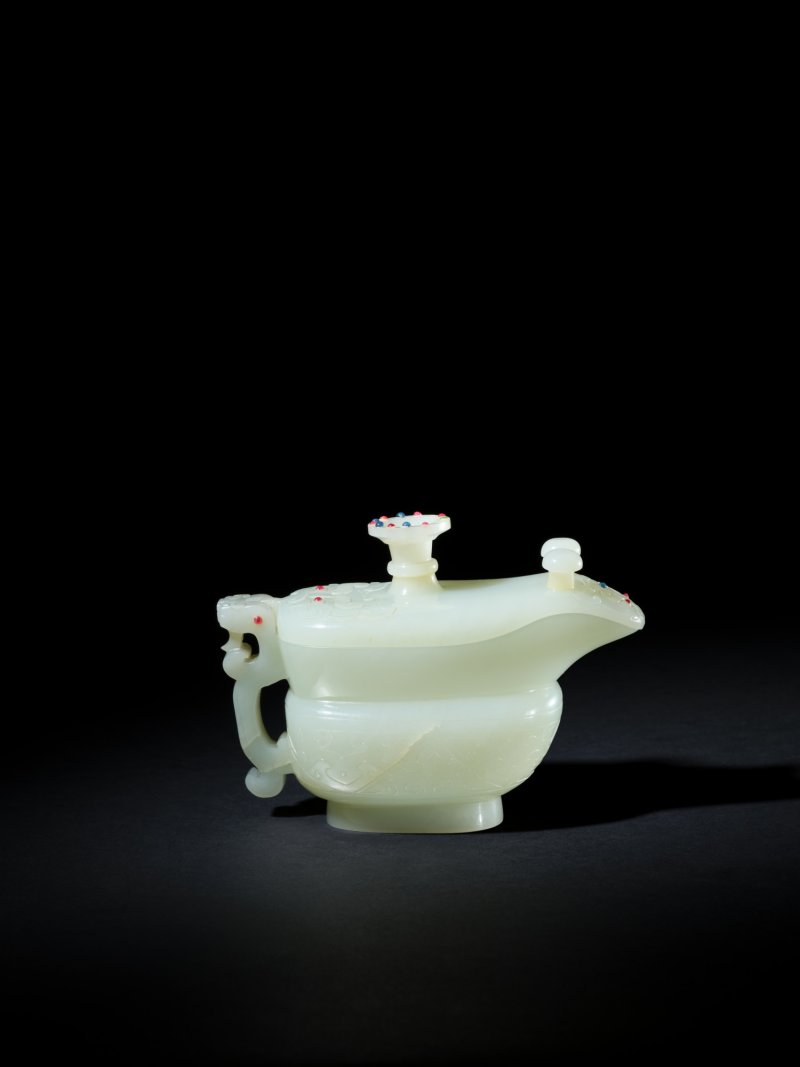
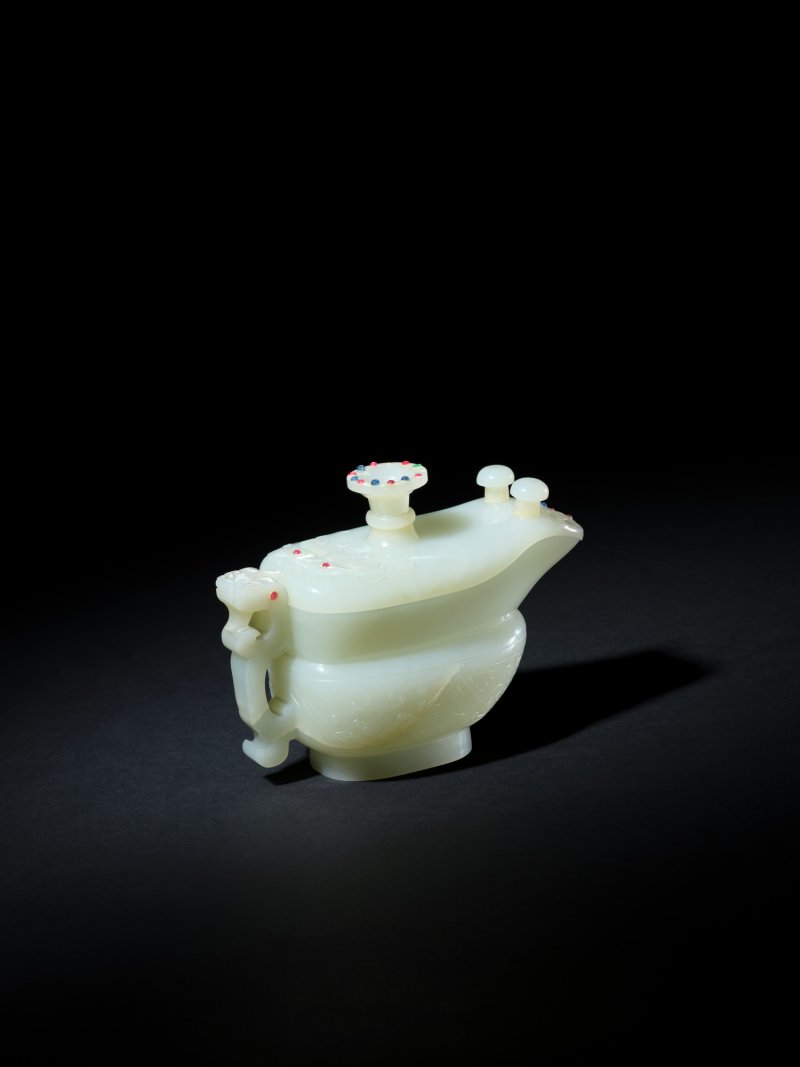
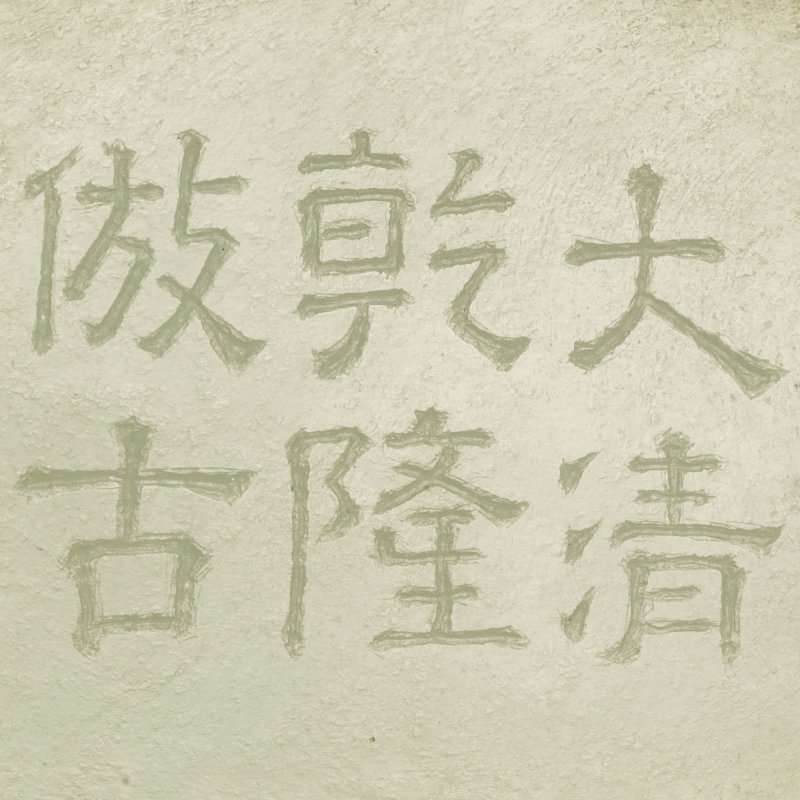
Lot 8057 A rare imperially inscribed celadon jade archaistic vessel and cover, yi, Fanggu mark and period of Qianlong, dated to the bingshen year (1776) | 清乾隆丙申年(1776年) 御製御題詩青白玉夔匜 《大清乾隆仿古》款
落槌价
预展中
成交价
预展中
| 拍卖公司 | 苏富比 |
|---|---|
| 拍卖时间 | 2026年10月30日 |
拍品信息
拍品名称
A rare imperially inscribed celadon jade archaistic vessel and cover, yi, Fanggu mark and period of Qianlong, dated to the bingshen year (1776) | 清乾隆丙申年(1776年) 御製御題詩青白玉夔匜 《大清乾隆仿古》款
起拍价
HKD 5,000,000
估值区间
5,000,000 - 8,000,000 HKD
尺寸
未知
品相
如欲了解本拍品狀況的更多資訊,請聯絡 Rubie.Fong@sothebys.com
更多信息
15.3 cm
来源:Illustrated Catalogue of an Extraordinary Collection of Imperial Jades and Other Beautiful Objects …: Mostly from the Private Collection of the Late Captain J.F. Peel … To Be Sold at Unrestricted Public Sale by Order of Messrs. Yamanaka & Co., American Art Galleries, New York, 1912, no. 163.
Collection of Robert Elliot Tod (1867–1944) and Katharine Alexander Chew Tod (1882–1969), and thence by family descent.
Sotheby’s New York, 23rd March 2011, lot 610.
A Hong Kong private collection.
图录
说明:來源
《宮廷玉器及其他珍玩圖錄:多為 J.F. Peel 私人收藏,經山中商會委託公開拍賣》,American Art Galleries,紐約,1912年,編號163
Robert Elliot Tod(1867–1944年)及 Katharine Alexander Chew Tod(1882–1969年)伉儷收藏,此後家族承傳
紐約蘇富比2011年3月23日,編號610
香港私人收藏
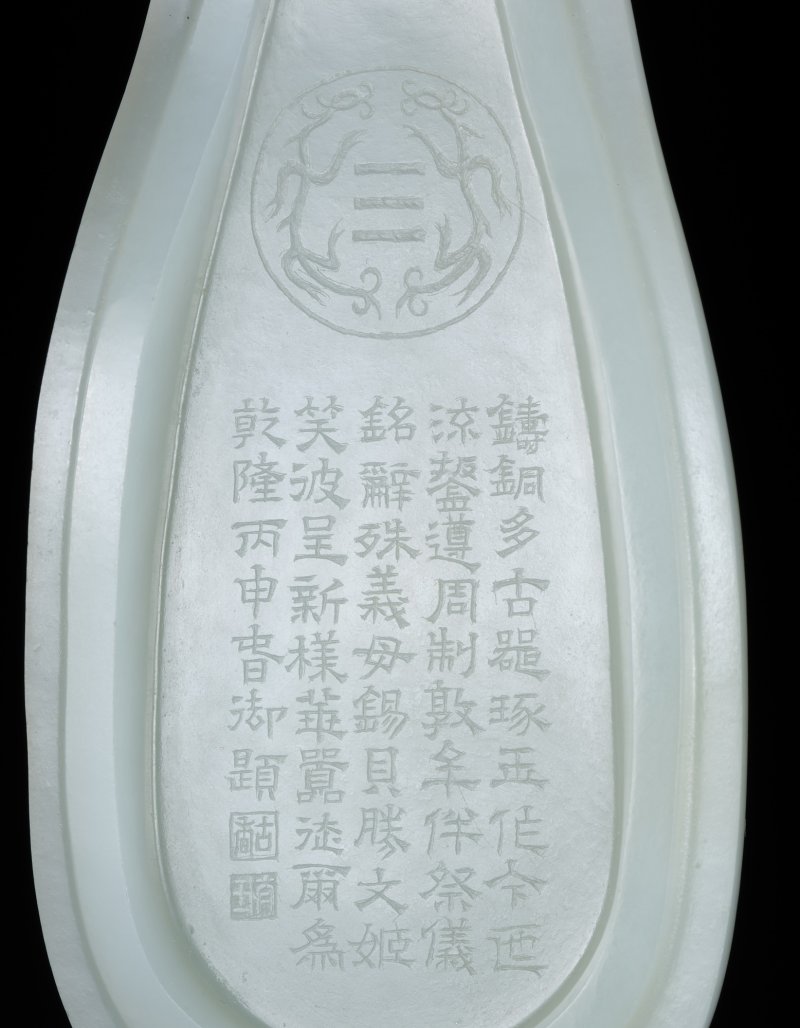
Of pure celadon-white stone, adorned with glass jewels, carved with vibrant archaic imagery and inscribed with an imperial poem, the present vessel is a masterpiece of Qing archaism. Carved across the inside of the cover below a Qian trigram confronted by dragons is the following inscription, composed by the Qianlong emperor himself:
鑄銅多古器,琢玉作今匜,
流鋬遵周制,敦牟伴祭儀,
銘詞殊義母,錫貝勝文姬,
笑彼呈新樣,華囂徒爾為。
In ancient times many vessels were cast in bronze,
But now this yi is made from polished jade.
Its spreading handle accords with Zhou conventions,
A fit companion in rituals to the dun and mou cauldrons.
Its inscription may differ from the one on the Yi Mu [vessel],
But as a treasure conferred it surpasses the Wen Yi [vessel].
I laugh at those presenting ‘New Style’ [jades],
Their gaudy ostentatiousness is all for nought.
Composed by the Qianlong emperor in the spring of the bingshen year (corresponding to 1776)
Entitled Yong Hetian yu kuiyi (Ode to a Hetian Jade kuiyi), this poem is recorded in the Qing Gaozong yuzhi shiwen quanji [Compendium of poems and writings imperially composed by Qing Gaozong], ji 4, juan 37, p. 27, and was inscribed on imperial command, apparently onto the very vessel that inspired it.
As the last couplet of the inscription proudly notes, the present vessel represents the Qianlong Emperor’s explicit rejection of the so-called ‘New Style’ (xinyang). Rising in popularity among the broader elite, a style of jade-carving appears to have emerged during the eighteenth century that was anathema to the monarch. Typified by spendthrift use of the material that revealed the original appearance of the stone and worked around natural inclusions, this heavily ornamental style was criticised throughout the Qianlong Emperor’s writings as an unworthy and ‘common’ use of the imperial material; see The Refined Taste of the Emperor: Special Exhibition of Archaic and Pictorial Jades of the Ch’ing Court, Palace Museum, Taipei, 1997, pp. 15-46. Reclaiming jade arts as the rightful domain of the imperial family alone, the Emperor advocated instead for the restoration of ancient ways or, as the mark of the present vessel puts it, fang gu (‘imitating antiquity’). As the celebrated emperors of the Song dynasty (960–1279) had done centuries before him, Qianlong saw it as his Confucian responsibility to turn to the ancients for inspiration: in statecraft, in conduct and in art.
In form, the present vessel is derived from archaic bronze vessels now known to connoisseurs as gong 觥 or, as the Qianlong Emperor knew them, yi 匜. Produced for elite ritual contexts in the Shang and Western Zhou dynasties, primarily between 1700 and 900 BCE, these magnificent bronze vessels continued to be studied and admired in the ensuing millennia, with 31 examples preserved in the court collection of Qianlong.
Like the great antiquarians before him, the Qianlong Emperor channelled this admiration for antiquity through the medium of epigraphy. Since the reign of Huizong, emperors, scholars and connoisseurs alike have recorded the forms and inscriptions of archaic bronze vessels in an attempt to understand, appreciate and immortalise the handicrafts of their ancestors. This practice appears to have been first applied to the antiques of an imperial collection during the illustrious reign of the Song Emperor Huizong (r. 1100–1126), who commissioned the Xuanhe bogu tu [Illustrations on a wide range of antiques from the Xuanhe reign] to catalogue his extensive collection of archaic bronzes. In Huizong’s footsteps, the Qianlong Emperor similarly collected a plethora of archaic bronzes, admired them, wrote poems inspired by them and commissioned vast catalogues (particularly the Xiqing gujian [Mirror of antiquity of the Western Qing]) collating them in the style of the Xuanhe bogu tu.
Records of the imperial workshops show how crucial these catalogues became to the Emperor’s archaism. Sent along with raw materials to the relevant workshop, line-drawings from the Xiqing gujian (and possibly earlier compendia) were brought to craftsmen to serve as inspiration, to be emulated in style, dimensions and impact.
While the specific imperial commission responsible for the present vessel has yet to be decoded, its archaic inspiration may be found by means of its inscription. Towards the end of the poem, the Qianlong Emperor turns to the ‘Wen Yi’ and the ‘Yi Mu’ vessels for comparison. These two bronze vessels, formerly preserved in the court of Song Huizong, are immortalised with line drawings in the twentieth juan of the Xuanhe bogu tu, pp. 31, 32 and 35 (fig. 1-3). While the present jade carving displays an artistic freedom clearly of eighteenth century origin and quite distinct from these two line drawings, the general scroll-like adornment of the lower section bears a remarkable resemblance to the surface decoration of both, and particularly to the Yi Mu Yi. Whether these specific drawings served as inspiration to the jade carvers or more generally formed part of a milieu with which they were familiar remains an unresolved question. What is clear, however, is the impact in text and design alike that such drawings made. While the Yi Mu Yi and Wen Yi Yi appear not to have survived into the eighteenth century, their memory and the legacy of those who preserved it remain embodied in the present vessel. Celebrating the artisans of the Shang and Zhou, the forethought and inquisition of the Song and the scholarly nature and artistic vision of the Qianlong Emperor himself, the present vessel proudly represents an unbroken chain of Chinese history through the millennia and places its owner, the Emperor, as the culmination of this artistic journey.
Several jade gong vessels of related form appear to have survived from the imperial collection. Compare two closely related examples without inlaid stones, in The Refined Taste of the Emperor, op. cit., cat. nos 13 and 20; another in The Complete Collection of Treasures of the Palace Museum. Jadeware (III), Hong Kong, 1995, pls 138 and 139, the latter particularly close in form and colour; a fourth gong in Tianjin shi Yishu Bowuguan cang yu [Jades in the Tianjin City Art Museum], Hong Kong, 1993, pl. 203; and a fifth, similarly inscribed with an Imperial poem, and also bearing a Qianlong fang gu mark, sold in our New York rooms, 19th March 2007, lot 8.
本品青白玉質,色澤純淨,嵌以料石,雕飾古樸盎然,並鐫御製詩一首,為清代仿古玉器之傑作。蓋內雕雙龍護乾卦,其下鐫刻乾隆帝御筆詩文:
鑄銅多古器,琢玉作今匜,
流鋬遵周制,敦牟伴祭儀,
銘詞殊義母,錫貝勝文姬,
笑彼呈新樣,華囂徒爾為
乾隆丙申年春御題
此詩題為〈詠和闐玉夔匜〉,著錄於《清高宗御製詩文全集》集四,卷三十七,頁二十七。此詩奉旨鐫刻於本品之上,足見本品即為啟發帝王賦詩之源。
詩末一聯語帶傲意,正見乾隆帝對所謂「新樣」之斷然否定。十八世紀間,達官貴人之間漸興一種琢玉風尚,為皇帝所深惡。此風靡費玉材,刻意保留玉皮並就天然綹裂隨形避讓,雕工繁縟;乾隆帝於著述中屢加貶抑,斥為糟蹋御用之材的「俗」用(參見《宮廷之雅:清代仿古及畫意玉器特展圖錄》,故宮博物院,台北,1997年,頁15至46)。乾隆帝力主玉器審美應由皇室主導,故轉而提倡復古,一如本器款識所書之「仿古」。數百年前,宋代(960–1279年)諸帝已開此風氣之先,乾隆帝亦以取法先民為儒家君主之責,治國、修身、論藝,皆以古為師。
就器形而言,此匜源自高古青銅器,今之鑑藏家多稱之為「觥」,乾隆帝則名之曰「匜」。此類青銅重器鑄於商代至西周(主要在公元前1700年至900年之間),乃貴族祭祀禮器;其後數千年,一直為世人研習賞鑒,乾隆內府所藏即有31件。
一如前代金石大家,乾隆帝對古物之傾慕,同樣寄託於金石之學。自宋徽宗一朝以來,帝王、學者與鑑藏家紛紛摹錄古青銅器之形制與銘文,冀能通解、賞鑒,使先民百工得以不朽。此舉應用於宮廷收藏,似始於宋徽宗(1100–1126年在位)盛世;徽宗敕修《宣和博古圖》,以著錄內府繁富之青銅舊藏。乾隆帝踵武徽宗,同樣廣蒐上古青銅,寶愛之餘賦詩詠之,又敕編巨帙加以匯錄,其中尤以《西清古鑑》為要,體例盡仿《宣和博古圖》。
從清宮造辦處檔案可見,此類圖籍對皇帝之仿古風尚至關重要。內府將《西清古鑑》(或更早之圖譜)中的線描圖樣連同玉材一併發往造辦處,交匠人取法,於風格、尺寸與神韻各方面加以摹擬。
雖本品之具體造辦紀錄尚待考證,然其仿古淵源,可自詩文中尋出端倪。詩近末處,乾隆帝以「文姬」、「義母」二器相較。此兩件青銅舊藏原屬徽宗內府,其線描圖樣見於《宣和博古圖》卷二十,頁31、32及35(圖1至3),賴以傳世。本器之琢工揮灑自如,具典型十八世紀風格,雖與兩幅線描圖面目迥異,然下腹一帶之卷曲紋飾,與二器之表面裝飾極為相近,與義母匜尤為神似。此類圖錄究竟為玉工直接臨摹之粉本,抑或僅為當時盛行風尚之體現,至今未有定論。然可以肯定的是,此類圖樣於文辭與紋飾兩方面皆影響深遠。義母匜與文姬匜雖似已不存於十八世紀,然二器之記憶,以及保存這份記憶者所留之遺風,皆凝練於本器之中。商周匠人之巧藝、宋人之遠見與考索、乾隆帝本人之學養與藝術遠見,於此一器之上匯而為一,貫串數千年中國歷史而未嘗中斷,而器主乾隆皇帝,正是這段藝術歷程之集大成者。
清宮舊藏之中,形制相類之玉觥尚有數例傳世。可比較兩件形制相近而無嵌飾者,載於前揭《宮廷之雅》,編號13及20;另一例見《故宮博物院藏文物珍品全集・玉器(下)》,香港,1995年,圖版138及139,後者之器形與玉色尤為接近;第四例見《天津市藝術博物館藏玉》,香港,1993年,圖版203;第五例亦鐫御製詩,並具乾隆「仿古」款,2007年3月19日售於紐約蘇富比,拍品編號8。
常见问题
这件A rare imperially inscribed celadon jade archaistic vessel and cover, yi, Fanggu mark and period of Qianlong, dated to the bingshen year (1776) | 清乾隆丙申年(1776年) 御製御題詩青白玉夔匜 《大清乾隆仿古》款的成交价是多少?
落槌价为 预展中。 成交价为 预展中。
拍品的品相状况如何?
如欲了解本拍品狀況的更多資訊,請聯絡 Rubie.Fong@sothebys.com
这件拍品的流传来源是什么?
Illustrated Catalogue of an Extraordinary Collection of Imperial Jades and Other Beautiful Objects …: Mostly from the Private Collection of the Late Captain J.F. Peel … To Be Sold at Unrestricted Public Sale by Order of Messrs. Yamanaka & Co., American Art Galleries, New York, 1912, no. 163.
Collection of Robert Elliot Tod (1867–1944) and Katharine Alexander Chew Tod (1882–1969), and thence by family descent.
Sotheby’s New York, 23rd March 2011, lot 610.
A Hong Kong private collection.
图录
Collection of Robert Elliot Tod (1867–1944) and Katharine Alexander Chew Tod (1882–1969), and thence by family descent.
Sotheby’s New York, 23rd March 2011, lot 610.
A Hong Kong private collection.
图录