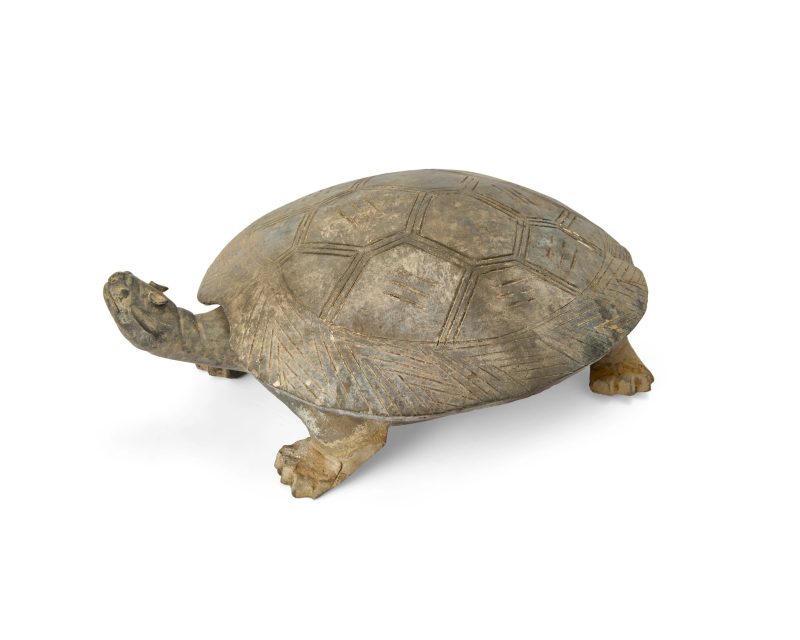
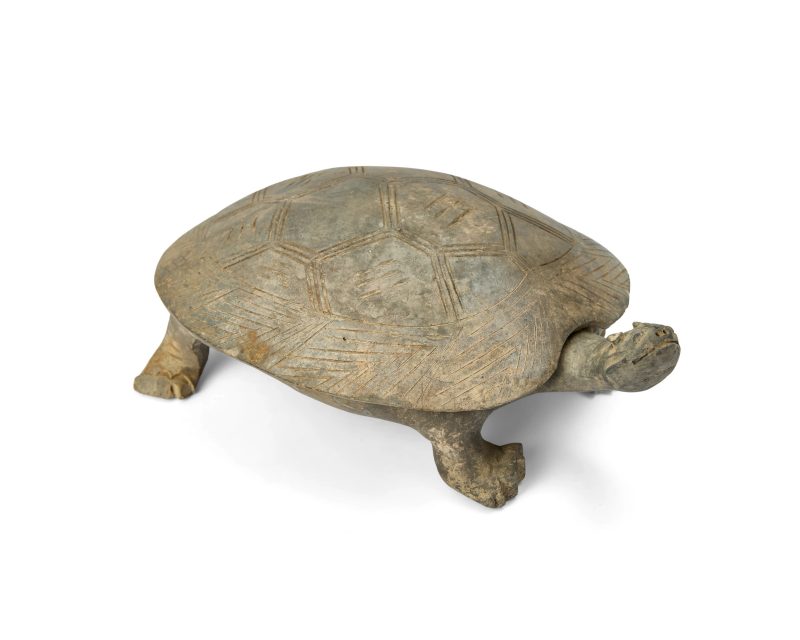
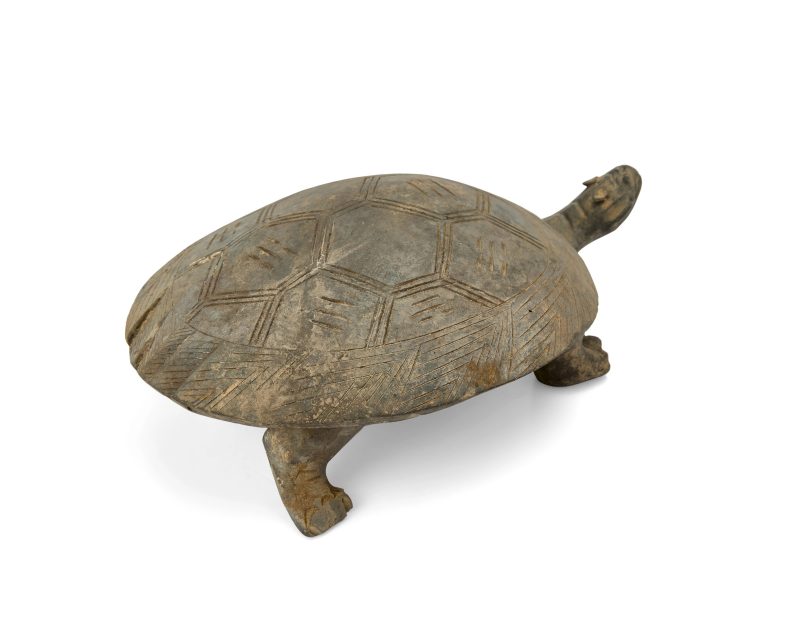
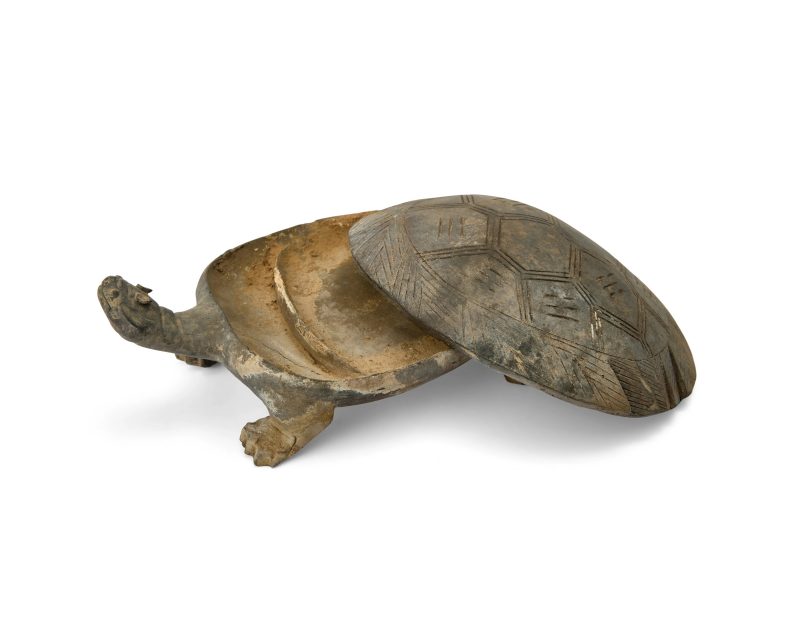
Lot 50 漢 陶製龜形八卦紋蓋硯 | A Chinese pottery tortoise-shaped inkstone and cover
落槌价
预展中
成交价
预展中
| 拍卖公司 | Roseberys |
|---|---|
| 拍卖时间 | 2026年11月03日 |
拍品信息
拍品名称
漢 陶製龜形八卦紋蓋硯 | A Chinese pottery tortoise-shaped inkstone and cover
年代
Han dynasty
起拍价
GBP 2,000
估值区间
Estimate: £5,000 - £6,000
尺寸
24.5cm long x 17.8cm wide x 8.5cm high.
品相
未知
更多信息
The Property of a Gentleman, to be offered without reserve (Lots 1 - 56)
A Chinese pottery tortoise-shaped inkstone and cover
Han dynasty
Naturalistically modelled as a tortoise standing four-square on short limbs with the forelegs resting naturally on the ground and the hind legs stretched backwards, its head gently raised and inclined towards the right, with a charmingly genial expression, the recessed tortoise shell forming an ink reservoir, surmounted by a domed shell forming the cover, the surface carved with the Eight Trigrams, the marginal and anal scute of the carapace carved with regular geometric patterns of straight lines, 24.5cm long x 17.8cm wide x 8.5cm high. (Import Duty Charged on the Hammer Price) 落槌價徵收進口關稅
Provenance: British private collection, assembled in Hong Kong 1988-1998.
漢 陶製龜形八卦紋蓋硯
來源:英國私人收藏,於1988至1998年間在香港購藏。
Cf. A similar Han dynasty tortoise-shaped inkstone was sold at Bonhams, London, on 7 November 2019, lot 29. Another example of a tortoise-shaped inkstone, dating from the Sui to early Tang dynasty, is in the collection of The Metropolitan Museum of Art, New York, accession no. 2003. 82a, b.
參閲:一件相似的漢代龜形硯於2019年11月7日在倫敦邦瀚斯拍賣,拍品編號29。另一件隋至唐初的龜形硯藏於美國紐約大都會藝術博物館,館藏編號2003. 82a, b。
The tortoise, qilin, phoenix, and dragon are regarded as 'Four Divine Beings' (Si Ling). The Book of Rites records: “The qilin is steadfast and benevolent; the phoenix discerns the rise and fall of order and disorder; the tortoise foretells good and ill fortune; and the dragon is endowed with the power of transformation. Thus are they known as the Four Divine Creatures.” The Four Divine Beings embodied an ideal order in which human affairs, ritual conduct, and all living things each occupied their proper place within the greater harmony of Heaven and Earth. In framing the rites, the sages took into consideration Heaven and Earth, the changing seasons, the movements of the celestial bodies, human nature, and the myriad forms of life.
As the Book of Rites, in its chapter Liyun, further records: “Thus, when the dragon is brought into accord, the creatures of the waters do not plunge beneath the surface; when the phoenix is brought into accord, the birds do not take wing in fear; when the qilin is brought into accord, the beasts do not flee; and when the tortoise is brought into accord, the human heart does not depart from its proper nature.” This presents an ideal vision of an ordered world brought into being through ritual cultivation, in which the Four Divine Beings themselves are imagined as capable of being brought into harmony with the human realm. Among them, the tortoise, believed to reveal good and ill fortune, discern what was yet to come, and perceive the course of human affairs, came to embody the ordering of the human world. The Book of Rites further states: “the kings, holding the divining stalks and tortoise shells, ordered the rites of sacrifice, proclaimed the words of blessing and prayer, and established the institutions of government. In this way, the state was governed by ritual, every official had his proper charge, every affair its appointed function, and every rite its rightful order.”
Its armoured shell, its ability to dwell in both water and on land, and its remarkable endurance in the face of hunger and thirst inspired in early peoples a profound reverence for the tortoise. From these natural attributes emerged an imaginative world in which the tortoise acquired meanings that transcended the bounds of its physical existence.
As early as the age of the primordial tribes, tortoise shells were employed for divination. By the Shang dynasty, the practice of turtle divination had flourished: tortoise shells were exposed to intense heat until they cracked into myriad patterns, known as guixiang, or “tortoise signs”. Through these signs, people sought to discern auspicious and ominous portents, and to divine the fortunes of prosperity and adversity. In the Records of the Grand Historian (Shiji), the Western Han historian Sima Qian writes in the Biographies of the Tortoise divination (Guice Liezhuan): “From antiquity, whenever a sage king was about to establish a state, receive the Mandate of Heaven, or embark upon a great undertaking, when did he ever fail to prize divination as an aid to the accomplishment of what was right? Of the times before Tang and Yu, little can now be known. From the rise of the Three Dynasties onwards, each rested its foundation upon auspicious omens. The portent at Tushan heralded the rise of Xia Qi and the founding of the Xia dynasty; the divination of the flying swallow accorded with the destiny through which Yin flourished; and the auspicious divination concerning the hundred grains foretold the rise of the Zhou kings. Whenever a ruler was called upon to resolve matters of doubt, he consulted the signs revealed through divination, and entrusted his final judgement to the milfoil and the tortoise shell. Such, from of old, has been the immutable way of kings.”
Within the royal court, divination was accorded profound importance. The tortoise was regarded as a sacred medium through which the will of Heaven could be communicated to the sovereign. Matters of consequence were submitted to divination before action was taken, and the questions and prognostications were inscribed upon tortoise plastrons and animal bones. Since the discovery of the tortoise plastrons and oracle bones at the ruins of Yin, some 150,000 inscribed fragments have been unearthed. Their inscriptions record a remarkable range of matters concerning the royal household and the state. From this tradition emerged oracle-bone script, the earliest known form of Chinese writing.
By the Han dynasty, the widespread use of bamboo slips, followed by the development of papermaking in the Eastern Han, had gradually displaced tortoise shell as a writing material. Yet, paradoxically, the veneration of the tortoise reached new heights. The Ding, a ritual bronze vessel associated with imperial authority since the Shang and Zhou periods, was cast with tortoise motifs during the Han and became known as the “Tortoise Ding” (Gui Ding). It symbolised the hope that the Han dynasty would enjoy a longevity as enduring as that of the divine tortoise.
The Records of the Grand Historian further relates: “He who first obtained this tortoise would become the Son of Heaven; every word would be answered, and every battle would be won. … Today, within the High Ancestral Temple, a chamber is kept for the tortoise, which is treasured there as a sacred portent.”
The tortoise motif also came to feature prominently on objects invested with political authority, including imperial regalia, official seals, tallies, and other emblems of rank. It thus became a visible symbol of imperial power and official status. The Book of the Later Han, in its account of ceremonial dress and insignia, records that when the Han emperors proceeded to suburban sacrifices or travelled on imperial progresses, their grand processions were accompanied by banners bearing the emblems of the dragon, phoenix, tiger, and tortoise. A commentary on the same passage further records: “The Crown Prince and feudal kings bore gold seals with tortoise-shaped knobs and red silk ribbons.”
Seen in this light, the tortoise-shaped inkstone with its Eight Trigrams decoration is more than a vessel for the scholar's brush. The tortoise bears the Eight Trigrams, evoking the order of Heaven and Earth, while the inkstone receives the scholar's ink and gives form to the written word. From an instrument of divination to an emblem of the Way, within its small compass lies an echo of an intellectual tradition stretching across millennia. The tortoise has carried across the centuries an ancient Chinese vision of a world in which Heaven and Earth are ordered, life endures, and human affairs find their rightful place within the greater harmony of the cosmos.
烏龜與麒麟、鳳凰、龍並稱為四靈。《禮記》記載:「麟體信厚,鳳知治亂,龜兆吉凶,龍能變化,故謂之四靈。」聖人制禮時,會考量天地、四時、天體運行、人情及生靈,而四靈則反映了人間政事、禮制行為與生靈萬物各得其序的理想。《禮記·禮運》曰:「龍以為畜,故魚鮪不淰。鳳以為畜,故鳥不獝。麟以為畜,故獸不狘。龜以為畜,故人情不失。」這一幅經禮儀教化而成的理想秩序圖景,被設想為四靈在有序世界中皆可馴服:魚不潛藏、鳥不飛遁、獸不逃散,人情亦不會偏離正道。其中烏龜因其兆吉凶,道未來,通人運,被視為正人間秩序的象徵。「故先王秉蓍龜,列祭祀,瘞繒,宣祝嘏辭說,設制度,故國有禮,官有御,事有職,禮有序。」
因甲胄覆體,水陸雙棲,耐飢耐渴,先民對不食不死的烏龜產生了崇拜,並隨之發展出許多遠超生命實體的精神喻想。
自原始部落時期,人們就開始藉助龜甲和蓍草進行占卜。殷商王朝,龜卜尤爲盛行,以灼燒龜甲使其裂變,形成五花八門的「龜象」裂紋來預測吉凶禍福。西漢司馬遷在《史記·龜策列傳》中記:「太史公曰:自古聖王將建國受命,興動事業,何嘗不寶卜筮以助善!唐虞以上,不可記已。自三代之興,各據禎祥。涂山之兆從而夏啟世,飛燕之卜順故殷興,百穀之筮吉故周王。王者決定諸疑,參以卜筮,斷以蓍龜,不易之道也。」王室極為迷信,龜被視為溝通天神與人君的化身,遇事必卜問而後行之,並將卦辭刻在龜甲或骨頭上。自殷墟甲骨發現以來,先後出土了約十五萬片刻辭甲骨,其中刻辭記述了大量王朝國事和王室活動。中國最早的文字甲骨文也由此應運而生。
至漢時,竹簡及東漢改良造紙術出現,龜甲喪失了承載文字的功能,然而龜崇拜卻到達了爆發。自商周以來一直被認為代表帝王權力的國鼎,至漢時被鑄加以龜紋,命名為「龜鼎」,寓意漢王朝與神龜同壽。《史記·龜策列傳》記載:「先得此龜者為天子,且十言十黨,十戰十勝……今高廟中有龜室,藏內以為神寶。」龜遂與統治權、王權產生了緊密聯繫,成爲神異、祥瑞與天命的象徵。
龜也出現在帝王儀仗、官印、符節等代表政治權威的器物之上,成爲等級與政治秩序的視覺符號。據《後漢書·輿服志》所載,漢時帝王郊祀、巡狩之際,儀仗森然,旌旗蔽日,列隊之中除建龍、鳳、虎諸旗之外,亦有龜旗。《後漢書·輿服志》注曰:「太子及諸侯王,金印,龜紐,纁朱綬。」
龜之於中國古代,從來不只是一介水陸之物。其負甲而行,若承天地;其壽綿延,若窺造化;其兆吉凶,似能通幽冥、察人事。龜的形象已由自然生命昇華為一種貫通天地與人間的文化符號,映照著古人對權威與天命的想像。及至漢代,龜紋入器,龜形入印,龜旗列於儀仗,神龜藏於高廟,其形已不復止於占卜之甲,而成為國家禮制與政治秩序的一部分。
故觀此龜形八卦紋蓋硯,甲負八卦象天地,硯承翰墨以載道。方寸之間,蘊藏了仰觀天象、俯察人事、以龜問道的千年智慧。
以下内容由AI翻译:
【名称】
漢 陶製龜形八卦紋蓋硯
【年代】
汉
【描述】
一位绅士的财产,无保留价拍卖(拍品编号1-56)
一件中国陶制龟形砚台及盖
汉代
自然地塑造为一只四足稳立的乌龟,前腿自然地放在地上,后腿向后伸展,头部微微抬起并向右倾斜,表情亲切和蔼,凹陷的龟壳形成墨池,上方覆盖着一个圆顶形的壳作为盖子,表面刻有八卦图案,边缘和肛盾雕刻有规则的几何直线图案,长24.5厘米 x 宽17.8厘米 x 高8.5厘米。 (落槌价征收进口关税)
常见问题
这件漢 陶製龜形八卦紋蓋硯 | A Chinese pottery tortoise-shaped inkstone and cover的成交价是多少?
落槌价为 预展中。 成交价为 预展中。
拍品的尺寸是多少?
24.5cm long x 17.8cm wide x 8.5cm high.