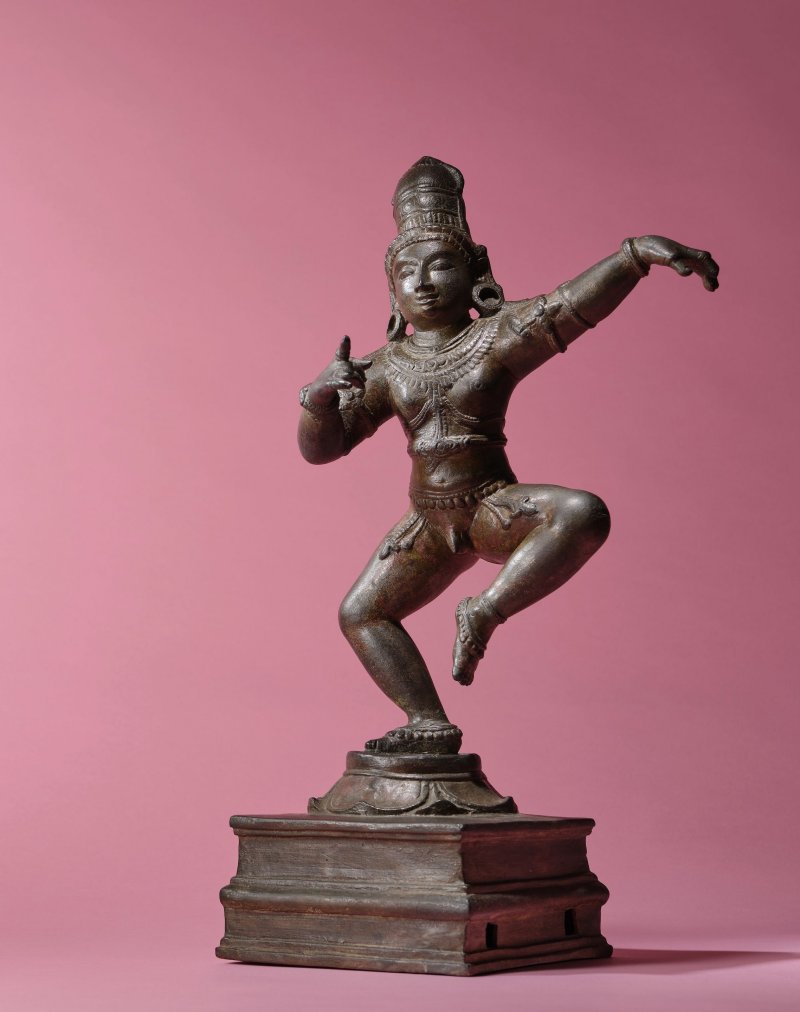

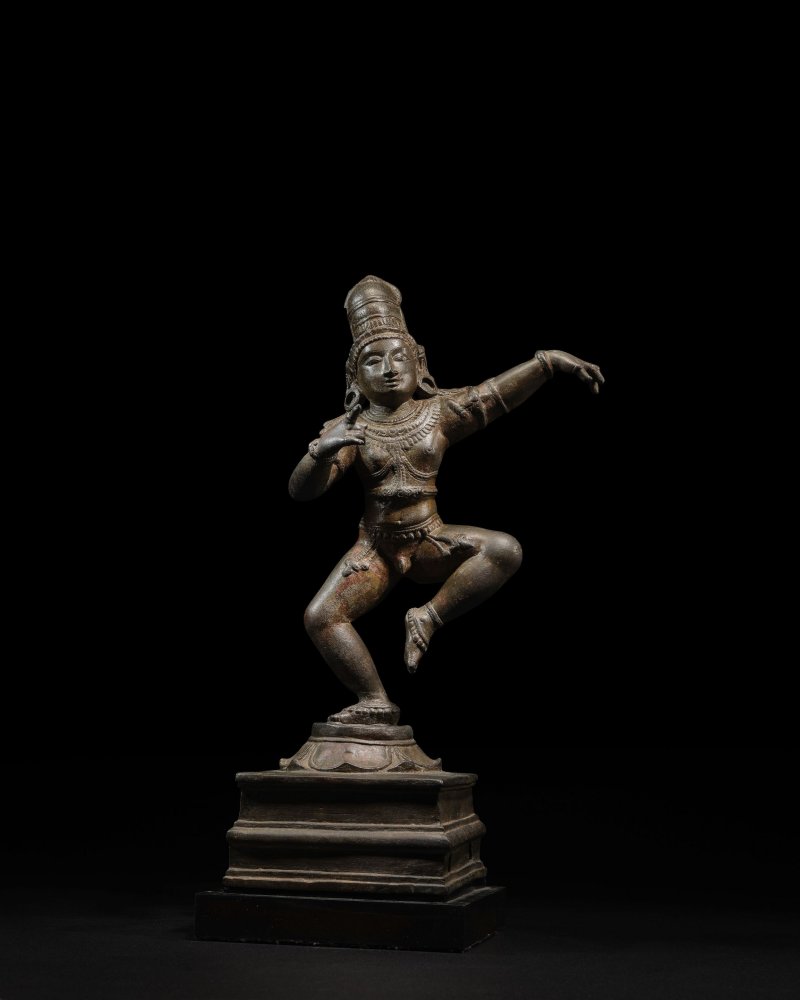
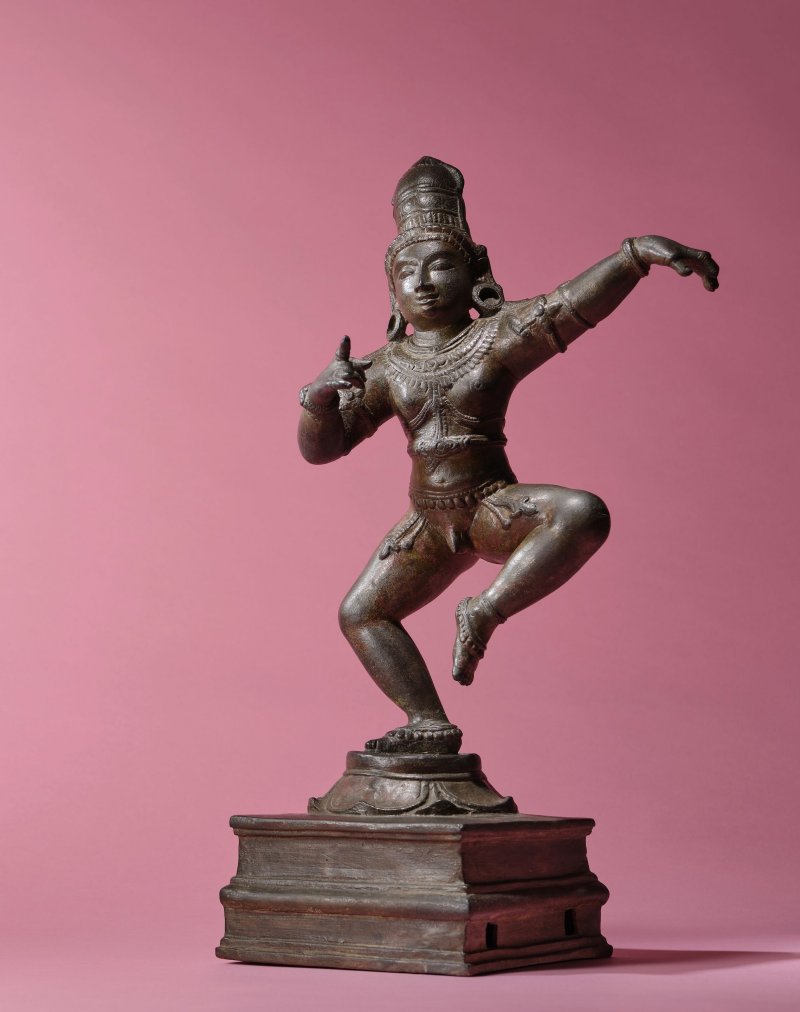

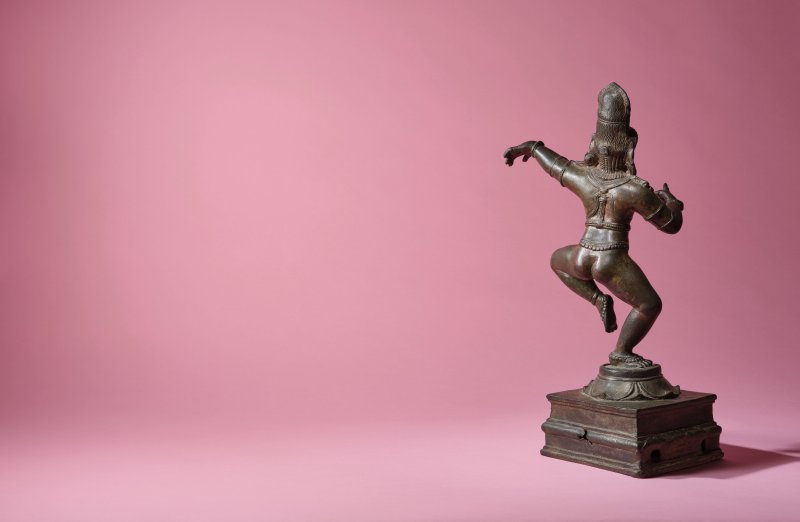
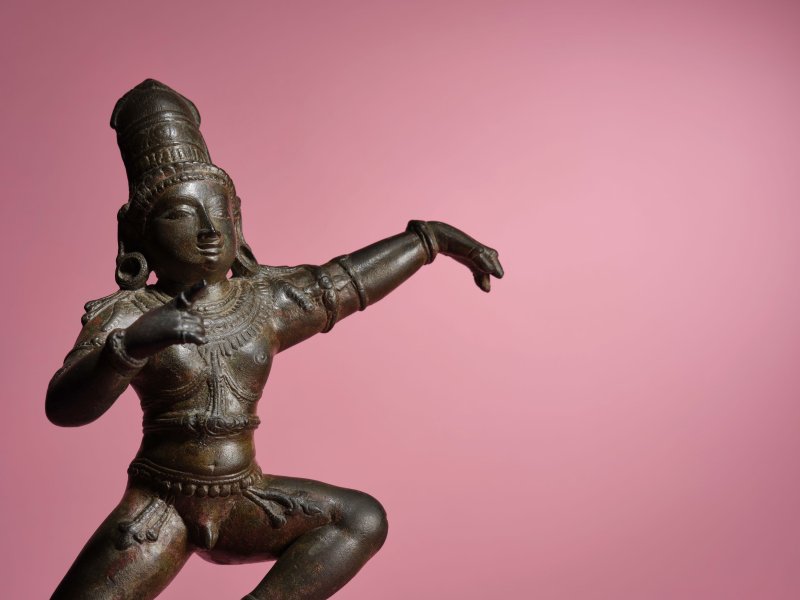
Lot 806 泰米爾納德 朱羅王朝 十一/十二世紀 森班達爾銅像 | A COPPER ALLOY FIGURE OF SAMBANDAR
落槌价
预展中
成交价
预展中
| 拍卖公司 | 邦瀚斯 |
|---|---|
| 拍卖时间 | 2026年10月29日 |
拍品信息
拍品名称
泰米爾納德 朱羅王朝 十一/十二世紀 森班達爾銅像 | A COPPER ALLOY FIGURE OF SAMBANDAR
年代
TAMIL NADU, CHOLA PERIOD, 11TH/12TH CENTURY
起拍价
HKD 800,000
估值区间
HKD 800000 - 1200000
尺寸
未知
品相
未知
更多信息
TAMIL NADU, CHOLA PERIOD, 11TH/12TH CENTURY
43 cm (16 7/8 in.) high
Footnotes
泰米爾納德 朱羅王朝 十一/十二世紀 森班達爾銅像
Published
Eberhard Rist, Treasures of Hindu Art, Vol. 1, pp. 574-575, no. 147.
Provenance
Estate of Lawrence Phillips, 1960s
Sotheby's, New York, 19 March 2014, lot 44
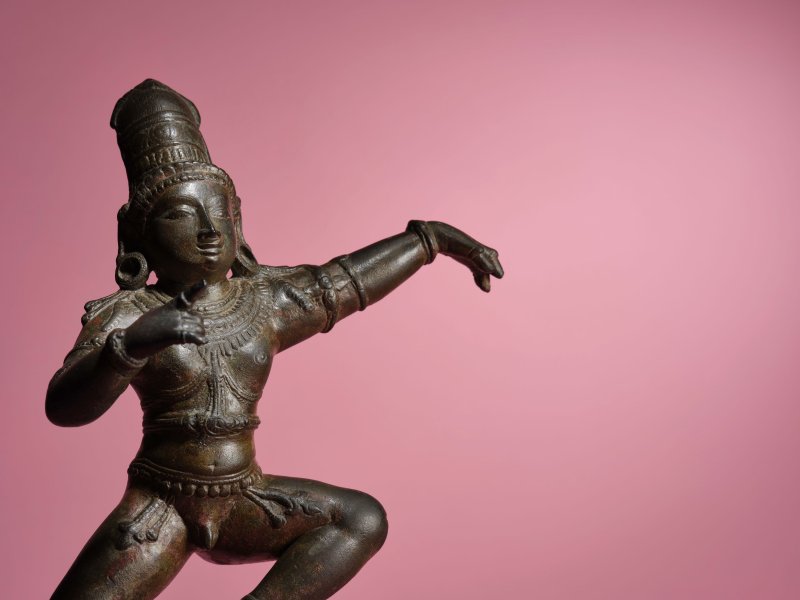
The child saint Sambandar, the most beloved of the sixty-three Nayanars of Tamil Shaivism, is captured here in the ecstatic dance with which he first praised Shiva. He stands on a lotus with the right leg bent and the left raised in dance, the stance most characteristic of the saint. The left arm is extended in the graceful elephant-trunk gesture (gajahasta), while the right hand is raised before the chest, its index finger extended in the pointing gesture that identifies Sambandar and recalls the miracle at the heart of his legend.
According to tradition, the three-year-old Sambandar accompanied his father to the temple at Sirkazhi and, left alone while his father took a ritual bath in the temple tank, began to cry. Parvati herself descended and fed the child milk from a golden cup. Questioned by his returning father about the source of the milk on his lips, the boy pointed upward toward Shiva and his consort and burst into song and dance. The hymns that followed, of which nearly four hundred survive from the thousands credited to him by tradition, were set to music and form the opening books of the Tevaram, at the foundation of the Tamil Shaivite canon. It is this joyous musicality that the dancing image commemorates. The iconography is closely related to that of the dancing Krishna, a resonance surely intentional: the child blessed with Parvati's milk answers the child delighted with stolen butter, and the saint's towering headdress has been understood by Vidya Dehejia as an adaptation of Krishna's crown. The pointing finger, however, distinguishes Sambandar unambiguously, where Krishna's hand is raised in .
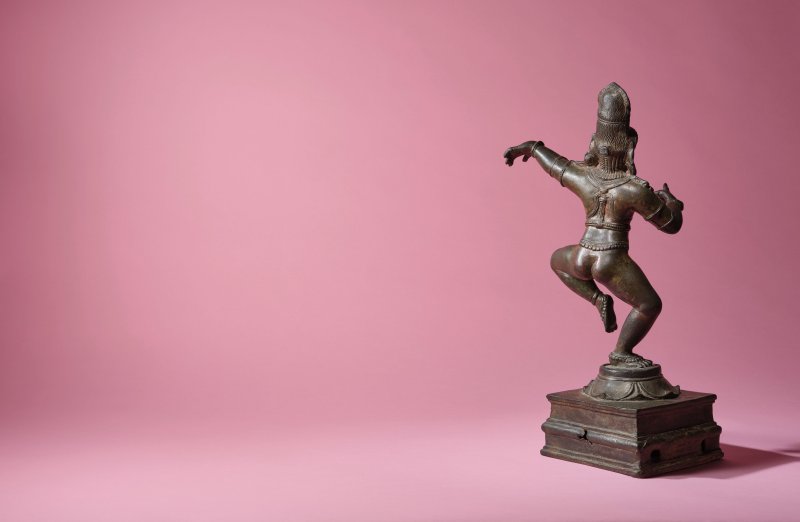
The modeling of the present figure is of notable quality. Finely rendered, from the gently swelling belly to the plump thighs and fleshy arms, the soft, full body of a child is invested with the poised energy of the dance. The torso sways from the weight-bearing leg, the raised foot turns inward with naturalistic ease, and the extended arms counterbalance one another so that the composition resolves in equilibrium. The face is serene and softly smiling, with almond-shaped eyes and a sharp, well-cut nose beneath the tall conical chignon secured by a narrow diadem. The saint is naked but for his ornaments: a girdle of bells () with pendent tassels at the hips, bell anklets, multiple bracelets and armlets, large circular earrings framing the face, and a heavy multi-row necklace from which delicate chains descend over the chest and back to a jeweled waist belt, branching to either side of the torso. The reverse is fully resolved, the chains crossing the back and the hair falling in finely incised locks. The solid-cast figure is inset into a lotus pedestal. The lotus and the hollow, stepped square base were cast in a single piece. The lower moulding is pierced on two sides with rectangular apertures for carrying poles, by which the image was borne in procession. Such bronzes were used in this way historically and, in Tamil Nadu, continue to be carried during temple festivals.
Bronzes of dancing Sambandar are considerably rarer than those of dancing Krishna, and the present figure is a comparatively large example of its type. A closely related dancing Sambandar of nearly identical scale is in the Linden-Museum, Stuttgart (SA 33588L; Vidya Dehejia, , New York, 2002, p. 154, cat. no. 28). Compare also the example sold at Christie's, New York, 13 September 2011, lot 272, and the dancing Sambandar from the Mr. and Mrs. John D. Rockefeller 3rd Collection in the Asia Society Museum, New York (1979.024; fig. 1).
For the figures listed in this essay, please refer to our printed or digital catalogue.
43 cm (16 7/8 in.) high
Footnotes
泰米爾納德 朱羅王朝 十一/十二世紀 森班達爾銅像
Published
Eberhard Rist, Treasures of Hindu Art, Vol. 1, pp. 574-575, no. 147.
Provenance
Estate of Lawrence Phillips, 1960s
Sotheby's, New York, 19 March 2014, lot 44
The child saint Sambandar, the most beloved of the sixty-three Nayanars of Tamil Shaivism, is captured here in the ecstatic dance with which he first praised Shiva. He stands on a lotus with the right leg bent and the left raised in dance, the stance most characteristic of the saint. The left arm is extended in the graceful elephant-trunk gesture (gajahasta), while the right hand is raised before the chest, its index finger extended in the pointing gesture that identifies Sambandar and recalls the miracle at the heart of his legend.
According to tradition, the three-year-old Sambandar accompanied his father to the temple at Sirkazhi and, left alone while his father took a ritual bath in the temple tank, began to cry. Parvati herself descended and fed the child milk from a golden cup. Questioned by his returning father about the source of the milk on his lips, the boy pointed upward toward Shiva and his consort and burst into song and dance. The hymns that followed, of which nearly four hundred survive from the thousands credited to him by tradition, were set to music and form the opening books of the Tevaram, at the foundation of the Tamil Shaivite canon. It is this joyous musicality that the dancing image commemorates. The iconography is closely related to that of the dancing Krishna, a resonance surely intentional: the child blessed with Parvati's milk answers the child delighted with stolen butter, and the saint's towering headdress has been understood by Vidya Dehejia as an adaptation of Krishna's crown. The pointing finger, however, distinguishes Sambandar unambiguously, where Krishna's hand is raised in .
The modeling of the present figure is of notable quality. Finely rendered, from the gently swelling belly to the plump thighs and fleshy arms, the soft, full body of a child is invested with the poised energy of the dance. The torso sways from the weight-bearing leg, the raised foot turns inward with naturalistic ease, and the extended arms counterbalance one another so that the composition resolves in equilibrium. The face is serene and softly smiling, with almond-shaped eyes and a sharp, well-cut nose beneath the tall conical chignon secured by a narrow diadem. The saint is naked but for his ornaments: a girdle of bells () with pendent tassels at the hips, bell anklets, multiple bracelets and armlets, large circular earrings framing the face, and a heavy multi-row necklace from which delicate chains descend over the chest and back to a jeweled waist belt, branching to either side of the torso. The reverse is fully resolved, the chains crossing the back and the hair falling in finely incised locks. The solid-cast figure is inset into a lotus pedestal. The lotus and the hollow, stepped square base were cast in a single piece. The lower moulding is pierced on two sides with rectangular apertures for carrying poles, by which the image was borne in procession. Such bronzes were used in this way historically and, in Tamil Nadu, continue to be carried during temple festivals.
Bronzes of dancing Sambandar are considerably rarer than those of dancing Krishna, and the present figure is a comparatively large example of its type. A closely related dancing Sambandar of nearly identical scale is in the Linden-Museum, Stuttgart (SA 33588L; Vidya Dehejia, , New York, 2002, p. 154, cat. no. 28). Compare also the example sold at Christie's, New York, 13 September 2011, lot 272, and the dancing Sambandar from the Mr. and Mrs. John D. Rockefeller 3rd Collection in the Asia Society Museum, New York (1979.024; fig. 1).
For the figures listed in this essay, please refer to our printed or digital catalogue.
常见问题
这件泰米爾納德 朱羅王朝 十一/十二世紀 森班達爾銅像 | A COPPER ALLOY FIGURE OF SAMBANDAR的成交价是多少?
落槌价为 预展中。 成交价为 预展中。