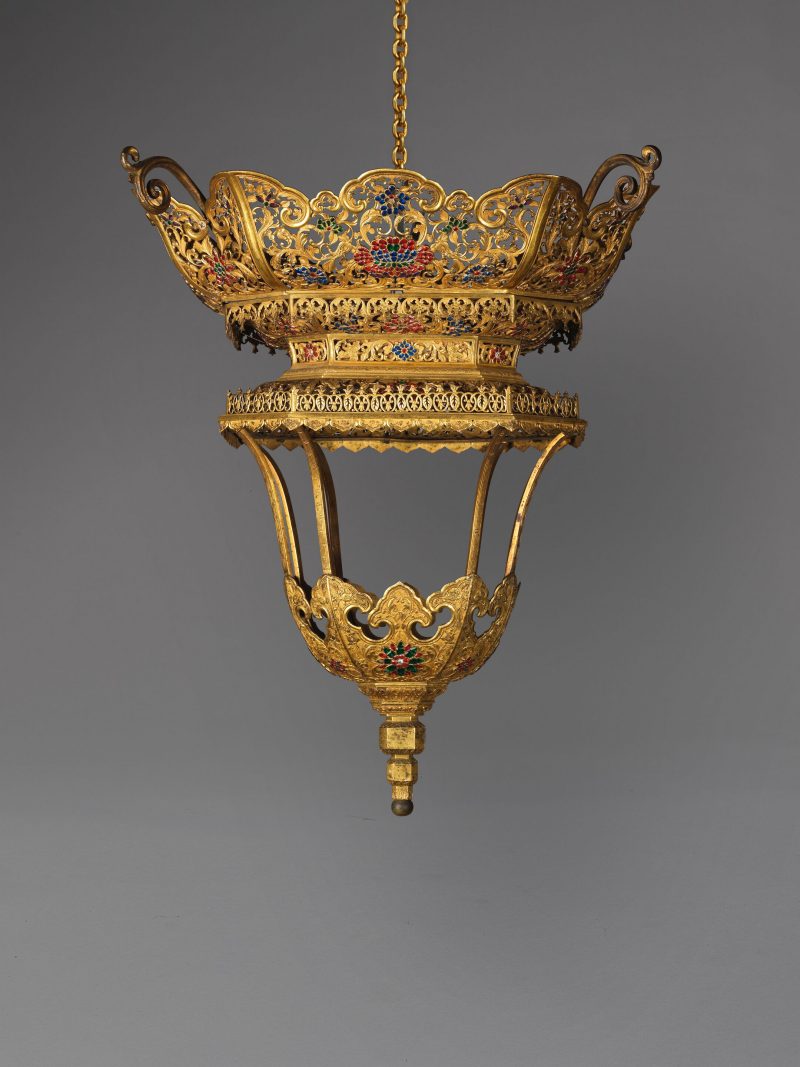

Lot 36 清乾隆 廣作銅鎏金嵌料宮燈 | MAGNIFIQUE LANTERNE IMPÉRIALE EN BRONZE DORÉ ET INCRUSTATIONS EN VERRE
落槌价
预展中
成交价
预展中
| 拍卖公司 | 邦瀚斯 |
|---|---|
| 拍卖时间 | 2026年12月10日 |
拍品信息
拍品名称
清乾隆 廣作銅鎏金嵌料宮燈 | MAGNIFIQUE LANTERNE IMPÉRIALE EN BRONZE DORÉ ET INCRUSTATIONS EN VERRE
年代
清乾隆
起拍价
未知
估值区间
EUR 30,000–50,000
尺寸
47 cm (18 1/2 in.) high
品相
未知
更多信息
MAGNIFIQUE LANTERNE IMPÉRIALE EN BRONZE DORÉ ET INCRUSTATIONS EN VERRE
Dynastie Qing, époque Qianlong (1736-1795)
A MAGNIFICIENT IMPERIAL CANTON-TRIBUTE GILT-METAL GLASS-EMBELLISHED LANTERN
Qing Dynasty, Qianlong period
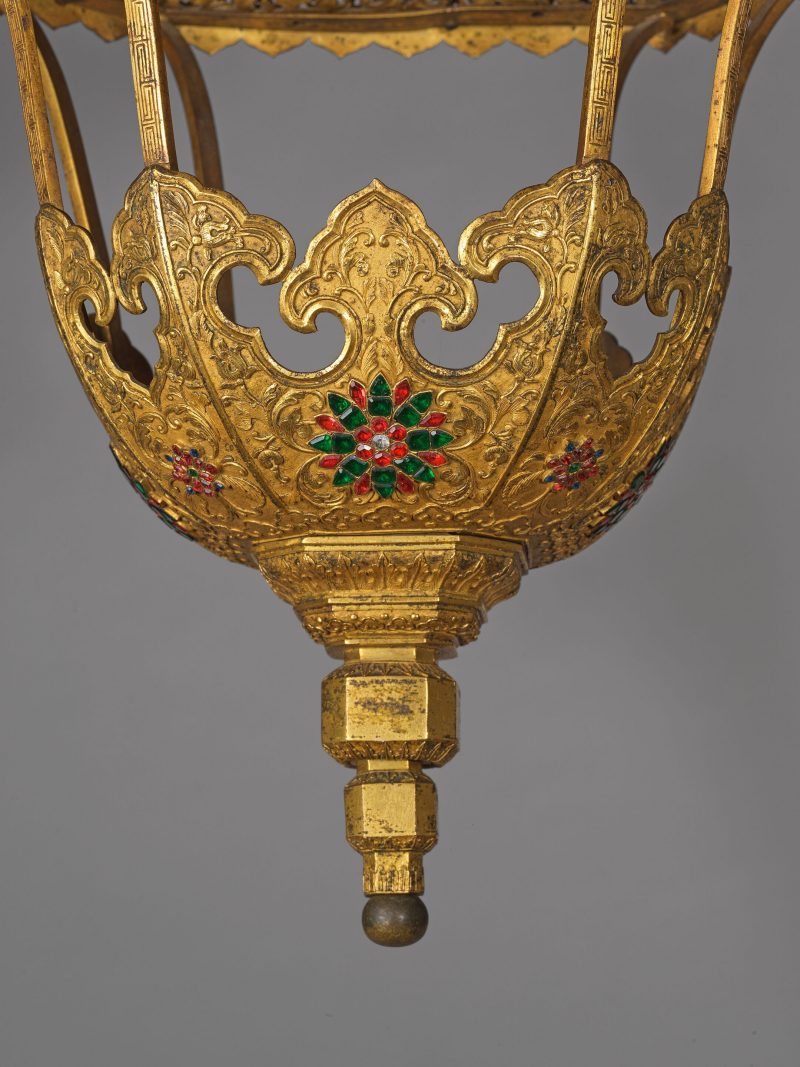
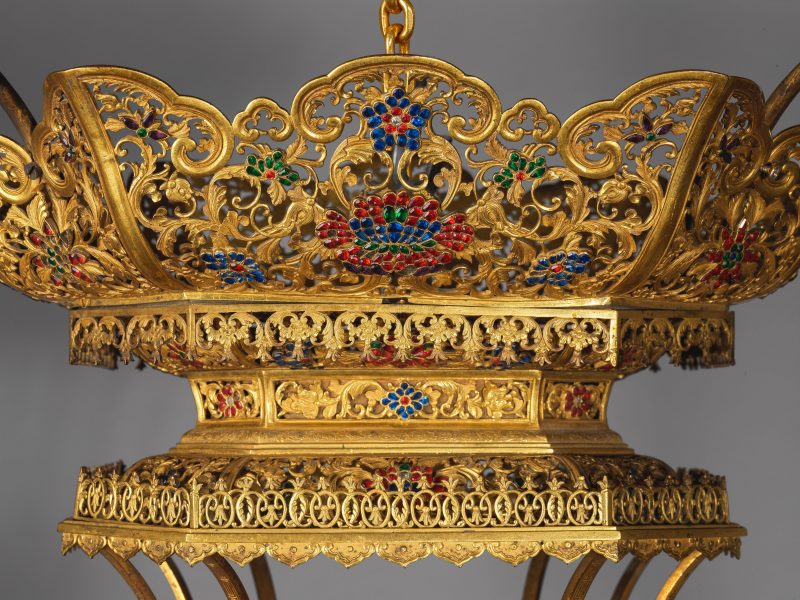
Of upturned pagoda-shape, worked in openwork and richly gilt, the open, octagonal frame of the lower part tapering to a crown of linked ruyi-shapes terminating in a facetted, stepped finial, all decorated with small multi-colored paste-set flowers made of coloured and facetted glass applied on a ground of finely incised scrolling foliage, framed at the top by a band of ruyi below an openwork scrollwork galleried frieze, all surmounted by an openwork frame of foliate-shaped brackets bordered by a ruyi-shaped rim, decorated with multi-coloured paste-set lotus flowerheads circled by paste-set florets, all on an openwork ground of leafy scrollwork, set at four corners with a scroll-form hook.
47 cm (18 1/2 in.) high
清乾隆 廣作銅鎏金嵌料宮燈
Provenance:
A French private collection
Sotheby's Paris, 10 June 2015, lot 29
Gisèle Croës Arts d'Extrême Orient, Brussels
來源:
法國私人收藏
巴黎蘇富比,2015年6月10日,拍品編號29
Gisèle Croës Arts d'Extrême Orient,布魯塞爾
The present lantern exemplifies the synthesis of Chinese and European decorative traditions during the Qianlong period. Its elaborate openwork and scrolling, acanthus-like foliage reflect the influence of European Rococo ornament, while the ruyi-shaped forms and floral motifs retain distinctly Chinese decorative elements. Such cultural exchange was fostered at the Qing Court, where European artists, including Jesuit missionaries, contributed to the design of the Western style Palace at the Yuanming Yuan, whose architecture combined European Baroque and Rococo forms with Chinese decorative conventions.
The lantern's combination of gilt metal, multicoloured glass-inlays and ruyi-shaped ornament finds parallels in other luxury objects associated with the Qing Court. See for example, a gilt-copper double-gourd-shaped clock inlaid with enamel, incorporating Western-style scrolling foliage and red and green glass-stone inlays within an elaborate architectural structure, made in Guangzhou, mid-Qing dynasty, in the Qing Court Collection, illustrated in The Complete Collection of Treasures of the Palace Museum: Scientific and Technical Instruments of the Qing Dynasty, Hong Kong, 1998, p. 246, no. 220.
See a related lantern in the form of a hanging basket, in situ in the Forbidden City, in the Hall of Mental Cultivation, illustrated in Classics of the Forbidden City: Life in the Forbidden City of Qing Dynasty, Beijing, 2007, p. 55.
Compare this lantern with a pair of gilt-bronze and paste-set lanterns, sold at Sotheby's New York, 5 Mars 2016, lot 115.
以下内容由AI翻译:
【描述】
呈上扬的宝塔形,镂空,鎏金鲜明,下部的八角形框架逐渐收窄至顶部相连的如意形状,顶部为多面阶梯状顶饰,全部装饰有由彩色和刻面玻璃制成的小花,镶嵌在精细雕刻的卷叶地上,顶部边缘饰有一圈如意纹,上方为镂空的卷草纹饰带,整体由带有如意形边缘的叶形托架构成的镂空框架覆盖,装饰有多色镶嵌的莲花花朵,周围环绕着镶嵌的小花,背景为镂空的叶形卷草纹,四角设有卷曲形式的挂钩。
这件宫灯体现了乾隆时期中国和欧洲装饰传统的融合。其复杂的镂空和卷曲、类似茛苕叶的叶子反映了欧洲洛可可装饰的影响,而如意形状和花卉图案则保留了明显的中国装饰元素。这种文化交流在清廷得到了促进,欧洲艺术家,包括耶稣会传教士,在圆明园西式宫殿的设计中做出了贡献,其建筑结合了欧洲巴洛克和洛可可风格与中国装饰传统。
宫灯的镀金金属、多彩玻璃镶嵌和如意形装饰在其他与清廷相关的奢侈品中也有相似之处。例如,一件广州制作的中清时期的铜镀金双葫芦形钟表,镶嵌珐琅,结合西方风格的卷叶纹饰和红绿玻璃石镶嵌在一个复杂的建筑结构中,见于《故宫博物院藏品大系:清代科技仪器》,香港,1998年,第246页,编号220。
另见一件悬挂篮形宫灯,位于紫禁城养心殿内,见于《故宫经典:清代紫禁城生活》,北京,2007年,第55页。
比较此件宫灯与一对镀金青铜和镶嵌玻璃的宫灯,曾于2016年3月5日在纽约苏富比拍卖,拍品编号115。
常见问题
这件清乾隆 廣作銅鎏金嵌料宮燈 | MAGNIFIQUE LANTERNE IMPÉRIALE EN BRONZE DORÉ ET INCRUSTATIONS EN VERRE的成交价是多少?
落槌价为 预展中。 成交价为 预展中。
拍品的尺寸是多少?
47 cm (18 1/2 in.) high