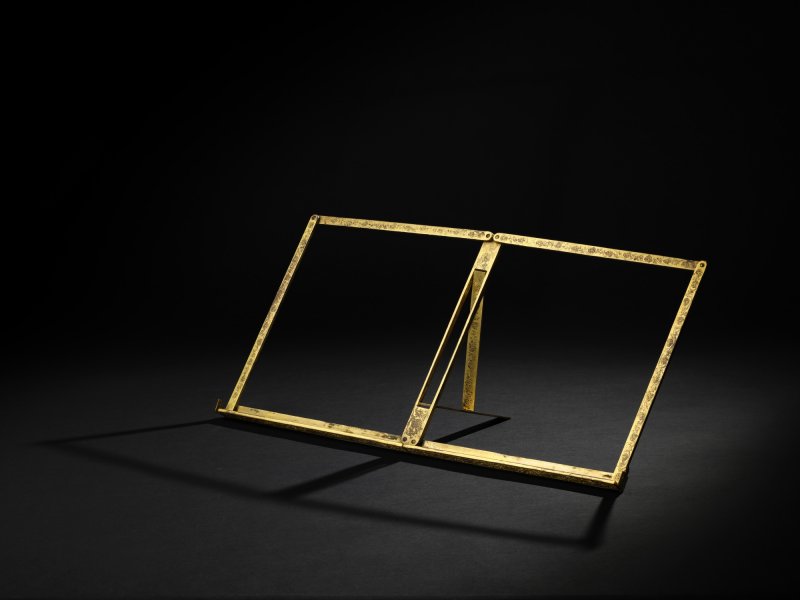


Lot 8069 An imperial inscribed gilt-bronze 'dragon' foldable book stand, Signed Yu Minzhong (1714–1779), Qing dynasty, Qianlong period | 清乾隆 鎏金銅雙龍戲珠紋摺疊式帖架 「臣于敏中」印
落槌价
预展中
成交价
预展中
| 拍卖公司 | 苏富比 |
|---|---|
| 拍卖时间 | 2026年10月30日 |
拍品信息
拍品名称
An imperial inscribed gilt-bronze 'dragon' foldable book stand, Signed Yu Minzhong (1714–1779), Qing dynasty, Qianlong period | 清乾隆 鎏金銅雙龍戲珠紋摺疊式帖架 「臣于敏中」印
起拍价
HKD 900,000
估值区间
900,000 - 1,500,000 HKD
尺寸
未知
品相
如欲了解本拍品狀況的更多資訊,請聯絡 Rubie.Fong@sothebys.com
更多信息
49.6 by 25.3 cm
来源:A French private collection.
Sotheby’s Paris, 22nd June 2017, lot 140.
展览:Nicolas Chow, The Literati Aesthetic, Hong Kong, 2018, no. 35.
图录
说明:來源
法國私人收藏
巴黎蘇富比2017年6月22日,編號140
出版
仇國仕,《無盡意》,香港,2018年,圖版35
This finely decorated and inscribed book stand is a rare item from the literati circles that flourished under the Qianlong Emperor (r. 1736-95). Stands of this form were used to put up lightweight documents such as calligraphy models or sheet music. A portable device such as this would have been valuable for the Emperor during his imperial tours, since for storage or transport, its hinged elements could be collapsed into a compact block.
The appreciation and practice of calligraphy held great significance for Chinese scholars. In the pursuit of refining their skills, scholars endeavoured to emulate the style of the celebrated masters, so that the book stand emerged as a vital stationery tool.
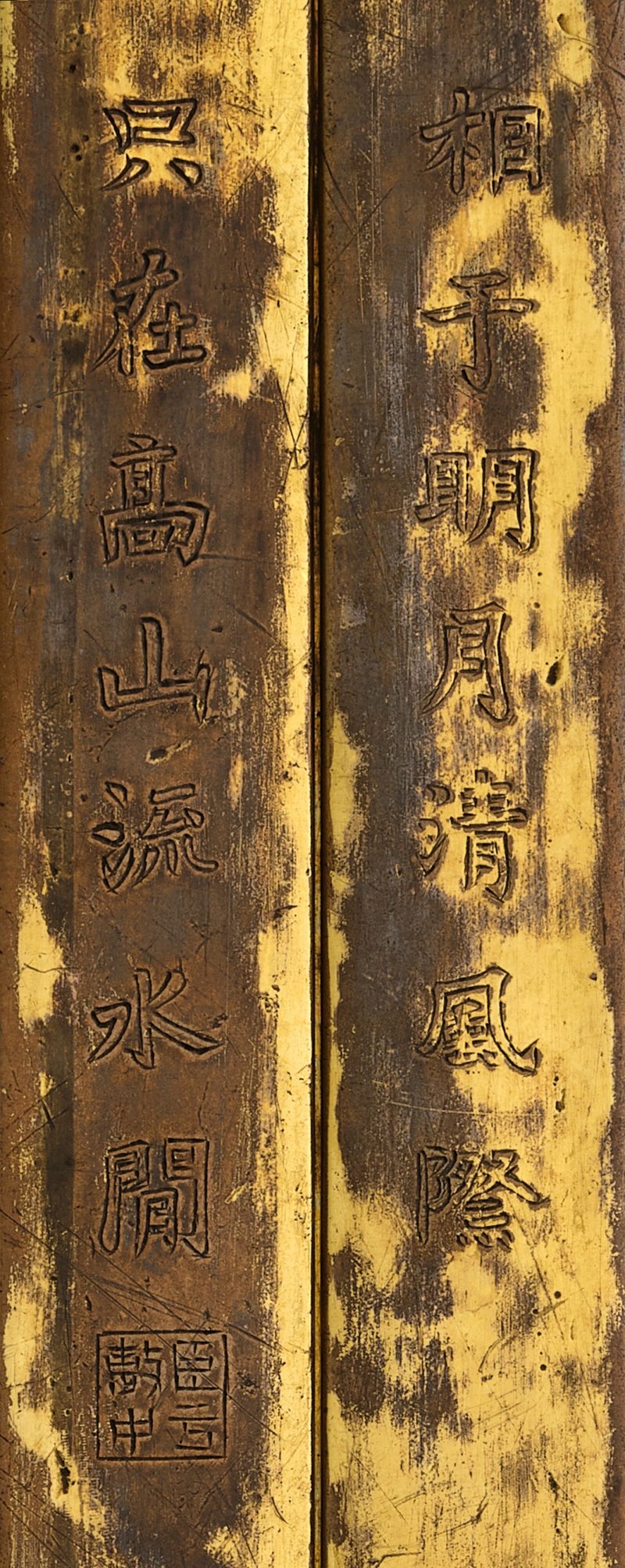
The inscription reads:
Like the bright moon in a clear breeze,
It exists solely between tall mountains and flowing streams.
and is followed by the signature Yu Minzhong in form of a seal.
相於明月清風際,只在高山流水間
臣于敏中
The inscription is taken from an imperial poem that the Qianlong Emperor had inscribed on the painting Ting qin tu (Listening to the qin) by Ming artist Wang Mengduan (Wang Fu, 1362 – 1416), and is recorded in Yuzhishi chuji (Anthology of imperial Qianlong poems), juan 39.1 Yu Minzhong (1714 - 1779), was a high official and compiler of the Hanlin Academy, who had achieved the distinction of being the most successful candidate in the national civil examination. As an official he was held in great esteem by the Emperor, took part in several pivotal imperial publications, such as Guochao guanshi (History of the Imperial Palace), and was entrusted with the task of transcribing imperial poems delivered orally by the Emperor. The signature, with the prefix chen (your subject) before the name, suggests that Yu would have presented the stand as a gift to the Emperor.
As a renowned connoisseur and an accomplished calligrapher himself, the Qianlong Emperor is celebrated for assembling an exceptional art collection, which included such prominent calligraphic works as the Kuaiyu shiqing tie (Timely clearing after snowfall) by Wang Xizhi (303 – 361), Zhongqui tie (Mid-autumn manuscript) by Wang Xianzhi (344 – 386), and Boyuan tie (Boyuan manuscript) by Wang Xun (349 – 400), known as the sanxi (three rarities). In the preface to Sanxitang fatie (Rubbings from the Hall of Three Rarities) the Emperor remarks that admiring the calligraphic work of the esteemed masters was not merely entertainment, but also a way to experience profound insights.
No other gilt-bronze folding book stand appears to have been published. Compare a cloisonné example, attributed to the late Qing period, illustrated in Gugong jingdian, wenfang qinggong / Classics of the Forbidden City, Scholar’s Paraphernalia, Beijing, 2009, pl. 188, p. 187. Compare also two wooded stands, one in the Minneapolis Institute of Arts, illustrated in Robert D. Jacobsen and Nicholas Grindley, Classical Chinese Furniture, Minneapolis, 1999, pl. 86; the other in Grace Wu Bruce, Chan Chair and Qin Bench: The Dr. S Y Yip Collection of Classic Chinese Furniture II, Hong Kong, 1998, p. 144, cat. no. 43.
題識:
相於明月清風際
只在高山流水間
「臣于敏中」印
銅胎鎏金,展開成長方形框,中有合頁支撐調節角度,折疊合為一尺,鏨刻雙龍戲珠及陰紋連枝花草紋,背面鏨刻雙鉤陰線楷書詩句:「相于明月清風際,只在高山流水間」,鈐印「臣于敏中」,通體鎏金。
此件帖架做工精細,極具巧思,為乾隆時期宮廷作品,或為皇帝出巡時隨身攜帶之文具。既可觀帖,又可臨帖。此類文具精巧而便於收納,存世稀少,目前並無發現其他銅鎏金之同類作品。北京故宮藏有一件清晚期掐絲琺瑯折疊帖架,應當傳襲自乾隆時期作品,可參考之,見《故宮經典:文房清供》,北京,2009年,圖版188,頁187。另可比較兩件十八世紀黃花梨折疊帖架,一藏於明尼阿波利斯藝術博物館,見Robert D. Jacobsen及Nicholas Grindley著,《古典中國家具》,明尼阿波利斯,1999年,圖版86;另一例著錄於伍嘉恩著《攻玉山房藏明式黃花梨家具II》,香港,1998年,頁144,編號43。
帖架所刻詩文同見於西苑瀛臺迎薰亭二聯,為乾隆御筆,著錄於于敏中編,《欽定日下舊聞考》,北京,1788年,卷22,頁1。該詩出自乾隆御製詩《題王孟端齋宿聽琴圖》,作於乾隆十二年(1747年),原句為「相於明月清風際,只在高山流水邊」,見《御製詩初集》,武英殿本,1749年,巻39,頁10 。帖架與迎薰亭二聯最後皆作「間」字,應為乾隆十二年後所改。
于敏中(1714—1780年),江蘇金壇人,字叔子,號耐圃。乾隆狀元。乾隆御製詩文多有于敏中代筆或改訂。乾隆三十八年授文華殿大學士,充上書房總師傅。曾與朱筠力主搜輯《永樂大典》中古書,為四庫全書館正總裁。後病卒,乾隆帝作詩悼念,入祀賢良祠,為有清一代漢臣所得最高褒獎。
常见问题
这件An imperial inscribed gilt-bronze 'dragon' foldable book stand, Signed Yu Minzhong (1714–1779), Qing dynasty, Qianlong period | 清乾隆 鎏金銅雙龍戲珠紋摺疊式帖架 「臣于敏中」印的成交价是多少?
落槌价为 预展中。 成交价为 预展中。
拍品的品相状况如何?
如欲了解本拍品狀況的更多資訊,請聯絡 Rubie.Fong@sothebys.com
这件拍品的流传来源是什么?
A French private collection.
Sotheby’s Paris, 22nd June 2017, lot 140.
Sotheby’s Paris, 22nd June 2017, lot 140.
这件拍品曾在哪些展览中展出过?
Nicolas Chow, The Literati Aesthetic, Hong Kong, 2018, no. 35.
图录
图录