
拍品信息
拍品名称
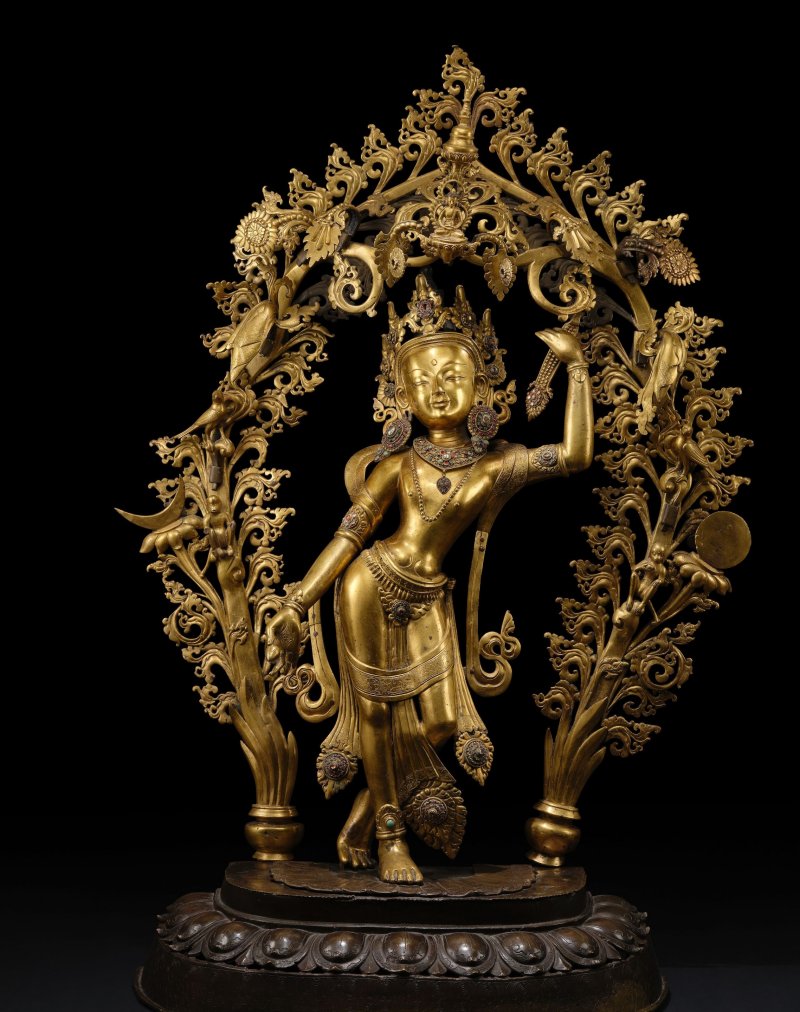
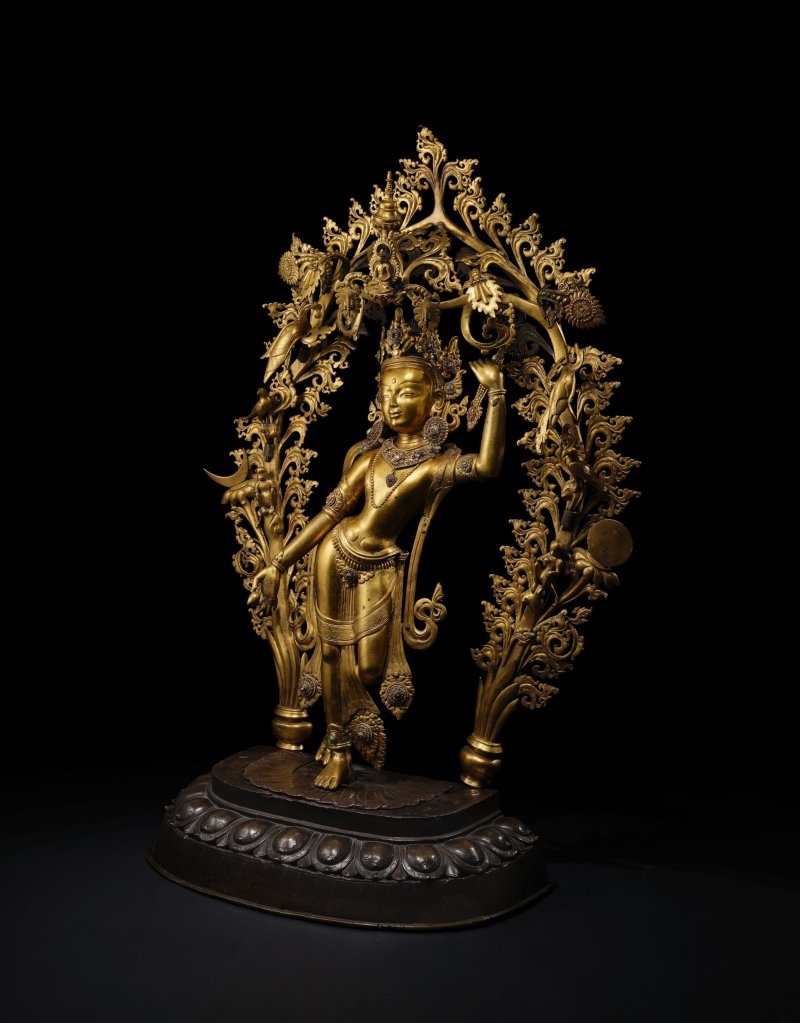
尼泊爾 十九世紀 銅鎏金倚樹觀音像 | A LARGE GILT COPPER ALLOY FIGURE OF CHINTAMANI LOKESHVARA
年代
NEPAL, 19TH CENTURY
起拍价
HKD 1,000,000
估值区间
HKD 1000000 - 1500000
尺寸
未知
品相
未知
更多信息
NEPAL, 19TH CENTURY
Himalayan Art Resources item no. 8875
112 cm (44 in.) high
Footnotes
尼泊爾 十九世紀 銅鎏金倚樹觀音像
Provenance
Pauline Karpidas Collection, London
Sotheby's, London, 18 September 2025, lot 162
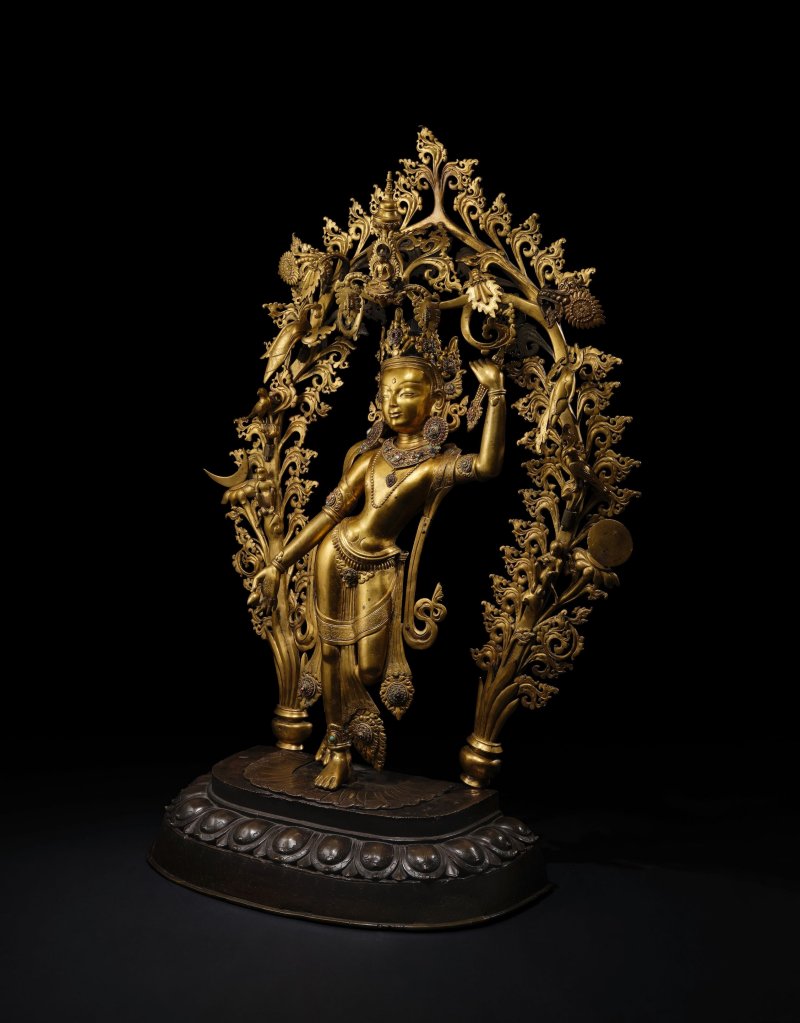
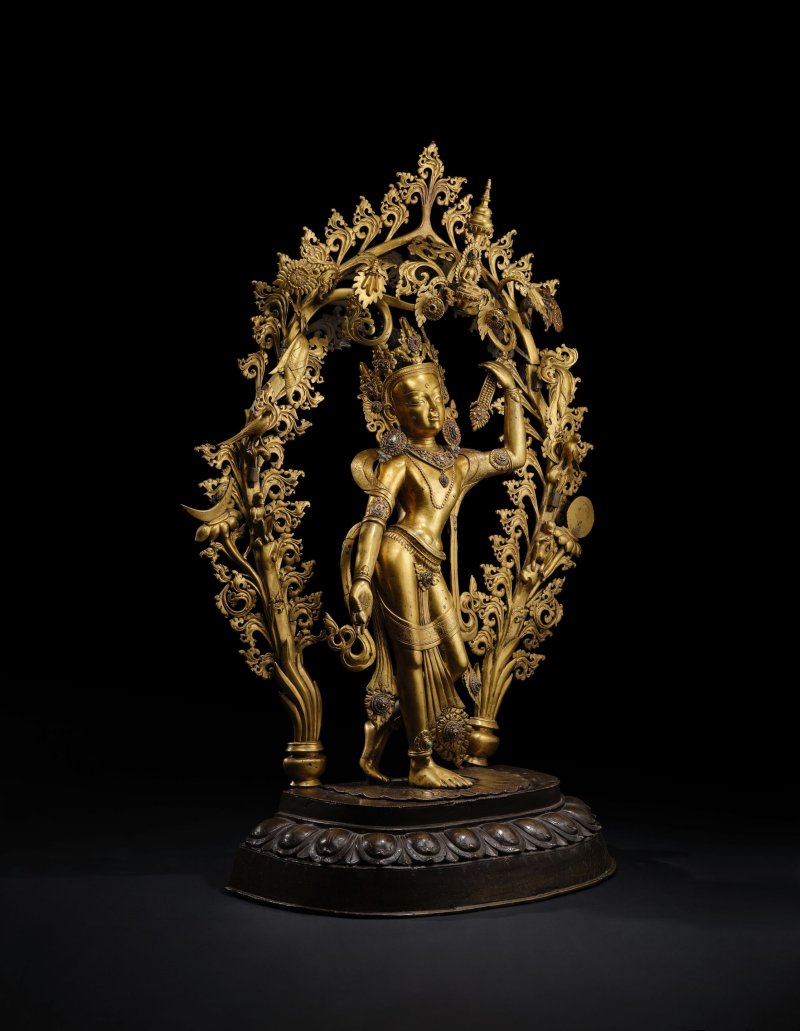
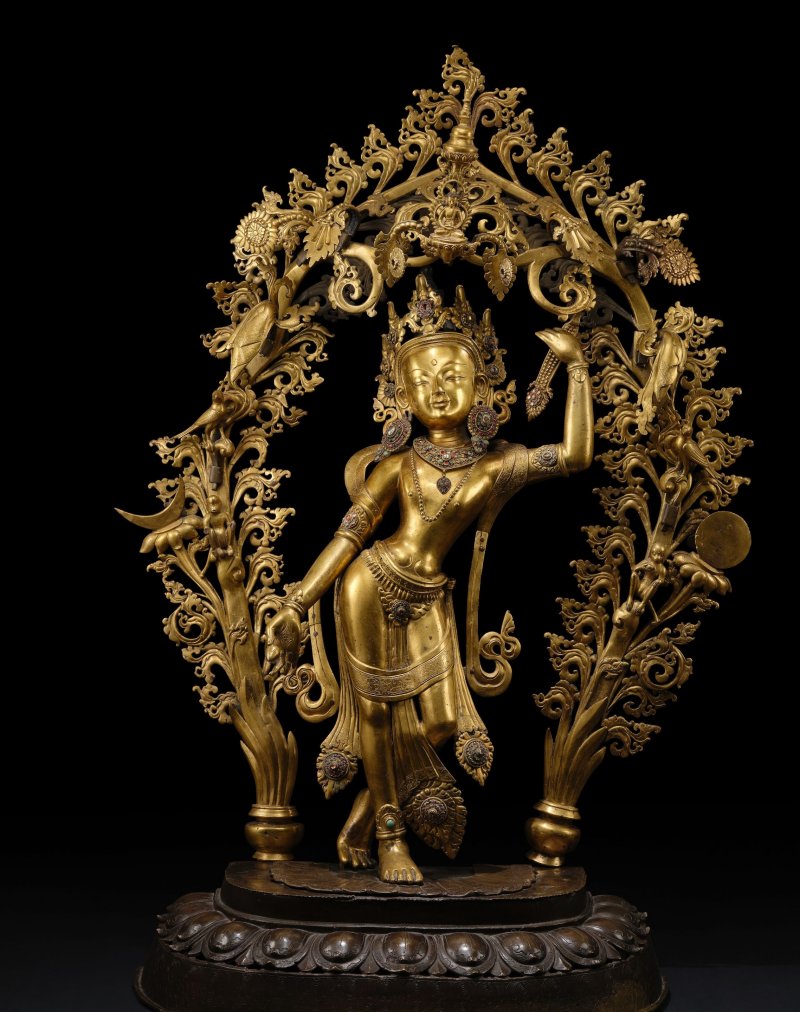
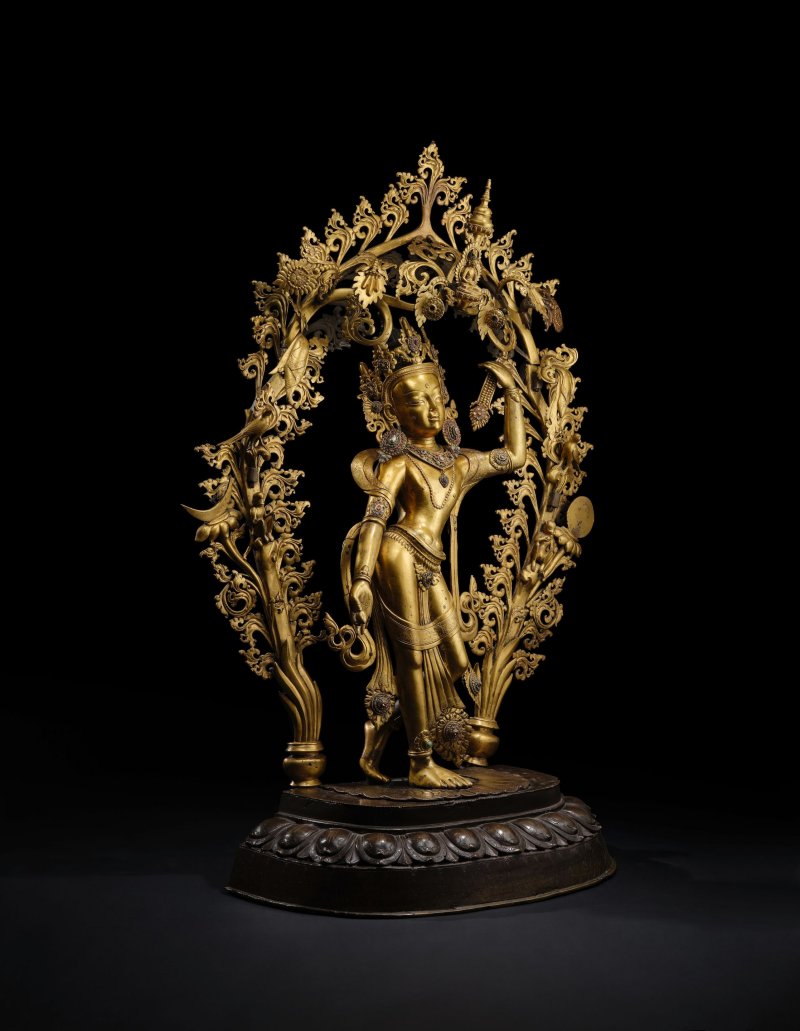
With ankles crossed and a finely delineated sash loosely knotted at the waist, Chintamani Lokeshvara stands gracefully beneath a lavish wish-fulfilling tree (kalpavriksha), whose foliage is elegantly stylised to form a mandorla around him. A form of the bodhisattva Avalokiteshvara, the deity takes his epithet from the chintamani, the wish-fulfilling gem. One hand rises as if to pluck fruit from the branches above, while the other gently extends it toward the viewer. An iconic image of Nepalese art, the subject is encountered in wood as well as in bronze and stone. Among the earliest surviving representations is a Pala bronze in the Bonardi Collection, its foliage inhabited by figures and animals (see Tucci, Transhimalaya, Geneva, 1973, no. 151).
In keeping with Nepalese casting traditions, the Lokeshvara is adorned with large stone-inset rosettes at the earrings, armbands, crown, and the prominent terminals of the sash. The body is slender and elegantly proportioned, the youthful face serene, its rounded contours softly modelled and warm in expression. Where the tree more commonly springs from one side in an asymmetrical composition, here it doubles as a mandorla, rimmed with flame-like leaves in place of the naturalistic waterdrop forms seen in other examples. This more elaborate structure allows for a greater number of elements: a stupa and a miniature Buddha crown the tree, accompanied by mythical creatures, while the sun and moon are borne on lily stems to either side.
A Chintamani Lokeshvara of this scale is exceedingly rare. A smaller gilt bronze of comparable date in the Musée Guimet, Paris (acc. no. MA 1779), depicts instead the birth of the Buddha from the side of Queen Maya. Despite the difference in subject, the overall composition, the smooth and slender treatment of the figures, the stone-inset waterdrop ornament, and even the thin sash-ends flanking the hips are remarkably consistent, indicating a shared technical and aesthetic tradition. In both, the central figure is set above an ungilt base with stylised lotus petals. Compare also a further Chintamani Lokeshvara (HAR 22491), and an example sold at Sotheby's, New York, 28 March 1996, lot 34.
Another related image of the deity, dated 1684, was sold at Christie's, Paris, 7 June 2011, lot 395. See also an early 18th century Nepalese painting of the same subject published in Pal, , Chicago, 2003, p. 82, no. 47.
Himalayan Art Resources item no. 8875
112 cm (44 in.) high
Footnotes
尼泊爾 十九世紀 銅鎏金倚樹觀音像
Provenance
Pauline Karpidas Collection, London
Sotheby's, London, 18 September 2025, lot 162
With ankles crossed and a finely delineated sash loosely knotted at the waist, Chintamani Lokeshvara stands gracefully beneath a lavish wish-fulfilling tree (kalpavriksha), whose foliage is elegantly stylised to form a mandorla around him. A form of the bodhisattva Avalokiteshvara, the deity takes his epithet from the chintamani, the wish-fulfilling gem. One hand rises as if to pluck fruit from the branches above, while the other gently extends it toward the viewer. An iconic image of Nepalese art, the subject is encountered in wood as well as in bronze and stone. Among the earliest surviving representations is a Pala bronze in the Bonardi Collection, its foliage inhabited by figures and animals (see Tucci, Transhimalaya, Geneva, 1973, no. 151).
In keeping with Nepalese casting traditions, the Lokeshvara is adorned with large stone-inset rosettes at the earrings, armbands, crown, and the prominent terminals of the sash. The body is slender and elegantly proportioned, the youthful face serene, its rounded contours softly modelled and warm in expression. Where the tree more commonly springs from one side in an asymmetrical composition, here it doubles as a mandorla, rimmed with flame-like leaves in place of the naturalistic waterdrop forms seen in other examples. This more elaborate structure allows for a greater number of elements: a stupa and a miniature Buddha crown the tree, accompanied by mythical creatures, while the sun and moon are borne on lily stems to either side.
A Chintamani Lokeshvara of this scale is exceedingly rare. A smaller gilt bronze of comparable date in the Musée Guimet, Paris (acc. no. MA 1779), depicts instead the birth of the Buddha from the side of Queen Maya. Despite the difference in subject, the overall composition, the smooth and slender treatment of the figures, the stone-inset waterdrop ornament, and even the thin sash-ends flanking the hips are remarkably consistent, indicating a shared technical and aesthetic tradition. In both, the central figure is set above an ungilt base with stylised lotus petals. Compare also a further Chintamani Lokeshvara (HAR 22491), and an example sold at Sotheby's, New York, 28 March 1996, lot 34.
Another related image of the deity, dated 1684, was sold at Christie's, Paris, 7 June 2011, lot 395. See also an early 18th century Nepalese painting of the same subject published in Pal, , Chicago, 2003, p. 82, no. 47.
常见问题
这件尼泊爾 十九世紀 銅鎏金倚樹觀音像 | A LARGE GILT COPPER ALLOY FIGURE OF CHINTAMANI LOKESHVARA的成交价是多少?
落槌价为 预展中。 成交价为 预展中。