
拍品信息
拍品名称
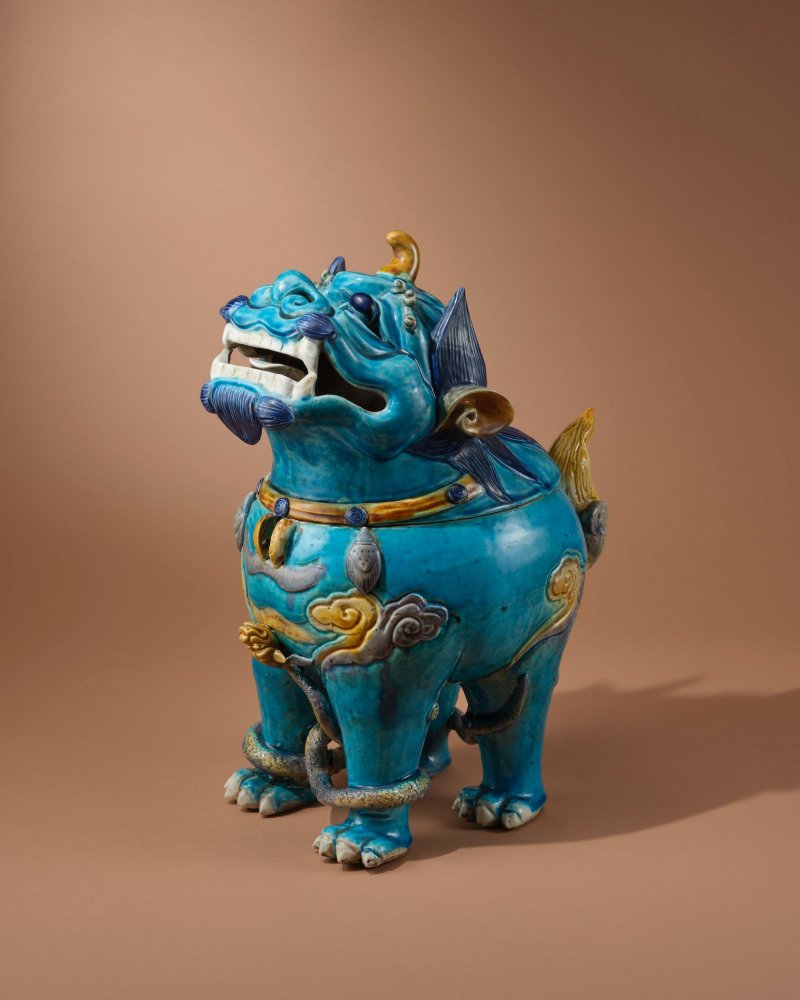
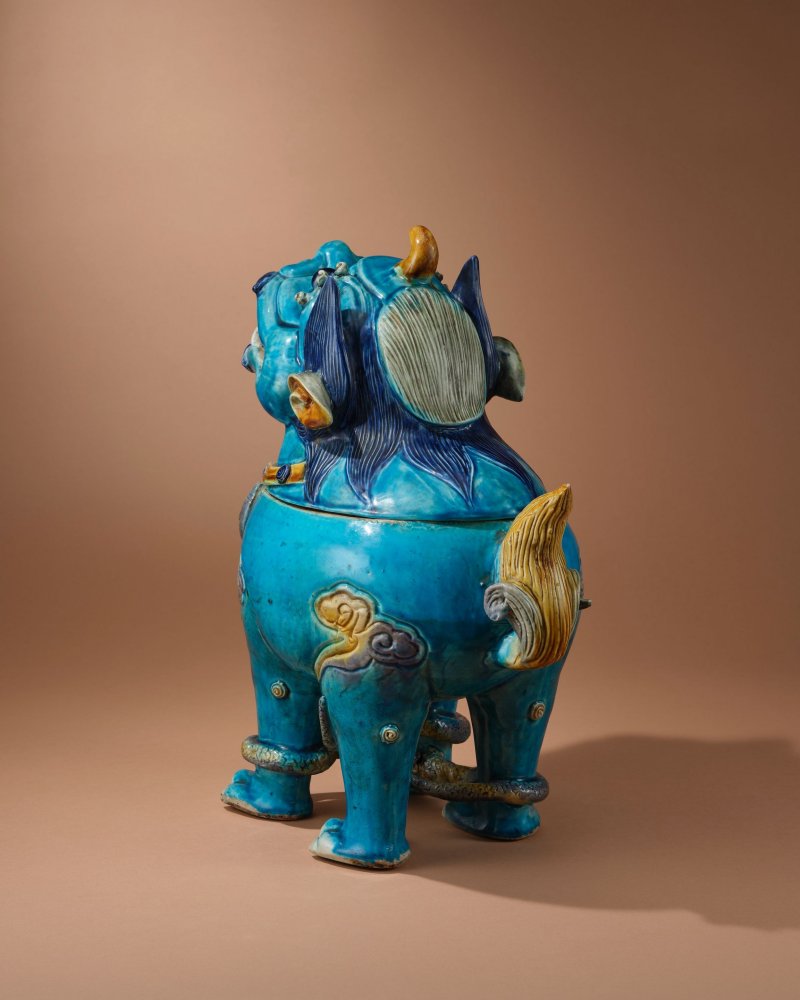
明弘治至嘉靖 琺華甪端薰爐 | A FAHUA LUDUAN INCENSE BURNER AND COVER
年代
Hongzhi/Jiajing
起拍价
HKD 300,000
估值区间
HKD 300000 - 400000
尺寸
未知
品相
未知
更多信息
Hongzhi/Jiajing
Superbly modelled in the form of a mythical beast, standing foursquare, the robust body glazed in a vibrant turquoise-blue and richly embellished with aubergine, yellow-ochre and dark blue enamels, the body enveloped by scrolling ruyi-shaped clouds, while a serpent-like creature coils dynamically around the legs, its head emerging across the chest, the detachable head, forming the cover, strikingly rendered with bulging eyes, wide gaping jaw exposing a rolled tongue and white fangs, beneath a single curled horn and finely incised mane, a tassel-hung collar encircles the neck.
33.6cm (13 1/4in) high. (2).
Footnotes
明弘治至嘉靖 琺華甪端薰爐
Provenance:
A European private collection, by repute
來源:
傳歐洲私人收藏
The present incense burner is a rare example of sculptural -glazed production, of a type for which no closely comparable published parallel appears to be known. It belongs to a small group of northern Chinese wares produced during the late fifteenth and early sixteenth centuries, when ancient bronze forms were creatively reinterpreted in ceramic media. See for example, a -glazed duck-form incense burner, Chenghua, illustrated in , New York, 2025, pp.144-145, which demonstrates the continued influence of ancient bronze prototypes on the development of sculptural ceramic incense burners during the Ming dynasty.
The beast is identifiable as a , an auspicious creature associated with sagacity, righteous rule, and the appearance of a virtuous sovereign. Its vigorous modelling, with a powerful quadruped stance, animated facial expression, and detachable head forming the cover, is characteristic of Ming sculptural workshop practice. As noted by P.Moss in , London, 1991, no.18, 'the model is known in early Ming Lung-ch'uan celadon, and variants may have been made throughout the Ming dynasty', indicating the longevity and popularity of the type across a variety of media.
Comparable representations of the occur in contemporary metalwork and porcelain. See, for example, a cloisonné enamel incense burner in the form of a , Wanli, in the Qing Court Collection, illustrated in , Beijing, 2011, p.209, no.103. See also a related blue and white incense burner in the form of a , early seventeenth century, in the Metropolitan Museum of Art, New York (acc.no.2018.154a,b). See also a related bronze form incense burner, Mid-Ming dynasty, 16th century, which was sold at Christie's Hong Kong, 28 May 2014, lot 3021.
The brilliant turquoise ground, highlighted with aubergine, yellow-ochre, and dark blue enamels, exemplifies the distinctive aesthetic of wares of the 15th/16th centuries and further distinguishes the present incense burner as a particularly ambitious and unusual interpretation of a long-established Ming sculptural form. See for example a hexagonal brushpot, c.1488-1566, inspired by a bronze prototype, illustrated by J.Harrison-Hall, , London, 2001, p.418, fig.13:19. See also a -glazed model of a boat, with simialr palette, with inscription dating it to 1506, in the British Museum, London, illustrated by J.Harrison-Hall, , London, 2001, p.427, 13:36. Compare also with a -glazed drum-shaped garden stool, Hongzhi, in the British Museum, London (acc.no.PDF.714).
此琺華甪端薰爐存世極罕,目前出版、著錄未見同類者。這類器物當屬十五世紀末至十六世紀初華北窯場產物,當時匠人常以陶瓷重新詮釋青銅古器之形制,例如一件成化時期三彩鳥形薰爐,見《Recasting the Past: The Art of Chinese Bronzes, 1100-1900》,紐約,2025年,頁144至145,足見明代陶雕香爐深受古青銅器影響。
甪端,傳說中與賢君、仁政盛世相伴而生。其四足雄踞,神情生動,頭部可拆卸為蓋,為明代雕塑作坊之典型做法。Paul Moss在《The Second Bronze Age: Later Chinese Metalwork》(倫敦,1991年,編號18)中指出此題材早見於明初龍泉青瓷,且各時期皆有所變化。足見甪端形象深受時人喜愛,並應用到各種材質之作品上。同類甪端薰爐亦見於金屬器與瓷器,例如清宮舊藏一件萬曆時期掐絲琺瑯甪端香熏,見《故宮博物院藏品大系:琺瑯器編1:元明掐絲琺瑯》,北京,2011年,頁209,編號103;及紐約大都會藝術博物館藏一件十七世紀初晚明景德鎮窯青花獸爐(館藏編號:2018.154a,b)。另參考一件十六世紀明中期銅甪端薰爐,售於香港佳士得,2014年5月28日,拍品編號3021。
本拍品以松石藍為地,飾以茄紫、赭黃、深藍諸色,色彩明麗,為十五、十六世紀琺華器之典型風格。其形制獨特,工藝精湛,尤顯匠人對明代雕塑傳統之創新詮釋。參考一件約1488至1566年之琺華六方筆筒,其造型亦受青銅器啟發,錄於霍吉淑,《Ming Ceramics in the British Museum》,倫敦,2001年,頁418,圖13:19。倫敦大英博物館另有一件1506紀年款琺華船,其用色與本品相似,見霍吉淑,《Catalogue of Late Yuan and Ming Ceramics in the British Museum》,倫敦,2001年,頁427,編號13:36;再參考同館一件弘治時期琺華坐墩(館藏編號PDF.714)。
Superbly modelled in the form of a mythical beast, standing foursquare, the robust body glazed in a vibrant turquoise-blue and richly embellished with aubergine, yellow-ochre and dark blue enamels, the body enveloped by scrolling ruyi-shaped clouds, while a serpent-like creature coils dynamically around the legs, its head emerging across the chest, the detachable head, forming the cover, strikingly rendered with bulging eyes, wide gaping jaw exposing a rolled tongue and white fangs, beneath a single curled horn and finely incised mane, a tassel-hung collar encircles the neck.
33.6cm (13 1/4in) high. (2).
Footnotes
明弘治至嘉靖 琺華甪端薰爐
Provenance:
A European private collection, by repute
來源:
傳歐洲私人收藏
The present incense burner is a rare example of sculptural -glazed production, of a type for which no closely comparable published parallel appears to be known. It belongs to a small group of northern Chinese wares produced during the late fifteenth and early sixteenth centuries, when ancient bronze forms were creatively reinterpreted in ceramic media. See for example, a -glazed duck-form incense burner, Chenghua, illustrated in , New York, 2025, pp.144-145, which demonstrates the continued influence of ancient bronze prototypes on the development of sculptural ceramic incense burners during the Ming dynasty.
The beast is identifiable as a , an auspicious creature associated with sagacity, righteous rule, and the appearance of a virtuous sovereign. Its vigorous modelling, with a powerful quadruped stance, animated facial expression, and detachable head forming the cover, is characteristic of Ming sculptural workshop practice. As noted by P.Moss in , London, 1991, no.18, 'the model is known in early Ming Lung-ch'uan celadon, and variants may have been made throughout the Ming dynasty', indicating the longevity and popularity of the type across a variety of media.
Comparable representations of the occur in contemporary metalwork and porcelain. See, for example, a cloisonné enamel incense burner in the form of a , Wanli, in the Qing Court Collection, illustrated in , Beijing, 2011, p.209, no.103. See also a related blue and white incense burner in the form of a , early seventeenth century, in the Metropolitan Museum of Art, New York (acc.no.2018.154a,b). See also a related bronze form incense burner, Mid-Ming dynasty, 16th century, which was sold at Christie's Hong Kong, 28 May 2014, lot 3021.
The brilliant turquoise ground, highlighted with aubergine, yellow-ochre, and dark blue enamels, exemplifies the distinctive aesthetic of wares of the 15th/16th centuries and further distinguishes the present incense burner as a particularly ambitious and unusual interpretation of a long-established Ming sculptural form. See for example a hexagonal brushpot, c.1488-1566, inspired by a bronze prototype, illustrated by J.Harrison-Hall, , London, 2001, p.418, fig.13:19. See also a -glazed model of a boat, with simialr palette, with inscription dating it to 1506, in the British Museum, London, illustrated by J.Harrison-Hall, , London, 2001, p.427, 13:36. Compare also with a -glazed drum-shaped garden stool, Hongzhi, in the British Museum, London (acc.no.PDF.714).
此琺華甪端薰爐存世極罕,目前出版、著錄未見同類者。這類器物當屬十五世紀末至十六世紀初華北窯場產物,當時匠人常以陶瓷重新詮釋青銅古器之形制,例如一件成化時期三彩鳥形薰爐,見《Recasting the Past: The Art of Chinese Bronzes, 1100-1900》,紐約,2025年,頁144至145,足見明代陶雕香爐深受古青銅器影響。
甪端,傳說中與賢君、仁政盛世相伴而生。其四足雄踞,神情生動,頭部可拆卸為蓋,為明代雕塑作坊之典型做法。Paul Moss在《The Second Bronze Age: Later Chinese Metalwork》(倫敦,1991年,編號18)中指出此題材早見於明初龍泉青瓷,且各時期皆有所變化。足見甪端形象深受時人喜愛,並應用到各種材質之作品上。同類甪端薰爐亦見於金屬器與瓷器,例如清宮舊藏一件萬曆時期掐絲琺瑯甪端香熏,見《故宮博物院藏品大系:琺瑯器編1:元明掐絲琺瑯》,北京,2011年,頁209,編號103;及紐約大都會藝術博物館藏一件十七世紀初晚明景德鎮窯青花獸爐(館藏編號:2018.154a,b)。另參考一件十六世紀明中期銅甪端薰爐,售於香港佳士得,2014年5月28日,拍品編號3021。
本拍品以松石藍為地,飾以茄紫、赭黃、深藍諸色,色彩明麗,為十五、十六世紀琺華器之典型風格。其形制獨特,工藝精湛,尤顯匠人對明代雕塑傳統之創新詮釋。參考一件約1488至1566年之琺華六方筆筒,其造型亦受青銅器啟發,錄於霍吉淑,《Ming Ceramics in the British Museum》,倫敦,2001年,頁418,圖13:19。倫敦大英博物館另有一件1506紀年款琺華船,其用色與本品相似,見霍吉淑,《Catalogue of Late Yuan and Ming Ceramics in the British Museum》,倫敦,2001年,頁427,編號13:36;再參考同館一件弘治時期琺華坐墩(館藏編號PDF.714)。
常见问题
这件明弘治至嘉靖 琺華甪端薰爐 | A FAHUA LUDUAN INCENSE BURNER AND COVER的成交价是多少?
落槌价为 预展中。 成交价为 预展中。