
拍品信息
拍品名称
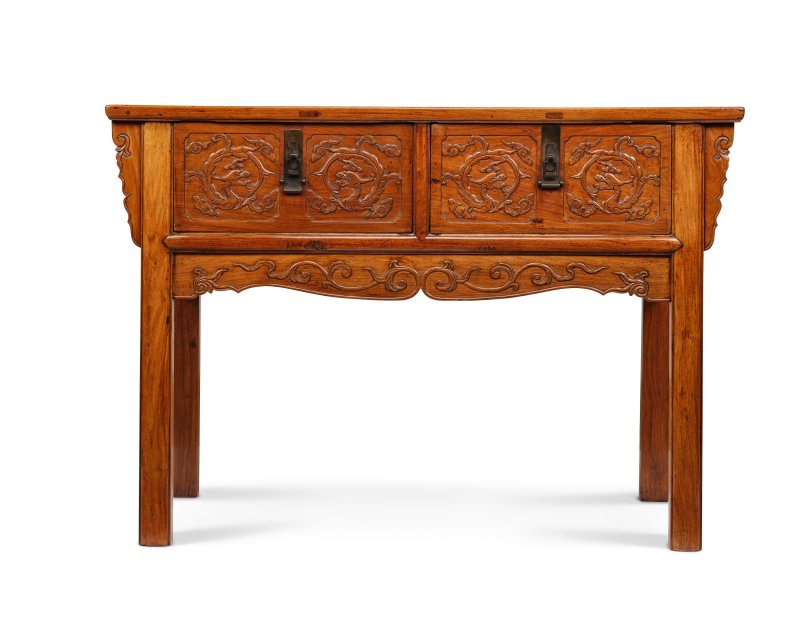
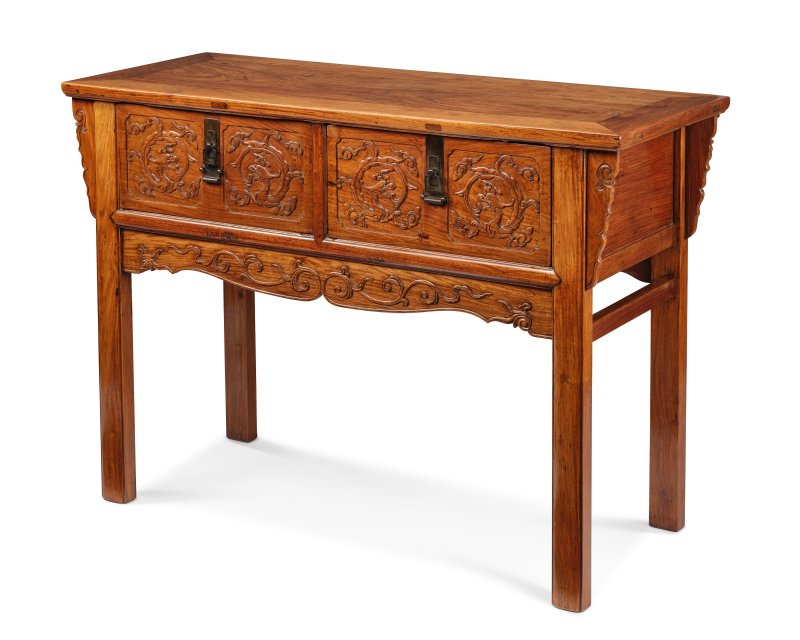
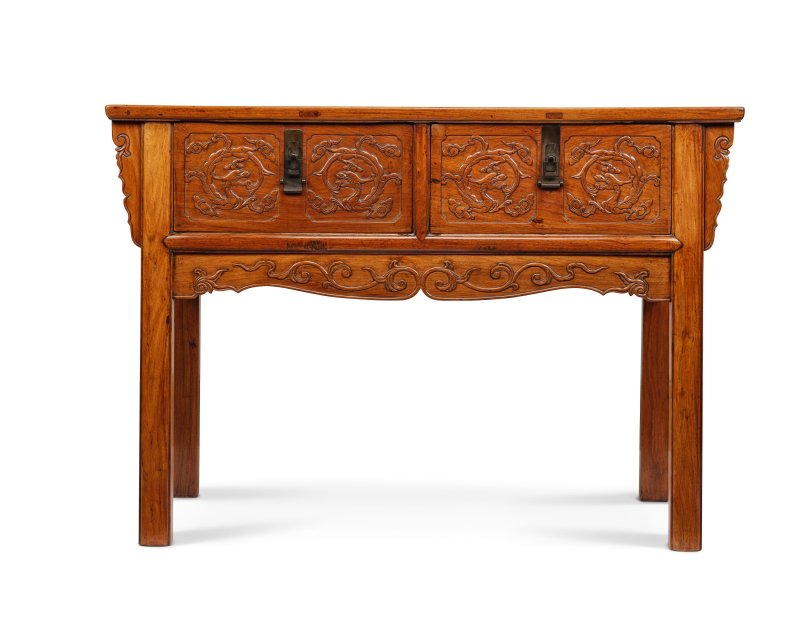
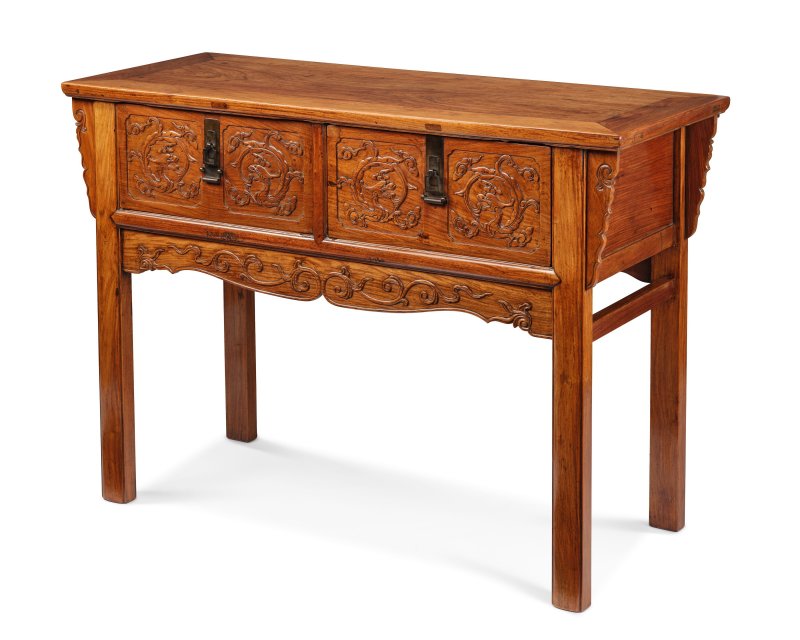
十七/十八世紀 黃花梨團龍紋聯二悶戶櫥 | A CARVED HUANGHUALI TWO-DRAWER COFFER, LIANERCHU
年代
17th/18th century
起拍价
HKD 200,000
估值区间
HKD 200000 - 300000
尺寸
未知
品相
未知
更多信息
17th/18th century
The rectangular top with everted flanges at either end, set above two drawers deeply carved in relief with dragon roundels and fitted with metal lock-plates and drop pulls, supported on a shaped apron carved with dynamic foliage, all raised on four straight legs of square section.
117cm (46in) wide x 45cm (17 3/4in) deep x 82.5cm (32 1/2in) high. (3).
Footnotes
十七/十八世紀 黃花梨團龍紋聯二悶戶櫥
Provenance:
Chan Shing Kee, Hong Kong, early 1990s
來源:
陳勝記,香港,1990年代初
The present coffer is notable for its elegant proportions and the fine grain and rich honey-colour of the wood, which is further enlivened by the dynamic dragon decoration. Its design was inspired by coffers produced during the Ming dynasty, which displayed an outstanding choice of huanghuali timber and exceptional craftsmanship. This is aptly demonstrated in the restrained balance allowing the superb timber the pride of place within the powerful geometric design formed by the careful balance between the drawers, legs, top and beading. See a related Ming dynasty coffer similarly carved with dragons, from the collection of Wang Shixiang, illustrated in , Hong Kong, 1985, pl.154.
Coffers played a prominent part in Ming and Qing dynasty interiors due to their impressive size and were used mostly for the storage of items such as bedding and clothes. A coffer with drawers is depicted in a woodblock print in the 'Classic of Lu Ban Jing, Lu Ban Jing, a Ming architectural manual, illustrated by K.Ruitenbeek, , The Netherlands, 1993, p.20 and 43.
本悶戶櫥以比例優美、紋理優雅及色澤蜜潤見長,器身雕飾生動之龍紋,更添靈動之氣。其設計源自明代聯櫥,展現了對黃花梨木材之嚴苛甄選與卓越之施藝工藝。整體造型收放有度,於抽屜、案腿、案面及陽線之間取得微妙平衡,構成剛勁有力之幾何線條,將上乘木材之天然美感展露無遺。參見王世襄舊藏一件相近之明代黃花梨雕龍紋聯櫥,著錄於《明式家具珍賞》,香港,1985年,圖版154。
悶戶櫥因體量宏大,於明清室內陳設中佔據重要地位,多用於貯藏被褥、衣物等日常用品。明代典籍《魯班經》中之一幅木刻版畫即繪有帶抽屜之聯櫥造型,詳見K. Ruitenbeek著《Carpentry & Building in Late Imperial China: A Study of the Fifteenth-Century Carpenter's Manual Lu Ban Jing》,荷蘭,1993年,頁20及頁43。
The rectangular top with everted flanges at either end, set above two drawers deeply carved in relief with dragon roundels and fitted with metal lock-plates and drop pulls, supported on a shaped apron carved with dynamic foliage, all raised on four straight legs of square section.
117cm (46in) wide x 45cm (17 3/4in) deep x 82.5cm (32 1/2in) high. (3).
Footnotes
十七/十八世紀 黃花梨團龍紋聯二悶戶櫥
Provenance:
Chan Shing Kee, Hong Kong, early 1990s
來源:
陳勝記,香港,1990年代初
The present coffer is notable for its elegant proportions and the fine grain and rich honey-colour of the wood, which is further enlivened by the dynamic dragon decoration. Its design was inspired by coffers produced during the Ming dynasty, which displayed an outstanding choice of huanghuali timber and exceptional craftsmanship. This is aptly demonstrated in the restrained balance allowing the superb timber the pride of place within the powerful geometric design formed by the careful balance between the drawers, legs, top and beading. See a related Ming dynasty coffer similarly carved with dragons, from the collection of Wang Shixiang, illustrated in , Hong Kong, 1985, pl.154.
Coffers played a prominent part in Ming and Qing dynasty interiors due to their impressive size and were used mostly for the storage of items such as bedding and clothes. A coffer with drawers is depicted in a woodblock print in the 'Classic of Lu Ban Jing, Lu Ban Jing, a Ming architectural manual, illustrated by K.Ruitenbeek, , The Netherlands, 1993, p.20 and 43.
本悶戶櫥以比例優美、紋理優雅及色澤蜜潤見長,器身雕飾生動之龍紋,更添靈動之氣。其設計源自明代聯櫥,展現了對黃花梨木材之嚴苛甄選與卓越之施藝工藝。整體造型收放有度,於抽屜、案腿、案面及陽線之間取得微妙平衡,構成剛勁有力之幾何線條,將上乘木材之天然美感展露無遺。參見王世襄舊藏一件相近之明代黃花梨雕龍紋聯櫥,著錄於《明式家具珍賞》,香港,1985年,圖版154。
悶戶櫥因體量宏大,於明清室內陳設中佔據重要地位,多用於貯藏被褥、衣物等日常用品。明代典籍《魯班經》中之一幅木刻版畫即繪有帶抽屜之聯櫥造型,詳見K. Ruitenbeek著《Carpentry & Building in Late Imperial China: A Study of the Fifteenth-Century Carpenter's Manual Lu Ban Jing》,荷蘭,1993年,頁20及頁43。
常见问题
这件十七/十八世紀 黃花梨團龍紋聯二悶戶櫥 | A CARVED HUANGHUALI TWO-DRAWER COFFER, LIANERCHU的成交价是多少?
落槌价为 预展中。 成交价为 预展中。