
拍品信息
拍品名称
新石器時代至民國 玉珠及佩等玉飾一組 | A GROUP OF JADE BEADS AND PENDANT CARVINGS
年代
Neolithic to Republic Period
起拍价
GBP 1,500
估值区间
GBP 1500 - 2000
尺寸
未知
品相
未知
更多信息
Neolithic to Republic Period
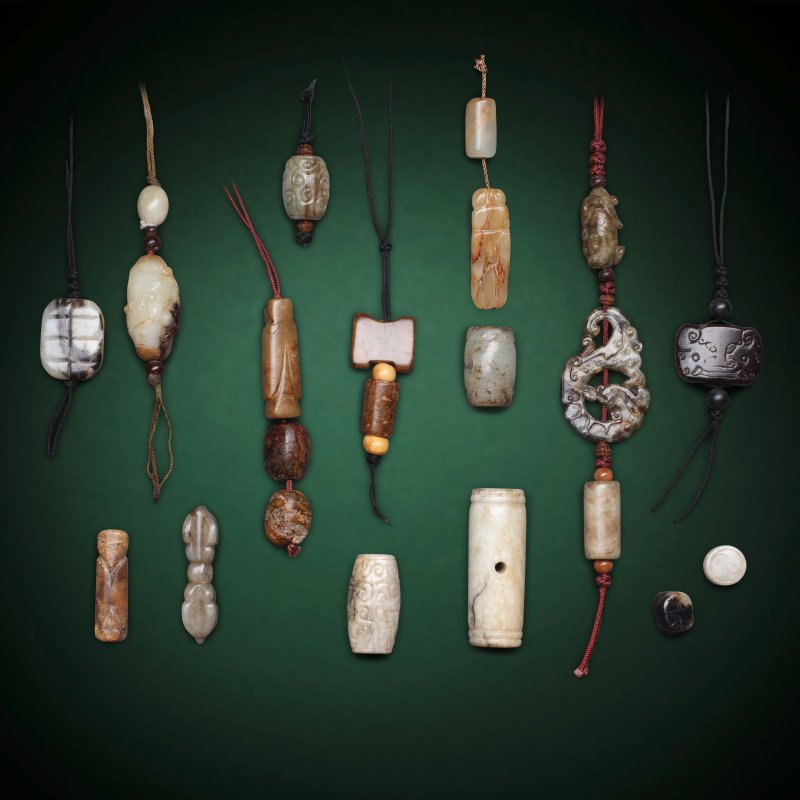
Comprising: a strand of jade carvings including a dragon-form plaque, an ovoid bead encircled by a chi dragon in high relief and a tubular bead; a plaque carved on one side with a mythical beast mask, the reverse pierced with two apertures, attached to a cord strung with two beads; an ovoid bead carved in relief with a sinuous chi dragon and a plain ovoid bead, both attached to a cord strung with three small beads; a cord suspending a jade carving of a wengzhong figure, and two turtle-shell-form jade beads; a string attached with a jade rectangular pendant and a tubular jade bead; a white and russet jade carving of a dragonfly attached to a cord strung with a tubular bead; two white and black jade turtle-shell-shaped pendants; two drum-shaped jade beads; a russet jade carving of a wengzhong figure; two jade beads both carved in relief with scrolling clouds; a jade bead carved on each side with a taijitu; a greyish jade vajra. The largest, 5.3cm high. (15).
Footnotes
新石器時代至民國 玉珠及佩等玉飾一組
Wengzhong figures emerged as a distinctive type of jade ornament during the Han dynasty. According to tradition, Ruan Wengzhong 阮翁仲 was a formidable general who served under the First Emperor of Qin and was stationed at the frontier, where his imposing presence was said to have caused the invading Xiongnu to flee. Following his death, his likeness was reputedly cast in bronze as a protective figure, and during the Han dynasty small jade figures of were produced as personal ornaments, worn as 辟邪 amulets to ward off evil and misfortune. A number of Han dynasty jade pendants are preserved in the Palace Museum, Beijing, illustrated in (故宮博物院藏品大系玉器編), vol.4, Beijing, 2011, pls.171-182. The type continued to be reproduced in later periods. Compare a Qing dynasty jade figure in the Palace Museum, Taipei (acc.no.故玉001909N000000000), and a Republic period example (acc.no.贈玉000251N000000000).
Compare the turtle-shell-shaped pendants with a related one, Western Zhou dynasty, in the collection of the Palace Museum, Beijing, illustrated in (中國傳世玉器全集), vol.1, Beijing, 2010, p.166.
Comprising: a strand of jade carvings including a dragon-form plaque, an ovoid bead encircled by a chi dragon in high relief and a tubular bead; a plaque carved on one side with a mythical beast mask, the reverse pierced with two apertures, attached to a cord strung with two beads; an ovoid bead carved in relief with a sinuous chi dragon and a plain ovoid bead, both attached to a cord strung with three small beads; a cord suspending a jade carving of a wengzhong figure, and two turtle-shell-form jade beads; a string attached with a jade rectangular pendant and a tubular jade bead; a white and russet jade carving of a dragonfly attached to a cord strung with a tubular bead; two white and black jade turtle-shell-shaped pendants; two drum-shaped jade beads; a russet jade carving of a wengzhong figure; two jade beads both carved in relief with scrolling clouds; a jade bead carved on each side with a taijitu; a greyish jade vajra. The largest, 5.3cm high. (15).
Footnotes
新石器時代至民國 玉珠及佩等玉飾一組
Wengzhong figures emerged as a distinctive type of jade ornament during the Han dynasty. According to tradition, Ruan Wengzhong 阮翁仲 was a formidable general who served under the First Emperor of Qin and was stationed at the frontier, where his imposing presence was said to have caused the invading Xiongnu to flee. Following his death, his likeness was reputedly cast in bronze as a protective figure, and during the Han dynasty small jade figures of were produced as personal ornaments, worn as 辟邪 amulets to ward off evil and misfortune. A number of Han dynasty jade pendants are preserved in the Palace Museum, Beijing, illustrated in (故宮博物院藏品大系玉器編), vol.4, Beijing, 2011, pls.171-182. The type continued to be reproduced in later periods. Compare a Qing dynasty jade figure in the Palace Museum, Taipei (acc.no.故玉001909N000000000), and a Republic period example (acc.no.贈玉000251N000000000).
Compare the turtle-shell-shaped pendants with a related one, Western Zhou dynasty, in the collection of the Palace Museum, Beijing, illustrated in (中國傳世玉器全集), vol.1, Beijing, 2010, p.166.
常见问题
这件新石器時代至民國 玉珠及佩等玉飾一組 | A GROUP OF JADE BEADS AND PENDANT CARVINGS的成交价是多少?
落槌价为 预展中。 成交价为 预展中。


