
Lot 111 A Chinese blue and white 'Magic Fountain' ewer
落槌价
****
成交价
****
拍品信息
拍品名称
A Chinese blue and white 'Magic Fountain' ewer
年代
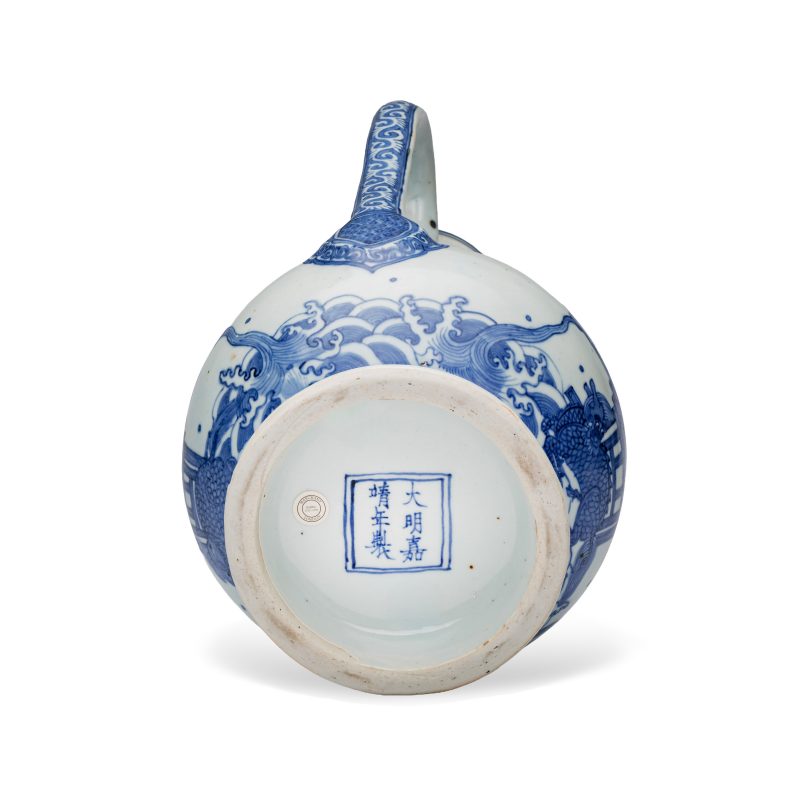
Jiajing mark and of the period
起拍价
未知
估值区间
€ 60.000 – € 120.000
尺寸
WH: H. 29,8 cm, W. 20,8 cm
品相
未知
更多信息
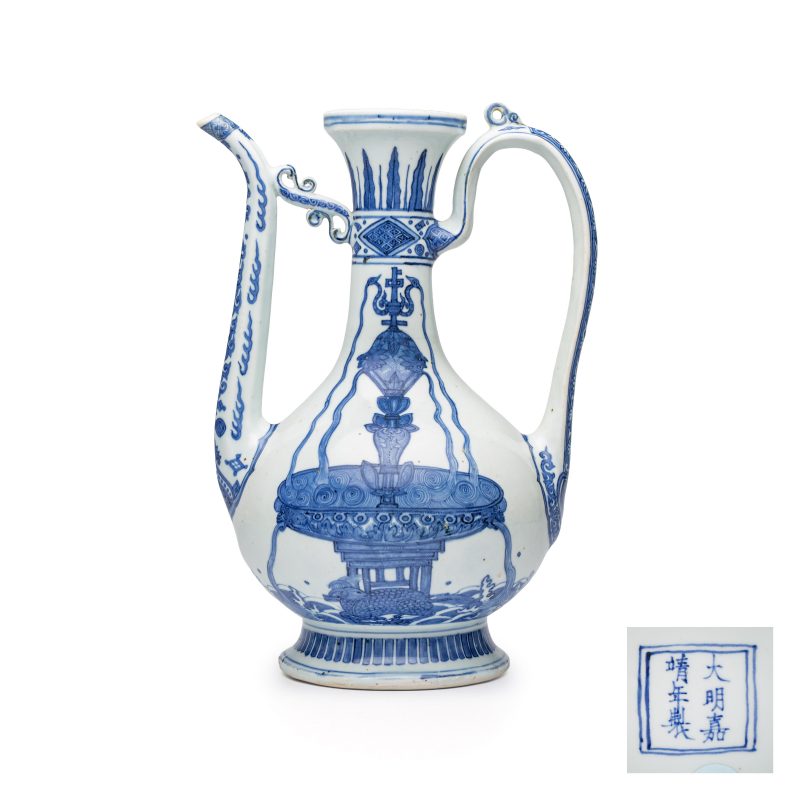
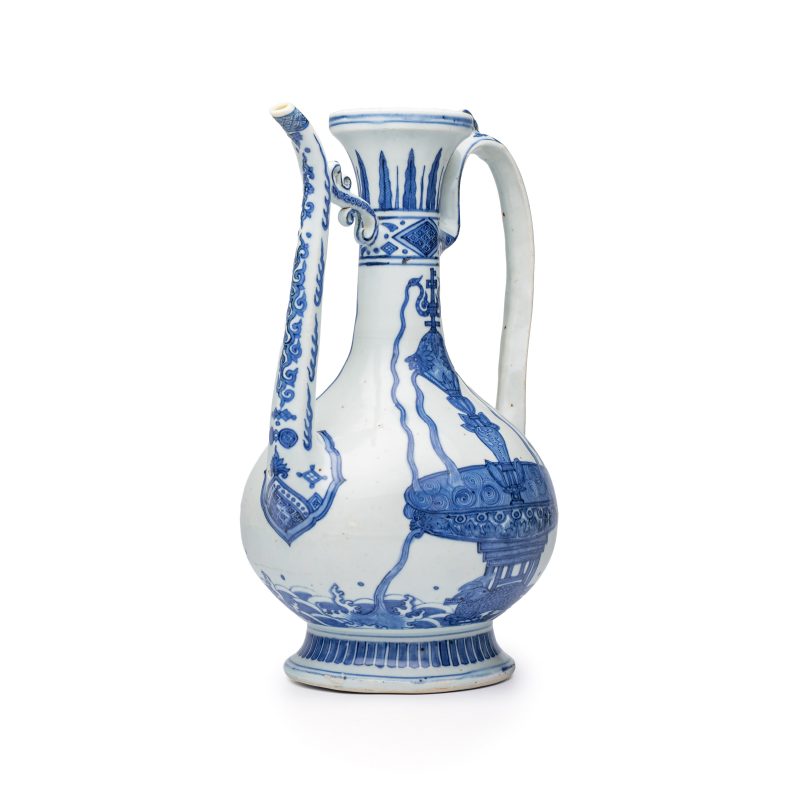
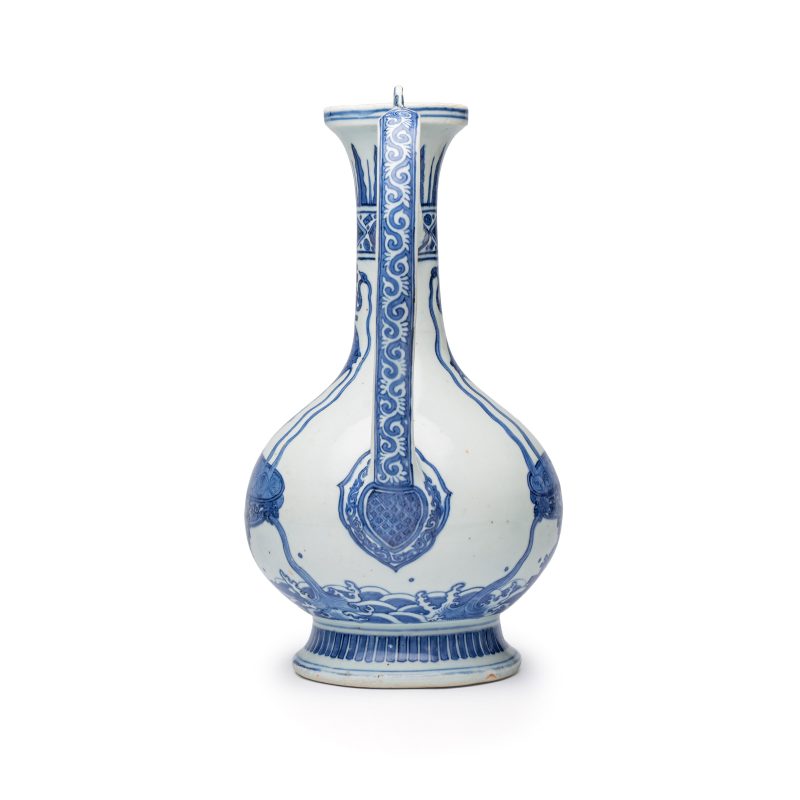
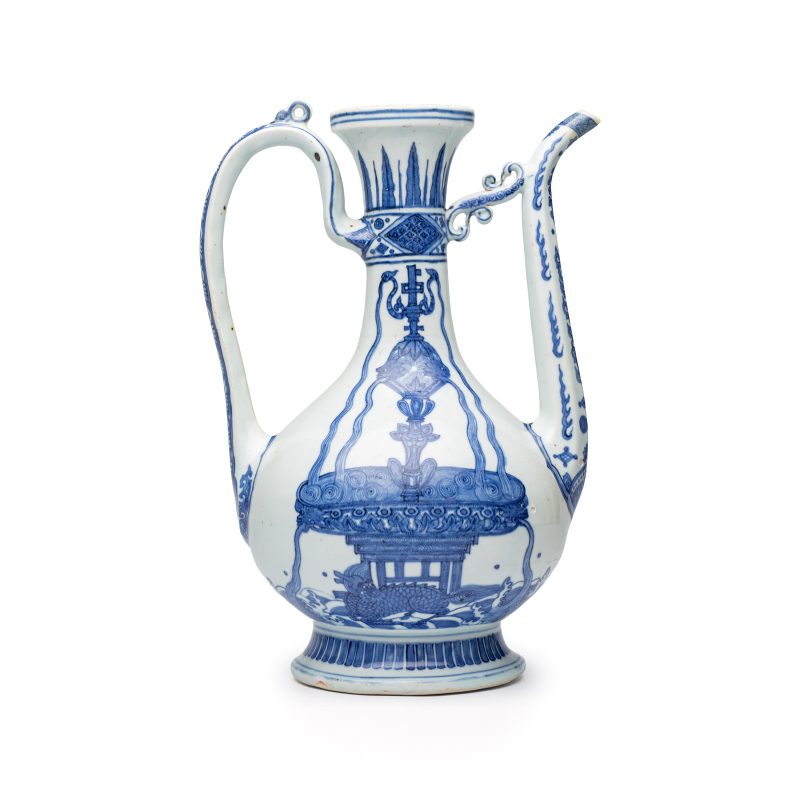
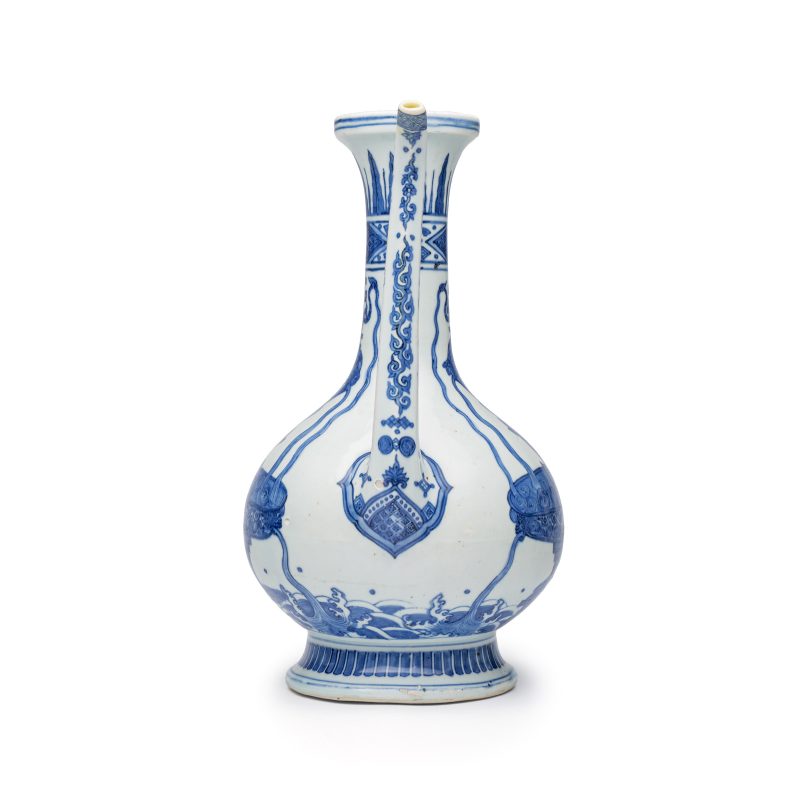
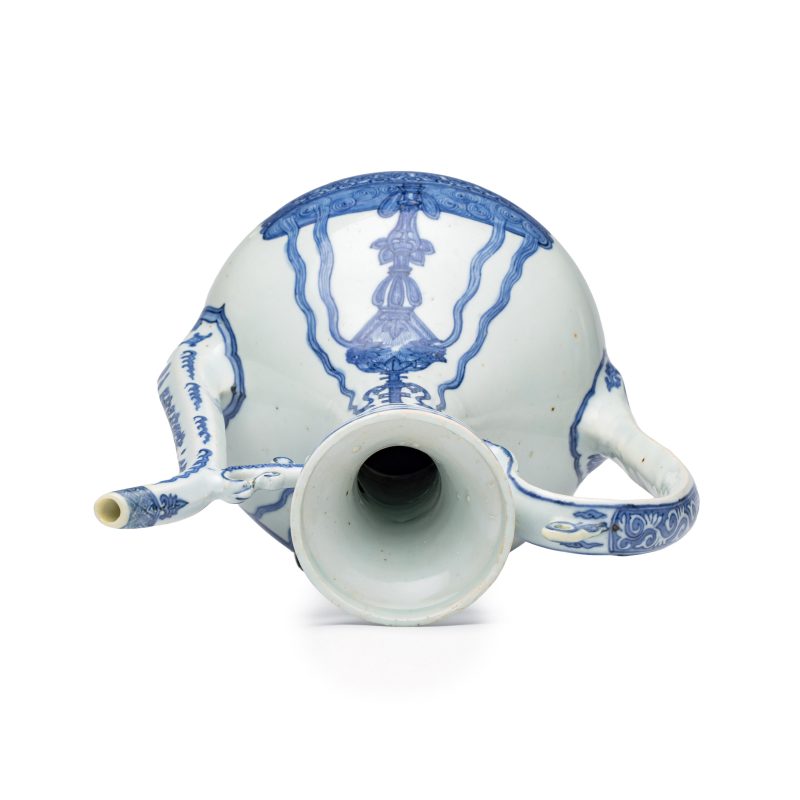
This rare blue and white porcelain ewer belongs to the celebrated group of so-called ‘Magic Fountain’ vessels, among the most imaginative and technically sophisticated wares produced at Jingdezhen during the Jiajing reign. The compressed pear-shaped body with tall curved spout and looped handle derives from Near Eastern metalwork prototypes, reflecting the extensive artistic exchange between China and the Islamic world. Successfully translated into porcelain from the fourteenth century onward, this distinctive form was produced for both domestic and export markets.
The decoration centres on the enigmatic ‘Magic Fountain’ motif: a monumental basin issuing streams of water, supported by a crouching qilin and framed by stylised architectural and flame-like elements. The origin of this imagery has long been debated. In 1952, Sir Percival David connected the design with the legendary mechanical fountain made by the Parisian goldsmith Guillaume Boucher for Möngke Khan at Karakorum in 1254. Later scholars proposed a more immediate European source, suggesting inspiration from Renaissance fountains transmitted to China through prints, paintings, tapestries, or Jesuit networks active in the sixteenth century.
The imagery would also have resonated with the Daoist interests of the Jiajing emperor, whose court was deeply preoccupied with immortality and longevity. In this context, the magical fountain may have symbolised life-giving or eternal qualities, making such vessels particularly appropriate for imperial taste. By the seventeenth century these ewers had become prized export objects, appearing in both Middle Eastern collections and European still-life paintings.
此件罕見的青花執壺屬於著名的「魔法噴泉」器物,是嘉靖時期景德鎮燒造的瓷器中最富奇思、工藝亦最為複雜的一類。壺身呈扁梨形,配高挑曲流及環柄,造型源自中東金屬器,反映了中國與伊斯蘭世界之間廣泛的藝術交流。自十四世紀起,這類金屬器造型便被成功轉化為瓷器,兼供宮廷內需及海外市場。
器身的主題為神秘的「魔法噴泉」圖:一座巨大的水池向外湧出水流,下由蹲伏的麒麟承托,四周環繞程式化的建築構件及火焰狀紋飾。此圖像的來源長期以來眾說紛紜。1952年,大維德爵士認為其與一座傳奇機械噴泉有關。該噴泉由巴黎金匠紀堯姆·布歇於1254年為蒙哥汗製作,置於蒙古帝國都城哈剌和林。後來亦有學者提出,其更直接的靈感可能來自歐洲文藝復興時期的噴泉,相關圖像或經由版畫、繪畫、壁毯,乃至十六世紀活躍於中國的耶穌會傳教網絡傳入。
這一題材亦與嘉靖皇帝崇奉道教、醉心求仙長生的宮廷風尚相契合。在此背景下,「魔法噴泉」或帶有生命之泉、長生不老等象徵意義,因而尤其符合當時的宮廷審美。至十七世紀,此類執壺已成為備受珍視的外銷器物,不僅見於中東地區的重要收藏,也屢次出現在歐洲靜物畫中。
Reference:
Comparable examples are in The Metropolitan Museum, New York, object no. 2023.582 (link), the Victoria and Albert Museum, London, accession no. C.105-1928 (link) and The Topkapi Saray Museum, Istanbul, Turkey, inv. no. TKS15/173 for a near-identical example and inv. no. TKS15/1462 for another Jiajing mark and period example.
Literature:
Sir Percival David, 'The Magic Fountain in Chinese Ceramic Art: An Exercise in Illustrational Interpretation, Bulletin of the Museum of Far Eastern Antiquities', 1952.
J. Ayers, R. Krahl, 'Chinese Ceramics in the Topkapi Saray Museum, Istanbul. Yuan and Ming Dynasty Porcelains', vol. II, 1986, nos. 1013-1016.
A. Pope, 'Chinese Porcelains from the Ardebil Shrine', 1956, pl. 99.
J. Harrison-Hall, 'Catalogue of Late Yuan and Ming Ceramics in the British Museum', 2001, p. 221, no. 9:10.
Provenance:
A Dutch private collection.
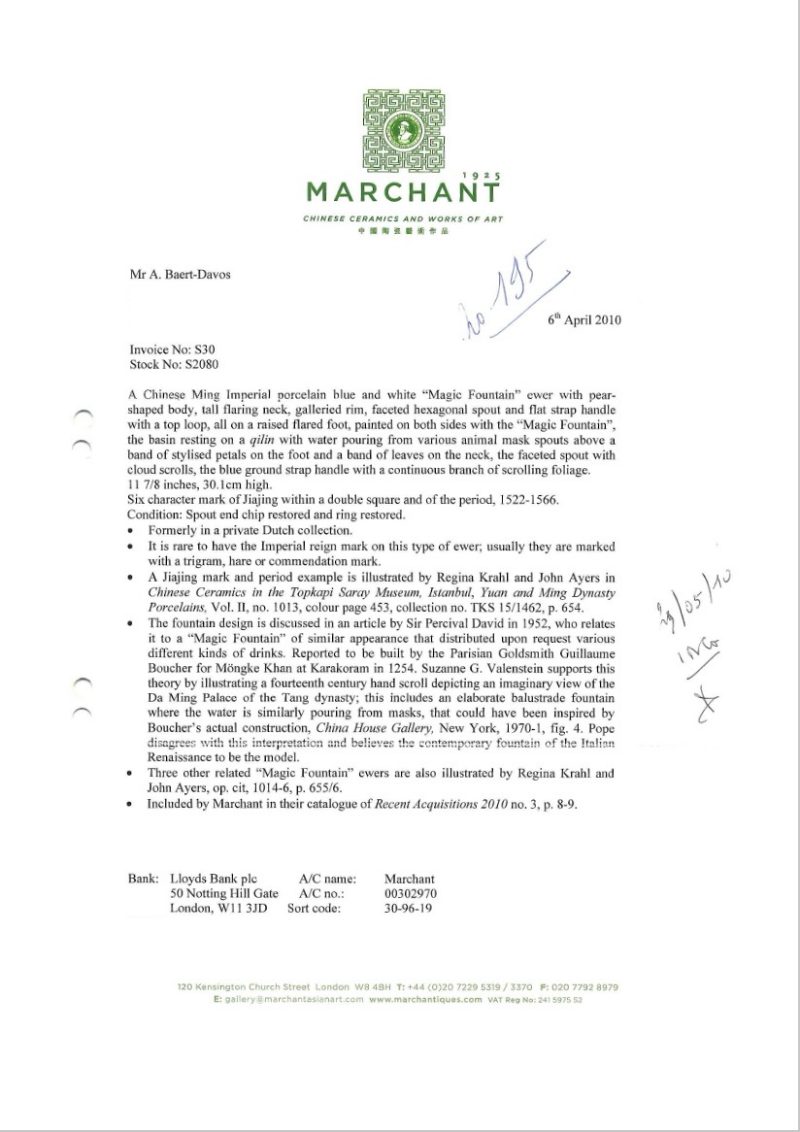
Marchant, London, with their label to the base.
The Mr. and Mrs. Baert-Devos Collection, Belgium. Acquired from the above on 6 April 2010, accompanied by a copy of their original invoice. (see added scan)
Exhibited & published:
Marchant, included in their June 2010 exhibition of 'Recent Acquisitions', and published in the accompanying catalogue pp. 8-9, no. 3 and back cover. Also illustrated in their 2025 publication, 'One Hundred Years', vol II, p. 220, no. 1433
The decoration centres on the enigmatic ‘Magic Fountain’ motif: a monumental basin issuing streams of water, supported by a crouching qilin and framed by stylised architectural and flame-like elements. The origin of this imagery has long been debated. In 1952, Sir Percival David connected the design with the legendary mechanical fountain made by the Parisian goldsmith Guillaume Boucher for Möngke Khan at Karakorum in 1254. Later scholars proposed a more immediate European source, suggesting inspiration from Renaissance fountains transmitted to China through prints, paintings, tapestries, or Jesuit networks active in the sixteenth century.
The imagery would also have resonated with the Daoist interests of the Jiajing emperor, whose court was deeply preoccupied with immortality and longevity. In this context, the magical fountain may have symbolised life-giving or eternal qualities, making such vessels particularly appropriate for imperial taste. By the seventeenth century these ewers had become prized export objects, appearing in both Middle Eastern collections and European still-life paintings.
此件罕見的青花執壺屬於著名的「魔法噴泉」器物,是嘉靖時期景德鎮燒造的瓷器中最富奇思、工藝亦最為複雜的一類。壺身呈扁梨形,配高挑曲流及環柄,造型源自中東金屬器,反映了中國與伊斯蘭世界之間廣泛的藝術交流。自十四世紀起,這類金屬器造型便被成功轉化為瓷器,兼供宮廷內需及海外市場。
器身的主題為神秘的「魔法噴泉」圖:一座巨大的水池向外湧出水流,下由蹲伏的麒麟承托,四周環繞程式化的建築構件及火焰狀紋飾。此圖像的來源長期以來眾說紛紜。1952年,大維德爵士認為其與一座傳奇機械噴泉有關。該噴泉由巴黎金匠紀堯姆·布歇於1254年為蒙哥汗製作,置於蒙古帝國都城哈剌和林。後來亦有學者提出,其更直接的靈感可能來自歐洲文藝復興時期的噴泉,相關圖像或經由版畫、繪畫、壁毯,乃至十六世紀活躍於中國的耶穌會傳教網絡傳入。
這一題材亦與嘉靖皇帝崇奉道教、醉心求仙長生的宮廷風尚相契合。在此背景下,「魔法噴泉」或帶有生命之泉、長生不老等象徵意義,因而尤其符合當時的宮廷審美。至十七世紀,此類執壺已成為備受珍視的外銷器物,不僅見於中東地區的重要收藏,也屢次出現在歐洲靜物畫中。
Reference:
Comparable examples are in The Metropolitan Museum, New York, object no. 2023.582 (link), the Victoria and Albert Museum, London, accession no. C.105-1928 (link) and The Topkapi Saray Museum, Istanbul, Turkey, inv. no. TKS15/173 for a near-identical example and inv. no. TKS15/1462 for another Jiajing mark and period example.
Literature:
Sir Percival David, 'The Magic Fountain in Chinese Ceramic Art: An Exercise in Illustrational Interpretation, Bulletin of the Museum of Far Eastern Antiquities', 1952.
J. Ayers, R. Krahl, 'Chinese Ceramics in the Topkapi Saray Museum, Istanbul. Yuan and Ming Dynasty Porcelains', vol. II, 1986, nos. 1013-1016.
A. Pope, 'Chinese Porcelains from the Ardebil Shrine', 1956, pl. 99.
J. Harrison-Hall, 'Catalogue of Late Yuan and Ming Ceramics in the British Museum', 2001, p. 221, no. 9:10.
Provenance:
A Dutch private collection.
Marchant, London, with their label to the base.
The Mr. and Mrs. Baert-Devos Collection, Belgium. Acquired from the above on 6 April 2010, accompanied by a copy of their original invoice. (see added scan)
Exhibited & published:
Marchant, included in their June 2010 exhibition of 'Recent Acquisitions', and published in the accompanying catalogue pp. 8-9, no. 3 and back cover. Also illustrated in their 2025 publication, 'One Hundred Years', vol II, p. 220, no. 1433
常见问题
拍品的尺寸是多少?
WH: H. 29,8 cm, W. 20,8 cm