
拍品信息
拍品名称
十七世紀 綠松石雕蟾蓮擺件 | A SUPERB AND EXCEPTIONALLY RARE LARGE 'NINE-TOAD' TURQUOISE CARVING
年代
17th century
起拍价
HKD 400,000
估值区间
HKD 400000 - 600000
尺寸
未知
品相
未知
更多信息
17th century
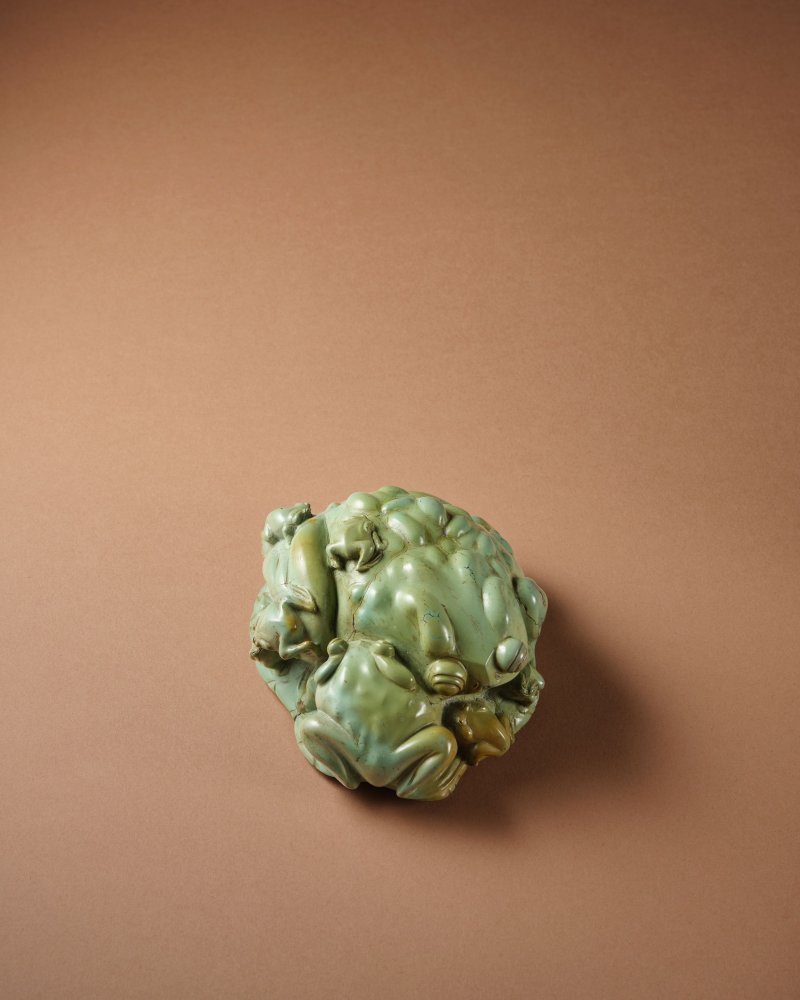
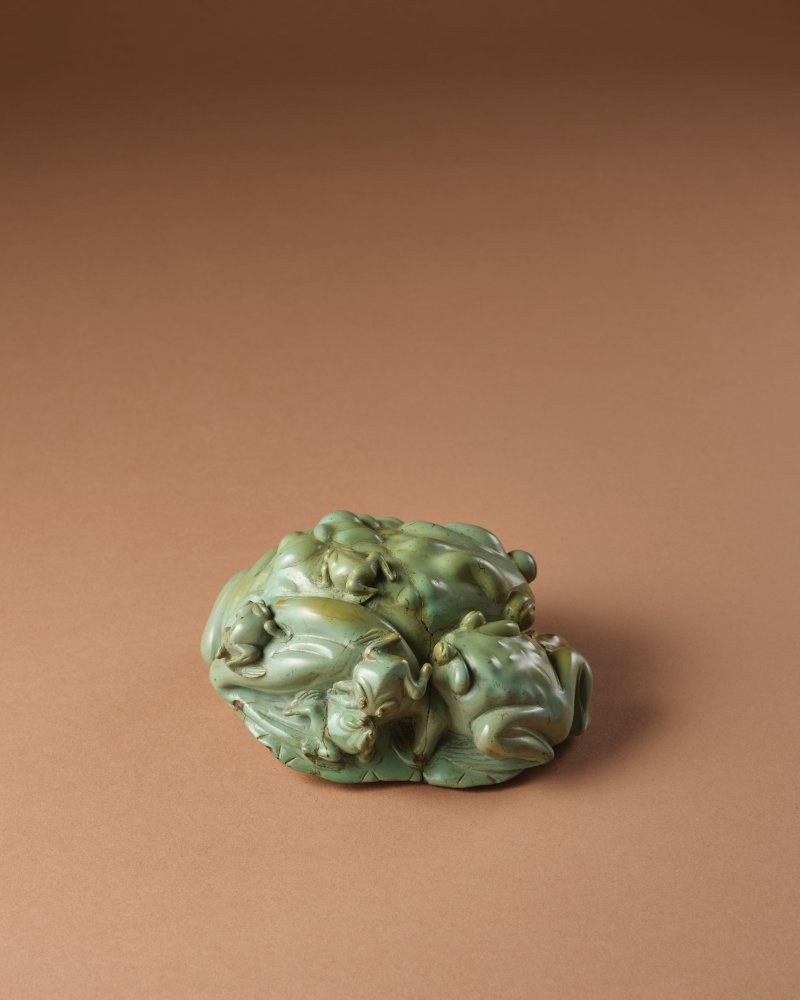
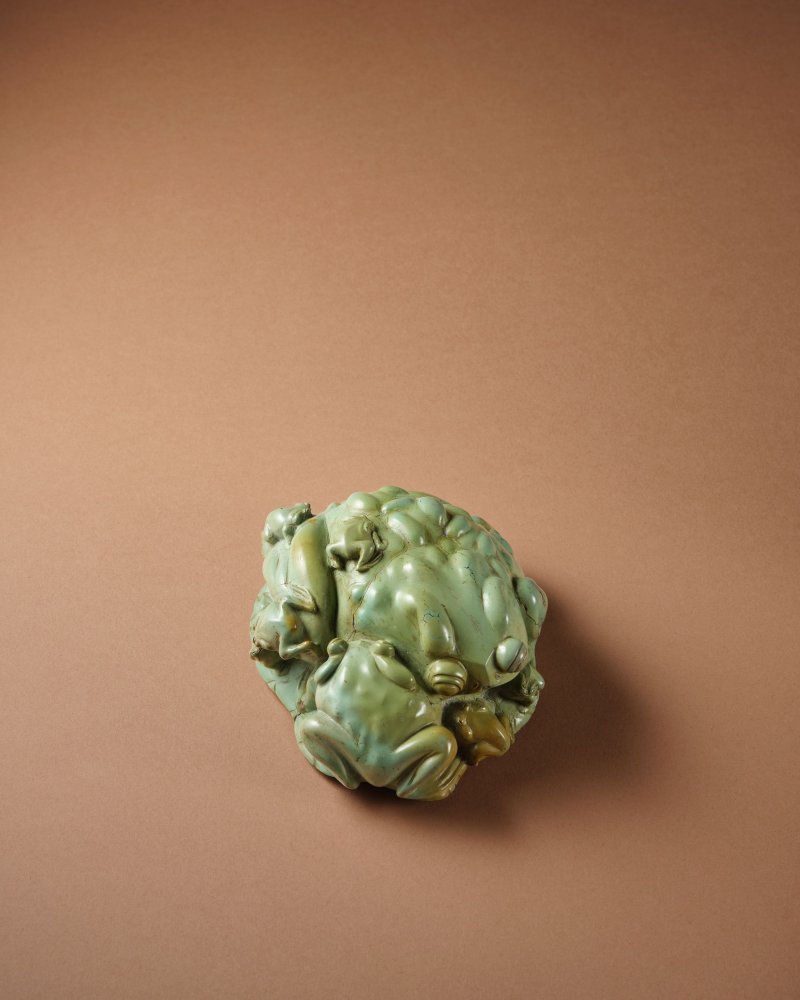
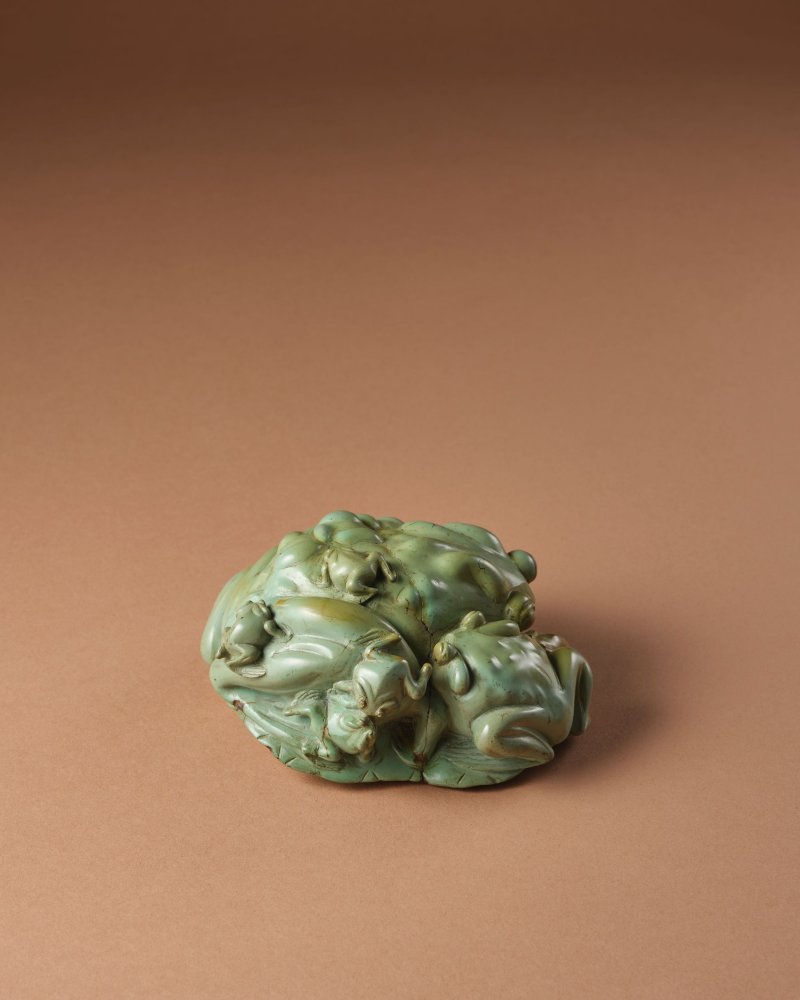
Naturalistically carved as a large toad with bulbous eyes and warts extending down its back, flanked by a medium-sized toad and seven smaller toads clambering over its body, all resting on a large undulating lotus leaf finely incised with veins, the stone of a glistening greenish-turquoise tone with yellow-ochre patches, the surface smoothly polished to impart a moist, slippery appearance.
11.6cm (4 5/8) long.
Footnotes
十七世紀 綠松石雕蟾蓮擺件
Provenance:
Artcurial, Paris, 11 June 2013, lot 134
來源:
Artcurial,巴黎,2013年6月11日,拍品編號134
The choice of turquoise for the present carving is particularly apt, its natural colouration and lustrous polish capturing the moist, slippery quality associated with toads and reinforcing their amphibious vitality. The subtle variations in tone and surface lend the forms a sense of animation, as though the creatures are in motion across the undulating lotus leaf. Such tactile appeal suggests that the carving may have functioned as a scholar's paperweight, intended not only to secure papers on the desk but also to serve as a constant visual and symbolic companion. In this context, the rebus imagery of toad and lotus, together with the auspicious connotations of multiplicity, may be read as an object of quiet encouragement, expressing the hope for successive success in the civil service examinations. See a related turquoise carving of a mythical animal, probably Ming or early Qing dynasty, illustrated by G.Tsang and H.Moss, , Hong Kong, 1986, pp.270-271, no.268.
A toad shown with or upon a lotus ( 蓮), as in the present lot, also participates in a long-established tradition of rebus imagery. Through homophony, the pairing forms (蟬聯), meaning 'to hold office or rank successively.' When combined conceptually with 甲 ('first' or 'top rank'), the rebus (一甲蟬聯) expresses the aspiration to attain first place repeatedly in the civil service examinations.
The toad itself ( 蟾 or 蟾蜍) is an auspicious creature in Chinese culture, associated with the moon, longevity, and transformation. From at least the Han dynasty, the toad appears in lunar mythology, notably in connection with Chang'e, where it is linked to immortality and cyclical renewal. In later tradition, particularly from the Ming and Qing periods, the toad also became associated with wealth and abundance, most famously in the form of the three-legged 'money toad' ( 金蟾).
Furthermore, the number nine ( 九) carries strong positive connotations in Chinese numerology, signifying completeness, supremacy, and longevity, and was closely associated with Imperial symbolism. While there is no fixed canonical myth concerning 'nine toads', the repetition of the motif in groups of nine may be understood as a numerological amplification of the toad's auspicious qualities, suggesting enduring prosperity, continuity, and successive success.
此擺件以綠松石為材,其天然色彩及光澤巧妙呈現蟾蜍表皮濕潤之質感,尤顯靈動。色澤深淺與表面肌理變化,賦予造像栩栩如生之態,宛若遊移於波紋荷葉之間。此器觸感細膩平滑,或為文人鎮紙之用,既鎮書案,亦為目賞心寄之物。
蟾蜍與蓮荷,寄寓科場連捷之願。蓮諧音「連」,蟾諧音「蟬」,合為「蟬聯」,喻科舉功名連貫不絕。若再配以「甲」,則成「一甲蟬聯」,寄寓連中三元之期許。參考一件綠松石雕瑞獸,應為明代或清初所製,見G.Tsang與莫士撝合著,《Arts from the Scholar's Studio》,香港,1986年,頁270至271,編號268。
蟾為祥瑞之物。自漢代以降,蟾蜍與月宮、嫦娥之傳說相繫,象徵永生不息。至明清時期,蟾蜍有豐足之寓意,尤以三足金蟾最為人所熟知。
此外,「九」在中國數術中為陽數之極,象徵圓滿極致,長長久久,與帝王之象緊密相連。雖無「九蟾」之典故,然以九蟾為一組,更添祥瑞之義,寄寓綿延不絕之昌隆與功成。
Naturalistically carved as a large toad with bulbous eyes and warts extending down its back, flanked by a medium-sized toad and seven smaller toads clambering over its body, all resting on a large undulating lotus leaf finely incised with veins, the stone of a glistening greenish-turquoise tone with yellow-ochre patches, the surface smoothly polished to impart a moist, slippery appearance.
11.6cm (4 5/8) long.
Footnotes
十七世紀 綠松石雕蟾蓮擺件
Provenance:
Artcurial, Paris, 11 June 2013, lot 134
來源:
Artcurial,巴黎,2013年6月11日,拍品編號134
The choice of turquoise for the present carving is particularly apt, its natural colouration and lustrous polish capturing the moist, slippery quality associated with toads and reinforcing their amphibious vitality. The subtle variations in tone and surface lend the forms a sense of animation, as though the creatures are in motion across the undulating lotus leaf. Such tactile appeal suggests that the carving may have functioned as a scholar's paperweight, intended not only to secure papers on the desk but also to serve as a constant visual and symbolic companion. In this context, the rebus imagery of toad and lotus, together with the auspicious connotations of multiplicity, may be read as an object of quiet encouragement, expressing the hope for successive success in the civil service examinations. See a related turquoise carving of a mythical animal, probably Ming or early Qing dynasty, illustrated by G.Tsang and H.Moss, , Hong Kong, 1986, pp.270-271, no.268.
A toad shown with or upon a lotus ( 蓮), as in the present lot, also participates in a long-established tradition of rebus imagery. Through homophony, the pairing forms (蟬聯), meaning 'to hold office or rank successively.' When combined conceptually with 甲 ('first' or 'top rank'), the rebus (一甲蟬聯) expresses the aspiration to attain first place repeatedly in the civil service examinations.
The toad itself ( 蟾 or 蟾蜍) is an auspicious creature in Chinese culture, associated with the moon, longevity, and transformation. From at least the Han dynasty, the toad appears in lunar mythology, notably in connection with Chang'e, where it is linked to immortality and cyclical renewal. In later tradition, particularly from the Ming and Qing periods, the toad also became associated with wealth and abundance, most famously in the form of the three-legged 'money toad' ( 金蟾).
Furthermore, the number nine ( 九) carries strong positive connotations in Chinese numerology, signifying completeness, supremacy, and longevity, and was closely associated with Imperial symbolism. While there is no fixed canonical myth concerning 'nine toads', the repetition of the motif in groups of nine may be understood as a numerological amplification of the toad's auspicious qualities, suggesting enduring prosperity, continuity, and successive success.
此擺件以綠松石為材,其天然色彩及光澤巧妙呈現蟾蜍表皮濕潤之質感,尤顯靈動。色澤深淺與表面肌理變化,賦予造像栩栩如生之態,宛若遊移於波紋荷葉之間。此器觸感細膩平滑,或為文人鎮紙之用,既鎮書案,亦為目賞心寄之物。
蟾蜍與蓮荷,寄寓科場連捷之願。蓮諧音「連」,蟾諧音「蟬」,合為「蟬聯」,喻科舉功名連貫不絕。若再配以「甲」,則成「一甲蟬聯」,寄寓連中三元之期許。參考一件綠松石雕瑞獸,應為明代或清初所製,見G.Tsang與莫士撝合著,《Arts from the Scholar's Studio》,香港,1986年,頁270至271,編號268。
蟾為祥瑞之物。自漢代以降,蟾蜍與月宮、嫦娥之傳說相繫,象徵永生不息。至明清時期,蟾蜍有豐足之寓意,尤以三足金蟾最為人所熟知。
此外,「九」在中國數術中為陽數之極,象徵圓滿極致,長長久久,與帝王之象緊密相連。雖無「九蟾」之典故,然以九蟾為一組,更添祥瑞之義,寄寓綿延不絕之昌隆與功成。
常见问题
这件十七世紀 綠松石雕蟾蓮擺件 | A SUPERB AND EXCEPTIONALLY RARE LARGE 'NINE-TOAD' TURQUOISE CARVING的成交价是多少?
落槌价为 预展中。 成交价为 预展中。