
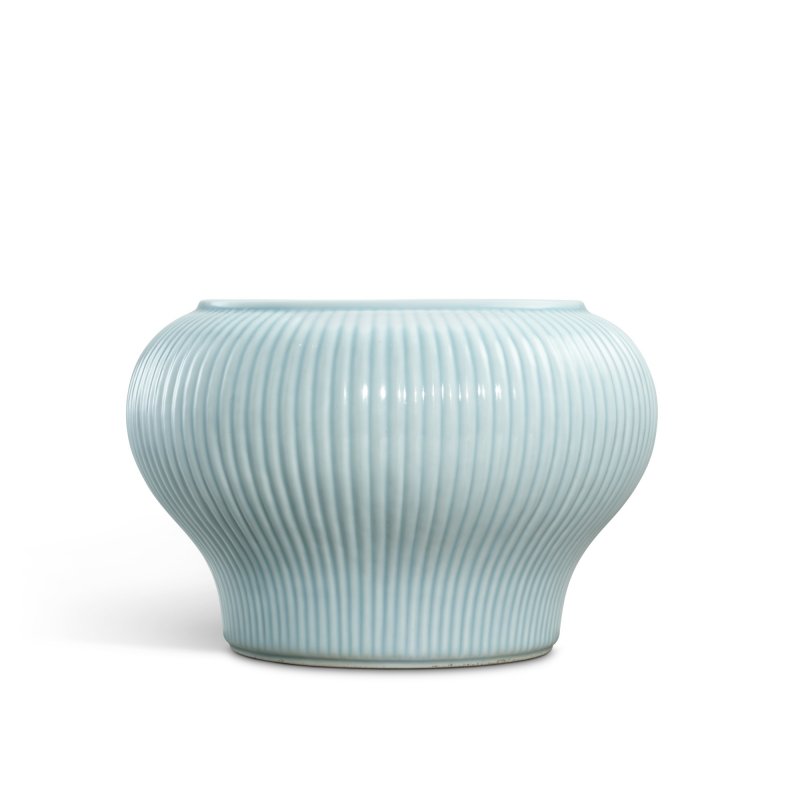
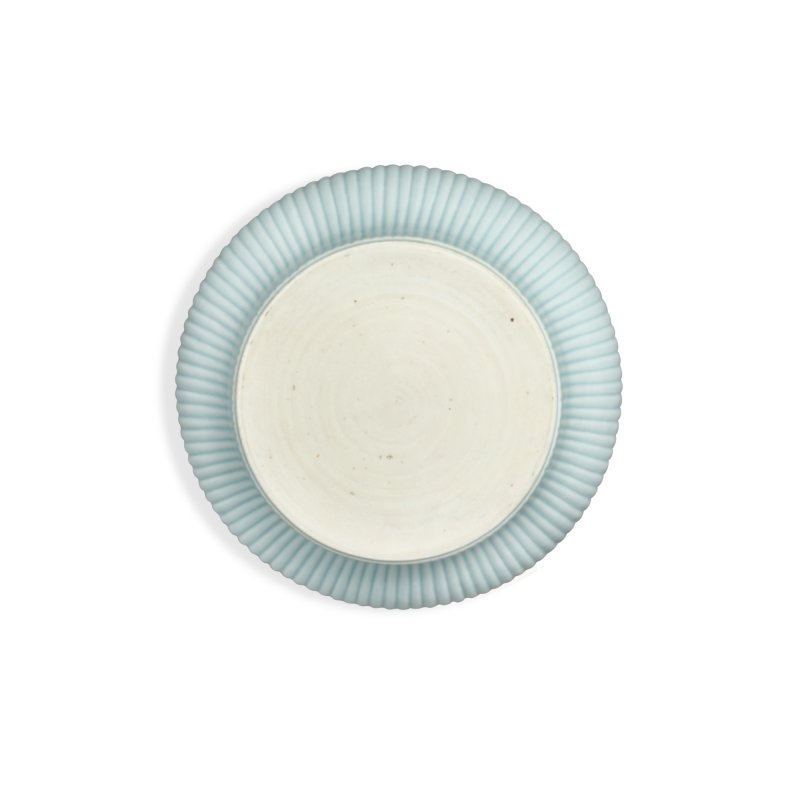
Lot 621 A 'clair-de-lune'-glazed 'hundred rib' jar, Qing dynasty, Kangxi period | 清康熙 天藍釉百條缸
落槌价
预展中
成交价
预展中
| 拍卖公司 | 苏富比 |
|---|---|
| 拍卖时间 | 2026年11月03日 |
拍品信息
拍品名称
A 'clair-de-lune'-glazed 'hundred rib' jar, Qing dynasty, Kangxi period | 清康熙 天藍釉百條缸
起拍价
HKD 400,000
估值区间
400,000 - 800,000 HKD
尺寸
未知
品相
如欲了解本拍品狀況的更多資訊,請聯絡 xiaoye.yang@sothebys.com
更多信息
A 'clair-de-lune'-glazed 'hundred rib' jar
Qing dynasty, Kangxi period
清康熙 天藍釉百條缸
w. 27.6 cm
图录
说明:The present jar is remarkable for its precisely potted large form which has been covered in a luminous clair-de-lune glaze. This high-fired glaze, with a cobalt content of about 1%, was first produced by the imperial kilns in Jingdezhen during the Kangxi Emperor’s reign. Known in the West by the 19th-century French connoisseurs’ term clair-de-lune (‘moon light’), and in China as tianlan (‘sky blue’), it was one of the most successful monochrome glazes created in Jingdezhen during the Kangxi reign, its soft hue reserved exclusively for imperial porcelains. The colour remained popular throughout the Qing dynasty, but after the Kangxi period lost its delicate tone.
A closely related jar, exhibited on loan at the Indianapolis Museum of Art, was offered in our New York rooms, 6th December 1989, lot 192; one from the Edward T. Chow collection was sold in these rooms, 25th November 1980, lot 73; and another from the J.M. Hu collection was sold in our New York rooms, 4th June 1985, lot 29. See also one sold in our London rooms, 10th July 1979, lot 203, and again in these rooms, 20th May 1980, lot 98; two further jars sold in our New York rooms, one from the collection of William L. Parker, 11th May 1978, lot 212, and the other, 22nd September 2022, lot 205; and one recently sold in these rooms, 5th April 2017, lot 1111; and one also sold in these rooms, 3rd April 2019, lot 3655.
The form of these jars derives from Longquan celadon wares of the 14th century, which were made with covers in the form of a lotus leaf, such as one from the collection of the Ottoman sultans and now in the Topkapi Saray Museum, Istanbul, included in Regina Krahl, Chinese Ceramics in the Topkapi Saray Museum, Istanbul, London, 1986, vol. I, pl. 213; and another, in the Tokyo National Museum, published in the Illustrated Catalogue of Tokyo National Museum. Chinese Ceramics II, Tokyo, 1990, cat. no. 14.
Jars of this type may in the later Qing period have been described as having a Ru glaze, the ribs referred to as ‘hundred folds’ (baizhe). According to the inventory of the Qing imperial court archives, dated to the twelfth month of the eleventh year of the Guangxu period (in accordance with 1885), Ru you ci baizhe xiao yugang yi kou or ‘a small Ru-glazed hundred-fold fish jar’ was stored in the porcelain quarter of Fangyuanju (Residence of the aromatic garden) in the Imperial Summer Palace at Chengde.
此百條缸器碩穩健,流麗優雅,通體施天藍釉,潔淨清淡,溫潤雋永。天藍釉為高溫色釉,內含約1%鈷料,康熙朝創燒於景德鎮。其釉色淺而發藍,通透純淨,似天青,故名「月白釉」,或「天藍釉」,屬當朝單色釉名品,為景德鎮御瓷專用色。而後歷朝皆燒天藍釉瓷,然色調略深,始未及康熙器之柔雅含蓄。
可比較一極近作例,曾借展印第安納波利斯美術館,後售於紐約蘇富比1989年12月6日,編號192。另參考仇焱之舊藏,售於香港蘇富比1980年12月25日,編號73。胡惠春雅蓄也有一例,售於紐約蘇富比1985年6月4日,編號29。再比較一類似例,分別售於蘇富比紐約1979年7月10日,編號203,及香港1980年5月20日,編號98。此外,紐約蘇富比亦曾售二相似罐例,其一為 William L. Parker 典藏,售於1978年5月11日,編號212;其二售於2022年9月22日,編號205。還有兩缸近售於香港蘇富比,一件售2017年4月5日,編號1111,另一件售於2019年4月3日,編號3655。
此罐器型源自14世紀龍泉窰青釉瓜棱荷葉蓋罐,可見一龍泉罐例,奥斯曼蘇丹舊藏,現存伊斯坦堡托普卡比宮殿博物館,載於康蕊君,《Chinese Ceramics in the Topkapi Saray Museum, Istanbul》,倫敦,1986年,卷1,圖版213。另見一例,藏東京國立博物館,刊於《東京国立博物館図版目錄:中国古陶磁篇2》,東京,1990年,編號14。
此類條棱於晚清被稱「百摺」,天藍釉則以為仿汝。據清宮檔案載,光緒十一年(1885年)陳設檔內〈十二月芳園居等處陳設鋪墊等項清檔〉有載「磁器鋪內設……乳釉磁百摺小魚缸一口」,可知當時有承德避暑山莊芳園居內有貯與此同類之器。
常见问题
这件A 'clair-de-lune'-glazed 'hundred rib' jar, Qing dynasty, Kangxi period | 清康熙 天藍釉百條缸的成交价是多少?
落槌价为 预展中。 成交价为 预展中。
拍品的品相状况如何?
如欲了解本拍品狀況的更多資訊,請聯絡 xiaoye.yang@sothebys.com