
拍品信息
拍品名称
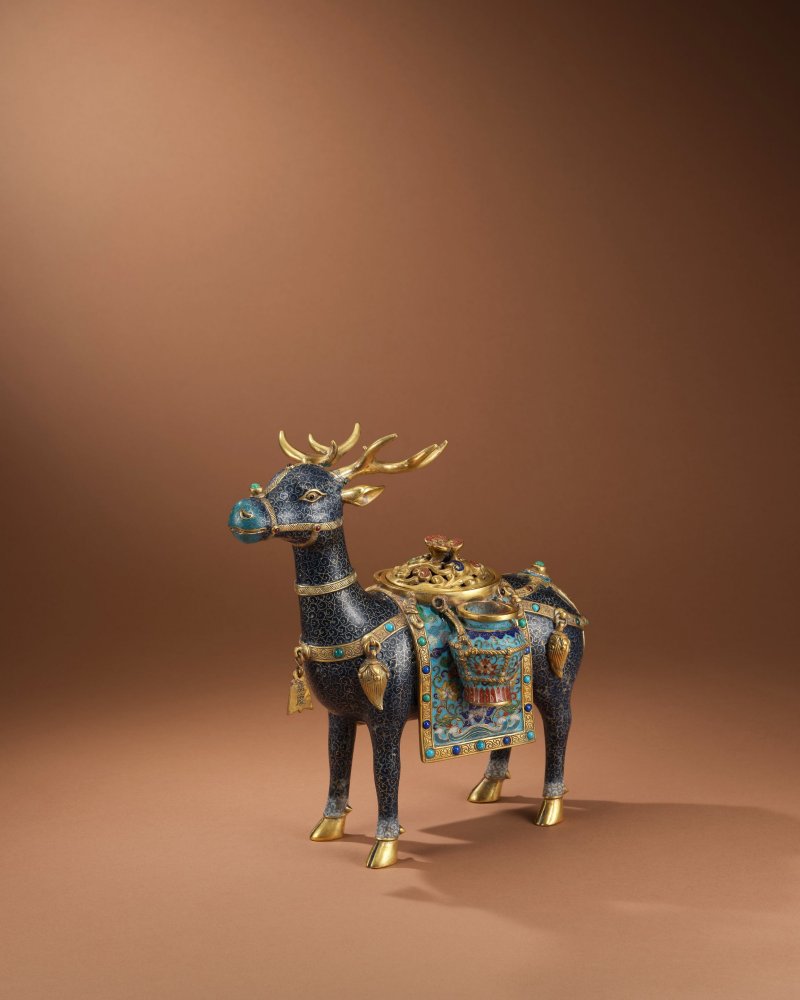
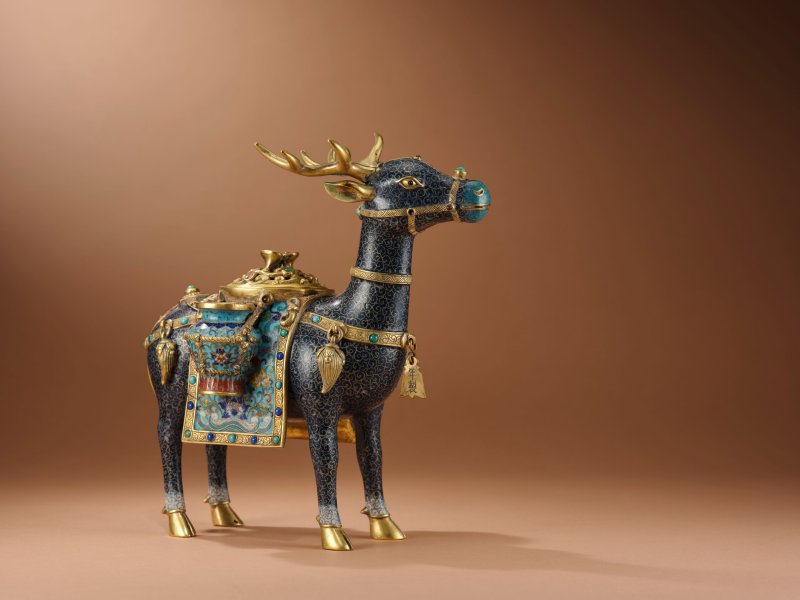
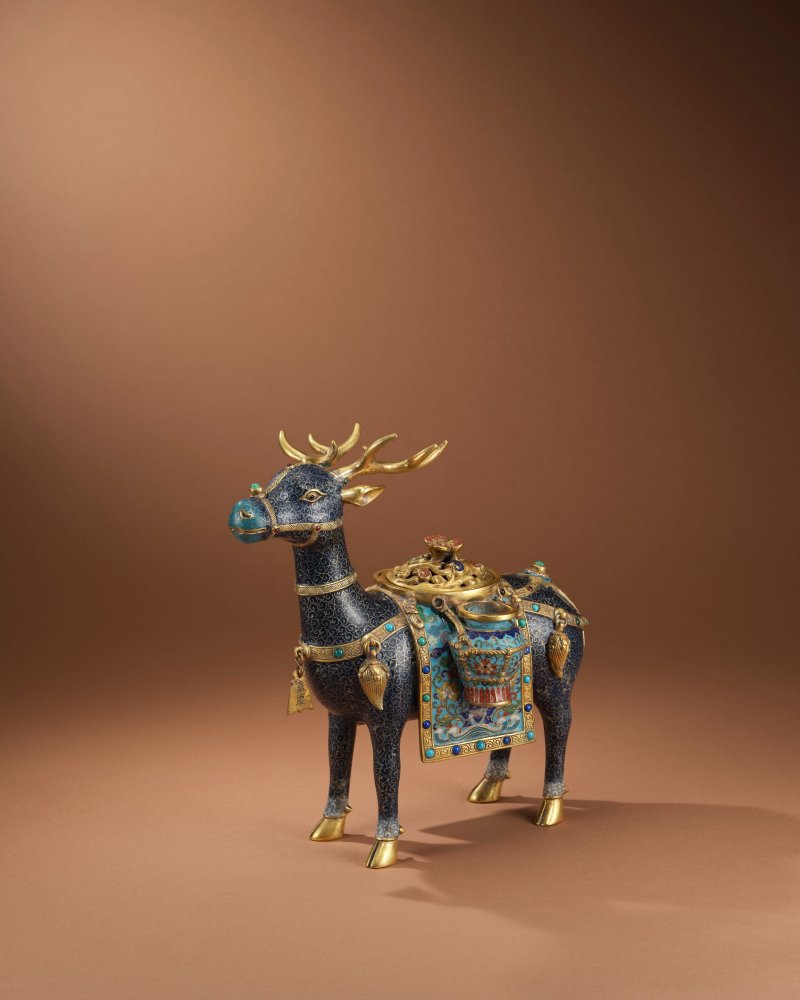
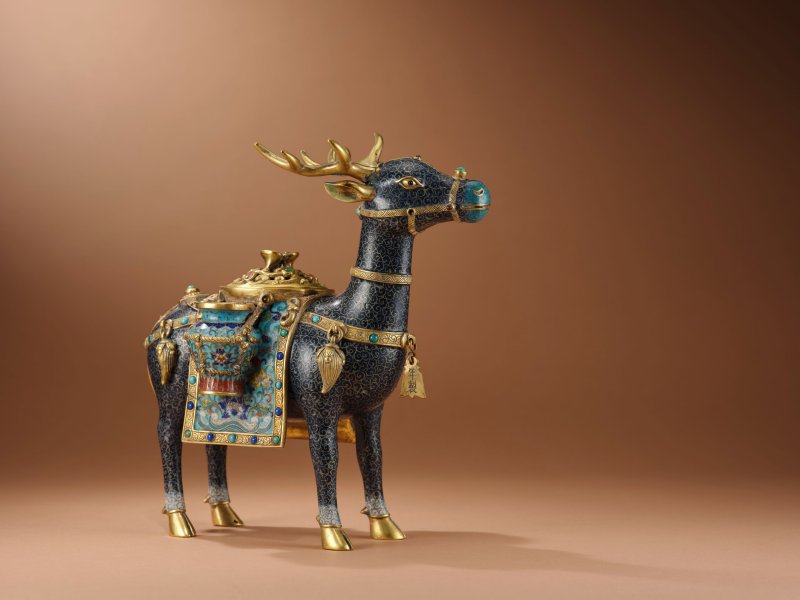
清嘉慶 御製嵌寶掐絲鏨胎琺瑯天祿蓋爐 | AN EXCEPTIONALLY RARE IMPERIAL CLOISONNÉ AND CHAMPLEVÉ ENAMEL AND GILT-BRONZE STAG-SHAPED INCENSE BURNER AND COVER
年代
Jiaqing four-character mark and of the period
起拍价
HKD 1,200,000
估值区间
HKD 1200000 - 1500000
尺寸
未知
品相
未知
更多信息
Jiaqing four-character mark and of the period
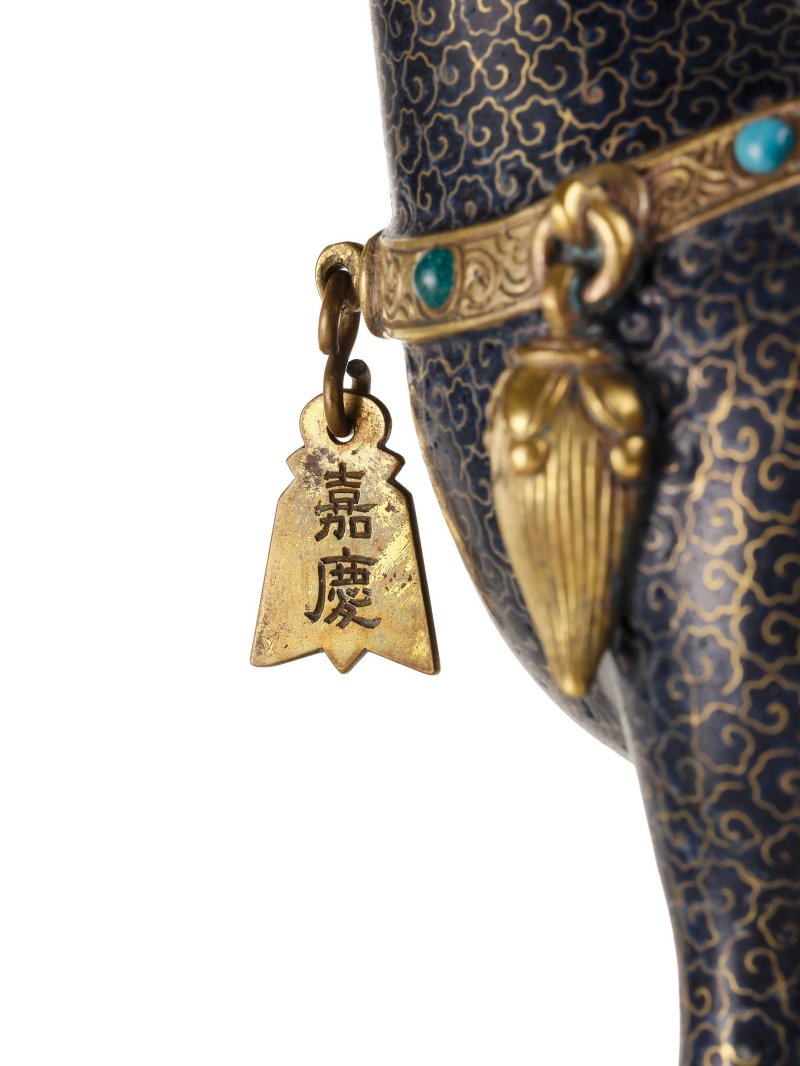
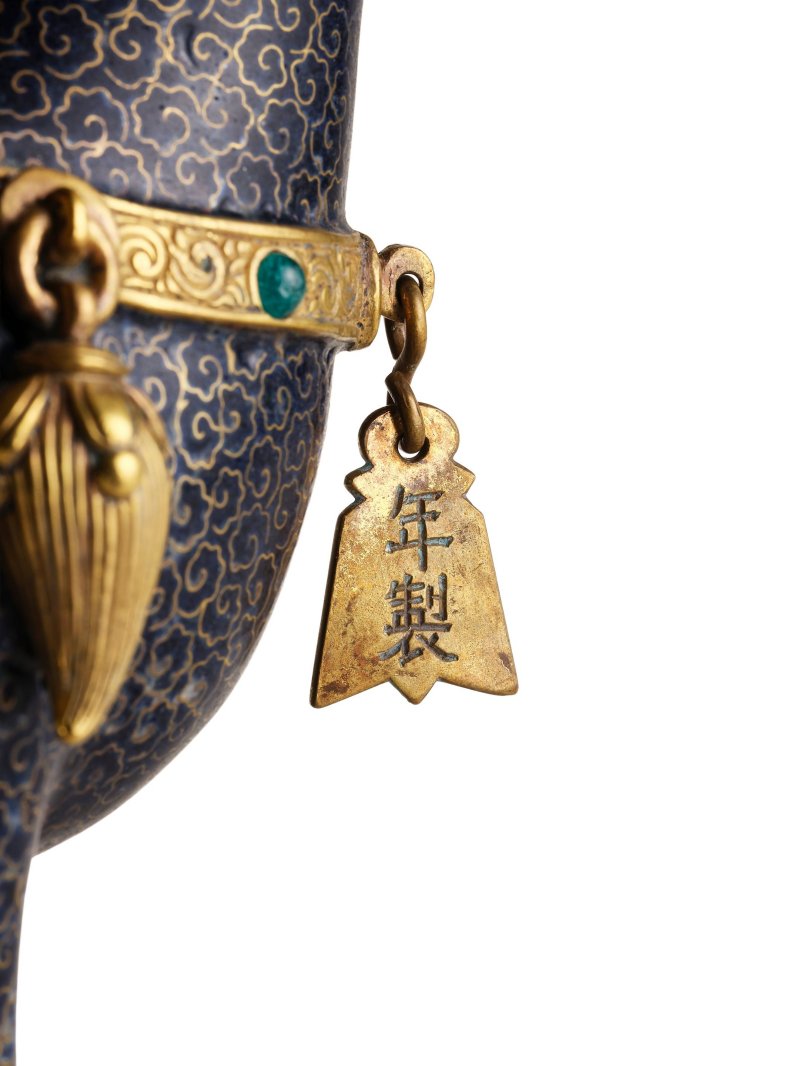
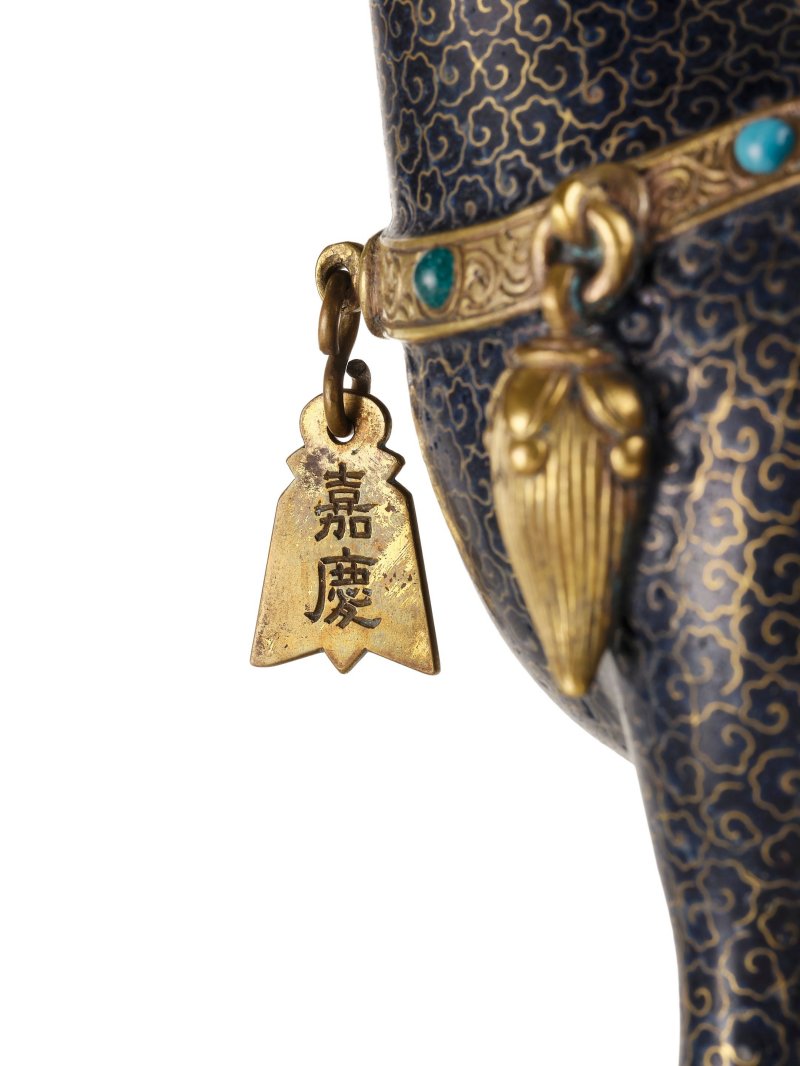
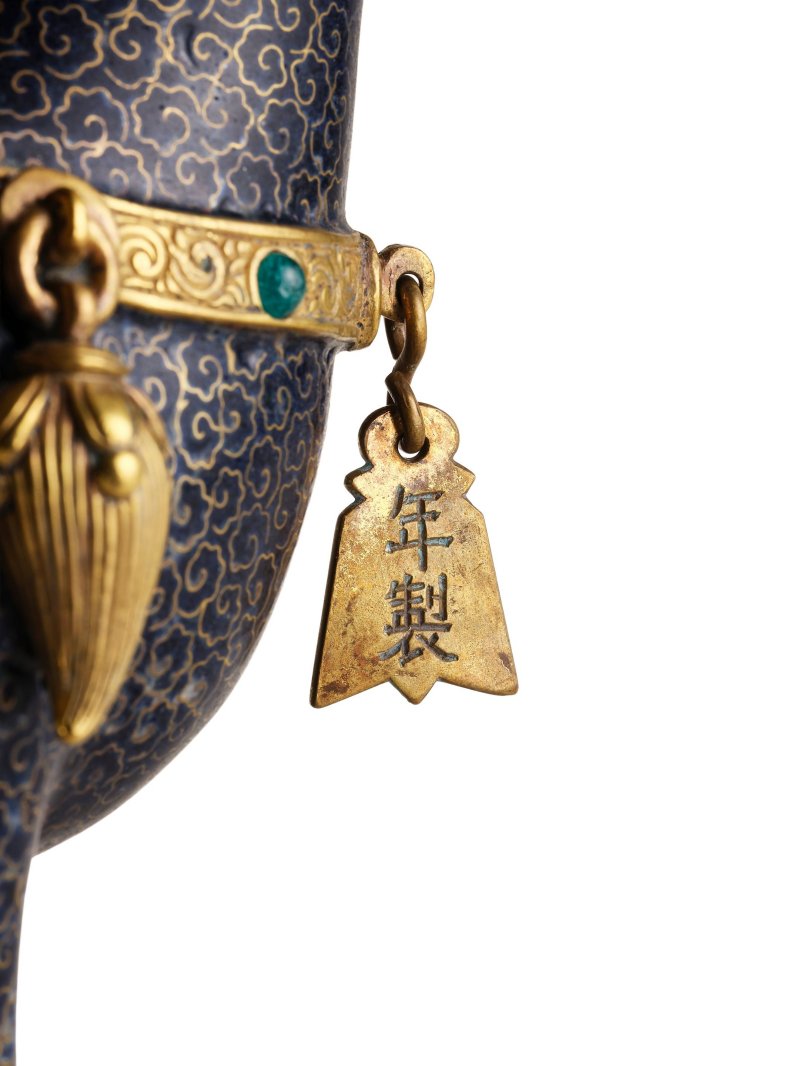
Expertly cast standing foursquare, the animal gazes forward with almond-shaped eyes, its long antlers and pricked ears in gilt bronze, the body enamelled in rich dark-blue, the surface intricately decorated with golden-wire scalloped swirls, and fitted with a finely modelled caparison and harness, the saddle blanket enamelled with lotus and cloud motifs, with two vases secured to the central aperture, the removable cover formed as openwork interlocking lingzhi fungi, with the hems of the harness and saddle accented by small blobs of champlevé enamel, a bell-shaped tassel hanging at the front of the harness, inscribed with the reign mark.
23cm (9in) long. (2).
Footnotes
清嘉慶 御製嵌寶掐絲鏨胎琺瑯天祿蓋爐
「嘉慶年製」款
Provenance:
An American private collection, according to the owner acquired circa 1995
美國私人收藏,據藏家稱約於1995年入藏
The present cloisonné and champlevé enamel stag-shaped incense burner is characteristic of the Qing Imperial Workshops' production of animal-form vessels during the Qianlong and Jiaqing periods. Such objects formed part of the Court's broader revival of archaic forms, with animal-shaped vessels drawing inspiration from ancient bronze prototypes and their representation in contemporary antiquarian literature. The Qianlong Emperor's enthusiasm for antiquarianism encouraged the study and reproduction of ancient bronzes in a variety of media, including cloisonné enamel. Particularly influential was the 《西清古鑑》 (), a monumental catalogue of bronzes in the Imperial collection, first compiled in 1751-1755 and richly illustrated with engraved representations of the vessels.
Comparable animal-form incense burners of the Qianlong period include a cloisonné and champlevé enamel ox-shaped vessel, Qianlong, in the Victoria & Albert Museum, London (acc.no.M.75-1953). See also a cloisonné enamel box and cover in the form of a mythical beast, Qianlong four-character mark and of the period, in the same museum (acc.no.M.192:1-1917). See also a related incense burner in the shape of a recumbent deer, Qianlong, illustrated by B.Quette, , New York, Paris, New Haven and London, 2011, pl.106. See also a container in the form of a unicorn, Qianlong mark and of the period, in the Cleveland Museum of Art (acc.no.1963.678).
Deer ( 鹿) occupy a richly layered symbolic position in Chinese visual culture. The animal's name is a homophone for (祿), meaning official emolument or salary, making the deer a potent emblem of career success, rank, and prosperity. This association rendered deer especially appropriate for objects intended for the scholar-official class or for courtly and elite settings.
Beyond its bureaucratic resonance, the deer is also closely linked with longevity and immortality. In Daoist belief, deer were thought to live to great age and were reputed to locate and consume (靈芝), the sacred fungus of Immortality. The present incense burner reinforces this Daoist symbolism through its openwork cover formed as sprigs of or -shaped fungus, visually uniting the deer with the substance believed to confer eternal life.
The saddle cloth bearing two vases further enriches the auspicious programme: the word for vase, (瓶), is a homophone for peace ( 平). Meanwhile, the deer's cloud-like hair, rendered in scrolling vapour forms, evokes auspicious clouds ( 祥雲), a conventional marker of the celestial sphere and a visual signifier of divine favour.
Taken together, these elements transform the deer from a naturalistic animal into a composite auspicious being, embodying wishes for longevity, official success, harmony, and transcendence; an especially fitting iconography for an incense burner, an object itself associated with purification, ritual practice, and communication with the spiritual realm.
The pendant around the neck of the deer with the reign mark is an unusual feature, but can be seen on other objects. See for example, an exceedingly rare Imperial cloisonné enamel incense burner in the form of a , incised Qianlong six-character mark and of the period, on the hinged collar, which was sold at Bonhams Hong Kong, 29 May 2023, lot 846. See also a related cloisonné enamel with vase on its back, Qianlong four-character mark and of the period, which was sold at Sotheby's Hong Kong, 2 April 2018, lot 3463.
鹿作昂首站立式,鎏金鹿角向後延伸。鹿通體以深藍色琺瑯為地,上飾卷雲紋,頭戴絡頭,身披鞦帶,上掛流蘇飾物,鹿背淺藍鞍墊,左右兩側掛寶瓶,寶瓶飾纏枝花紋。背開一圓槽,腹內與寶瓶相通,圓蓋鏤空飾靈芝紋。通體以鎏金修飾,胎體厚重,氣派非凡。鹿頸懸佩上署有「嘉慶年製」四字款,此做法極為罕見,未見可比之著錄例子。
此天祿乃乾隆、嘉慶時期清宮造辦處動物形器之代表。此類器物屬於宮廷復古風潮之一環,其造型多取材自上古青銅器及當時金石學圖譜。乾隆皇帝篤嗜古學,倡導以掐絲琺瑯等多種材質仿製古器,其中尤以乾隆十五至二十年(1751至1755年)編纂之《西清古鑑》影響最深,該書詳細著錄內府藏器,並附精繪圖版,為仿古製作提供豐富範本。
乾隆朝同類動物造型之香爐,可比較倫敦維多利亞與艾伯特博物館藏一件掐絲鏨胎琺瑯牛形器(館藏編號M.75-1953);同館另藏一件乾隆四字款掐絲琺瑯瑞獸式蓋盒(館藏編號M.192:1-1917)。另參考一件乾隆時期掐絲琺瑯臥鹿式香爐,見B.Quette,《Cloisonne: Chinese Enamels from the Yuan, Ming, and Qing Dynasties》,紐約、巴黎、紐哈芬及倫敦,2011年,圖版106。克利夫蘭藝術博物館亦藏一件乾隆款掐絲琺瑯獨角獸形器(館藏編號1963.678),可供比對。
鹿諧音「祿」,象徵官職、俸祿,有官運亨通之寓意,故常見於士大夫或皇室貴冑居所。鹿亦寓意長壽,道教傳統認為鹿能壽至千年,且可尋食靈芝仙草,而本品蓋面鏤雕靈芝及如意形卷雲,增添長生不老之寓意。鹿身鞍上飾雙瓶,瓶諧音「平」,象徵平安;鹿身飾卷雲紋,狀似祥雲,有平安吉祥的祝福。
鹿頸懸佩上署年款,此署款方式雖罕見,類似方法亦偶見於其他掐絲琺瑯器。例如一件御製銅鎏金掐絲琺瑯纏枝番蓮紋甪端薰爐,其活環頸圈上刻「大清乾隆年製」款,售於香港邦瀚斯,2023年5月29日,拍品編號846。另見一件乾隆四字款掐絲琺瑯麒麟背瓶,售於香港蘇富比,2018年4月2日,拍品編號3463。
Expertly cast standing foursquare, the animal gazes forward with almond-shaped eyes, its long antlers and pricked ears in gilt bronze, the body enamelled in rich dark-blue, the surface intricately decorated with golden-wire scalloped swirls, and fitted with a finely modelled caparison and harness, the saddle blanket enamelled with lotus and cloud motifs, with two vases secured to the central aperture, the removable cover formed as openwork interlocking lingzhi fungi, with the hems of the harness and saddle accented by small blobs of champlevé enamel, a bell-shaped tassel hanging at the front of the harness, inscribed with the reign mark.
23cm (9in) long. (2).
Footnotes
清嘉慶 御製嵌寶掐絲鏨胎琺瑯天祿蓋爐
「嘉慶年製」款
Provenance:
An American private collection, according to the owner acquired circa 1995
美國私人收藏,據藏家稱約於1995年入藏
The present cloisonné and champlevé enamel stag-shaped incense burner is characteristic of the Qing Imperial Workshops' production of animal-form vessels during the Qianlong and Jiaqing periods. Such objects formed part of the Court's broader revival of archaic forms, with animal-shaped vessels drawing inspiration from ancient bronze prototypes and their representation in contemporary antiquarian literature. The Qianlong Emperor's enthusiasm for antiquarianism encouraged the study and reproduction of ancient bronzes in a variety of media, including cloisonné enamel. Particularly influential was the 《西清古鑑》 (), a monumental catalogue of bronzes in the Imperial collection, first compiled in 1751-1755 and richly illustrated with engraved representations of the vessels.
Comparable animal-form incense burners of the Qianlong period include a cloisonné and champlevé enamel ox-shaped vessel, Qianlong, in the Victoria & Albert Museum, London (acc.no.M.75-1953). See also a cloisonné enamel box and cover in the form of a mythical beast, Qianlong four-character mark and of the period, in the same museum (acc.no.M.192:1-1917). See also a related incense burner in the shape of a recumbent deer, Qianlong, illustrated by B.Quette, , New York, Paris, New Haven and London, 2011, pl.106. See also a container in the form of a unicorn, Qianlong mark and of the period, in the Cleveland Museum of Art (acc.no.1963.678).
Deer ( 鹿) occupy a richly layered symbolic position in Chinese visual culture. The animal's name is a homophone for (祿), meaning official emolument or salary, making the deer a potent emblem of career success, rank, and prosperity. This association rendered deer especially appropriate for objects intended for the scholar-official class or for courtly and elite settings.
Beyond its bureaucratic resonance, the deer is also closely linked with longevity and immortality. In Daoist belief, deer were thought to live to great age and were reputed to locate and consume (靈芝), the sacred fungus of Immortality. The present incense burner reinforces this Daoist symbolism through its openwork cover formed as sprigs of or -shaped fungus, visually uniting the deer with the substance believed to confer eternal life.
The saddle cloth bearing two vases further enriches the auspicious programme: the word for vase, (瓶), is a homophone for peace ( 平). Meanwhile, the deer's cloud-like hair, rendered in scrolling vapour forms, evokes auspicious clouds ( 祥雲), a conventional marker of the celestial sphere and a visual signifier of divine favour.
Taken together, these elements transform the deer from a naturalistic animal into a composite auspicious being, embodying wishes for longevity, official success, harmony, and transcendence; an especially fitting iconography for an incense burner, an object itself associated with purification, ritual practice, and communication with the spiritual realm.
The pendant around the neck of the deer with the reign mark is an unusual feature, but can be seen on other objects. See for example, an exceedingly rare Imperial cloisonné enamel incense burner in the form of a , incised Qianlong six-character mark and of the period, on the hinged collar, which was sold at Bonhams Hong Kong, 29 May 2023, lot 846. See also a related cloisonné enamel with vase on its back, Qianlong four-character mark and of the period, which was sold at Sotheby's Hong Kong, 2 April 2018, lot 3463.
鹿作昂首站立式,鎏金鹿角向後延伸。鹿通體以深藍色琺瑯為地,上飾卷雲紋,頭戴絡頭,身披鞦帶,上掛流蘇飾物,鹿背淺藍鞍墊,左右兩側掛寶瓶,寶瓶飾纏枝花紋。背開一圓槽,腹內與寶瓶相通,圓蓋鏤空飾靈芝紋。通體以鎏金修飾,胎體厚重,氣派非凡。鹿頸懸佩上署有「嘉慶年製」四字款,此做法極為罕見,未見可比之著錄例子。
此天祿乃乾隆、嘉慶時期清宮造辦處動物形器之代表。此類器物屬於宮廷復古風潮之一環,其造型多取材自上古青銅器及當時金石學圖譜。乾隆皇帝篤嗜古學,倡導以掐絲琺瑯等多種材質仿製古器,其中尤以乾隆十五至二十年(1751至1755年)編纂之《西清古鑑》影響最深,該書詳細著錄內府藏器,並附精繪圖版,為仿古製作提供豐富範本。
乾隆朝同類動物造型之香爐,可比較倫敦維多利亞與艾伯特博物館藏一件掐絲鏨胎琺瑯牛形器(館藏編號M.75-1953);同館另藏一件乾隆四字款掐絲琺瑯瑞獸式蓋盒(館藏編號M.192:1-1917)。另參考一件乾隆時期掐絲琺瑯臥鹿式香爐,見B.Quette,《Cloisonne: Chinese Enamels from the Yuan, Ming, and Qing Dynasties》,紐約、巴黎、紐哈芬及倫敦,2011年,圖版106。克利夫蘭藝術博物館亦藏一件乾隆款掐絲琺瑯獨角獸形器(館藏編號1963.678),可供比對。
鹿諧音「祿」,象徵官職、俸祿,有官運亨通之寓意,故常見於士大夫或皇室貴冑居所。鹿亦寓意長壽,道教傳統認為鹿能壽至千年,且可尋食靈芝仙草,而本品蓋面鏤雕靈芝及如意形卷雲,增添長生不老之寓意。鹿身鞍上飾雙瓶,瓶諧音「平」,象徵平安;鹿身飾卷雲紋,狀似祥雲,有平安吉祥的祝福。
鹿頸懸佩上署年款,此署款方式雖罕見,類似方法亦偶見於其他掐絲琺瑯器。例如一件御製銅鎏金掐絲琺瑯纏枝番蓮紋甪端薰爐,其活環頸圈上刻「大清乾隆年製」款,售於香港邦瀚斯,2023年5月29日,拍品編號846。另見一件乾隆四字款掐絲琺瑯麒麟背瓶,售於香港蘇富比,2018年4月2日,拍品編號3463。
常见问题
这件清嘉慶 御製嵌寶掐絲鏨胎琺瑯天祿蓋爐 | AN EXCEPTIONALLY RARE IMPERIAL CLOISONNÉ AND CHAMPLEVÉ ENAMEL AND GILT-BRONZE STAG-SHAPED INCENSE BURNER AND COVER的成交价是多少?
落槌价为 预展中。 成交价为 预展中。