
拍品信息
拍品名称
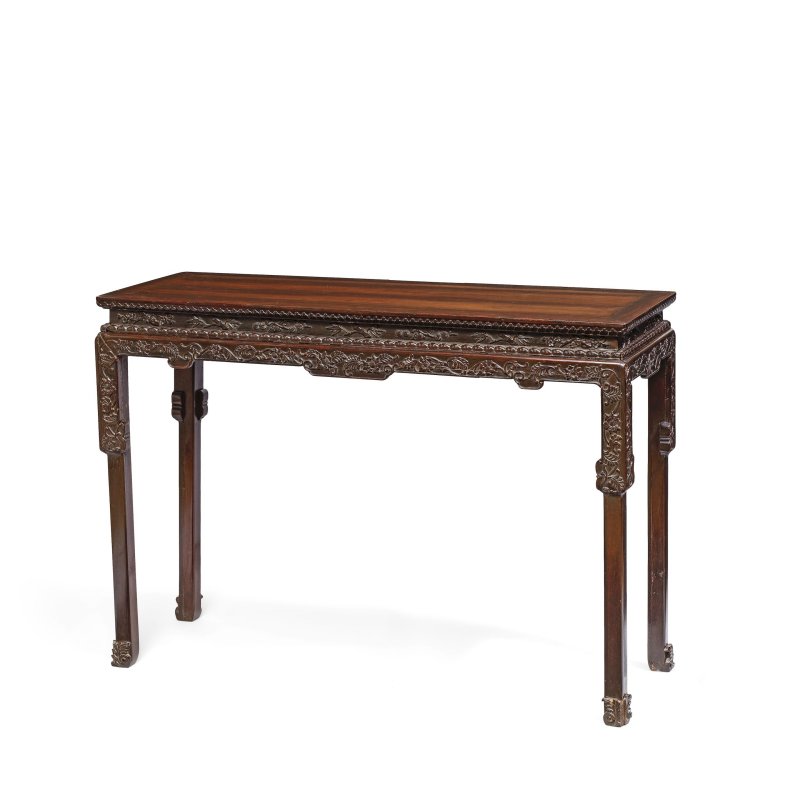
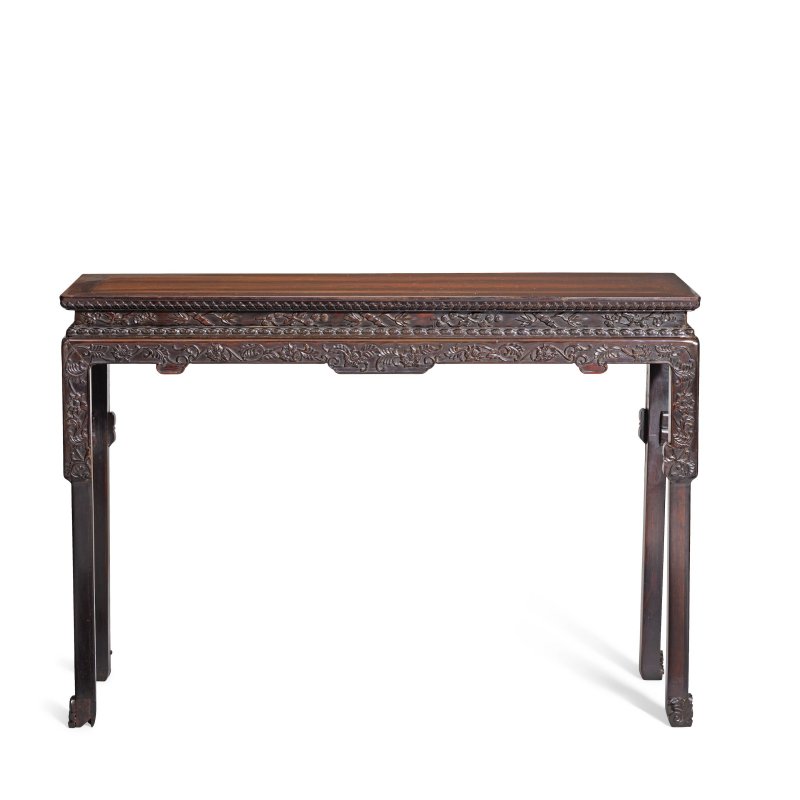
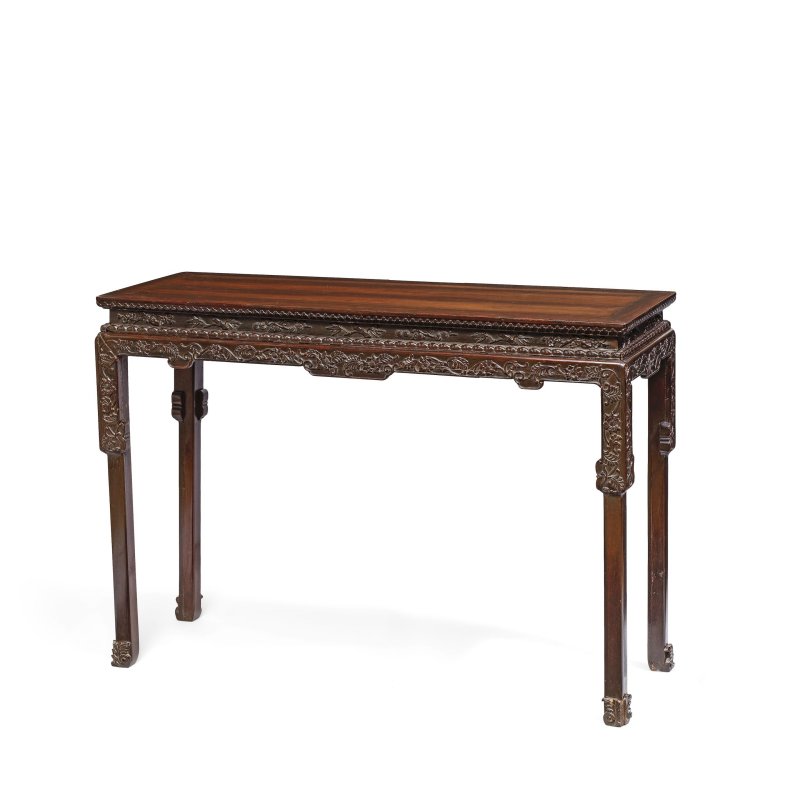
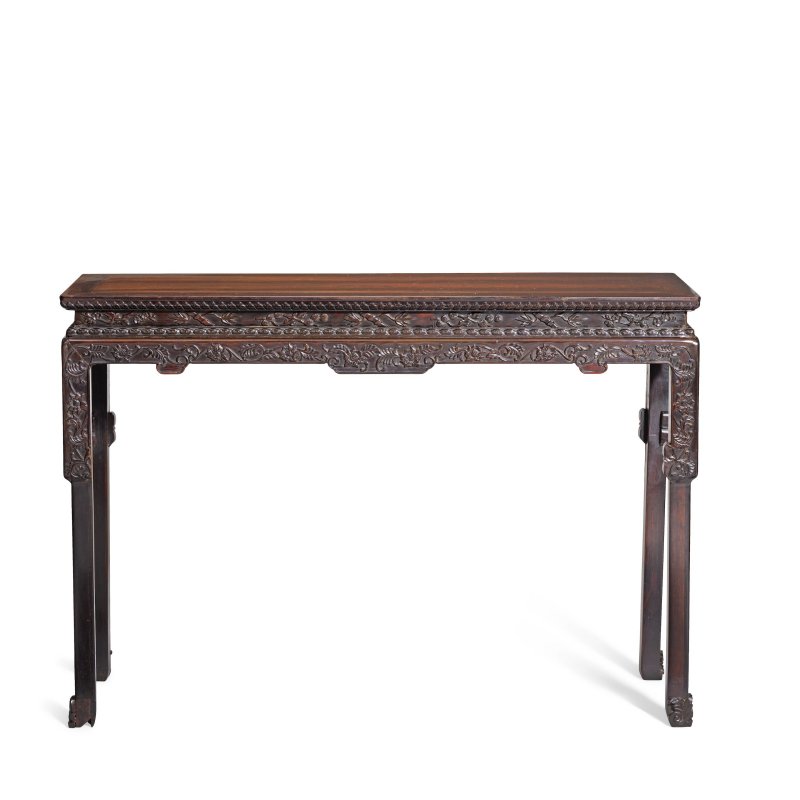
清中期 紫檀雕歲寒三友紋有束腰條桌 | A RARE ZITAN 'THREE FRIENDS OF WINTER' TABLE
年代
Mid-Qing Dynasty
起拍价
GBP 8,000
估值区间
GBP 8000 - 12000
尺寸
未知
品相
未知
更多信息
Mid-Qing Dynasty
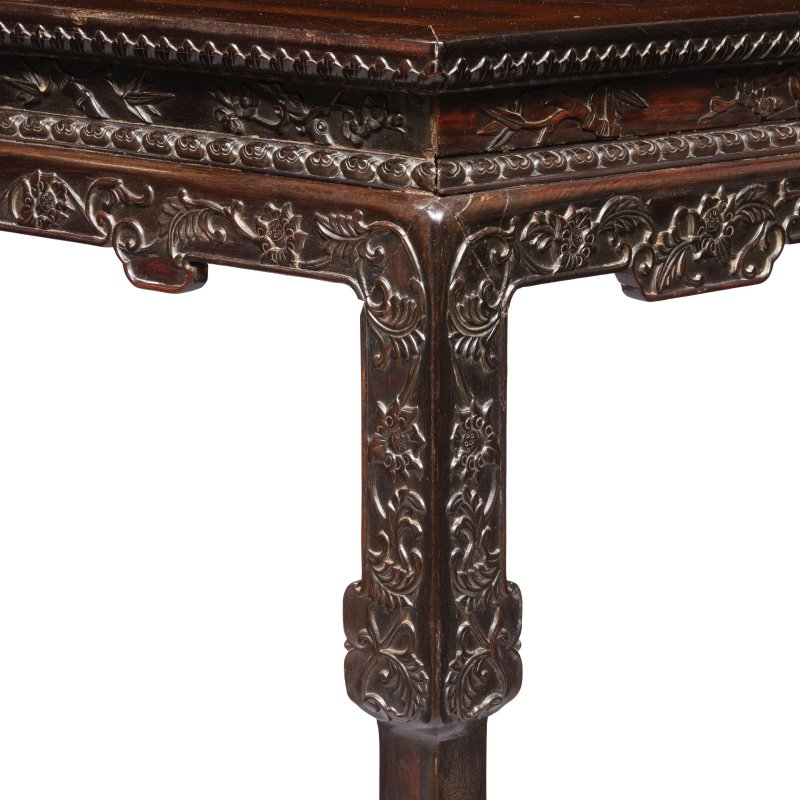
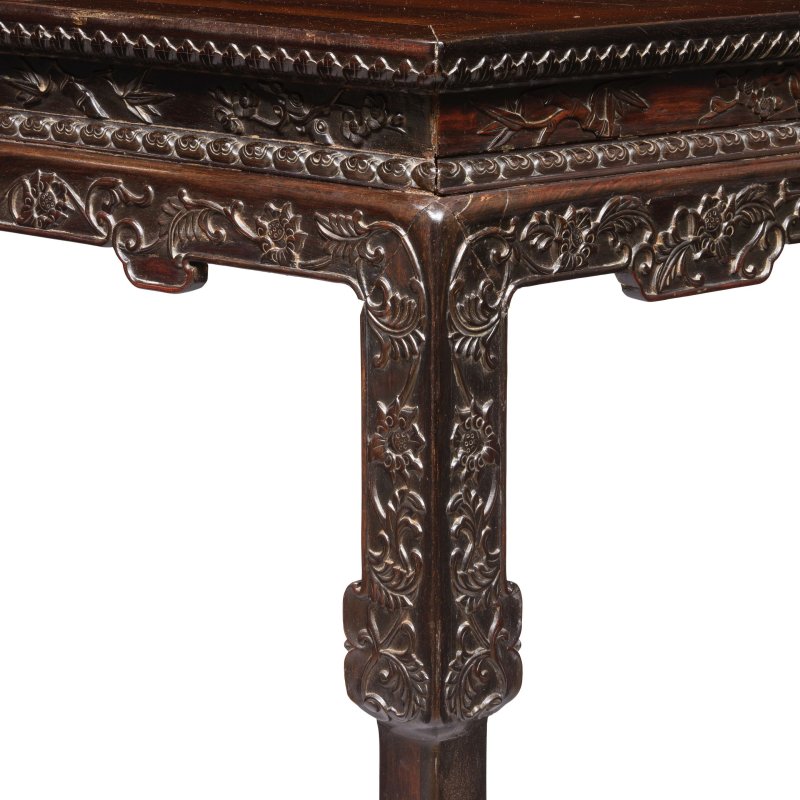
The top panel set within a rectangular frame above a high waist elaborately carved in relief with bamboo, plum blossoms and pine branches between lappet borders, elegantly scrolled lotus flowers and leaves further carved on the shaped aprons and extending down the legs, the whole supported on four legs of square section terminating in floral-shaped feet, the wood of an attractive dark chocolate hue. 121.9cm (48in) wide x 85.2cm (33 1/2in) high x 44cm (17 3/8in) deep.
Footnotes
清中期 紫檀雕歲寒三友紋有束腰條桌
Provenance: Evaristo Caretti (1879-1955), China and Italy, and thence by descent
Noted in a valuation conducted by Robert Kleiner in 1988
來源: Evaristo Caretti (1879-1955),中國及意大利,並由後人保存迄今
Robert Kleiner于1988年所作的評估中曾提及此件拍品
Elaborately carved zitan furniture is particularly rare, owing to the difficulty of carving such a dense and valuable wood. For examples of related zitan tables, see one carved with a lingzhi pattern, Qing dynasty, in the Qing Court Collection, illustrated in , Hong Kong, 2002, pl.100. See also a table with similar treatment of the carved lotus patterns on the aprons and waist, Qianlong, in the Qing Court Collection, illustrated in ., no.91.
The elegantly scrolling lotus foliage on the aprons and legs also reflects the Qing dynasty taste for increasingly elaborate and naturalistic foliate ornament. During the Qianlong period, traditional Chinese floral motifs were sometimes rendered in conjunction with European-inspired scrolling foliage, particularly acanthus, introduced to the Qing court through Jesuit artists and European style interiors at the Yuanmingyuan. The flowing treatment of the lotus leaves on the present table recalls this broader taste for luxuriant foliate carving, while retaining the distinctly Chinese lotus motif; for more on European influence on Chinese furniture, see Tian Jiaqing, 'Zitan and Zitan Furniture', , Hong Kong, 1999, pp.195-196. See also related acanthus leaves carved on a lotus-decorated stool, mid-Qing dynasty, illustrated by Tian Jiaqing, , Hong Kong, 1995, p.81, no.15.
The 'Three Friends of Winter' (, 歲寒三友) carved in relief across the waist, aprons and legs, are traditionally associated with resilience and steadfastness: pine and bamboo remain evergreen through winter, while prunus is celebrated for flowering in the coldest months. Together they came to symbolise endurance, integrity and friendship in adversity, and formed one of the most enduring auspicious themes in Chinese art. The incorporation of all three plants into a continuous, naturalistic composition across the table is particularly effective, with the gnarled branches and flowering stems contrasting with the dark, lustrous surface of the . A table carved with the 'Three Friends of Winter' is in the Art Institute of Chicago, bequest of Russell Tyson, (acc.no.1964.572).
A related table carved with prunus, early 18th century, was sold at Sotheby's Hong Kong, 7 April 2010, lot 1847.
The top panel set within a rectangular frame above a high waist elaborately carved in relief with bamboo, plum blossoms and pine branches between lappet borders, elegantly scrolled lotus flowers and leaves further carved on the shaped aprons and extending down the legs, the whole supported on four legs of square section terminating in floral-shaped feet, the wood of an attractive dark chocolate hue. 121.9cm (48in) wide x 85.2cm (33 1/2in) high x 44cm (17 3/8in) deep.
Footnotes
清中期 紫檀雕歲寒三友紋有束腰條桌
Provenance: Evaristo Caretti (1879-1955), China and Italy, and thence by descent
Noted in a valuation conducted by Robert Kleiner in 1988
來源: Evaristo Caretti (1879-1955),中國及意大利,並由後人保存迄今
Robert Kleiner于1988年所作的評估中曾提及此件拍品
Elaborately carved zitan furniture is particularly rare, owing to the difficulty of carving such a dense and valuable wood. For examples of related zitan tables, see one carved with a lingzhi pattern, Qing dynasty, in the Qing Court Collection, illustrated in , Hong Kong, 2002, pl.100. See also a table with similar treatment of the carved lotus patterns on the aprons and waist, Qianlong, in the Qing Court Collection, illustrated in ., no.91.
The elegantly scrolling lotus foliage on the aprons and legs also reflects the Qing dynasty taste for increasingly elaborate and naturalistic foliate ornament. During the Qianlong period, traditional Chinese floral motifs were sometimes rendered in conjunction with European-inspired scrolling foliage, particularly acanthus, introduced to the Qing court through Jesuit artists and European style interiors at the Yuanmingyuan. The flowing treatment of the lotus leaves on the present table recalls this broader taste for luxuriant foliate carving, while retaining the distinctly Chinese lotus motif; for more on European influence on Chinese furniture, see Tian Jiaqing, 'Zitan and Zitan Furniture', , Hong Kong, 1999, pp.195-196. See also related acanthus leaves carved on a lotus-decorated stool, mid-Qing dynasty, illustrated by Tian Jiaqing, , Hong Kong, 1995, p.81, no.15.
The 'Three Friends of Winter' (, 歲寒三友) carved in relief across the waist, aprons and legs, are traditionally associated with resilience and steadfastness: pine and bamboo remain evergreen through winter, while prunus is celebrated for flowering in the coldest months. Together they came to symbolise endurance, integrity and friendship in adversity, and formed one of the most enduring auspicious themes in Chinese art. The incorporation of all three plants into a continuous, naturalistic composition across the table is particularly effective, with the gnarled branches and flowering stems contrasting with the dark, lustrous surface of the . A table carved with the 'Three Friends of Winter' is in the Art Institute of Chicago, bequest of Russell Tyson, (acc.no.1964.572).
A related table carved with prunus, early 18th century, was sold at Sotheby's Hong Kong, 7 April 2010, lot 1847.
常见问题
这件清中期 紫檀雕歲寒三友紋有束腰條桌 | A RARE ZITAN 'THREE FRIENDS OF WINTER' TABLE的成交价是多少?
落槌价为 预展中。 成交价为 预展中。


