
Lot 11 清順治 青花魁星點斗詩文花觚 | A RARE BLUE AND WHITE 'KUI XING' BEAKER VASE
落槌价
预展中
成交价
预展中
| 拍卖公司 | 邦瀚斯 |
|---|---|
| 拍卖时间 | 2026年11月05日 |
拍品信息
拍品名称
清順治 青花魁星點斗詩文花觚 | A RARE BLUE AND WHITE 'KUI XING' BEAKER VASE
年代
Shunzhi
起拍价
GBP 15,000
估值区间
GBP 15000 - 20000
尺寸
未知
品相
未知
更多信息
Shunzhi
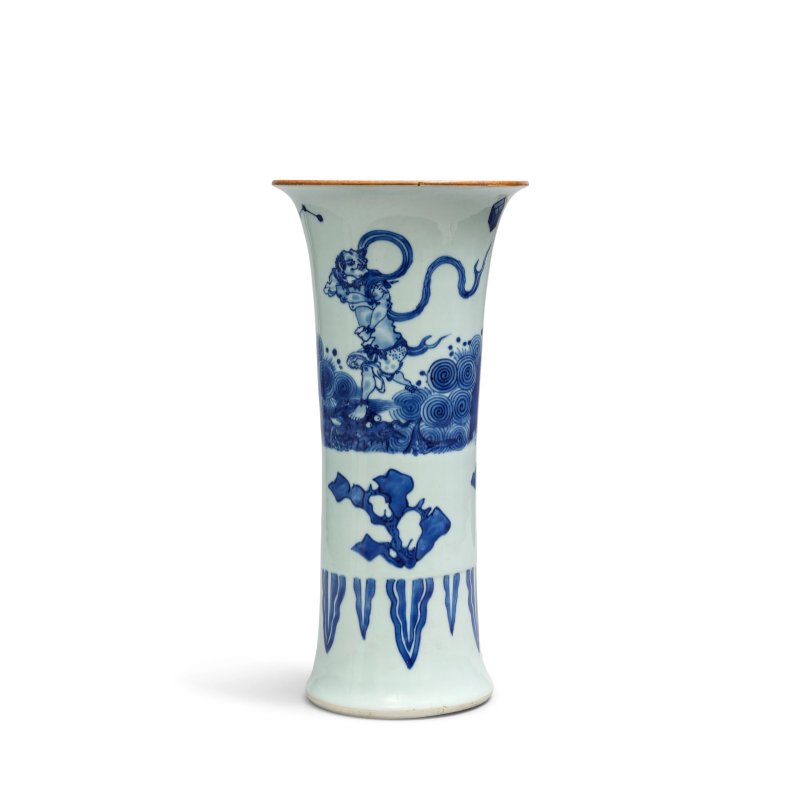
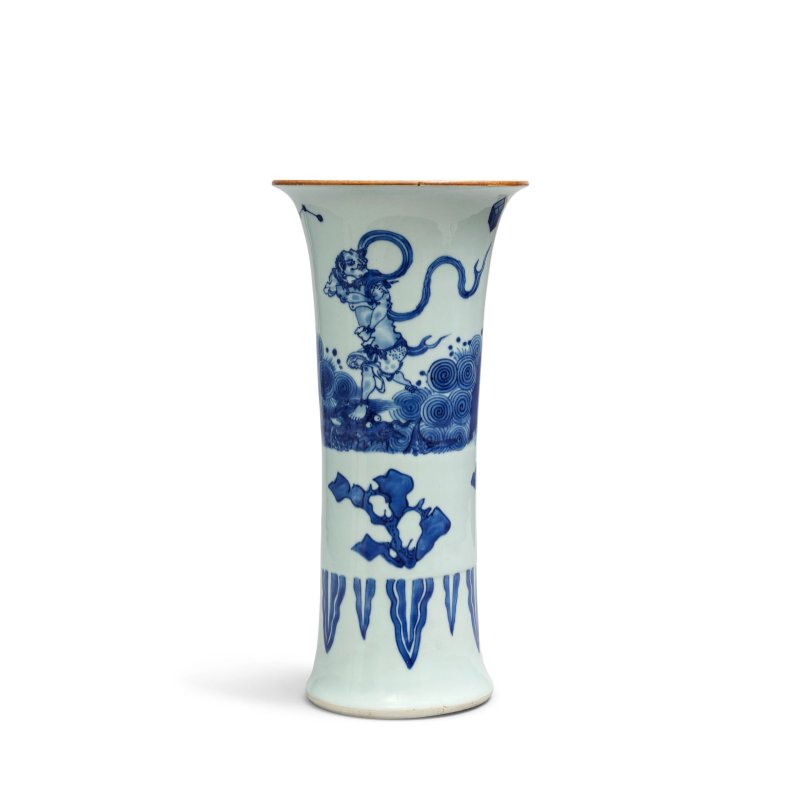
Elegantly potted rising from a spreading foot to a tall trumpet neck with brown-painted rim, boldly painted around the exterior with Kui Xing clad in animal fur tunic and billowing scarves, a brush in right hand and a silver ingot in his left, his left foot atop the mythical fish-dragon or ao, all amidst swirling waves, beneath the north star constellation and a dipper, twenty-five-characters inscription, the central section of the vase painted with craggy Taihu scholars' rocks, the lower section of the vase with pendant plantain leaves. 39.3cm (15 1/2in) high.
Footnotes
清順治 青花魁星點斗詩文花觚
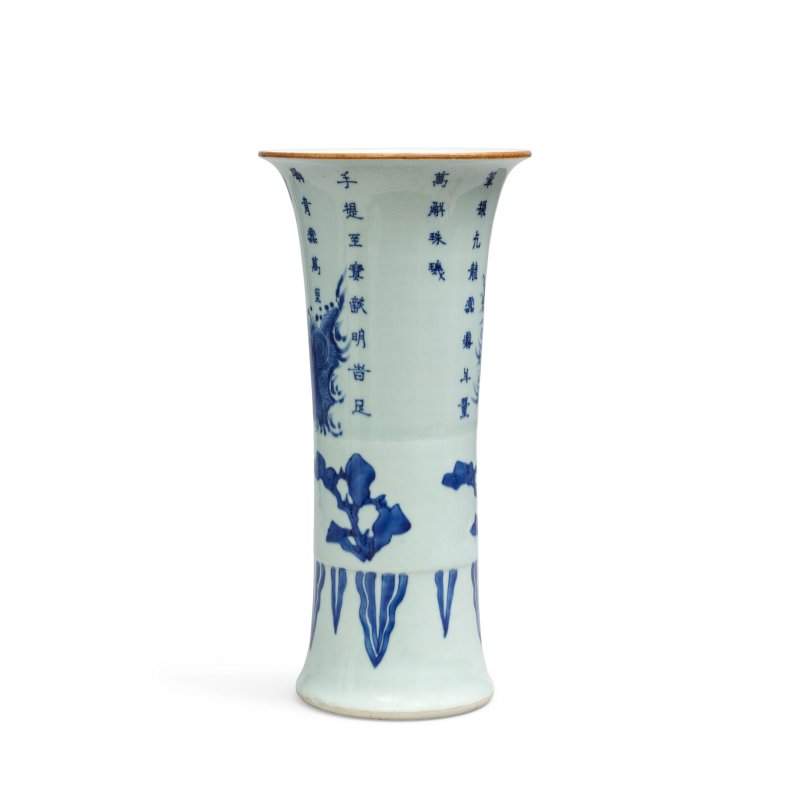
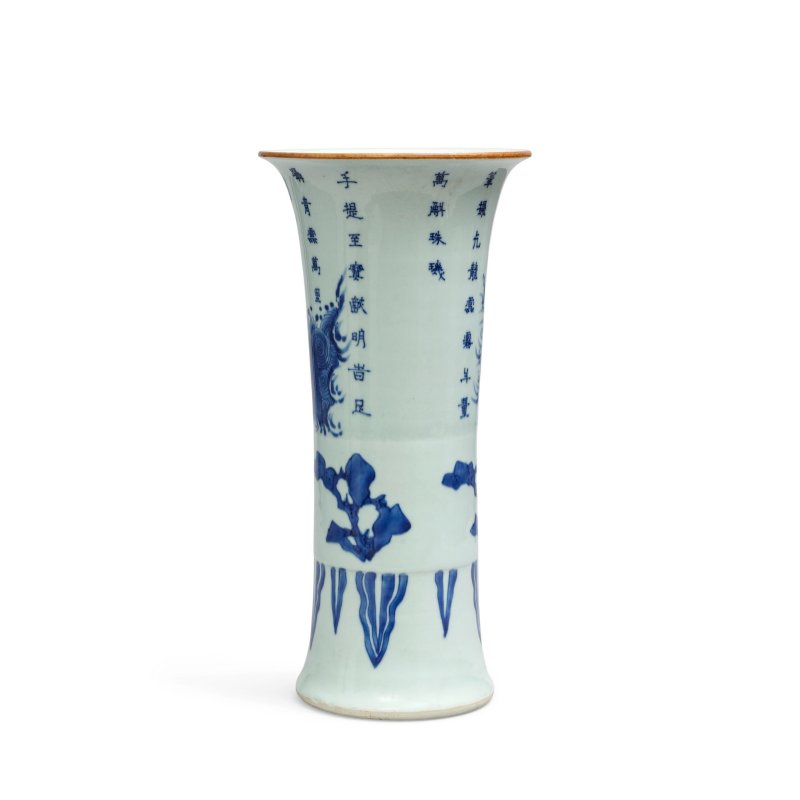
款識:筆掃九靝雲霧,斗量萬觚珠璣。手提至寶獻明時,足躡青雲萬里。
Provenance:
Kwok Gallery, Singapore, 28 September 1985
An Asian private collection
Christie's London, 4 November 2008, lot 172
Published and Illustrated:
S.Marsh, Brushpots: A Collector's View, Hong Kong, 2020, pp.100-101
郭古玩行私人有限公司,新加坡,1985年9月28日
亞洲私人收藏
倫敦佳士得,2008年11月4日,拍品編號172
墨一閑,《筆筒淵鑑:收藏家的隨心所悟》,香港,2020年,第100-101頁
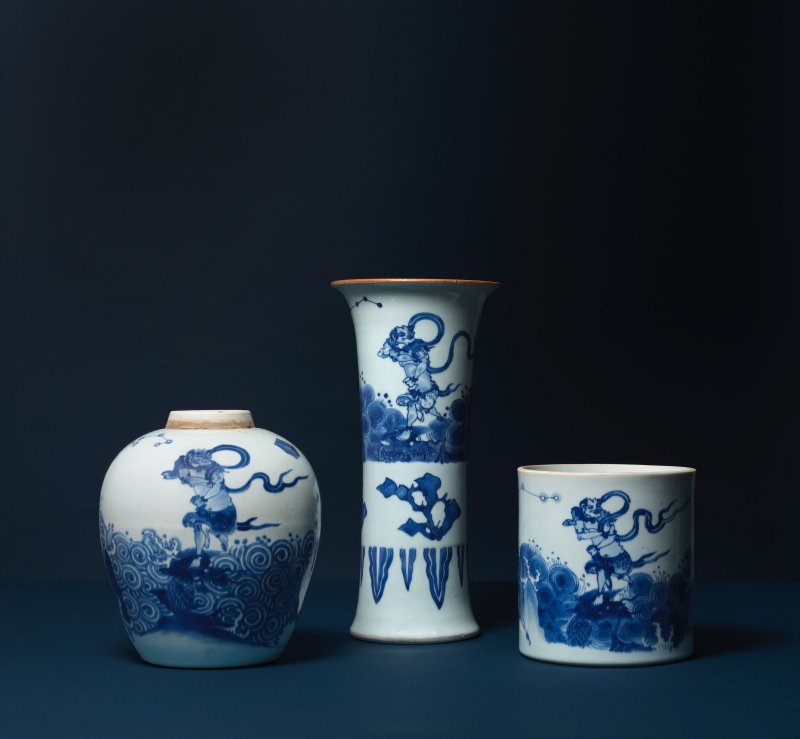
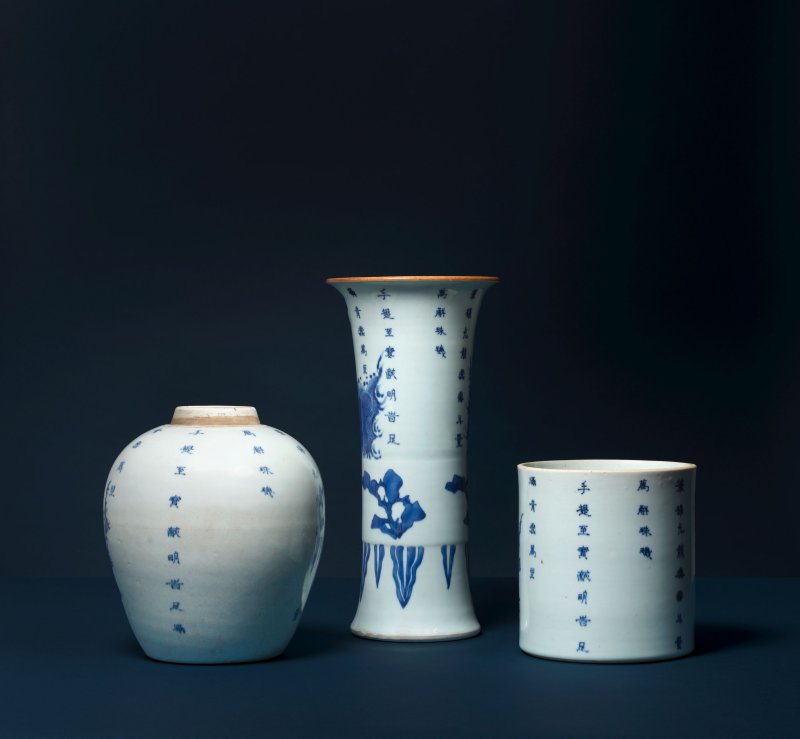
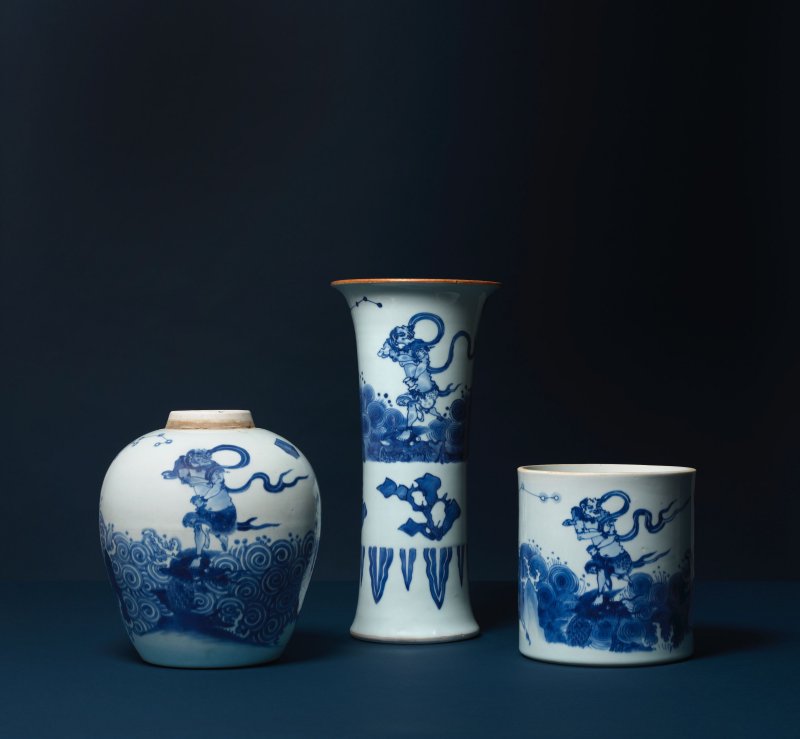
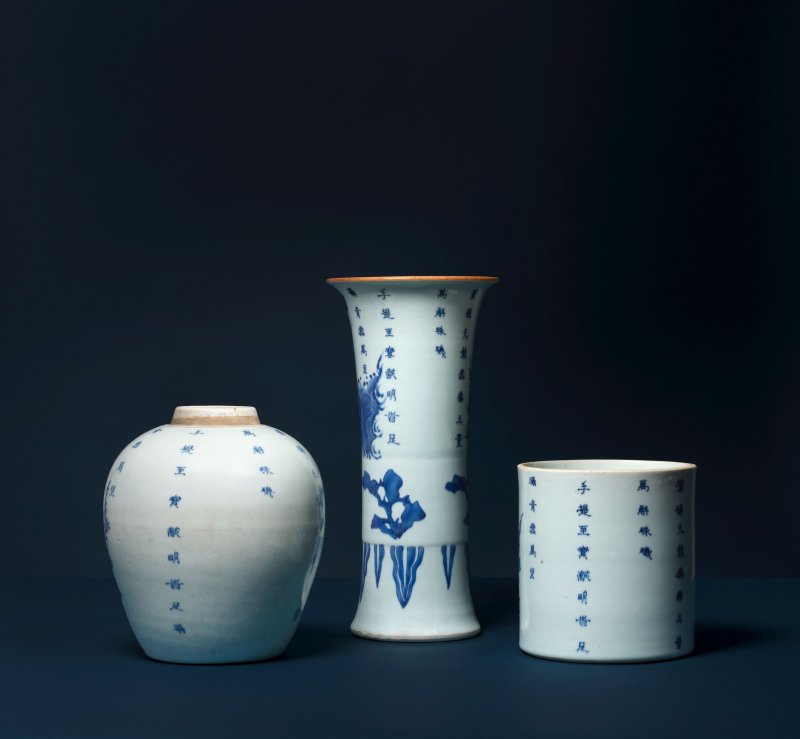
Of particular interest is the inscription borne on the present vessel, a twenty-five-character poem celebrating literary accomplishment and official advancement, which can also be seen on Lots 9 and 10:
筆掃九靝雲霧,
斗量萬觚珠璣,
手提至寶獻明時,
足躡青雲萬里
Which may be translated:
The poem extols the transformative power of literary talent and learned accomplishment. Refined writing is likened to pearls and jade of immeasurable value, whilst the concluding image of 'treading the blue clouds' evokes rapid advancement through the Imperial examination system and elevation to official rank. Such themes accord closely with the accompanying image of Kui Xing (魁星), the Daoist deity associated with literature and scholarly success.
Most remarkably, the same twenty-five-character poem appears on Lots 9 and 10 in this catalogue, seemingly written by the very same hand. This may be recognised through the distinctive use of an archaic form of the character (時), meaning 'time' or 'moment', which recurs consistently across the inscriptions. The repetition of both text and calligraphic style strongly suggests the work of a single specialist inscription writer operating within the same workshop tradition. In , Michael Butler, Julia Curtis, and Stephen Little note (p.63) that Bai Qianshen identified this calligraphic hand as corresponding to that found on the celebrated 'Three Friends of Winter' vase dated 1653 in the Shanghai Museum.
Widely revered by examination candidates, Kui Xing was regarded as the divine patron of literary distinction and official promotion. The character (魁) combines the radical for 'ghost' or 'demon' with the component (斗), meaning a dipper or ladle, alluding to the deity's celestial association with the Big Dipper, represented on the present vessel by the square-form dipper shown above. According to legend, Kui Xing was a brilliant scholar whose ungainly appearance prevented him from achieving success in the examinations. After casting himself into a river in despair, he was rescued by the mythical creature and subsequently ascended to the heavens, becoming the patron deity of scholars. Images of Kui Xing standing atop an thus became potent emblems of examination success, literary accomplishment, and advancement to high office.
The central register is further decorated with a band of fantastically perforated rocks, among the most prized objects within the scholar's studio. During the late Ming and early Qing periods, the collecting and connoisseurship of scholars' rocks attained unprecedented popularity amongst the educated elite, who admired their dramatic silhouettes, weathered surfaces, and evocative resemblance to mountains and cosmic landscapes in miniature. Their cultural significance is reflected in contemporary literature, notably in Pu Songling's (1640-1715) , where the tale (石清虛) recounts a collector so captivated by a remarkable scholar's rock that he is willing to sacrifice years of his life in order to possess it. The inclusion of rocks on the present vessel therefore reinforces its distinctly scholarly character, complementing the imagery of Kui Xing and the accompanying poem celebrating literary accomplishment and official success. See another related blue and white beaker vase, with similar decoration of rocks around the middle register above pendant leaves, but with a lotus pond on the upper register, Shunzhi, in the Palace Museum, Beijing, illustrated in , Beijing, 2005, pp.104-105, no.55.
See also a blue and white rolwagen, circa 1650, with similar depiction of Kui Xing and the same inscription, illustrated by J.B.Curtis, , New York, 1995, pp.118-119.
Compare with a blue and white 'Romance of the Three Kingdoms' vase, Chenghua six-character mark, Kangxi, which was sold at Bonhams Hong Kong, 5 May 2025, lot 221. See also a blue and white vase, mid 17th century, which was sold at Christie's London, 14 May 2010, lot 759.
Elegantly potted rising from a spreading foot to a tall trumpet neck with brown-painted rim, boldly painted around the exterior with Kui Xing clad in animal fur tunic and billowing scarves, a brush in right hand and a silver ingot in his left, his left foot atop the mythical fish-dragon or ao, all amidst swirling waves, beneath the north star constellation and a dipper, twenty-five-characters inscription, the central section of the vase painted with craggy Taihu scholars' rocks, the lower section of the vase with pendant plantain leaves. 39.3cm (15 1/2in) high.
Footnotes
清順治 青花魁星點斗詩文花觚
款識:筆掃九靝雲霧,斗量萬觚珠璣。手提至寶獻明時,足躡青雲萬里。
Provenance:
Kwok Gallery, Singapore, 28 September 1985
An Asian private collection
Christie's London, 4 November 2008, lot 172
Published and Illustrated:
S.Marsh, Brushpots: A Collector's View, Hong Kong, 2020, pp.100-101
郭古玩行私人有限公司,新加坡,1985年9月28日
亞洲私人收藏
倫敦佳士得,2008年11月4日,拍品編號172
墨一閑,《筆筒淵鑑:收藏家的隨心所悟》,香港,2020年,第100-101頁
Of particular interest is the inscription borne on the present vessel, a twenty-five-character poem celebrating literary accomplishment and official advancement, which can also be seen on Lots 9 and 10:
筆掃九靝雲霧,
斗量萬觚珠璣,
手提至寶獻明時,
足躡青雲萬里
Which may be translated:
The poem extols the transformative power of literary talent and learned accomplishment. Refined writing is likened to pearls and jade of immeasurable value, whilst the concluding image of 'treading the blue clouds' evokes rapid advancement through the Imperial examination system and elevation to official rank. Such themes accord closely with the accompanying image of Kui Xing (魁星), the Daoist deity associated with literature and scholarly success.
Most remarkably, the same twenty-five-character poem appears on Lots 9 and 10 in this catalogue, seemingly written by the very same hand. This may be recognised through the distinctive use of an archaic form of the character (時), meaning 'time' or 'moment', which recurs consistently across the inscriptions. The repetition of both text and calligraphic style strongly suggests the work of a single specialist inscription writer operating within the same workshop tradition. In , Michael Butler, Julia Curtis, and Stephen Little note (p.63) that Bai Qianshen identified this calligraphic hand as corresponding to that found on the celebrated 'Three Friends of Winter' vase dated 1653 in the Shanghai Museum.
Widely revered by examination candidates, Kui Xing was regarded as the divine patron of literary distinction and official promotion. The character (魁) combines the radical for 'ghost' or 'demon' with the component (斗), meaning a dipper or ladle, alluding to the deity's celestial association with the Big Dipper, represented on the present vessel by the square-form dipper shown above. According to legend, Kui Xing was a brilliant scholar whose ungainly appearance prevented him from achieving success in the examinations. After casting himself into a river in despair, he was rescued by the mythical creature and subsequently ascended to the heavens, becoming the patron deity of scholars. Images of Kui Xing standing atop an thus became potent emblems of examination success, literary accomplishment, and advancement to high office.
The central register is further decorated with a band of fantastically perforated rocks, among the most prized objects within the scholar's studio. During the late Ming and early Qing periods, the collecting and connoisseurship of scholars' rocks attained unprecedented popularity amongst the educated elite, who admired their dramatic silhouettes, weathered surfaces, and evocative resemblance to mountains and cosmic landscapes in miniature. Their cultural significance is reflected in contemporary literature, notably in Pu Songling's (1640-1715) , where the tale (石清虛) recounts a collector so captivated by a remarkable scholar's rock that he is willing to sacrifice years of his life in order to possess it. The inclusion of rocks on the present vessel therefore reinforces its distinctly scholarly character, complementing the imagery of Kui Xing and the accompanying poem celebrating literary accomplishment and official success. See another related blue and white beaker vase, with similar decoration of rocks around the middle register above pendant leaves, but with a lotus pond on the upper register, Shunzhi, in the Palace Museum, Beijing, illustrated in , Beijing, 2005, pp.104-105, no.55.
See also a blue and white rolwagen, circa 1650, with similar depiction of Kui Xing and the same inscription, illustrated by J.B.Curtis, , New York, 1995, pp.118-119.
Compare with a blue and white 'Romance of the Three Kingdoms' vase, Chenghua six-character mark, Kangxi, which was sold at Bonhams Hong Kong, 5 May 2025, lot 221. See also a blue and white vase, mid 17th century, which was sold at Christie's London, 14 May 2010, lot 759.
常见问题
这件清順治 青花魁星點斗詩文花觚 | A RARE BLUE AND WHITE 'KUI XING' BEAKER VASE的成交价是多少?
落槌价为 预展中。 成交价为 预展中。