
拍品信息
拍品名称
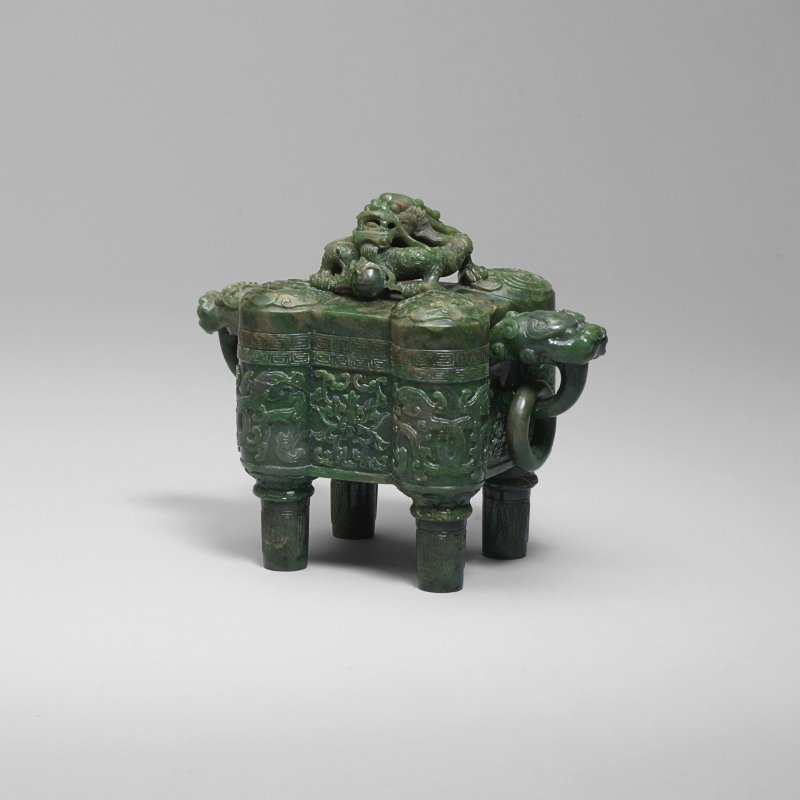
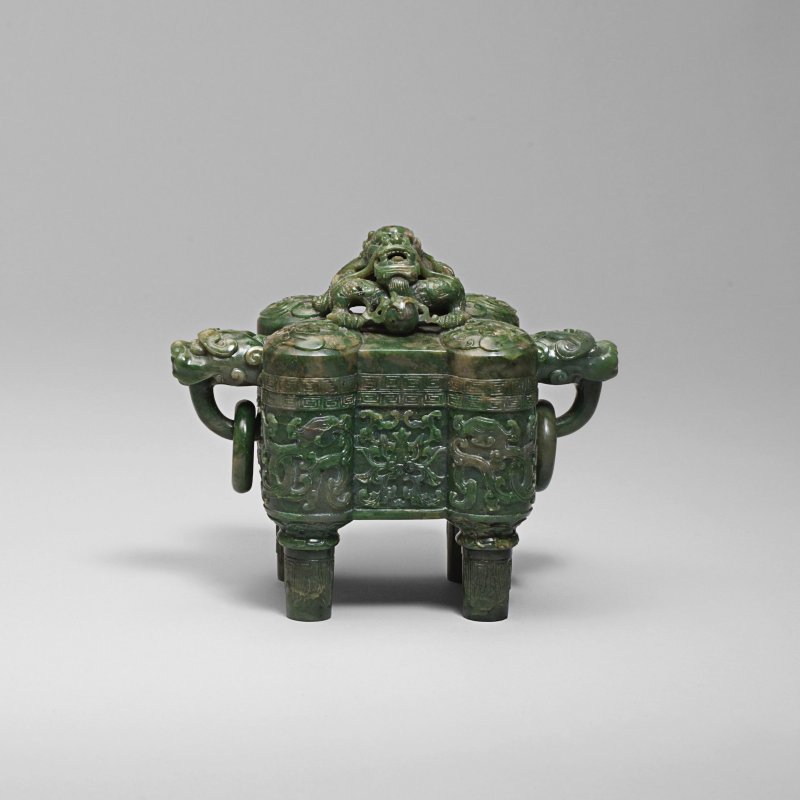
清乾隆 碧玉雕雙龍活環耳蓋爐 | AN ARCHAISTIC SPINACH-GREEN JADE INCENSE BURNER AND COVER, TULU
年代
Qianlong
起拍价
GBP 3,000
估值区间
GBP 3000 - 5000
尺寸
未知
品相
未知
更多信息
Qianlong
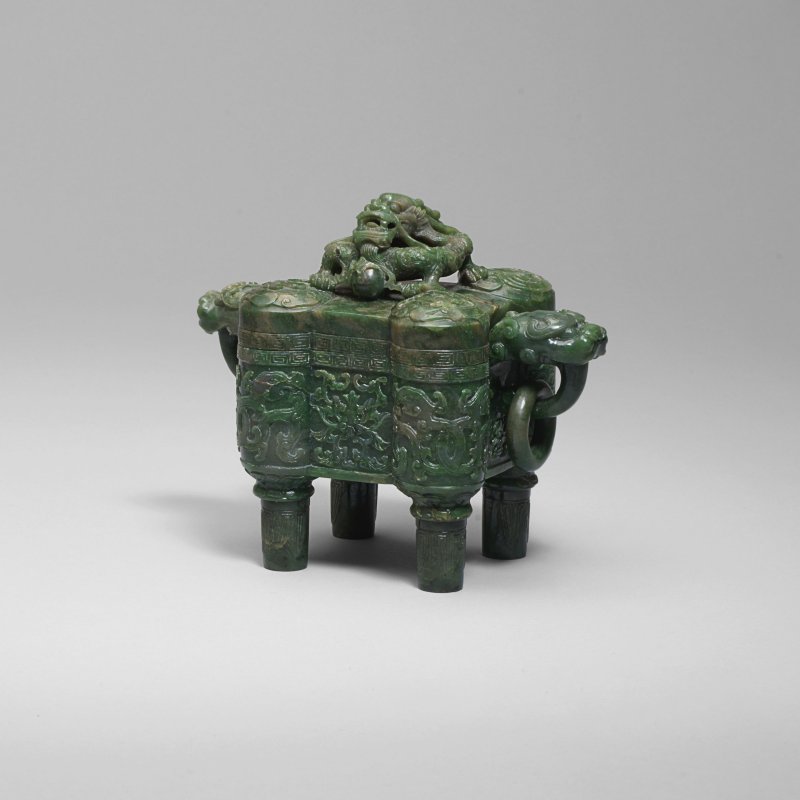
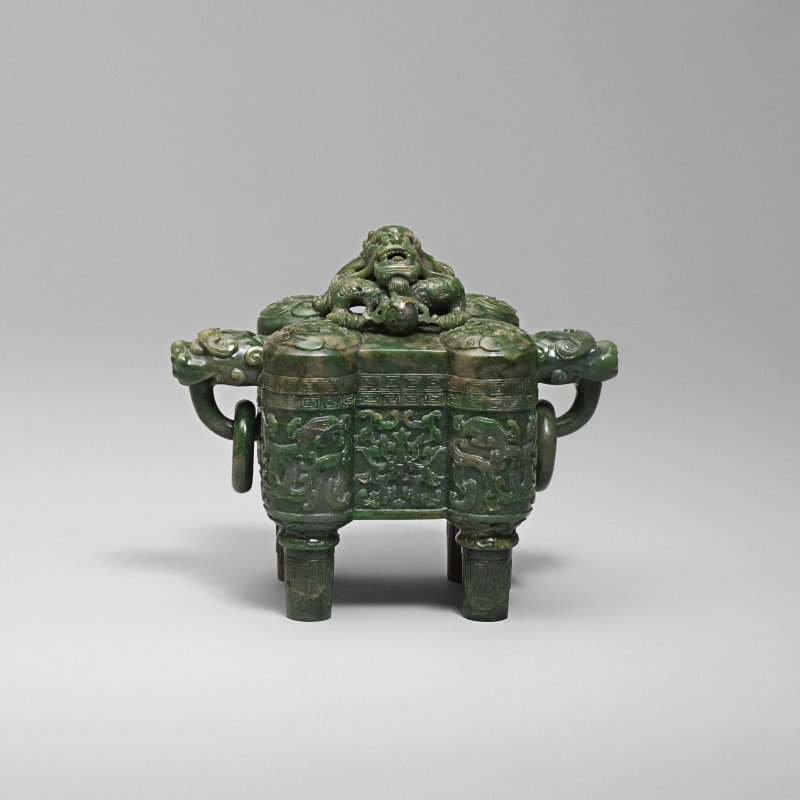
Of square section with tubular corners, supported on four legs, finely carved around the exterior with a decorative band of archaistic dragons and lotus beneath key-fret border, flanked with a pair of animal-head handles suspending loose rings, the cover carved with a large coiling five-clawed dragon finial surrounded by four smaller chilong, the stone of deep green tone, wood stand. 17.7cm (7in) wide. (3).
Footnotes
清乾隆 碧玉雕雙龍活環耳蓋爐
Provenance: Sir George Mowlem Burt KBE (1884–1964), Surrey, and thence by descent. According to a Spink & Son Ltd., London, valuation, dated to 14 August 1974, the incense burner was previously owned by the Earl of Derby.
來源:大英帝國爵級司令勛章獲得者George Mowlem Burt爵士(1884-1964),英國薩裏,并由後人保存迄今。据倫敦古董商Spink & Son Ltd.于1974年8月14日所做評估報告,此爐曾由Derby伯爵持有
Born in Westminster on 10 January 1884, Sir George Mowlem Burt KBE joined the family firm, John Mowlem & Co., in 1902, following in the footsteps of his father and uncle. He subsequently became supervising director of the company and was involved in a number of major engineering and building projects. He was a prominent figure in the development of the civil engineering industry, serving as a founding member of the Federation of Civil Engineering Contractors and on various Government committees and missions. He was also Master of the Worshipful Company of Paviors. Outside his professional life, Burt was a distinguished fencer, winning the British épée championship in 1922 and representing Great Britain in épée at the 1920 Olympic Games. He was knighted in 1942 and died at Blindley Heath, Surrey, on 1 September 1964. An enthusiastic collector of art, his collection included paintings, ivory, netsuke and jade.
The present incense burner and cover would have formed part of a three-piece garniture comprising an incense burner, a vase and an incense box, often referred to as the 'Three Accessories' or . See two examples of such sets in spinach-green jade in the Qing Court Collection, illustrated in , Beijing, 2011, no.111, and another in the Musée des Arts Décoratifs, Paris, illustrated by Tsao Huei-chung, , Paris, 2016, no.132. Such sets were placed on the scholar's table in the Qing Court for the burning of incense.
The form derives from the archaic bronze tradition, in line with the Qing Imperial project of 'restoring ancient ways', which conceived of antiquity as embodying qualities of sincerity, simplicity and restrained vitality. The Qianlong Emperor in particular favoured the adaptation of archaic forms into contemporary designs, commissioning the systematic study of antiquities through compilations such as the Catalogue of (), which were made available to Court craftsmen as models for inspiration. See Chang Li-tuan, , Taipei, 1997, pp.49–50.
A related archaic bronze vessel is illustrated by Wang Tao, , London, 2009, no.127, where the author notes that the unusual form suggests a function distinct from conventional ritual food vessels and proposes that it may instead have served as a pigment container. It is also notable that vessels of this type were produced in jade during the late Shang to early Western Zhou periods. See Prof Ch'eng Te-k'un, 'The T'u-lu Colour-Container of the Shang-Chou Period', , 1965, vol.37, pp.239–50.
Compare also a similar spinach-green jade and cover, late 18th century, in the Victoria and Albert Museum, London, illustrated by M.Wilson, , London, 2004, pl.52.
See a related spinach-green jade incense burner and cover, , Qianlong, which was sold at Bonhams London, 12 May 2022, lot 115.
Of square section with tubular corners, supported on four legs, finely carved around the exterior with a decorative band of archaistic dragons and lotus beneath key-fret border, flanked with a pair of animal-head handles suspending loose rings, the cover carved with a large coiling five-clawed dragon finial surrounded by four smaller chilong, the stone of deep green tone, wood stand. 17.7cm (7in) wide. (3).
Footnotes
清乾隆 碧玉雕雙龍活環耳蓋爐
Provenance: Sir George Mowlem Burt KBE (1884–1964), Surrey, and thence by descent. According to a Spink & Son Ltd., London, valuation, dated to 14 August 1974, the incense burner was previously owned by the Earl of Derby.
來源:大英帝國爵級司令勛章獲得者George Mowlem Burt爵士(1884-1964),英國薩裏,并由後人保存迄今。据倫敦古董商Spink & Son Ltd.于1974年8月14日所做評估報告,此爐曾由Derby伯爵持有
Born in Westminster on 10 January 1884, Sir George Mowlem Burt KBE joined the family firm, John Mowlem & Co., in 1902, following in the footsteps of his father and uncle. He subsequently became supervising director of the company and was involved in a number of major engineering and building projects. He was a prominent figure in the development of the civil engineering industry, serving as a founding member of the Federation of Civil Engineering Contractors and on various Government committees and missions. He was also Master of the Worshipful Company of Paviors. Outside his professional life, Burt was a distinguished fencer, winning the British épée championship in 1922 and representing Great Britain in épée at the 1920 Olympic Games. He was knighted in 1942 and died at Blindley Heath, Surrey, on 1 September 1964. An enthusiastic collector of art, his collection included paintings, ivory, netsuke and jade.
The present incense burner and cover would have formed part of a three-piece garniture comprising an incense burner, a vase and an incense box, often referred to as the 'Three Accessories' or . See two examples of such sets in spinach-green jade in the Qing Court Collection, illustrated in , Beijing, 2011, no.111, and another in the Musée des Arts Décoratifs, Paris, illustrated by Tsao Huei-chung, , Paris, 2016, no.132. Such sets were placed on the scholar's table in the Qing Court for the burning of incense.
The form derives from the archaic bronze tradition, in line with the Qing Imperial project of 'restoring ancient ways', which conceived of antiquity as embodying qualities of sincerity, simplicity and restrained vitality. The Qianlong Emperor in particular favoured the adaptation of archaic forms into contemporary designs, commissioning the systematic study of antiquities through compilations such as the Catalogue of (), which were made available to Court craftsmen as models for inspiration. See Chang Li-tuan, , Taipei, 1997, pp.49–50.
A related archaic bronze vessel is illustrated by Wang Tao, , London, 2009, no.127, where the author notes that the unusual form suggests a function distinct from conventional ritual food vessels and proposes that it may instead have served as a pigment container. It is also notable that vessels of this type were produced in jade during the late Shang to early Western Zhou periods. See Prof Ch'eng Te-k'un, 'The T'u-lu Colour-Container of the Shang-Chou Period', , 1965, vol.37, pp.239–50.
Compare also a similar spinach-green jade and cover, late 18th century, in the Victoria and Albert Museum, London, illustrated by M.Wilson, , London, 2004, pl.52.
See a related spinach-green jade incense burner and cover, , Qianlong, which was sold at Bonhams London, 12 May 2022, lot 115.
常见问题
这件清乾隆 碧玉雕雙龍活環耳蓋爐 | AN ARCHAISTIC SPINACH-GREEN JADE INCENSE BURNER AND COVER, TULU的成交价是多少?
落槌价为 预展中。 成交价为 预展中。


