
拍品信息
拍品名称
唐/遼 玉狻猊 | A RARE PALE GREEN AND RUSSET JADE CARVING OF A LION
年代
Tang/Liao Dynasty
起拍价
GBP 2,000
估值区间
GBP 2000 - 3000
尺寸
未知
品相
未知
更多信息
Tang/Liao Dynasty
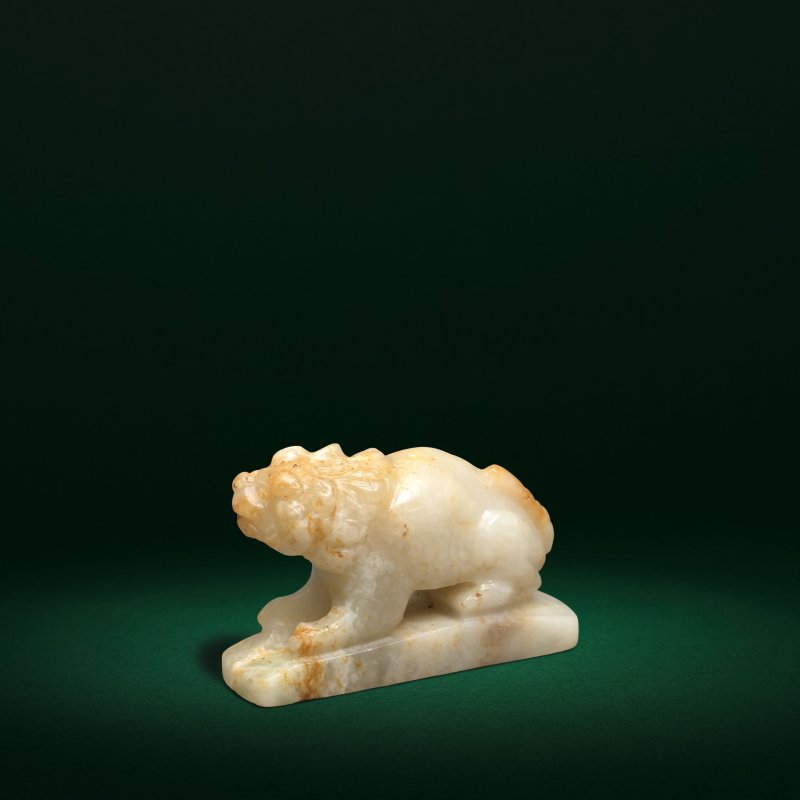
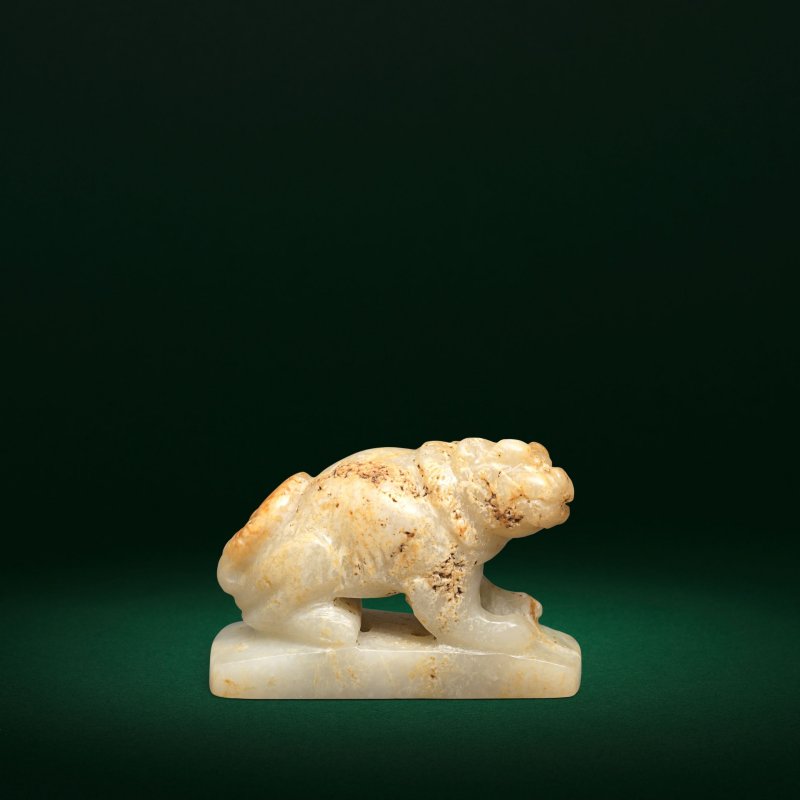
Deftly carved as a crouching lion with its head turned slightly to the right, detailed with raised brows and a bushy mane, the body resting on its haunches with the forelegs bent, supported on a flat, square plinth pierced with two apertures, the stone of a white tone with beige and russet patches. 4.5cm (1 3/4in) long.
Footnotes
唐/遼 玉狻猊
The beast depicted in the present lot may be identified as a suanni (狻猊), a mythical creature whose earliest literary reference appears in the Warring States period Tale of King Mu, Son of Heaven (穆天子傳), which mentions: 'Among the famous beasts, some are capable of travelling a thousand li; the suanni and wild horses can travel five hundred li.' The Jin dynasty scholar Guo Pu commented: 'Suanni is the lion, native to the Western Regions.' In traditional Chinese mythology, the suanni is regarded as the fifth of the Nine Sons of the Dragon and is conventionally depicted as resembling a lion as seen in the present lot, a motif particularly seen in the art of the Tang dynasty. See a related jade carving of suanni, Tang dynasty, in the collection of the Palace Museum, Beijing, illustrated in The Pictorial Handbook of Ancient Chinese Jades (中國古玉器圖典), Beijing, 2007, p.327.
See a related pale green and brown jade mythical beast similarly portrayed as crouching on a plinth, Ming dynasty, in the collection of the Tianjin Museum, illustrated in (中國傳世玉器全集), vol.4, Beijing, 2010, p.166.
Deftly carved as a crouching lion with its head turned slightly to the right, detailed with raised brows and a bushy mane, the body resting on its haunches with the forelegs bent, supported on a flat, square plinth pierced with two apertures, the stone of a white tone with beige and russet patches. 4.5cm (1 3/4in) long.
Footnotes
唐/遼 玉狻猊
The beast depicted in the present lot may be identified as a suanni (狻猊), a mythical creature whose earliest literary reference appears in the Warring States period Tale of King Mu, Son of Heaven (穆天子傳), which mentions: 'Among the famous beasts, some are capable of travelling a thousand li; the suanni and wild horses can travel five hundred li.' The Jin dynasty scholar Guo Pu commented: 'Suanni is the lion, native to the Western Regions.' In traditional Chinese mythology, the suanni is regarded as the fifth of the Nine Sons of the Dragon and is conventionally depicted as resembling a lion as seen in the present lot, a motif particularly seen in the art of the Tang dynasty. See a related jade carving of suanni, Tang dynasty, in the collection of the Palace Museum, Beijing, illustrated in The Pictorial Handbook of Ancient Chinese Jades (中國古玉器圖典), Beijing, 2007, p.327.
See a related pale green and brown jade mythical beast similarly portrayed as crouching on a plinth, Ming dynasty, in the collection of the Tianjin Museum, illustrated in (中國傳世玉器全集), vol.4, Beijing, 2010, p.166.
常见问题
这件唐/遼 玉狻猊 | A RARE PALE GREEN AND RUSSET JADE CARVING OF A LION的成交价是多少?
落槌价为 预展中。 成交价为 预展中。


