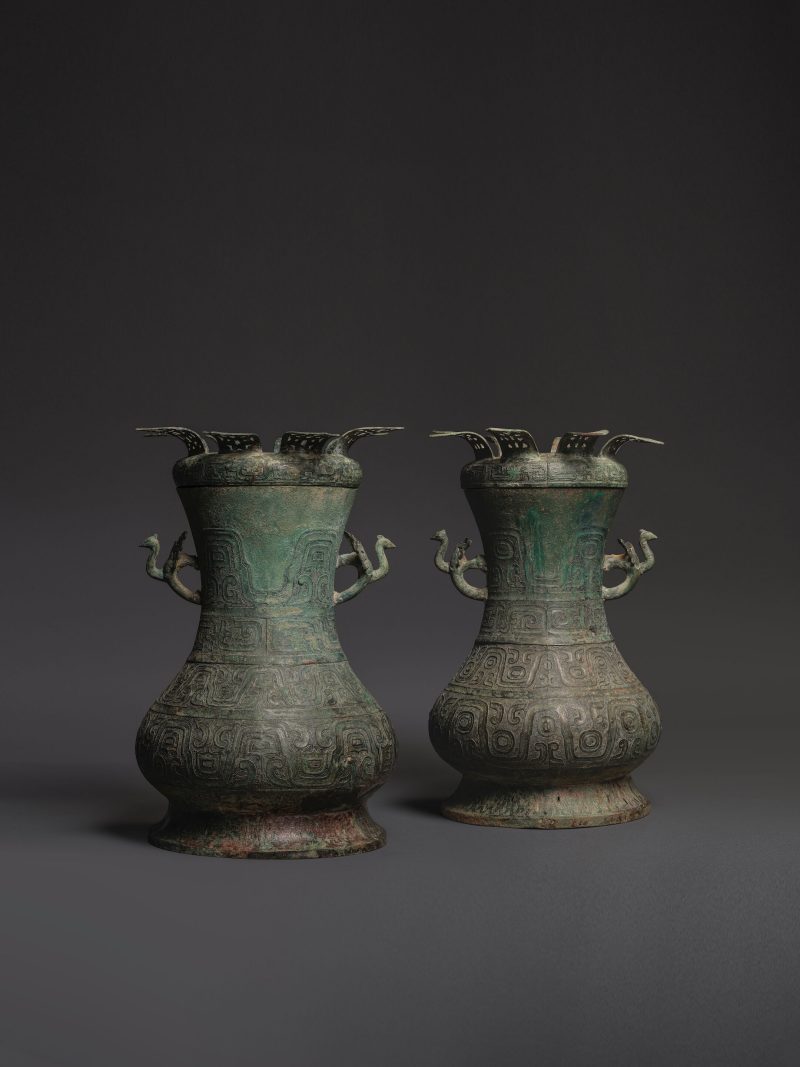
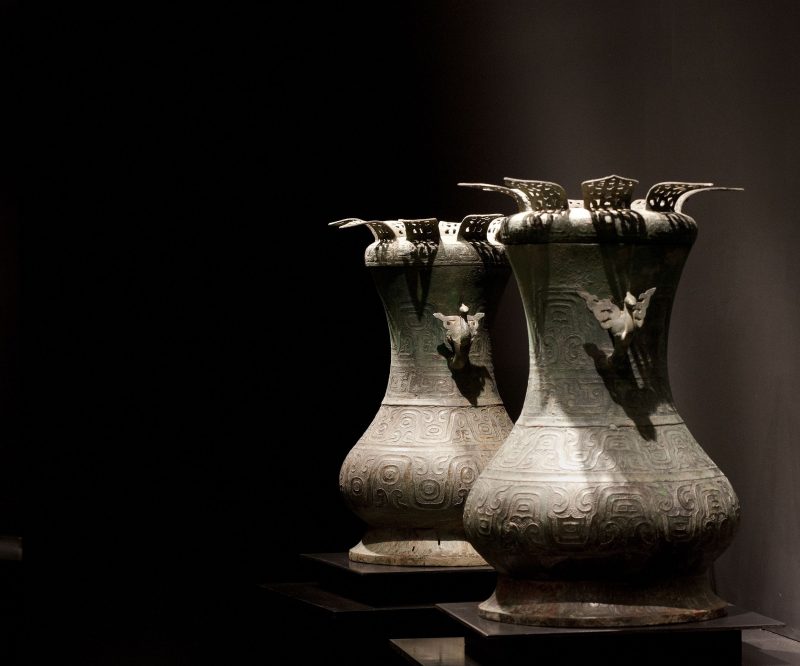
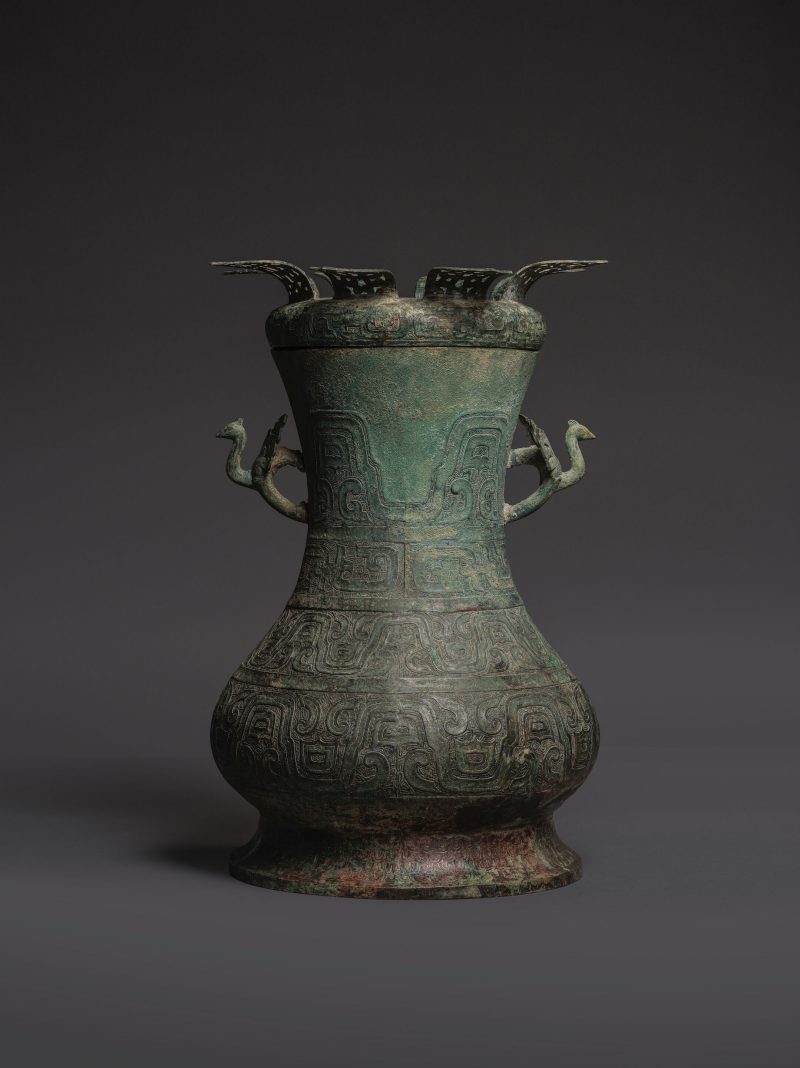
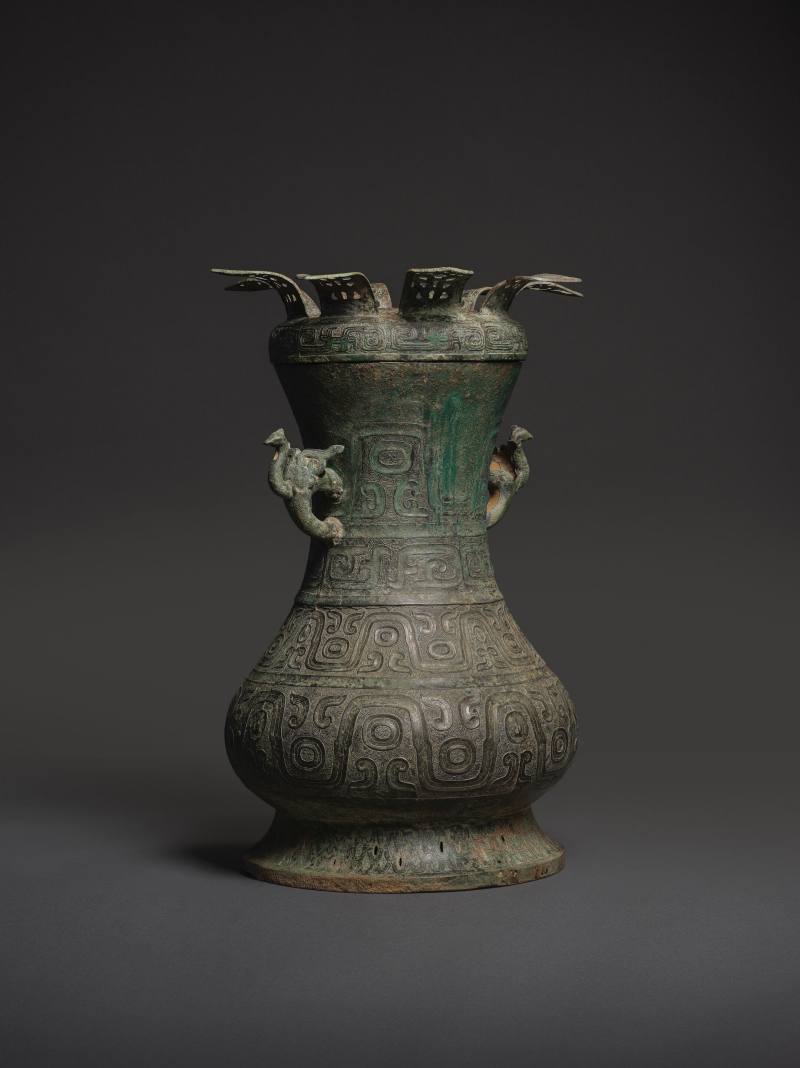
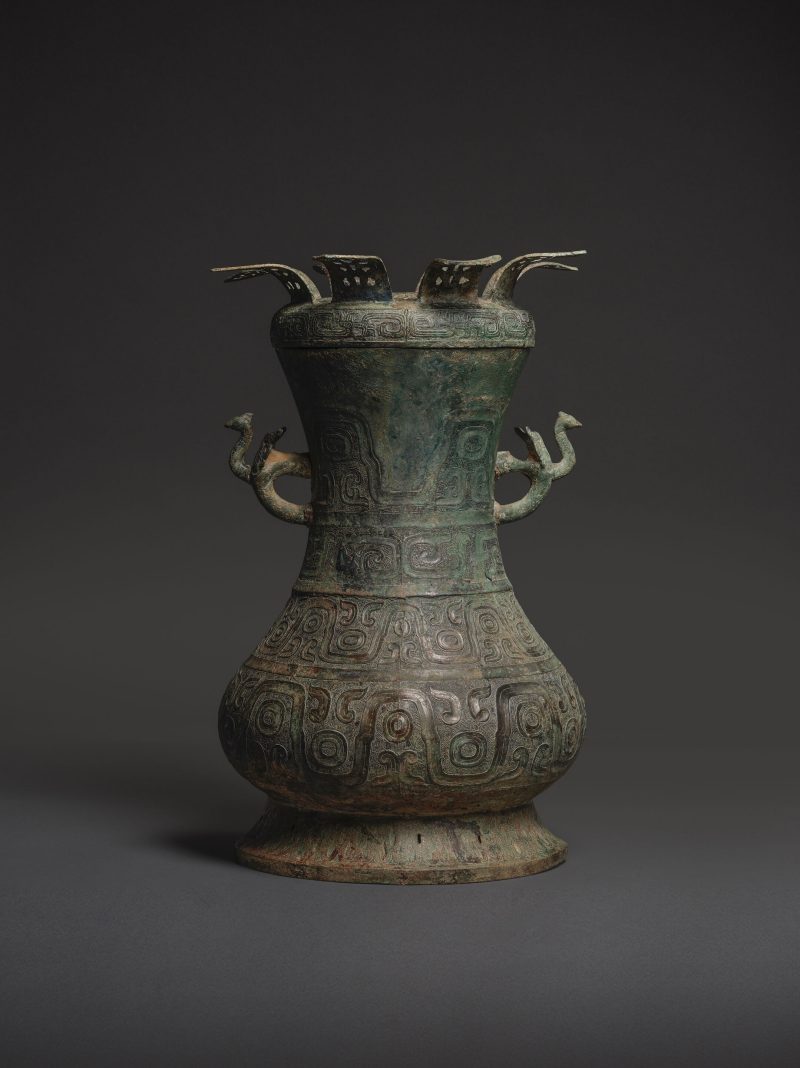
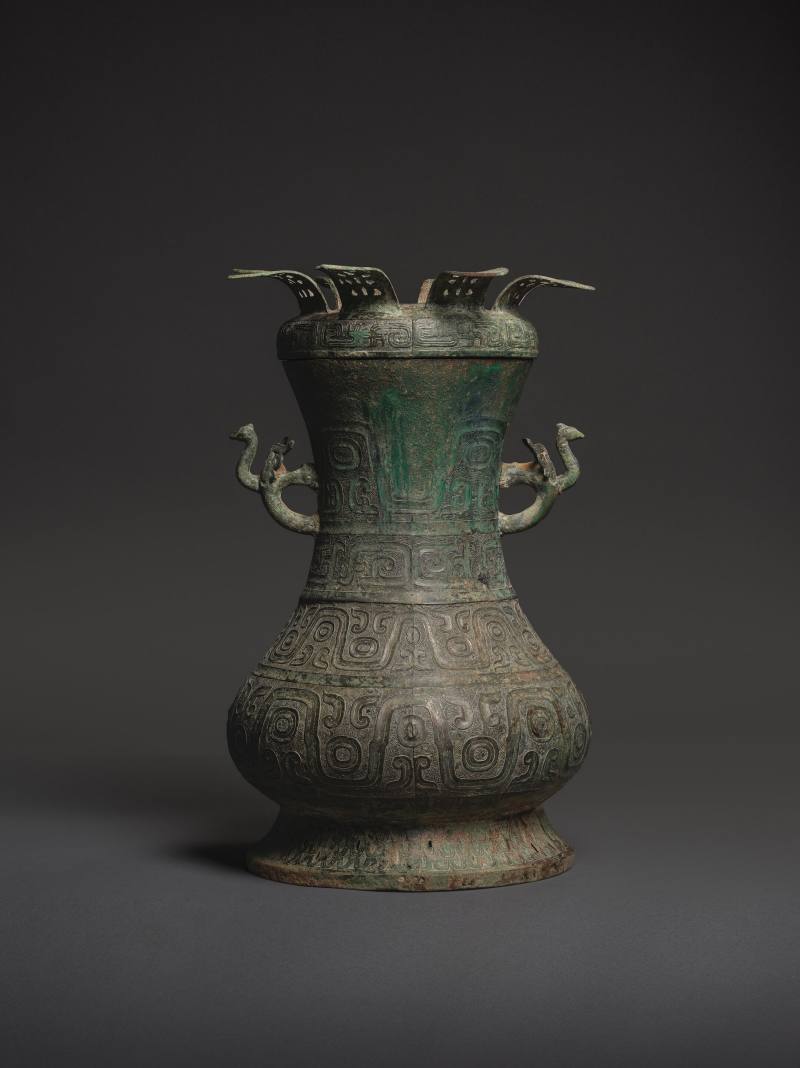
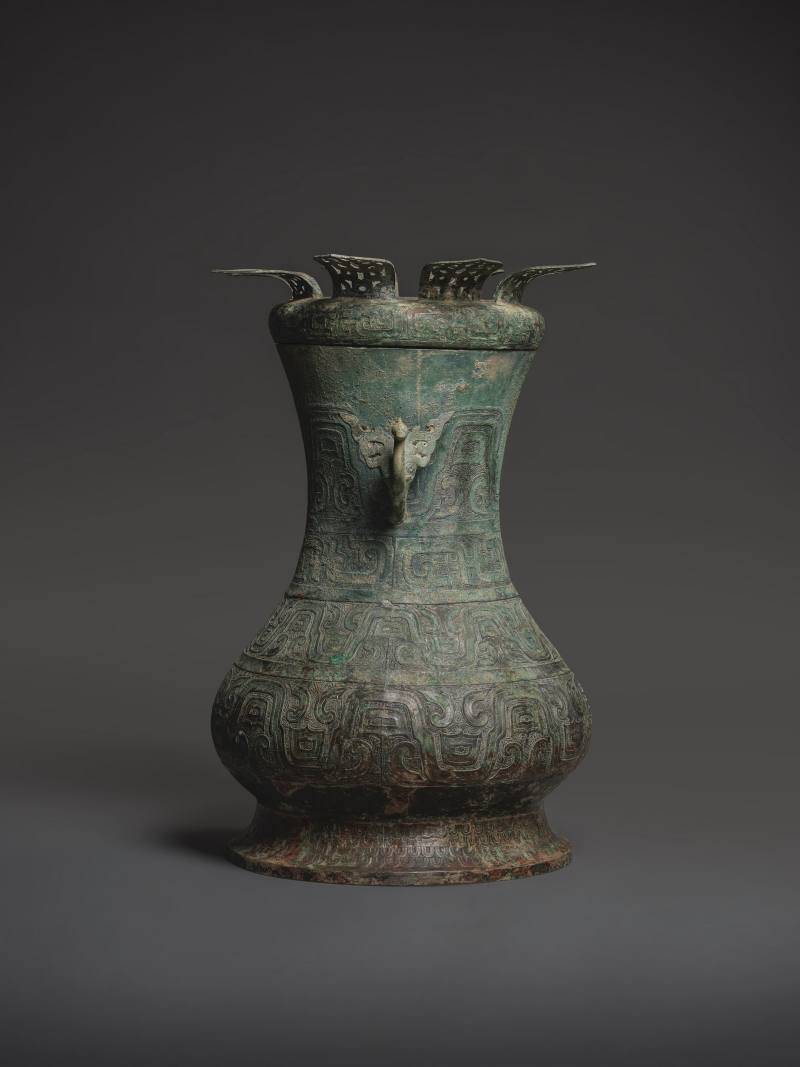
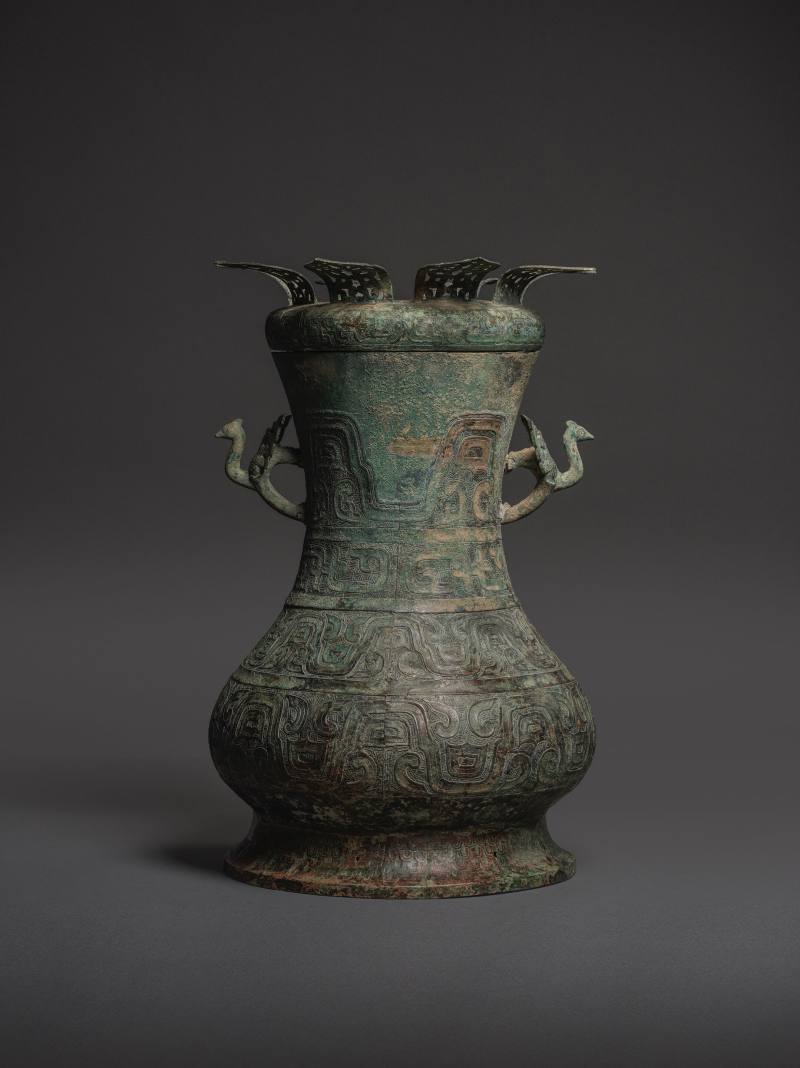
Lot 23 春秋早期 公元前770-476年 青銅波曲紋壺一對 | MAGNIFIQUE ET IMPORTANTE PAIRE DE GRANDS VASES COUVERTS RITUELS EN BRONZE, HU
落槌价
预展中
成交价
预展中
| 拍卖公司 | 邦瀚斯 |
|---|---|
| 拍卖时间 | 2026年12月10日 |
拍品信息
拍品名称
春秋早期 公元前770-476年 青銅波曲紋壺一對 | MAGNIFIQUE ET IMPORTANTE PAIRE DE GRANDS VASES COUVERTS RITUELS EN BRONZE, HU
年代
春秋早期 公元前770-476年
起拍价
未知
估值区间
EUR 150,000–250,000
尺寸
Each 60 cm (23 5/8 in.) and 59 cm (23 1/4 in.) high
品相
未知
更多信息
MAGNIFIQUE ET IMPORTANTE PAIRE DE GRANDS VASES COUVERTS RITUELS EN BRONZE, HU
Début de la période des Printemps et Automnes, 770-476 av. J.-C.
A MAGNIFICENT AND VERY RARE PAIR OF LARGE ARCHAIC BRONZE RITUAL WINE VESSELS AND COVERS, HU
Early Spring and Autumn period, 770-476 BC
Solidly cast, each with a generously shaped, compressed pear-shaped body raised on a spreading foot, rising to a waisted neck and flared mouth, the body cast with registers of bold triangular leiwen formed by slanting and triangular forms, the registers divided by plain, narrow bands, the neck set with a pair of bold large-horned taotie masks issuing loop handles set with upright bird figures and suspending large rings, the slightly domed cover crowned by a ring of curved petals intricately cast in openwork.
Each 60 cm (23 5/8 in.) and 59 cm (23 1/4 in.) high (4).
春秋早期 公元前770-476年 青銅波曲紋壺一對
Provenance:
Gisèle Croës Arts d'Extrême Orient, Brussels, 2000
Published, Illustrated and Exhibited:
Gisèle Croës Arts d'Extrême Orient, Treasures from the Shang and a Selection of Ritual Objects, New York, 2001, p. 62
來源:
Gisèle Croës Arts d'Extrême Orient,布魯塞爾,2000年
展覽著錄:
Gisèle Croës Arts d'Extrême Orient,《Treasures from the Shang and a Selection of Ritual Objects》,紐約,2001年,第62頁
Impressive in their sheer size and volume, and flamboyant in their design, this magnificent pair of large bronze hu demonstrates the creative style that evolved in the bronze casting workshops and foundries of the late Western Zhou dynasty, and that matured in the Spring and Autumn period of the Eastern Zhou dynasty. Tall you were adapted and turned into slender hu before being transformed into generously proportioned pear-shaped hu as represented by the present pair of vessels. The crisply cast deep wave pattern arranged in registers on the bodies of these two vessels was one of the motifs invented concurrently with the marked changes in ritual vessel shape. More impressive and larger vessels with extravagant features and designs were made to suit the various demands of the lavish lifestyle of the nobility reflecting ideological transformation and social upheaval.
Jessica Rawson traces the development of this type of vessel in the middle of the Western Zhou period, illustrating examples, see Jessica Rawson, Western Zhou Ritual Bronzes from the Arthur M. Sackler Collections, vol. IIA, Washington, D.C., 1990, figs. 135 and 143a.
In the Spring and Autumn period, this vessel type evolved into an even more elaborate form, decorated with bold geometric designs that reflect and enhance the bold curves of the vessel. Strongly rooted in the Western Zhou tradition, the decoration is cast in registers filled with repetitive design units. Slight discontinuities in the design correspond to mould marks and point to a technical feature that links these two vessels to the bronze casting workshops of the Houma foundry in Shanxi province. In design and ornamentation, these two hu recall vessels created at the Jin State foundry in Houma, Shanxi province, a major centre of bronze casting in the Eastern Zhou dynasty. A pair of equally magnificent related bronze hu of similarly large size, also cast with a crown of openwork petals on the cover, in the collection of the British Museum, London (accession no. 1972,0229.1.b), are inscribed, the inscription linking them to the Jin state.
Large bronze hu of related shape and design are rare and only a few examples are known. Among them is a covered hu decorated with a similar design of waves, a crown-like cover, and zoomorphic handles, in the collection of the Palace Museum, Taipei (accession no. 001309), and the 'Ceng Bo Yi' hu of late Western Zhou date, also in the Palace Museum collection, published in Masterpieces of Chinese Bronze in the National Palace Museum, Taipei, 1969, pl. 36. A related example loosely example from the collection of the Shanghai Museum, in Shanghai bowuguan cang qingtongqi, Shanghai, 1964, pl. 75. Compare also with vessels published in Li Xixing, Shaanxi Bronzes, Beijing, 1994, pp. 209 and 210, nos. 170 and 171. A late Western Zhou bronze hu of related design was sold at Sotheby's New York, 18-19 March 2025, lot 250.
以下内容由AI翻译:
【描述】
铸造坚实,每件壶身呈丰满的梨形,立于外撇的圈足之上,向上延伸至束颈和敞口。壶身饰有由倾斜和三角形组成的粗犷三角形雷纹,各层之间以窄而平滑的带状纹分隔。颈部饰有一对大角饕餮面具,两侧伸出环耳,环耳上饰有直立的鸟形图案,并悬挂大型环。微隆的盖顶饰有一圈精细镂空的弧形花瓣。
这对青铜壶以其巨大的尺寸和体积以及华丽的设计令人印象深刻,展示了西周晚期青铜铸造作坊和铸造厂中发展起来的创作风格,并在东周春秋时期成熟。高大的卣逐渐演变成细长的壶,最终形成了如本对器物所示的丰满梨形壶。这两件器物壶身上清晰铸出的深波纹是随着礼器形状显著变化而同时发明的一种纹饰。为了满足贵族奢华生活方式的各种需求,制作了更加壮观和更大规模、具有夸张特征和设计的器物,反映了意识形态的转变和社会动荡。
杰西卡·罗森追溯了这种类型器物在西周中期的发展,并举例说明,见杰西卡·罗森,《阿瑟·M·萨克勒收藏的西周礼器》,卷IIA,华盛顿特区,1990年,图135和143a。
在春秋时期,这种类型的器物演变成了更加复杂的形式,装饰着大胆的几何图案,这些图案与器物的大胆曲线相呼应并增强其效果。这种装饰深深植根于西周传统,装饰被铸成填充重复设计单元的层次。设计中的轻微不连续性对应于模具痕迹,指向将这两件器物与山西省侯马铸造厂联系起来的技术特征。在设计和装饰方面,这两件壶让人联想到在东周时期主要青铜铸造中心山西侯马晋国铸造厂创作的器物。伦敦大英博物馆收藏的一对同样宏伟的相关青铜壶(馆藏编号1972,0229.1.b),也饰有类似的镂空花瓣盖,铭文将其与晋国联系在一起。
类似形状和设计的大青铜壶非常罕见,只有少数例子为人所知。其中包括台北故宫博物院收藏的一件饰有类似波纹、冠状盖和兽形把手的带盖壶(馆藏编号001309),以及台北故宫博物院收藏的西周晚期“曾伯彝”壶,见《国立故宫博物院藏中国青铜器精品》,台北,1969年,图版36。上海博物馆收藏的一件相关例子,见《上海博物馆藏青铜器》,上海,1964年,图版75。另可比较李希星,《陕西青铜器》,北京,1994年,第209页和210页,编号170和171。一件西周晚期类似设计的青铜壶曾在苏富比纽约2025年3月18-19日拍卖会上售出,拍品编号250。
常见问题
这件春秋早期 公元前770-476年 青銅波曲紋壺一對 | MAGNIFIQUE ET IMPORTANTE PAIRE DE GRANDS VASES COUVERTS RITUELS EN BRONZE, HU的成交价是多少?
落槌价为 预展中。 成交价为 预展中。
拍品的尺寸是多少?
Each 60 cm (23 5/8 in.) and 59 cm (23 1/4 in.) high