
Lot 286 清嘉慶/道光 巨型青花九龍大瓶(附山中商會1943年圖錄) | A Magnificent, Monumental, and Extremely Rare Chinese Blue and White 'Nine Dragons' Vase, Qing Dynasty, Jiaqing/Daoguang Period
落槌价
****
成交价
****
拍品信息
拍品名称
清嘉慶/道光 巨型青花九龍大瓶(附山中商會1943年圖錄) | A Magnificent, Monumental, and Extremely Rare Chinese Blue and White 'Nine Dragons' Vase, Qing Dynasty, Jiaqing/Daoguang Period
年代
Jiaqing/Daoguang Period (1796-1850)
起拍价
未知
估值区间
$40,000 - $60,000
尺寸
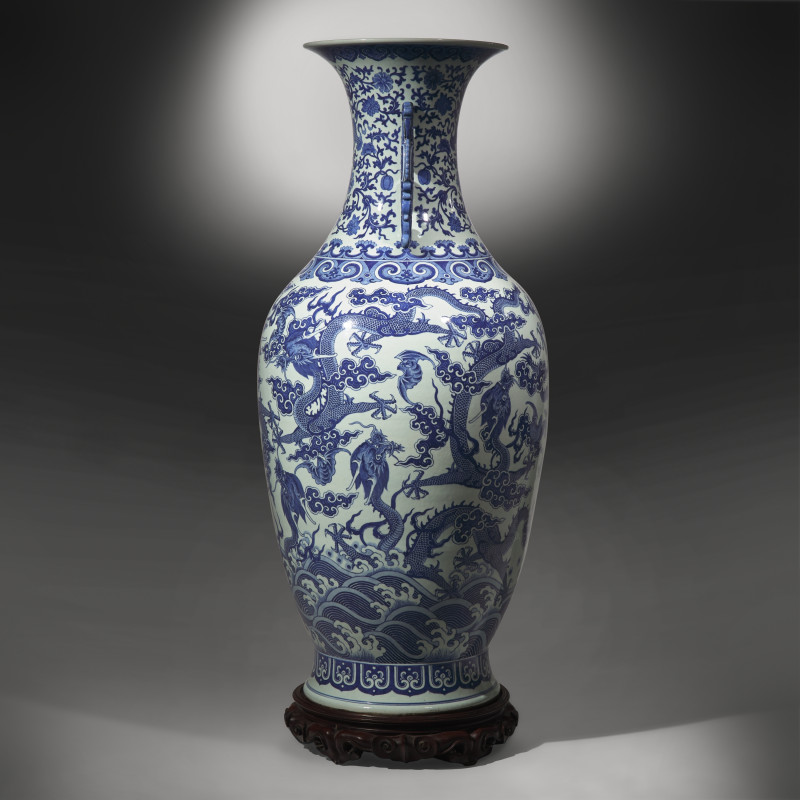
Height 50 in., 127 cm.
品相
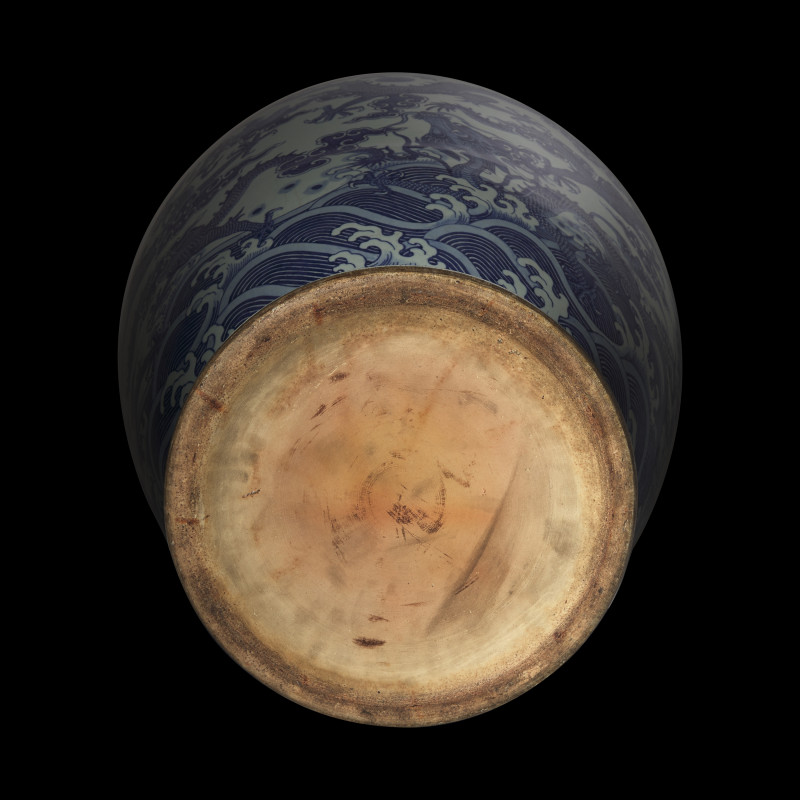
Overall excellent condition for its age and use; moderate surface wear; scattered lines of craquelure in the glaze, particularly above the foot and lower body; lip very slightly uneven; under UV light, no repairs or restorations visible. Weight over 200 lbs (90 kg).
更多信息
**PREMIUM LOT**
Additional registration documentation, including a wire deposit, is required to bid on this lot. Online bids will not be accepted. Please contact bid@freemansauction.com to arrange for absentee or telephone bidding.
注:本品不接受網絡出價。參與競拍請電郵競拍部bid@freemansauction.com
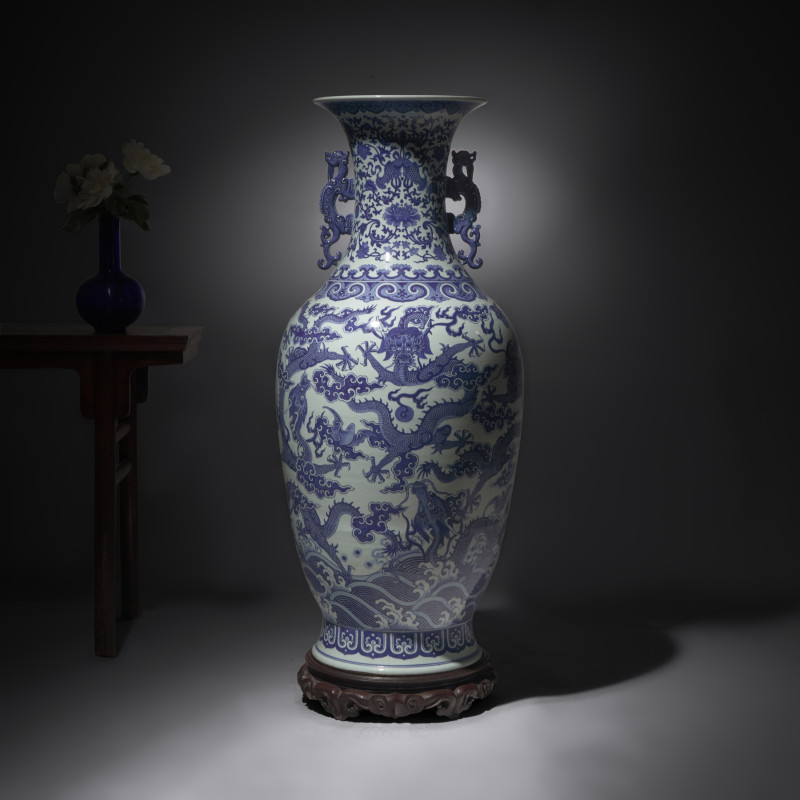
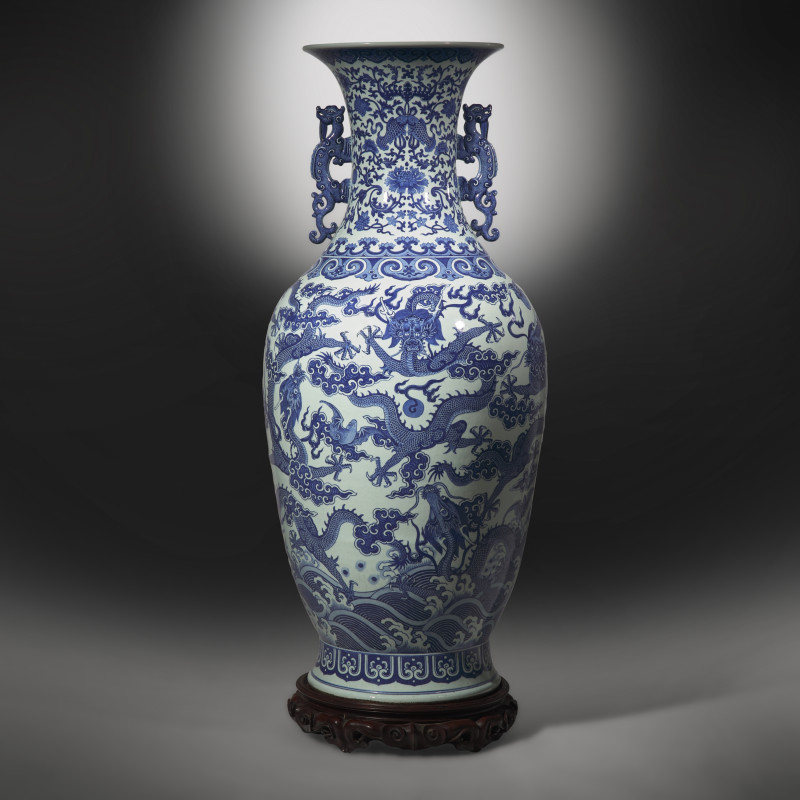
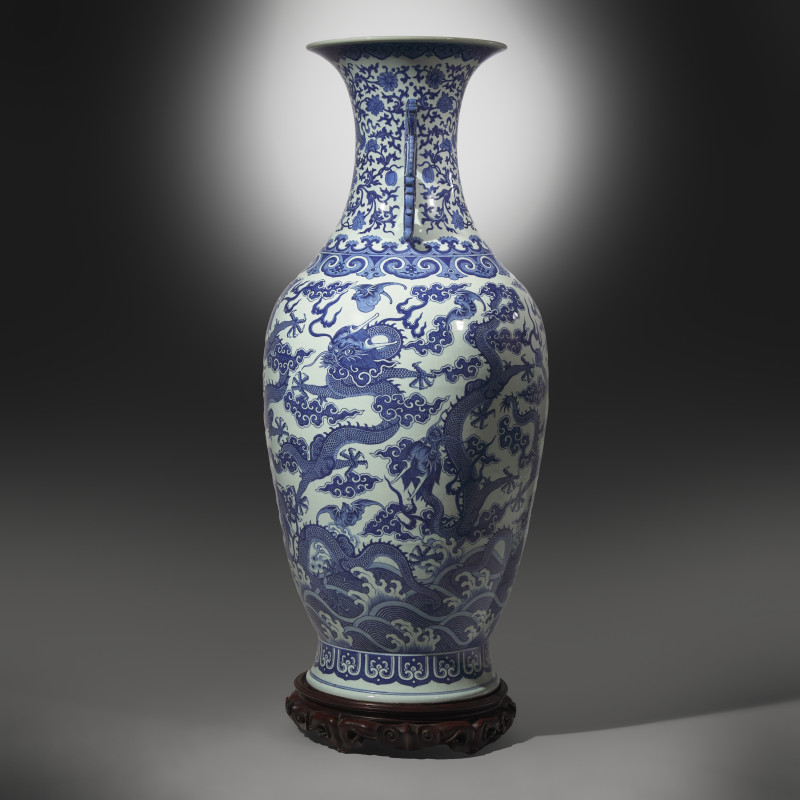
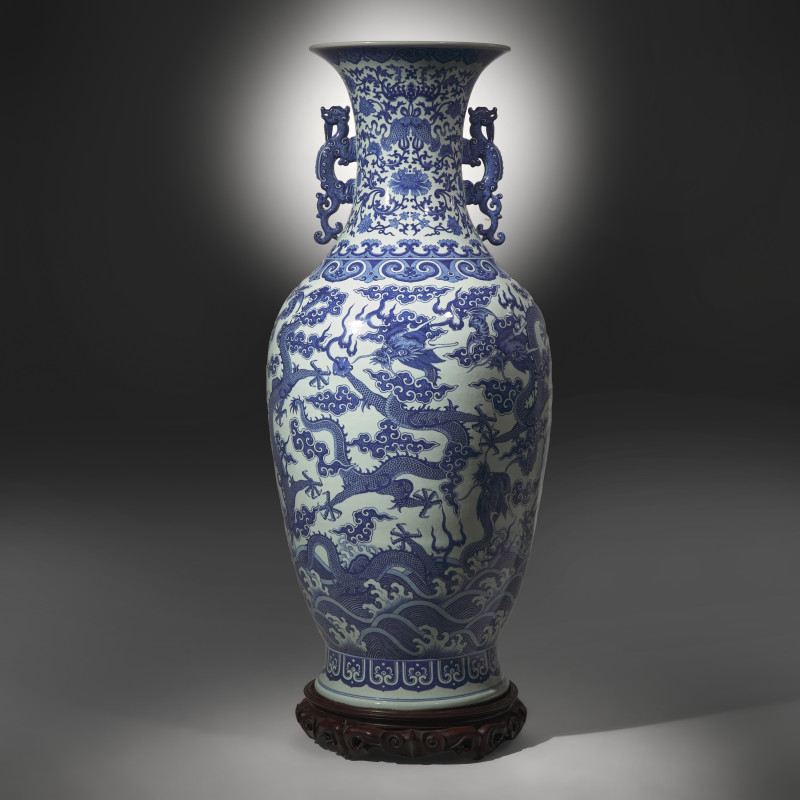
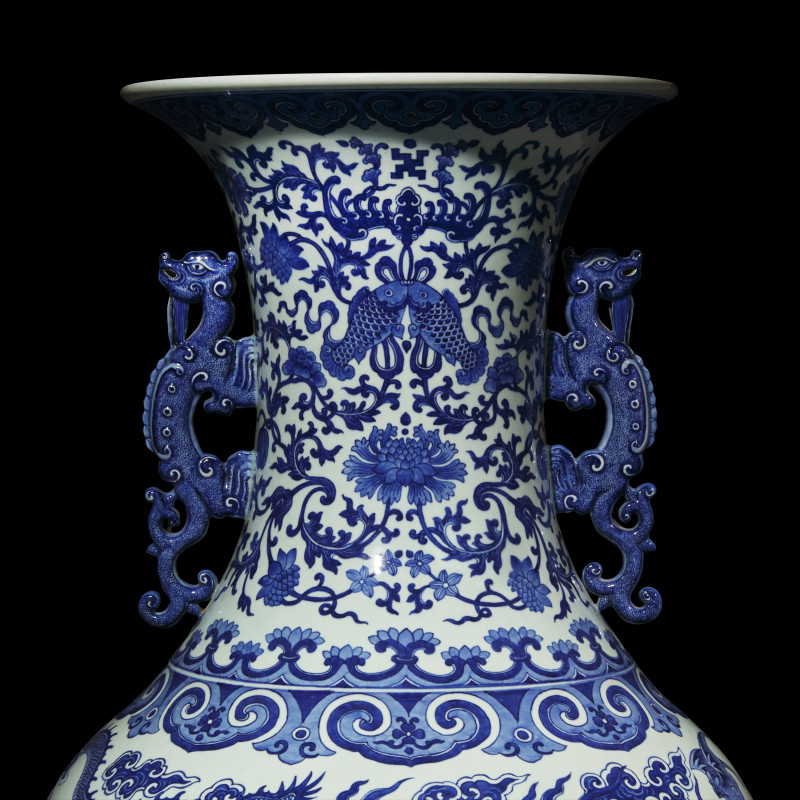
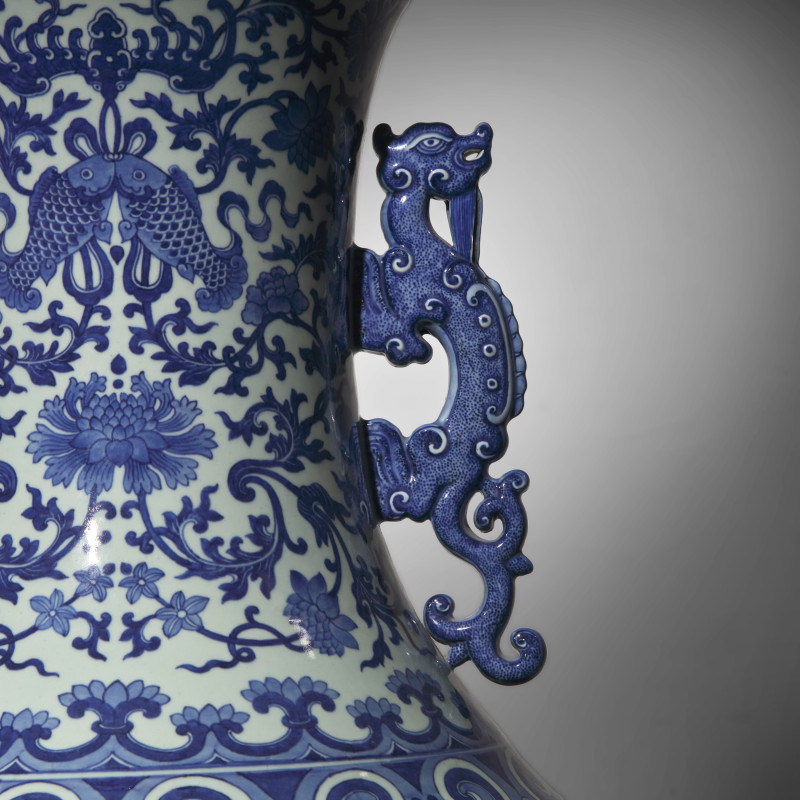
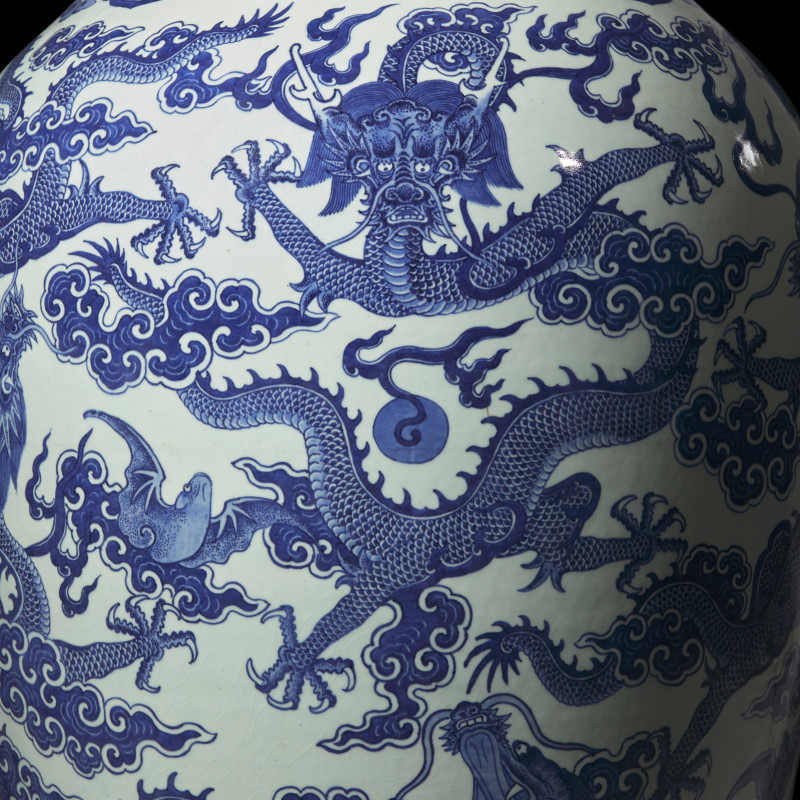
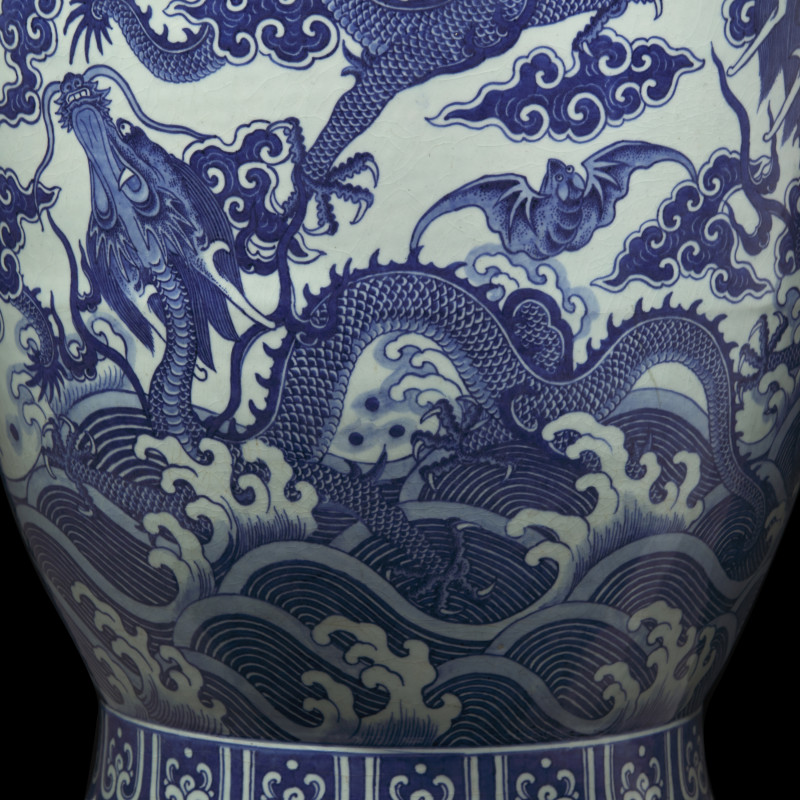
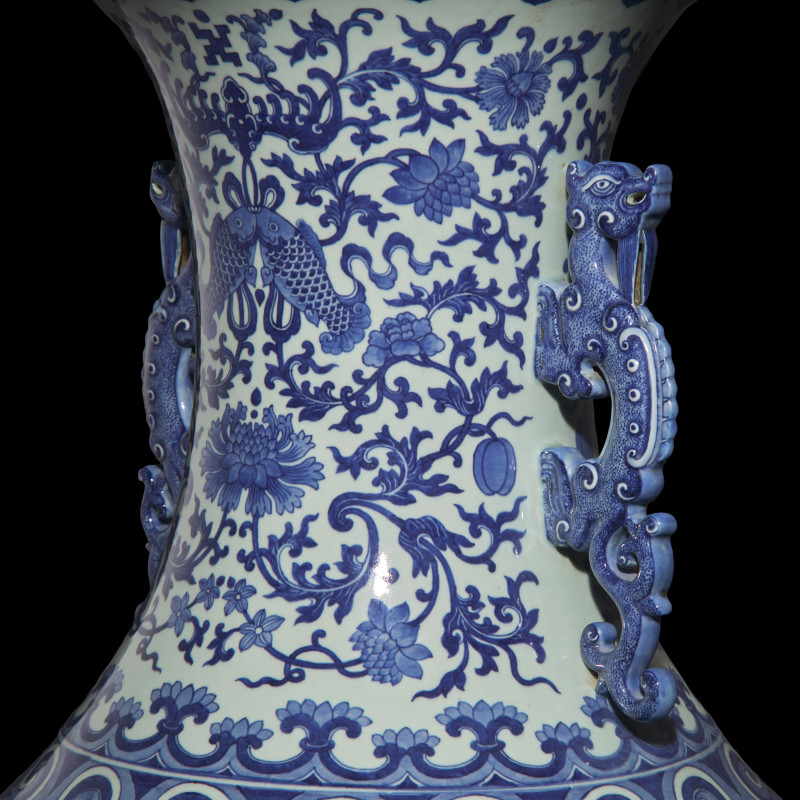
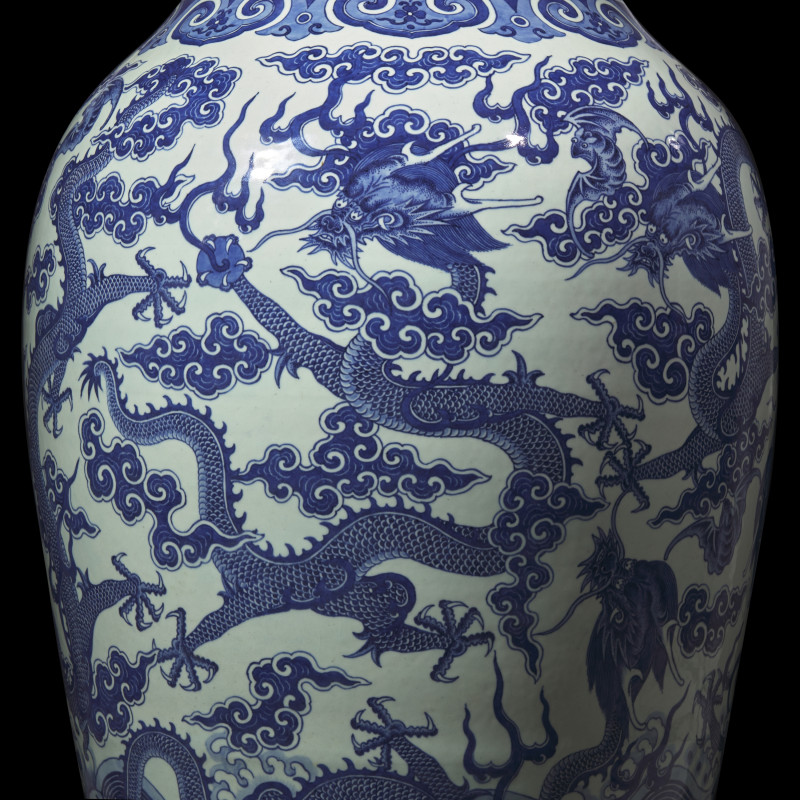
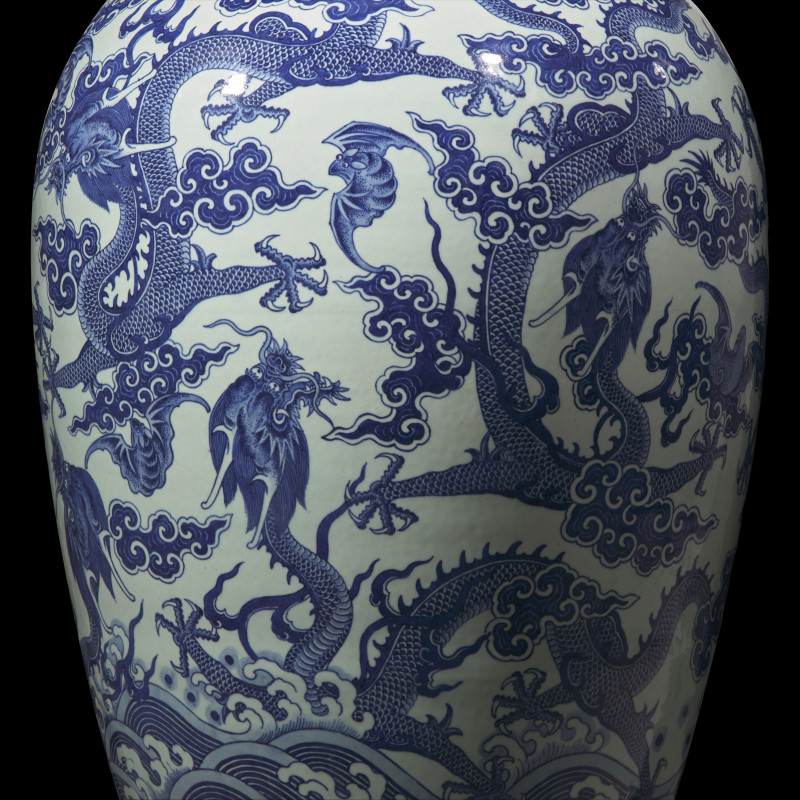
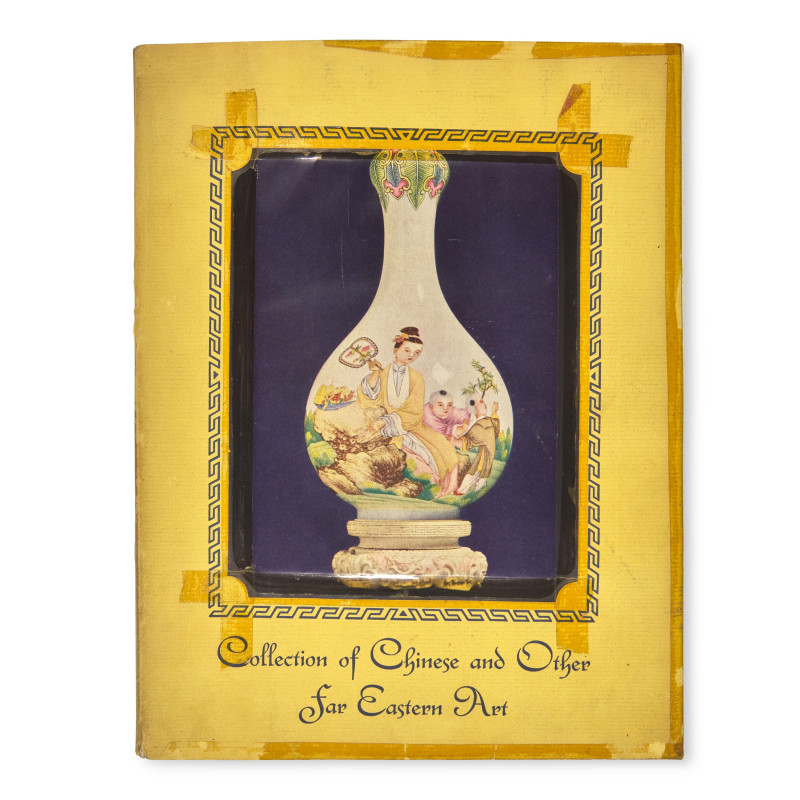
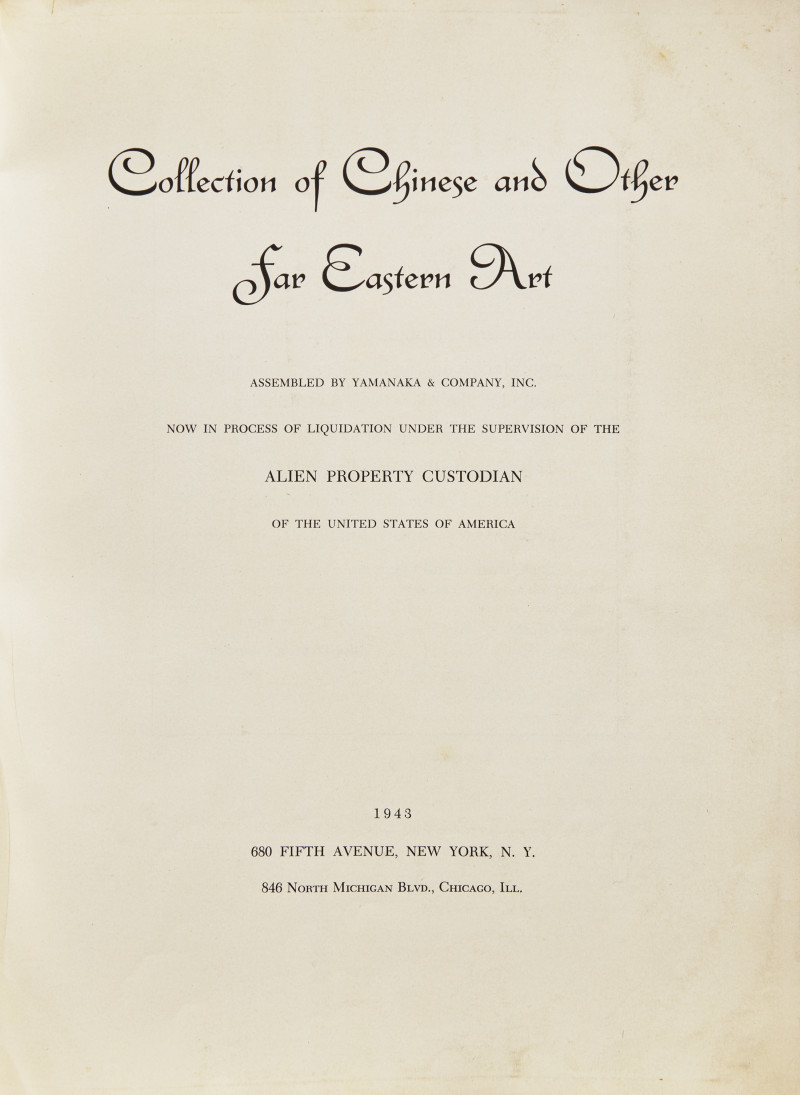
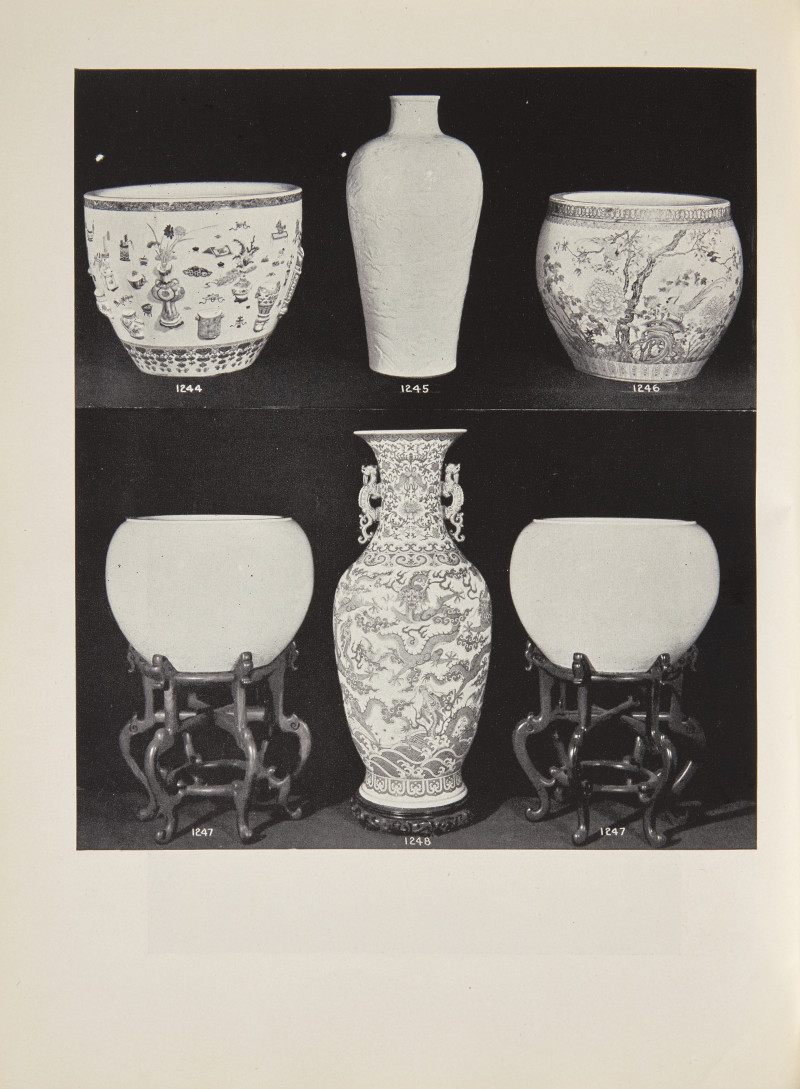
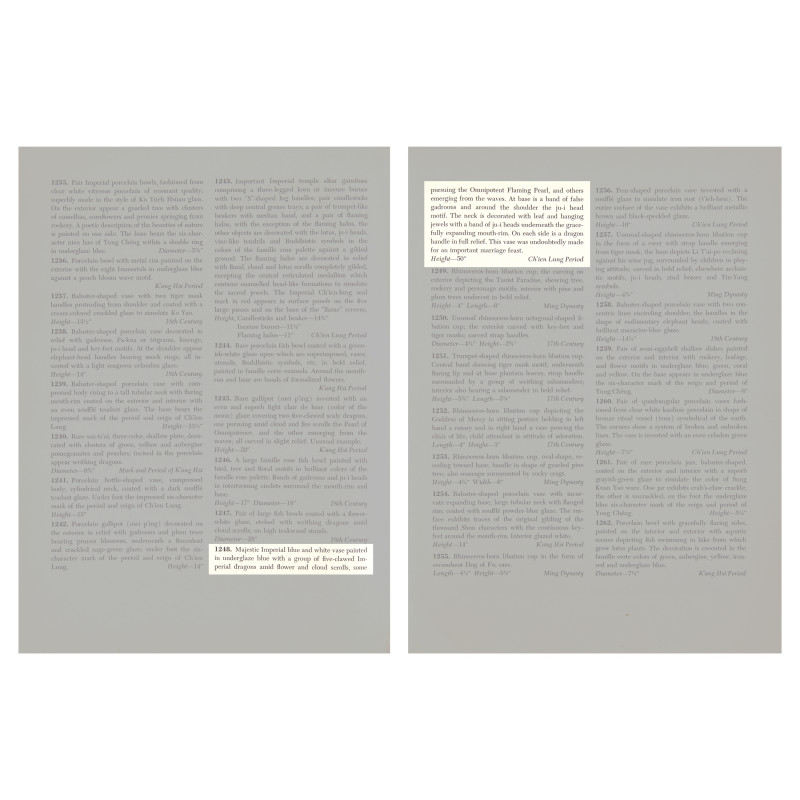
Of imposing scale, the body of slender baluster form, rising from a slightly spreading foot, with applied scrolling archaistic dragon handles at the neck, the body painted with a wide band of nine five-clawed dragons and numerous bats amongst cloud and flame scrolls, the central dragon on one side encircling a flaming pearl, the central dragon on the reverse grasping a pearl in its claws, above other dragons emerging from breaking waves, all below a wide band at the neck depicting a wan symbol, a stylized descending bat with twin fish suspended from a ribbon, peony, lotus, and other stylized blossoms on a fruiting melon vine, below a narrow band of ruyi heads at the flaring rim, echoed by a broader border at the shoulder, and a band of lappets above the foot, the unglazed underside raised on a low foot ring; carved wood stand. Accompanied by a copy of The Yamanaka & Company, Inc., 1943 catalogue in which the present vase is illustrated.
Essay:
Qing dynasty vases of this monumental size and exceptional quality are extremely rare and would have been very challenging to produce and successfully fire, particularly as this vase was made in three separate sections luted together before firing.
The treatment of the central dragon is very similar to that seen on Imperial moonflasks from the Qianlong period, with a large frontal-facing dragon such as that found on the large Qianlong mark and period doucai example, with elaborate scrolling archaistic dragon handles, sold at Christie’s, Hong Kong, May 30, 2023, lot 2903. The depiction of an enlarged frontal dragon symbolizes the emperor, and beneath it is a smaller, five-clawed dragon, which is rising out of breaking waves. The smaller dragon represents the heir apparent and appears to be looking up at the larger dragon. This decoration is generally known as ‘The Emperor instructing the Crown Prince’, or ‘The [Eastern] blue dragon teaching his son’ (Canglong jiuzi), and it appears on only a small number of Imperial porcelains. While the dragons on the present vase are all of similar scale, the treatment of the subsidiary dragons emerging from the waves and looking up to the central dragon implies this subject.
The dragon (known as long or loong) is a legendary figure in Chinese culture, usually depicted as a snake-like creature with four legs. They have traditionally been associated with control over water and the weather. During the Tang dynasty (618-907 AD), emperors wore robes with dragon motifs as an imperial symbol. On ceramics, dragons have been depicted from the Neolithic era, but it was not until the Song dynasty that the dragon became the exclusive symbol of the Emperor, with a decree passed by Emperor Huizong (1082-1135) forbidding its unauthorized use. Its use was further refined during the Yuan dynasty, where the depiction of the horned five-clawed dragon began to exclusively represent the ‘Son of Heaven’ and four-clawed dragons were to be used by princes and courtiers.
The motif of nine dragons has long been a reference in Chinese culture to the Emperor and his sons, and is also referenced in the saying “The Dragon has nine sons, and all are not the same”, Long sheng jiu zi, ge bu xiangtong, where it is recognized that one’s children have differing talents and skills. Such sentiments have been embodied in monumental ceramic form since at least the late 14th century, illustrated by the famed Nine Dragon screen wall in the compound of the Palace of the Prince of Dai, son of the Hongwu Emperor, in Datong (Pingcheng). Screen walls such as this inspired the only two other surviving tilework screens of grand scale, both Imperially commissioned in Beijing during the 18th century. The first of these was created for the former Imperial gardens in Beihai Park, circa 1756; the other is found before the Palace of Tranquil Longevity, Ningshou Quan Gong, built as the “retirement" palace for the Qianlong Emperor in the first part of the 1770s.
This theme of nine dragons depicted in multiple poses can be seen on large Imperial blue and white vases of the Yongzheng and Qianlong periods. One example of this, an extremely rare Yongzheng mark and period tianqiuping (“heavenly sphere" vase) was sold at Christie’s, Hong Kong, May 2, 2025, lot 802. The dragons on this vase are finely painted with great attention to detail, and the flame scrolls and the swirling waves express a high degree of movement and energy. In addition, the dragons include one winged dragon just above the waves, and another showing the underside of his chin. This degree of inventiveness in the depiction of dragons may be seen in the Kangxi period, as depicted in the blue and white vase and dish sold at Bukowski’s, Stockholm, December 11, 2020, lot 594. It is quite likely that this would have been painted at one of the private kilns at Jingdezhen, which allowed for a greater degree of creativity and experimentation with designs than the imperial kilns. However, one does see this type of depiction in the Imperial blue and white nine dragon tianqiuping vase mentioned above. Compare also the extraordinary 18th century blue and white “Nine Dragon” vase sold for 145,000 Euros at Asium in Paris in 2020, where the dragons are depicted with verve and creativity against a ground of spiraling waves.
The design of the wan symbol (ten-thousand or “limitless”), bat, twin fish, peony and fruiting vine at the neck of this vase form a rebus. The descending bat (fu dao) represents the arrival of good fortune and blessings, the twin fish (shuang yu), harmony and abundance, the peony (mudan), wealth and honor, and the melons, with their numerous seeds, a wish for numerous children. Together they form a powerful visual message of great happiness and abundance.
In terms of comparisons, no direct examples have been located, but a smaller (27.5 in.) Yongzheng seal mark and period vase without handles can be seen in the Qing Court Collection at the Palace Museum, 新00087847, illustrated in 'The Complete Treasures of the Palace Museum, Blue and White Porcelain with Underglazed Red', Geng Baochang et al, Hong Kong, 2012, Volume III, no. 89, p 103. Here the nine dragons are painted on a Ming-style ground of scrolling flowers, with thin bands of breaking waves at the base and at the shoulder. With regard to the painting of the present vase, this is of very fine quality, and this combined with the five-claw dragons and monumental size, points to an Imperial production. However, the stylistic treatment of the ruyi and lappet bands and the breaking waves is in a slightly more linear manner than one might expect in the Qianlong period, which suggests a date after the Yongzheng and Qianlong periods. Compare the ruyi-head border on the lip of the Jiaqing seal mark and period dragon-decorated blue and white bottle vase sold at Sotheby’s, New York, September 13, 2017, lot 22, and the similar border on the extremely rare Jiaqing seal mark and period double-gourd blue and white “Nine Dragon” vase, sold at Sotheby’s, New York, November 7, 2018, lot 70.
The careful yet stylized archaistic treatment of the dragon handles was also particularly prevalent from the Qianlong through Daoguang periods, as may be illustrated by the monumental yellow-ground Qianlong mark and period vase sold at Sotheby’s, Hong Kong, April 7, 2015, lot 3608. Compare also the painting of a pair of handles on a massive unmarked ruby ground vase, dated to the Qianlong/Jiaqing period, sold at Christie’s, New York, September 25, 2020, lot 1596. For another unmarked ruby-ground vase with similarly painted handles dated to the Qianlong/Jiaqing period, see Christie’s, Hong Kong, May 28, 2014, lot 3466. A third unmarked ruby-ground vase, dated to the Qianlong/Jiaqing period, with stylized handles painted in russet brown, and the neck decorated with descending bat, chime, lotus, endless knot and twin-fish was sold at Christie’s, New York, September 17, 2010, lot 1420. This treatment of decorative motifs found on the necks of these four vases also closely relates to the motifs and treatment of the neck of the present vase, such as the ruyi-head border to the lip, and the complex composite pendant surrounded by symmetrical floral scrolls, further supporting a date from the late 18th to the first part of the 19th century for the present vase, and demonstrating that not all vases of Imperial quality and dramatic scale received reign marks during this period.
Robert Bradlow
Robert Bradlow撰文:
清代如此體量且品質卓越的大瓶極為罕見。製作與燒造難度極高,本品由三段分別成型後拼接燒造,成器不易。
瓶身正面龍紋的處理手法與乾隆朝御製抱月瓶相似,參見香港佳士得2023年5月30日專場第編號2903號乾隆鬥彩螭龍耳大抱月瓶。迎面龍象徵帝王,下方一條五爪小龍躍出波濤,仰望大龍,象徵儲君——也就是蒼龍教子,見於少數御窯瓷器。本品所繪群龍體型相若,但由波濤中躍起並仰望大龍的姿態暗合這一主題。
龍是中國文化中的神獸,四足蛇形,掌管水與氣。唐代已有帝王穿著龍紋袞服彰顯皇權。陶瓷上的龍紋則可上溯至新石器時代。宋徽宗下詔禁止民間擅用,龍於是成為帝王專屬象徵。元代更進一步,五爪龍專屬天子,親王及宗室則用四爪。
九龍紋飾在中國文化中象徵帝王及其子嗣,“龍生九”,子嗣各有所長。體現在大型陶瓷器,最著名莫過於山西大同(平城)明洪武帝之子代王府前的九龍壁。此壁啟發了清代興建御製琉璃九龍壁:一座位于北海,建於1756年;另一座立於紫禁城寧壽宮,1770年代初為乾隆皇帝頤養天年而做。
雍正-乾隆朝青花九龍大尊參見:香港佳士得2025年5月2日第802號清雍正青花九龍紋天球瓶;斯德哥爾摩 Bukowskis行 2020年12月11日第594號青花瓶,出自景德鎮民窯,紋飾更具自由性與實驗性;以及巴黎2020年拍出的清中期青花九龍瓶,龍紋在漩渦狀的海浪中飛揚,極富創意。
本品頸部飾有卍字、蝙蝠、雙魚和牡丹等吉祥圖案。倒飛的蝙蝠寓意福到,雙魚象徵豐足,牡丹代表富貴,多籽的瓜果寓意子孫萬代。
遍查公私收藏,未見與本品相同之例。北京故宮博物院藏有一只尺寸較小(70厘米)的清雍正款青花九龍紋尊,九龍紋繪於纏枝花卉地之上,肩部及足際飾浪紋。本品畫工精湛,五爪龍紋與碩大體量,很可能確爲御窯之作。然如意雲頭紋、蓮瓣紋和波濤的處理較爲僵化,年代在雍乾之後。參見紐約蘇富比2017年9月13日第22號嘉慶款青花龍紋賞瓶,口沿如意雲頭紋與本品相類;又見紐約蘇富比2018年11月7日第70號嘉慶款青花九龍葫蘆瓶。
瓶頸兩側的仿古夔龍耳,盛行于乾隆至道光時期,參見香港蘇富比2015年4月7日第3608號乾隆黃地大尊;紐約佳士得2020年9月25日第1596號乾隆/嘉慶胭脂紅地無款大尊;香港佳士得2014年5月28日第3466號乾隆/嘉慶胭脂紅地大尊;以及紐約佳士得2010年9月17日第1420號乾隆/嘉慶胭脂紅地無款尊。以上四件頸部的紋飾處理與本品高度一致,進一步印證了本品應斷代為十八世紀末至十九世紀初,而且在這段時期,並非所有官窯品質的大體量瓷器皆有落款。
Property from the collection of The Honorable Robert C. Shelton, Jr.
Provenance:
Yamanaka & Company, Inc., New York, Boston, Chicago.
Charles and Aline Anderson, Hamburg, New Jersey.
The Honorable Robert C. Shelton Jr. (1934-2023), acquired from the above, November 1969, thence by descent.
Illustrated:
Collection of Chinese and Other Far Eastern Art Assembled by Yamanaka & Company, Inc. New York: Yamanaka & Co, 1943, no. 1248, catalogued as Qianlong period.
Chinese and Other Far Eastern Art. New York: Apollo, Poughkeepsie, New York, 1988, no. 1248.
A Qing Dynasty Vase, A Father’s Love, and A Daughter’s Quest
The Honorable Robert C. Shelton, Jr. (1934-2023), son of Helen and Robert C. Shelton Sr., was raised in Franklin, NJ. He is survived by his son, three daughters, many grand and great-grandchildren, and his pride and joy, a magnificent 50-inch blue and white Qing dynasty “Nine Dragon” vase.
Judge Shelton wore a variety of hats throughout his life: son, Husband, Father, Grandfather, Attorney, Prosecutor, Assemblyman, Superior Court Judge, World Traveler, Photographer, Ham Radio Operator, Car Enthusiast, Pilot, Opera Aficionado, and Collector of Chinese Antiquities, inspired by his magnificent vase.
Charles (d. 1966) and Aline Anderson, well-known antiques dealers in Hamburg, New Jersey, were clients and friends of Judge Shelton. The Judge had long admired his friend Charles’s most beautiful treasure, an imposing blue and white porcelain vase, painted with nine five-clawed dragons. He was awestruck by its size and the beauty of the dragons and enchanted by the history chronicled by Mr. Anderson, a story of the imperial household, a wedding, and symbols of good fortune, happiness, and longevity. Mr. Anderson was well aware of Judge Shelton’s passion for his porcelain trophy and had instructed his wife to sell it to his good friend the Judge, should he be called from this realm ahead of her. In 1969, she fulfilled her husband’s wishes.
Upon acquisition of the vase, Judge Shelton had one conundrum. How did one move a rare porcelain treasure of 50 inches in height, a diameter of 23 inches, and a weight of 200-plus pounds? Judge Shelton’s time as a volunteer fireman inspired him to request an ambulance transport with the promise of a generous donation. Who better to handle his newfound love with care and precision than the men and women who had taken the oath “To first do no harm”. So the vase was strapped to a stretcher and moved from its home in Hamburg, New Jersey to Judge Shelton’s law office in the neighboring town of Franklin.
In the mid 1970’s the Judge decided to move the vase to his home in Ogdensburg, New Jersey. The sitting room in the Sheltons’ home was redesigned to complement the vase. The walls were covered in cerulean flocked wallpaper, the sofa reupholstered in the same tone. Blue and white Chinese vases were converted to lamps, and a Ming bowl of similar color sat on a marble table. An Oriental carpet was purchased to complete the room.
The vase remained the cornerstone of the room until the late 1990’s and, perhaps most surprisingly, survived the five Shelton children without a scratch or chip,
It was in this room that Judge Shelton and his wife entertained friends and colleagues, and he inevitably spent a portion of each soiree regaling his guests with the tale of his treasure in a deep, resonating basso voice: “…originally commissioned as a wedding gift to a member of the imperial family, as noted by the various symbols represented in its artwork.”
In the 1990’s, the Judge and his wife separated. She maintained the home; he maintained the vase. A new room was designed to showcase his masterpiece. The Judge was getting older, and the vase, which had been a forbidden fruit to his children, now became a time capsule for his granddaughter, who was more treasured than his priceless vase.
While traveling with a son to Australia, he happened upon an article written by a young auction house specialist, Robert Bradlow, titled “Interesting Finds and Fakes in Chinese Porcelain”. The article included a photograph of an Imperial vase with a dragon that closely resembled his. The Judge wrote a letter to the young man, who surprisingly wrote back. The Judge had all intentions of continuing the correspondence, but life had other tragedies to deal with, including his own failing health.
The Judge passed peacefully surrounded by his remaining children and grandchildren in 2023. He bequeathed his vase to his daughter, with the understanding that if its importance were recognized, it may be sold to benefit the family. Thus began his daughter’s research into the vase’s provenance and where divine providence intervened. She began reading through her father’s file on the vase and following any potential leads to its origins. This included reconnecting with Robert Bradlow, decades after her father’s original correspondence.
She shared the reputed history she had learned from her father. Upon acquiring the vase, Judge Shelton had found a crumpled piece of paper that stated the vase was brought to the U.S. by Cornelius Vanderbilt. There were also references in her father’s file to various Rockefeller and Vanderbilt estate auctions; they followed up on these leads to no avail.
She spent hours each evening researching names which, in turn, led to more names, including Yamanaka & Co., storied purveyors of Chinese treasures. One evening she came across a 1943 catalog, “Collection of Chinese and Other Far Eastern Art Assembled by Yamanaka and Company, Inc.” She began scrolling the 256-page catalog of 1683 items. And then, on page 168, her hands began shaking…THE VASE. Item 1248.
Instantly she was transported to her childhood home, her father standing proudly in front of the vase, mesmerizing his guests with his tale and description, as the catalogue stated“…This vase was undoubtedly made for an important marriage feast.”, printed words that echoed her father’s story told so many times over the years.
來源:
山中商會紐約、波士頓或芝加哥店。
新澤西州漢堡市古董商Charles及Aline Anderson夫婦藏。
新澤西州Robert C. Shelton Jr.法官(1934-2023)1969年購自上述,后家族傳承。
著錄:
山中商會1943年《中國及遠東工藝品》銷售圖錄第1248號(斷代乾隆)。
高近1.3米、重達200斤,巨大、全品、氣勢撼人。叢叢蝙蝠圍繞九龍,發色沉鬱,瑩潤清麗。山中商會斷代乾隆,但就如意、雲紋、纏枝蓮的畫法而言,顯然是清中後期的風格。
山中商會在珍珠港事件翌年被查封,一整個1942年,碩果僅存的三家店(芝加哥、波士頓、紐約)都在美國政府敵方資產管理局的監管中清倉“放糧”。1943年春發行了這本二百五十余頁的“終極圖錄”,面向各大博物館、古董商、收藏家,至1943年末,圖錄所收之半售出。轉年春夏,三店所餘匯集紐約,在帕克-博納拍賣行的五個專場裏消失殆盡。
這尊編號1248的大瓶沒有收錄到五場拍賣中的任何一場,也就是説,在1943年春-1944年初已經售出,買家是誰卻不可考——這也是我們的委托方一直在盡力尋找的。
委托方從父親小羅伯特·謝爾頓法官(1934-2023)處繼承此瓶,謝爾頓法官則購自新澤西州漢堡市古董商安德森夫婦。那時他二十余嵗,剛剛開始收藏,在安德森家中見到此瓶,念念不忘,屢次求購,安德森都不捨得,但他囑咐太太,如果自己下世,她處理遺產時可賣給謝爾頓,1969年,25嵗的謝爾頓如願自安德森遺孀手中購得此瓶。因其體型巨大易碎,運輸公司不便承攬,謝爾頓靈機一動,想到自己曾在本地消防隊作志願者,遂向消防隊承諾大筆捐款,讓健壯的消防員們用擔架“像運送傷員一樣”把瓶子送到了他的辦公室。
幾年後,法官在新澤西奥格登斯堡的新家為大瓶特地留出角落,四周搭配青花瓷器、藍白窗簾與中式地毯,連沙發和壁紙也用藍色絲絨,恭恭敬敬把大瓶請回家中。又二十年,婚姻破裂,房子留給妻子,瓶子留給自己。不過這時的他已經年逾六旬,對收藏的興致早就讓給含飴弄孫的天倫之樂,大瓶沉默在新居客廳,甘爲孫兒們玩笑打鬧的背景板。
在一次和孩子們前往澳洲的旅行途中,他偶然在報章雜志看到中國古董屢創天價的新聞(那是藝術市場騰飛的2010年代),其中便有九龍紋樣的青花瓷,想到半個世紀前買下的大瓶,遂重翻故紙堆,聯絡拍賣行,試圖追索更早之前的來源。然而法官的工作繁忙,步入老年又精力有限,這項“研究”也就擱置。在他去世之後,繼承此瓶的女兒也繼承了這項“研究”,可惜止步於1943年,再之前的來源,已隨著山中商會的消散遠去如風。
大多古董都是這樣,幾十年閒的流傳已經難説清楚,何況百年。沒有打破沒有損傷,或許曾經蒙塵,但收拾乾净還能完完整整體體面面亮相在大家眼前,已經是一種福祐。人和物之間的緣分真奇妙,不知道九月一過,它又要流向何方。
以下内容由AI翻译:
【名称】
清嘉慶/道光 巨型青花九龍大瓶(附山中商會1943年圖錄)
【年代】
嘉慶/道光時期 (1796-1850)
【描述】
**重要拍品**
競投此拍品需額外註冊,包括電匯押金。不接受網上出價。請聯繫bid@freemansauction.com安排缺席或電話競投。
器形硕大,瘦长橄榄式瓶身,下承微撇圈足,颈部两侧贴塑仿古螭龙耳,腹部通绘一周九条五爪龙及众多蝙蝠,穿行于云气与火焰纹间;一面正中之龙环绕火珠,另一面正中之龙以爪握珠,其下诸龙自海涛中跃出。上方颈部饰一周宽带,绘卍字纹、程式化倒垂蝙蝠及以绶带系挂的双鱼、牡丹、莲花与其他程式化花卉,缀于结实的瓜藤之上;撇口沿下饰一周窄如意云头纹,肩部亦有一周较宽的同类纹饰,足上饰一周莲瓣纹;底部无釉,承以矮圈足;配木雕座。另附山中商会1943年图录一册,本品见于其中。
【品相】
對於其年齡和使用情況來說,整體狀況非常好;表面有適度磨損;釉面上有多處裂紋,特別是在底足和下部;口沿略有不平整;紫外線燈下未見修復或恢復痕跡。重量超過200磅(90公斤)。
Additional registration documentation, including a wire deposit, is required to bid on this lot. Online bids will not be accepted. Please contact bid@freemansauction.com to arrange for absentee or telephone bidding.
注:本品不接受網絡出價。參與競拍請電郵競拍部bid@freemansauction.com
Of imposing scale, the body of slender baluster form, rising from a slightly spreading foot, with applied scrolling archaistic dragon handles at the neck, the body painted with a wide band of nine five-clawed dragons and numerous bats amongst cloud and flame scrolls, the central dragon on one side encircling a flaming pearl, the central dragon on the reverse grasping a pearl in its claws, above other dragons emerging from breaking waves, all below a wide band at the neck depicting a wan symbol, a stylized descending bat with twin fish suspended from a ribbon, peony, lotus, and other stylized blossoms on a fruiting melon vine, below a narrow band of ruyi heads at the flaring rim, echoed by a broader border at the shoulder, and a band of lappets above the foot, the unglazed underside raised on a low foot ring; carved wood stand. Accompanied by a copy of The Yamanaka & Company, Inc., 1943 catalogue in which the present vase is illustrated.
Essay:
Qing dynasty vases of this monumental size and exceptional quality are extremely rare and would have been very challenging to produce and successfully fire, particularly as this vase was made in three separate sections luted together before firing.
The treatment of the central dragon is very similar to that seen on Imperial moonflasks from the Qianlong period, with a large frontal-facing dragon such as that found on the large Qianlong mark and period doucai example, with elaborate scrolling archaistic dragon handles, sold at Christie’s, Hong Kong, May 30, 2023, lot 2903. The depiction of an enlarged frontal dragon symbolizes the emperor, and beneath it is a smaller, five-clawed dragon, which is rising out of breaking waves. The smaller dragon represents the heir apparent and appears to be looking up at the larger dragon. This decoration is generally known as ‘The Emperor instructing the Crown Prince’, or ‘The [Eastern] blue dragon teaching his son’ (Canglong jiuzi), and it appears on only a small number of Imperial porcelains. While the dragons on the present vase are all of similar scale, the treatment of the subsidiary dragons emerging from the waves and looking up to the central dragon implies this subject.
The dragon (known as long or loong) is a legendary figure in Chinese culture, usually depicted as a snake-like creature with four legs. They have traditionally been associated with control over water and the weather. During the Tang dynasty (618-907 AD), emperors wore robes with dragon motifs as an imperial symbol. On ceramics, dragons have been depicted from the Neolithic era, but it was not until the Song dynasty that the dragon became the exclusive symbol of the Emperor, with a decree passed by Emperor Huizong (1082-1135) forbidding its unauthorized use. Its use was further refined during the Yuan dynasty, where the depiction of the horned five-clawed dragon began to exclusively represent the ‘Son of Heaven’ and four-clawed dragons were to be used by princes and courtiers.
The motif of nine dragons has long been a reference in Chinese culture to the Emperor and his sons, and is also referenced in the saying “The Dragon has nine sons, and all are not the same”, Long sheng jiu zi, ge bu xiangtong, where it is recognized that one’s children have differing talents and skills. Such sentiments have been embodied in monumental ceramic form since at least the late 14th century, illustrated by the famed Nine Dragon screen wall in the compound of the Palace of the Prince of Dai, son of the Hongwu Emperor, in Datong (Pingcheng). Screen walls such as this inspired the only two other surviving tilework screens of grand scale, both Imperially commissioned in Beijing during the 18th century. The first of these was created for the former Imperial gardens in Beihai Park, circa 1756; the other is found before the Palace of Tranquil Longevity, Ningshou Quan Gong, built as the “retirement" palace for the Qianlong Emperor in the first part of the 1770s.
This theme of nine dragons depicted in multiple poses can be seen on large Imperial blue and white vases of the Yongzheng and Qianlong periods. One example of this, an extremely rare Yongzheng mark and period tianqiuping (“heavenly sphere" vase) was sold at Christie’s, Hong Kong, May 2, 2025, lot 802. The dragons on this vase are finely painted with great attention to detail, and the flame scrolls and the swirling waves express a high degree of movement and energy. In addition, the dragons include one winged dragon just above the waves, and another showing the underside of his chin. This degree of inventiveness in the depiction of dragons may be seen in the Kangxi period, as depicted in the blue and white vase and dish sold at Bukowski’s, Stockholm, December 11, 2020, lot 594. It is quite likely that this would have been painted at one of the private kilns at Jingdezhen, which allowed for a greater degree of creativity and experimentation with designs than the imperial kilns. However, one does see this type of depiction in the Imperial blue and white nine dragon tianqiuping vase mentioned above. Compare also the extraordinary 18th century blue and white “Nine Dragon” vase sold for 145,000 Euros at Asium in Paris in 2020, where the dragons are depicted with verve and creativity against a ground of spiraling waves.
The design of the wan symbol (ten-thousand or “limitless”), bat, twin fish, peony and fruiting vine at the neck of this vase form a rebus. The descending bat (fu dao) represents the arrival of good fortune and blessings, the twin fish (shuang yu), harmony and abundance, the peony (mudan), wealth and honor, and the melons, with their numerous seeds, a wish for numerous children. Together they form a powerful visual message of great happiness and abundance.
In terms of comparisons, no direct examples have been located, but a smaller (27.5 in.) Yongzheng seal mark and period vase without handles can be seen in the Qing Court Collection at the Palace Museum, 新00087847, illustrated in 'The Complete Treasures of the Palace Museum, Blue and White Porcelain with Underglazed Red', Geng Baochang et al, Hong Kong, 2012, Volume III, no. 89, p 103. Here the nine dragons are painted on a Ming-style ground of scrolling flowers, with thin bands of breaking waves at the base and at the shoulder. With regard to the painting of the present vase, this is of very fine quality, and this combined with the five-claw dragons and monumental size, points to an Imperial production. However, the stylistic treatment of the ruyi and lappet bands and the breaking waves is in a slightly more linear manner than one might expect in the Qianlong period, which suggests a date after the Yongzheng and Qianlong periods. Compare the ruyi-head border on the lip of the Jiaqing seal mark and period dragon-decorated blue and white bottle vase sold at Sotheby’s, New York, September 13, 2017, lot 22, and the similar border on the extremely rare Jiaqing seal mark and period double-gourd blue and white “Nine Dragon” vase, sold at Sotheby’s, New York, November 7, 2018, lot 70.
The careful yet stylized archaistic treatment of the dragon handles was also particularly prevalent from the Qianlong through Daoguang periods, as may be illustrated by the monumental yellow-ground Qianlong mark and period vase sold at Sotheby’s, Hong Kong, April 7, 2015, lot 3608. Compare also the painting of a pair of handles on a massive unmarked ruby ground vase, dated to the Qianlong/Jiaqing period, sold at Christie’s, New York, September 25, 2020, lot 1596. For another unmarked ruby-ground vase with similarly painted handles dated to the Qianlong/Jiaqing period, see Christie’s, Hong Kong, May 28, 2014, lot 3466. A third unmarked ruby-ground vase, dated to the Qianlong/Jiaqing period, with stylized handles painted in russet brown, and the neck decorated with descending bat, chime, lotus, endless knot and twin-fish was sold at Christie’s, New York, September 17, 2010, lot 1420. This treatment of decorative motifs found on the necks of these four vases also closely relates to the motifs and treatment of the neck of the present vase, such as the ruyi-head border to the lip, and the complex composite pendant surrounded by symmetrical floral scrolls, further supporting a date from the late 18th to the first part of the 19th century for the present vase, and demonstrating that not all vases of Imperial quality and dramatic scale received reign marks during this period.
Robert Bradlow
Robert Bradlow撰文:
清代如此體量且品質卓越的大瓶極為罕見。製作與燒造難度極高,本品由三段分別成型後拼接燒造,成器不易。
瓶身正面龍紋的處理手法與乾隆朝御製抱月瓶相似,參見香港佳士得2023年5月30日專場第編號2903號乾隆鬥彩螭龍耳大抱月瓶。迎面龍象徵帝王,下方一條五爪小龍躍出波濤,仰望大龍,象徵儲君——也就是蒼龍教子,見於少數御窯瓷器。本品所繪群龍體型相若,但由波濤中躍起並仰望大龍的姿態暗合這一主題。
龍是中國文化中的神獸,四足蛇形,掌管水與氣。唐代已有帝王穿著龍紋袞服彰顯皇權。陶瓷上的龍紋則可上溯至新石器時代。宋徽宗下詔禁止民間擅用,龍於是成為帝王專屬象徵。元代更進一步,五爪龍專屬天子,親王及宗室則用四爪。
九龍紋飾在中國文化中象徵帝王及其子嗣,“龍生九”,子嗣各有所長。體現在大型陶瓷器,最著名莫過於山西大同(平城)明洪武帝之子代王府前的九龍壁。此壁啟發了清代興建御製琉璃九龍壁:一座位于北海,建於1756年;另一座立於紫禁城寧壽宮,1770年代初為乾隆皇帝頤養天年而做。
雍正-乾隆朝青花九龍大尊參見:香港佳士得2025年5月2日第802號清雍正青花九龍紋天球瓶;斯德哥爾摩 Bukowskis行 2020年12月11日第594號青花瓶,出自景德鎮民窯,紋飾更具自由性與實驗性;以及巴黎2020年拍出的清中期青花九龍瓶,龍紋在漩渦狀的海浪中飛揚,極富創意。
本品頸部飾有卍字、蝙蝠、雙魚和牡丹等吉祥圖案。倒飛的蝙蝠寓意福到,雙魚象徵豐足,牡丹代表富貴,多籽的瓜果寓意子孫萬代。
遍查公私收藏,未見與本品相同之例。北京故宮博物院藏有一只尺寸較小(70厘米)的清雍正款青花九龍紋尊,九龍紋繪於纏枝花卉地之上,肩部及足際飾浪紋。本品畫工精湛,五爪龍紋與碩大體量,很可能確爲御窯之作。然如意雲頭紋、蓮瓣紋和波濤的處理較爲僵化,年代在雍乾之後。參見紐約蘇富比2017年9月13日第22號嘉慶款青花龍紋賞瓶,口沿如意雲頭紋與本品相類;又見紐約蘇富比2018年11月7日第70號嘉慶款青花九龍葫蘆瓶。
瓶頸兩側的仿古夔龍耳,盛行于乾隆至道光時期,參見香港蘇富比2015年4月7日第3608號乾隆黃地大尊;紐約佳士得2020年9月25日第1596號乾隆/嘉慶胭脂紅地無款大尊;香港佳士得2014年5月28日第3466號乾隆/嘉慶胭脂紅地大尊;以及紐約佳士得2010年9月17日第1420號乾隆/嘉慶胭脂紅地無款尊。以上四件頸部的紋飾處理與本品高度一致,進一步印證了本品應斷代為十八世紀末至十九世紀初,而且在這段時期,並非所有官窯品質的大體量瓷器皆有落款。
Property from the collection of The Honorable Robert C. Shelton, Jr.
Provenance:
Yamanaka & Company, Inc., New York, Boston, Chicago.
Charles and Aline Anderson, Hamburg, New Jersey.
The Honorable Robert C. Shelton Jr. (1934-2023), acquired from the above, November 1969, thence by descent.
Illustrated:
Collection of Chinese and Other Far Eastern Art Assembled by Yamanaka & Company, Inc. New York: Yamanaka & Co, 1943, no. 1248, catalogued as Qianlong period.
Chinese and Other Far Eastern Art. New York: Apollo, Poughkeepsie, New York, 1988, no. 1248.
A Qing Dynasty Vase, A Father’s Love, and A Daughter’s Quest
The Honorable Robert C. Shelton, Jr. (1934-2023), son of Helen and Robert C. Shelton Sr., was raised in Franklin, NJ. He is survived by his son, three daughters, many grand and great-grandchildren, and his pride and joy, a magnificent 50-inch blue and white Qing dynasty “Nine Dragon” vase.
Judge Shelton wore a variety of hats throughout his life: son, Husband, Father, Grandfather, Attorney, Prosecutor, Assemblyman, Superior Court Judge, World Traveler, Photographer, Ham Radio Operator, Car Enthusiast, Pilot, Opera Aficionado, and Collector of Chinese Antiquities, inspired by his magnificent vase.
Charles (d. 1966) and Aline Anderson, well-known antiques dealers in Hamburg, New Jersey, were clients and friends of Judge Shelton. The Judge had long admired his friend Charles’s most beautiful treasure, an imposing blue and white porcelain vase, painted with nine five-clawed dragons. He was awestruck by its size and the beauty of the dragons and enchanted by the history chronicled by Mr. Anderson, a story of the imperial household, a wedding, and symbols of good fortune, happiness, and longevity. Mr. Anderson was well aware of Judge Shelton’s passion for his porcelain trophy and had instructed his wife to sell it to his good friend the Judge, should he be called from this realm ahead of her. In 1969, she fulfilled her husband’s wishes.
Upon acquisition of the vase, Judge Shelton had one conundrum. How did one move a rare porcelain treasure of 50 inches in height, a diameter of 23 inches, and a weight of 200-plus pounds? Judge Shelton’s time as a volunteer fireman inspired him to request an ambulance transport with the promise of a generous donation. Who better to handle his newfound love with care and precision than the men and women who had taken the oath “To first do no harm”. So the vase was strapped to a stretcher and moved from its home in Hamburg, New Jersey to Judge Shelton’s law office in the neighboring town of Franklin.
In the mid 1970’s the Judge decided to move the vase to his home in Ogdensburg, New Jersey. The sitting room in the Sheltons’ home was redesigned to complement the vase. The walls were covered in cerulean flocked wallpaper, the sofa reupholstered in the same tone. Blue and white Chinese vases were converted to lamps, and a Ming bowl of similar color sat on a marble table. An Oriental carpet was purchased to complete the room.
The vase remained the cornerstone of the room until the late 1990’s and, perhaps most surprisingly, survived the five Shelton children without a scratch or chip,
It was in this room that Judge Shelton and his wife entertained friends and colleagues, and he inevitably spent a portion of each soiree regaling his guests with the tale of his treasure in a deep, resonating basso voice: “…originally commissioned as a wedding gift to a member of the imperial family, as noted by the various symbols represented in its artwork.”
In the 1990’s, the Judge and his wife separated. She maintained the home; he maintained the vase. A new room was designed to showcase his masterpiece. The Judge was getting older, and the vase, which had been a forbidden fruit to his children, now became a time capsule for his granddaughter, who was more treasured than his priceless vase.
While traveling with a son to Australia, he happened upon an article written by a young auction house specialist, Robert Bradlow, titled “Interesting Finds and Fakes in Chinese Porcelain”. The article included a photograph of an Imperial vase with a dragon that closely resembled his. The Judge wrote a letter to the young man, who surprisingly wrote back. The Judge had all intentions of continuing the correspondence, but life had other tragedies to deal with, including his own failing health.
The Judge passed peacefully surrounded by his remaining children and grandchildren in 2023. He bequeathed his vase to his daughter, with the understanding that if its importance were recognized, it may be sold to benefit the family. Thus began his daughter’s research into the vase’s provenance and where divine providence intervened. She began reading through her father’s file on the vase and following any potential leads to its origins. This included reconnecting with Robert Bradlow, decades after her father’s original correspondence.
She shared the reputed history she had learned from her father. Upon acquiring the vase, Judge Shelton had found a crumpled piece of paper that stated the vase was brought to the U.S. by Cornelius Vanderbilt. There were also references in her father’s file to various Rockefeller and Vanderbilt estate auctions; they followed up on these leads to no avail.
She spent hours each evening researching names which, in turn, led to more names, including Yamanaka & Co., storied purveyors of Chinese treasures. One evening she came across a 1943 catalog, “Collection of Chinese and Other Far Eastern Art Assembled by Yamanaka and Company, Inc.” She began scrolling the 256-page catalog of 1683 items. And then, on page 168, her hands began shaking…THE VASE. Item 1248.
Instantly she was transported to her childhood home, her father standing proudly in front of the vase, mesmerizing his guests with his tale and description, as the catalogue stated“…This vase was undoubtedly made for an important marriage feast.”, printed words that echoed her father’s story told so many times over the years.
來源:
山中商會紐約、波士頓或芝加哥店。
新澤西州漢堡市古董商Charles及Aline Anderson夫婦藏。
新澤西州Robert C. Shelton Jr.法官(1934-2023)1969年購自上述,后家族傳承。
著錄:
山中商會1943年《中國及遠東工藝品》銷售圖錄第1248號(斷代乾隆)。
高近1.3米、重達200斤,巨大、全品、氣勢撼人。叢叢蝙蝠圍繞九龍,發色沉鬱,瑩潤清麗。山中商會斷代乾隆,但就如意、雲紋、纏枝蓮的畫法而言,顯然是清中後期的風格。
山中商會在珍珠港事件翌年被查封,一整個1942年,碩果僅存的三家店(芝加哥、波士頓、紐約)都在美國政府敵方資產管理局的監管中清倉“放糧”。1943年春發行了這本二百五十余頁的“終極圖錄”,面向各大博物館、古董商、收藏家,至1943年末,圖錄所收之半售出。轉年春夏,三店所餘匯集紐約,在帕克-博納拍賣行的五個專場裏消失殆盡。
這尊編號1248的大瓶沒有收錄到五場拍賣中的任何一場,也就是説,在1943年春-1944年初已經售出,買家是誰卻不可考——這也是我們的委托方一直在盡力尋找的。
委托方從父親小羅伯特·謝爾頓法官(1934-2023)處繼承此瓶,謝爾頓法官則購自新澤西州漢堡市古董商安德森夫婦。那時他二十余嵗,剛剛開始收藏,在安德森家中見到此瓶,念念不忘,屢次求購,安德森都不捨得,但他囑咐太太,如果自己下世,她處理遺產時可賣給謝爾頓,1969年,25嵗的謝爾頓如願自安德森遺孀手中購得此瓶。因其體型巨大易碎,運輸公司不便承攬,謝爾頓靈機一動,想到自己曾在本地消防隊作志願者,遂向消防隊承諾大筆捐款,讓健壯的消防員們用擔架“像運送傷員一樣”把瓶子送到了他的辦公室。
幾年後,法官在新澤西奥格登斯堡的新家為大瓶特地留出角落,四周搭配青花瓷器、藍白窗簾與中式地毯,連沙發和壁紙也用藍色絲絨,恭恭敬敬把大瓶請回家中。又二十年,婚姻破裂,房子留給妻子,瓶子留給自己。不過這時的他已經年逾六旬,對收藏的興致早就讓給含飴弄孫的天倫之樂,大瓶沉默在新居客廳,甘爲孫兒們玩笑打鬧的背景板。
在一次和孩子們前往澳洲的旅行途中,他偶然在報章雜志看到中國古董屢創天價的新聞(那是藝術市場騰飛的2010年代),其中便有九龍紋樣的青花瓷,想到半個世紀前買下的大瓶,遂重翻故紙堆,聯絡拍賣行,試圖追索更早之前的來源。然而法官的工作繁忙,步入老年又精力有限,這項“研究”也就擱置。在他去世之後,繼承此瓶的女兒也繼承了這項“研究”,可惜止步於1943年,再之前的來源,已隨著山中商會的消散遠去如風。
大多古董都是這樣,幾十年閒的流傳已經難説清楚,何況百年。沒有打破沒有損傷,或許曾經蒙塵,但收拾乾净還能完完整整體體面面亮相在大家眼前,已經是一種福祐。人和物之間的緣分真奇妙,不知道九月一過,它又要流向何方。
以下内容由AI翻译:
【名称】
清嘉慶/道光 巨型青花九龍大瓶(附山中商會1943年圖錄)
【年代】
嘉慶/道光時期 (1796-1850)
【描述】
**重要拍品**
競投此拍品需額外註冊,包括電匯押金。不接受網上出價。請聯繫bid@freemansauction.com安排缺席或電話競投。
器形硕大,瘦长橄榄式瓶身,下承微撇圈足,颈部两侧贴塑仿古螭龙耳,腹部通绘一周九条五爪龙及众多蝙蝠,穿行于云气与火焰纹间;一面正中之龙环绕火珠,另一面正中之龙以爪握珠,其下诸龙自海涛中跃出。上方颈部饰一周宽带,绘卍字纹、程式化倒垂蝙蝠及以绶带系挂的双鱼、牡丹、莲花与其他程式化花卉,缀于结实的瓜藤之上;撇口沿下饰一周窄如意云头纹,肩部亦有一周较宽的同类纹饰,足上饰一周莲瓣纹;底部无釉,承以矮圈足;配木雕座。另附山中商会1943年图录一册,本品见于其中。
【品相】
對於其年齡和使用情況來說,整體狀況非常好;表面有適度磨損;釉面上有多處裂紋,特別是在底足和下部;口沿略有不平整;紫外線燈下未見修復或恢復痕跡。重量超過200磅(90公斤)。
常见问题
拍品的品相状况如何?
Overall excellent condition for its age and use; moderate surface wear; scattered lines of craquelure in the glaze, particularly above the foot and lower body; lip very slightly uneven; under UV light, no repairs or restorations visible. Weight over 200 lbs (90 kg).
拍品的尺寸是多少?
Height 50 in., 127 cm.