

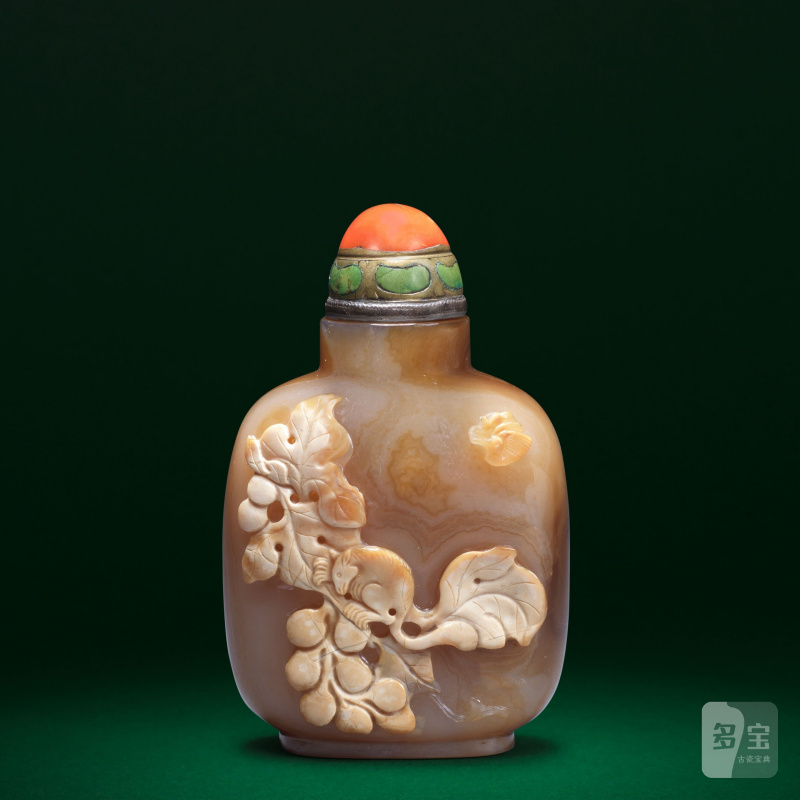

Lot 381Y 十八/十九世紀 瑪瑙巧雕松鼠葡萄紋鼻烟壺 | A CHALCEDONY AGATE 'SQUIRREL AND GRAPES' SNUFF BOTTLE
落槌价
****
成交价
****
| 拍卖公司 | 邦瀚斯 |
|---|---|
| 拍卖时间 | 2026年05月18日 |
请安装多宝古瓷宝典APP,查看高清无损大图
拍品信息
拍品名称
十八/十九世紀 瑪瑙巧雕松鼠葡萄紋鼻烟壺 | A CHALCEDONY AGATE 'SQUIRREL AND GRAPES' SNUFF BOTTLE
起拍价
GBP 800
估值区间
未知
尺寸
未知
品相
未知
更多信息
18th/19th century
The body with a rounded rectangular outline, the stone of a rich honey hue with lighter areas, exhibiting an opaque cream skin expertly carved in relief to depict a nimble squirrel climbing a grape-laden vine with a small crane flying in the distance, the fur and veins of the leaves finely incised, the reverse uncarved, stopper. 6.4cm (2 1/2in) high. (2).
Footnotes
十八/十九世紀 瑪瑙巧雕松鼠葡萄紋鼻烟壺
Provenance: Hugh Moss Ltd., London
Trudy and John Cohen, collection no.B51, acquired from the above circa 1974
來源:倫敦古董商Hugh Moss Ltd.
Trudy及John Cohen伉儷,藏品編號B51,約1974年從上處獲得
The image of squirrels frolicking among grapevines conveys an auspicious wish for a prosperous family. Grapes, with their abundant clusters, symbolise fertility and the wish for many descendants, while squirrels embody vitality, agility, and resourcefulness. The motif gained prominence during the Ming dynasty, as seen in works such as Squirrel on a Grapevine (葡萄松鼠) by Zhou Zhimian (周之冕, 1521–?), now in the Palace Museum, Taipei. By the Qing dynasty, the motif was widespread on a variety of objects, including those commissioned by the Court.
Making deft use of the pale inclusion at the upper right of the present lot, the carver has introduced a crane, another symbol of longevity, further enriching the bottle's auspicious meaning.
The body with a rounded rectangular outline, the stone of a rich honey hue with lighter areas, exhibiting an opaque cream skin expertly carved in relief to depict a nimble squirrel climbing a grape-laden vine with a small crane flying in the distance, the fur and veins of the leaves finely incised, the reverse uncarved, stopper. 6.4cm (2 1/2in) high. (2).
Footnotes
十八/十九世紀 瑪瑙巧雕松鼠葡萄紋鼻烟壺
Provenance: Hugh Moss Ltd., London
Trudy and John Cohen, collection no.B51, acquired from the above circa 1974
來源:倫敦古董商Hugh Moss Ltd.
Trudy及John Cohen伉儷,藏品編號B51,約1974年從上處獲得
The image of squirrels frolicking among grapevines conveys an auspicious wish for a prosperous family. Grapes, with their abundant clusters, symbolise fertility and the wish for many descendants, while squirrels embody vitality, agility, and resourcefulness. The motif gained prominence during the Ming dynasty, as seen in works such as Squirrel on a Grapevine (葡萄松鼠) by Zhou Zhimian (周之冕, 1521–?), now in the Palace Museum, Taipei. By the Qing dynasty, the motif was widespread on a variety of objects, including those commissioned by the Court.
Making deft use of the pale inclusion at the upper right of the present lot, the carver has introduced a crane, another symbol of longevity, further enriching the bottle's auspicious meaning.