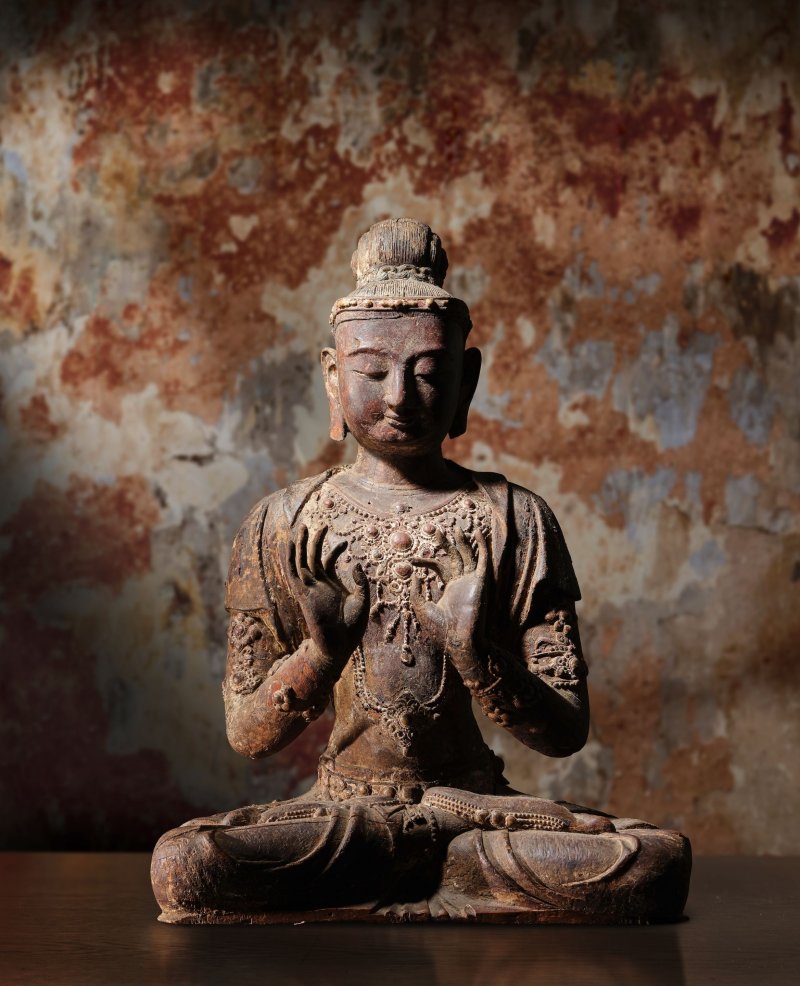

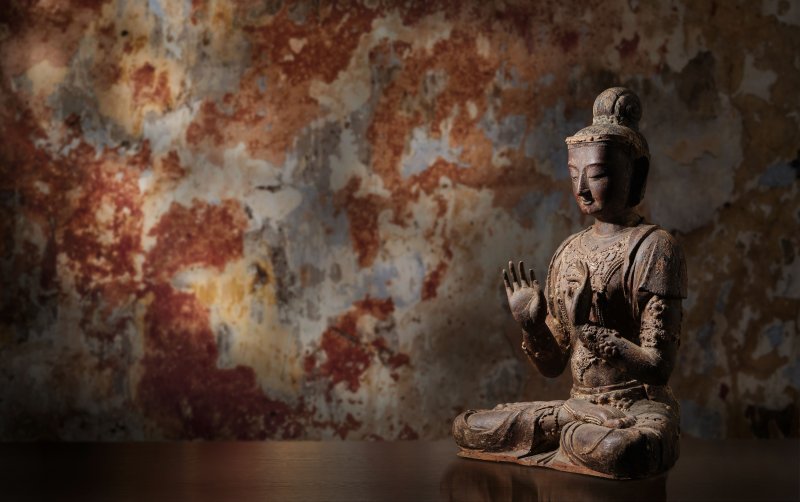
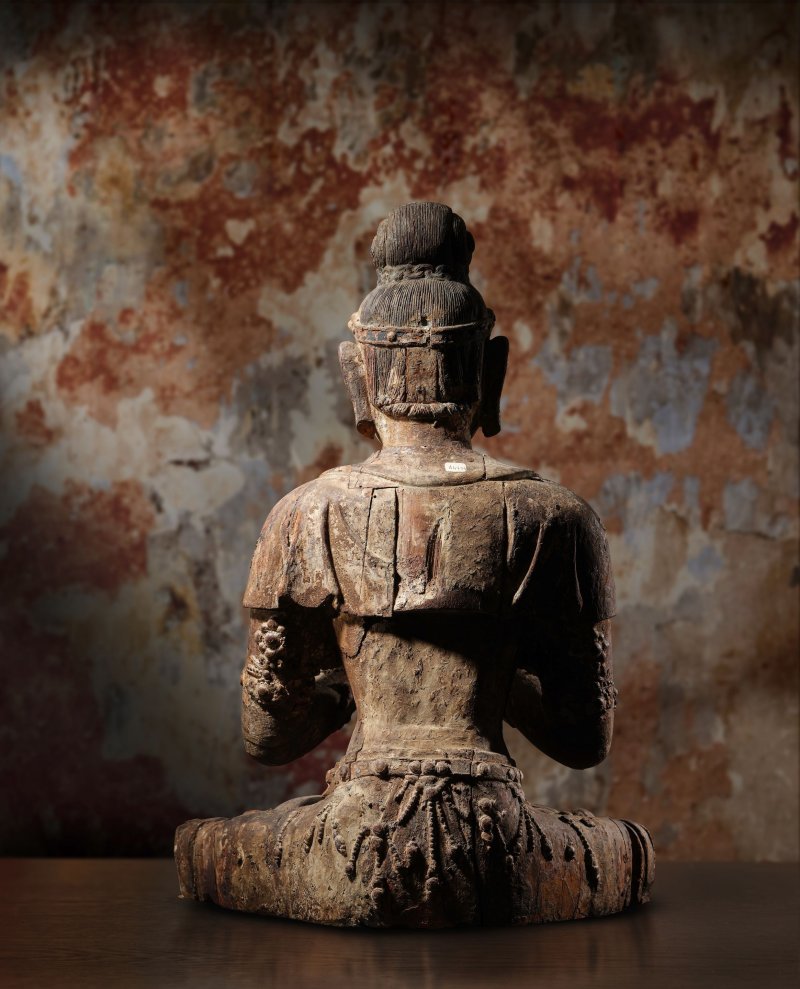
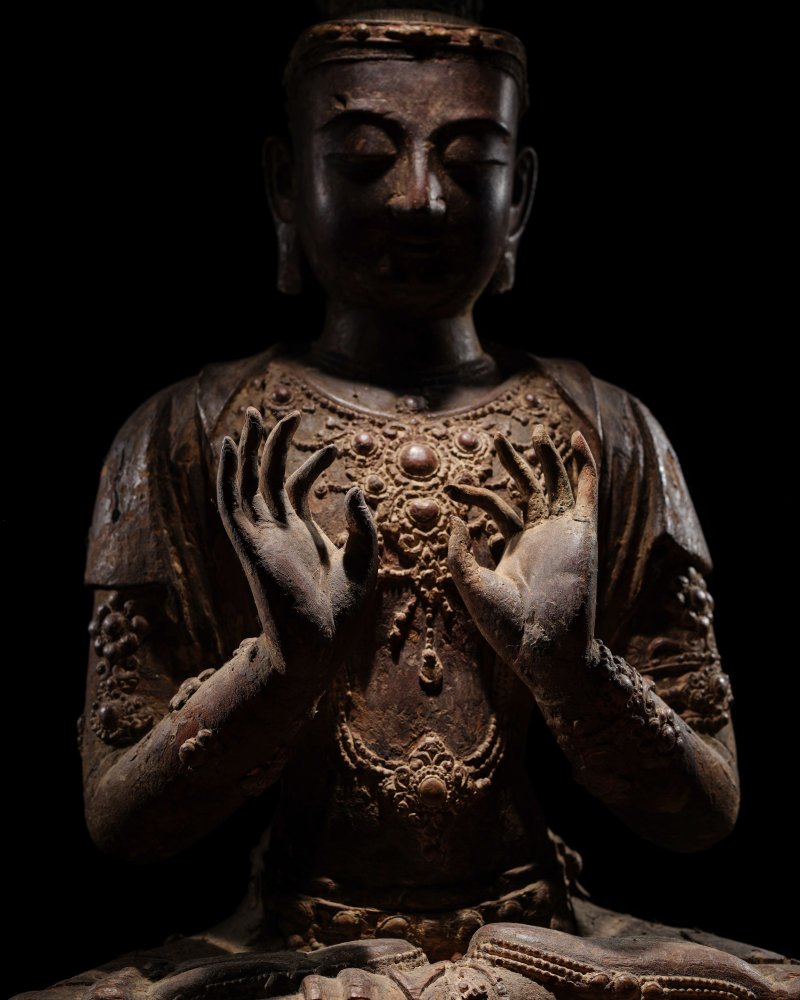
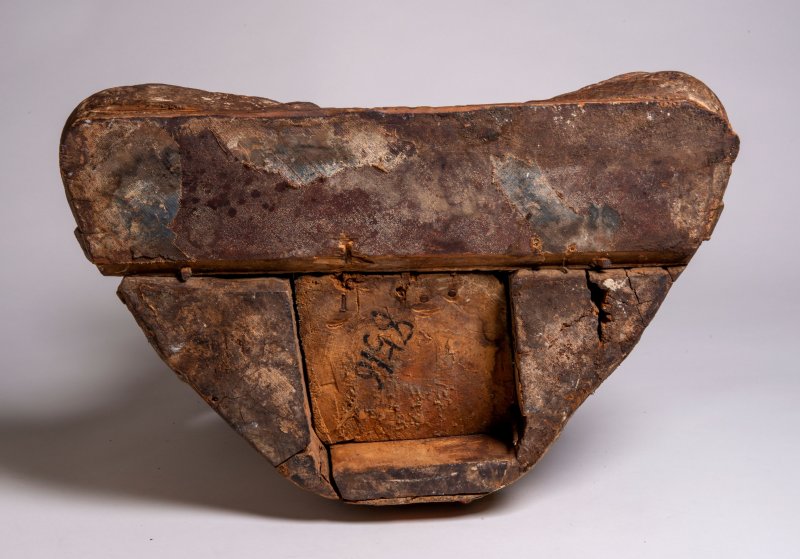
Lot 111 十四世紀 漆金木菩薩坐像 | A RARE LARGE LACQUERED WOOD FIGURE OF A SEATED BODHISATTVA
落槌价
预展中
成交价
预展中
| 拍卖公司 | 邦瀚斯 |
|---|---|
| 拍卖时间 | 2026年10月28日 |
拍品信息
拍品名称
十四世紀 漆金木菩薩坐像 | A RARE LARGE LACQUERED WOOD FIGURE OF A SEATED BODHISATTVA
年代
14th century
起拍价
HKD 800,000
估值区间
HKD 800000 - 1200000
尺寸
未知
品相
未知
更多信息
14th century
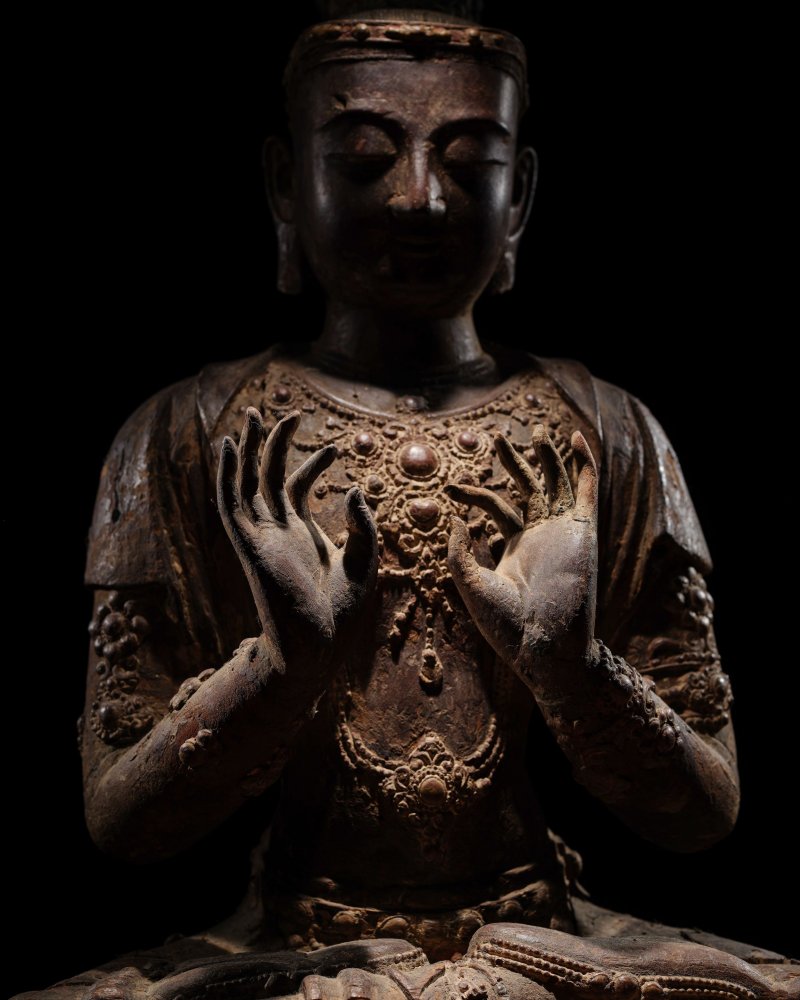
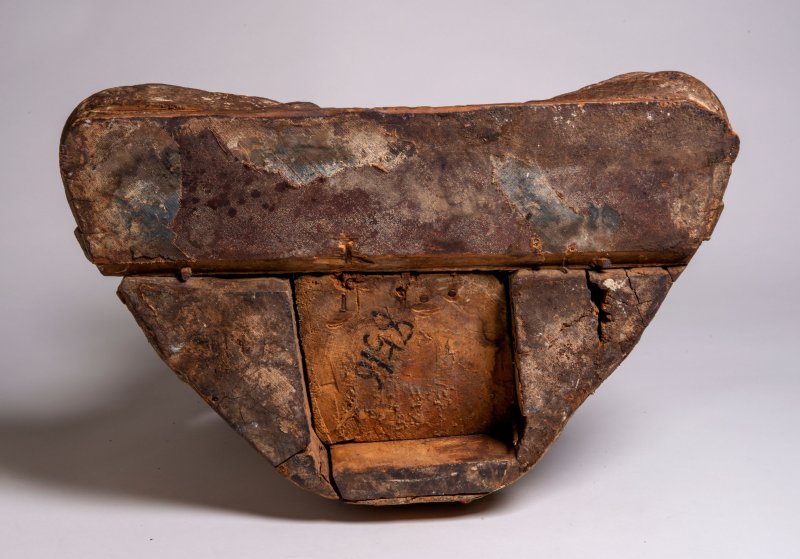
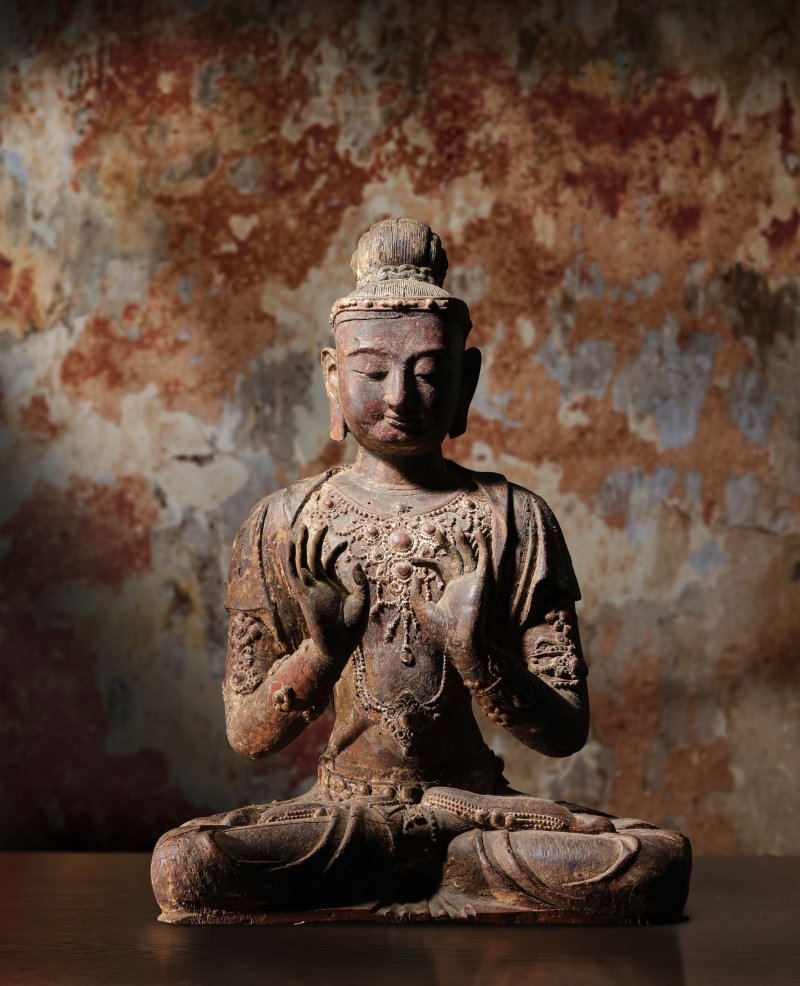
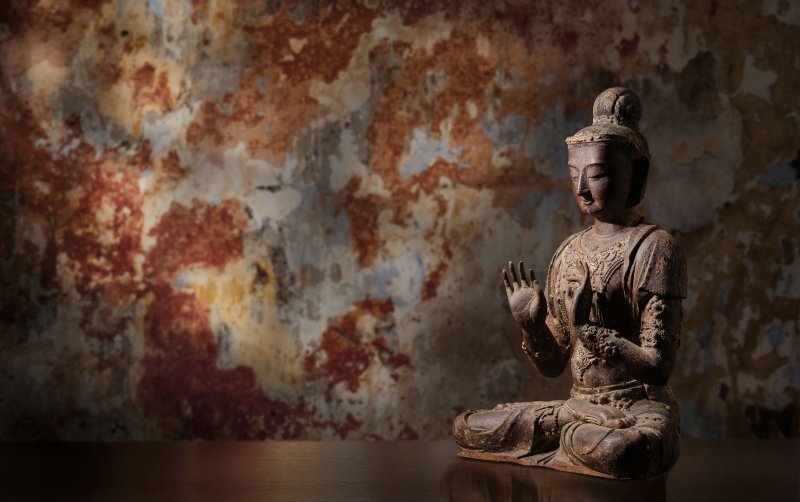
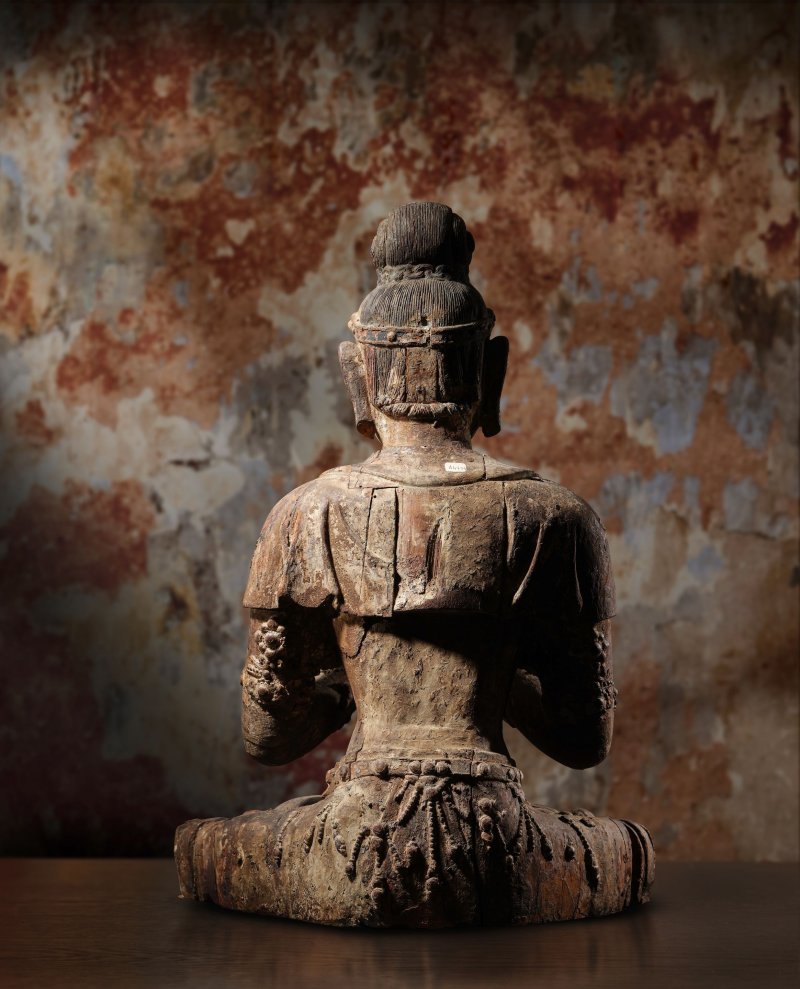
Seated in vajraparyankasana with both hands held before the chest in dharmachakramudra, the face serenely rendered with a tranquil, benevolent expression, framed by downcast eyes beneath sweeping arched brows, a well-defined nose, and a gentle smile above a full chin, the hair swept up into a high, layered chignon secured at the hairline by a low diadem, the body embellished with intricate beaded jewellery, while voluminous robes drape fluidly over the shoulders and fall in rhythmic, cascading folds across the legs.
64cm (25 1/4in) high
Footnotes
十四世紀 漆金木菩薩坐像
Provenance:
A French private collection
Galerie Jacques Barrère, Paris, 22 July 2014
來源:
法國私人收藏
Galerie Jacques Barrère, 巴黎,2014年7月22日
See closely comparable 14th-century carved wood seated Bodhisattvas including one (59.8cm high) with his hands in , preserved in the Kyoto National Museum, inv. no. 26887; and another figure (59.1cm high) with his hands in , housed at the Metropolitan Museum of Art, New York, acc. no. 46.181. Each of these important museum examples share a remarkably similar rendering of the facial features, characterised by serene downcast eyes and a gentle smile, as well as a harmonious sense of proportion.
Embodying the classic tradition of Chinese wooden Buddhist sculpture that flourished during the Song dynasty and continued into subsequent periods, this figure reflects a masterful balance of naturalism and devotional poise. Sculptures from this lineage are celebrated for departing from rigid iconographic formality in favour of a humanised, serene portrayal of the divine. The present example is particularly notable for its expressive modelling, especially the delicate rendering of the hands held before the chest. The broad chest is draped in multi-tiered beaded festoons, while the robes fall in deeply carved, fluid folds over the lower body, retaining rich remnants of historic gesso and polychromy.
The specific identification of this figure is deeply rooted in its sacred iconography. While representations of Bodhisattvas are frequently depicted in relaxed postures of royal ease, Bodhisattvas seated in with hands held in specifically invoke Maitreya, the Future Buddha awaiting his rebirth to expound the Law, or Manjushri, the embodiment of transcendent wisdom. In the multicultural environment of 14th-century China, both deities enjoyed widespread devotional veneration among imperial patrons and monastic communities alike.
Synthesisation of visual vocabulary from different regions was actively fostered in the Yuan capital of (modern Beijing) during the 14th century, where court-sponsored Himalayan masters such as the Nepalese artist systematically combined Newar-Tibetan proportions with traditional Han-Chinese craftsmanship. By marrying the sensual plastic modelling, broad shoulders, and fitted drapery of the Tibetan aesthetic with the linear elegance, intricate jewellery detailing, and refined facial contours of the Sino-Buddhist tradition, these artisans established a new iconographic repertoire that would define courtly Buddhist sculpture throughout the Yuan and early Ming dynasties.
See a smaller lacquered wood figure of a bodhisattva, Late Yuan/early Ming dynasty, similarly rendered with a slender waist and lavishly adorned, sold at Christie's New York, 20 September 2013, lot 1522.
可參照十四世紀木雕菩薩坐像之相近實例:其一高59.8厘米,結禪定印,現藏京都國立博物館,藏品編號26887;另一尊高59.1厘米,結法輪印,庋藏紐約大都會博物館,入藏編號46.181。此二件館藏例,面相刻畫於本品頗為雷同,皆以垂目靜穆、笑意溫和為特徵,身形比例協調雋雅。
此尊造像承繼宋代之木質佛造像傳統,餘韻綿延後世,融寫實神韻與敬穆氣度於一身。此一脈造像之可貴,在於跳脫圖像制式之拘囿,賦予佛造像富有人情之靜穆風采。本品尤勝在形塑生動傳神,尤以胸前雙手最見功力。寬闊胸臆之上,層疊珠瓔絡腋;下身衣紋深鑿流轉,垂裾飄然,尚存彩飾殘跡。
菩薩造像固多呈悠然自得之坐姿,然結金剛趺坐、手結轉法輪印之菩薩像,乃特指等待轉世下生說法之未來佛——彌勒菩薩,抑或象徵無上智慧之文殊菩薩。於十四世紀中國多元文化之交融背景下,此二尊神均深得皇家庇護者與僧團之廣泛崇奉。
十四世紀期間,元大都(今北京)積極推動不同地域視覺語彙之融合。於朝廷資助下,尼泊爾藝術家阿尼哥等藏傳佛教工藝大師,將紐瓦爾-西藏之造像比例與漢地傳統工藝系統性地結合。工匠將西藏藝術中飽滿之立體造型、寬肩與合身衣飾,與漢傳佛教傳統之流暢線條、繁複瓔珞細節及秀麗面部輪廓完美交融,創立出全新之圖像學範式,並深遠影響了元代至明初之宮廷佛教造像風格。
另可參考一尊較小之元末/明初漆金木菩薩坐像,身形纖細,裝飾華麗,與本品極為相似,售於紐約佳士得,2013年9月20日,拍品編號1522。
Seated in vajraparyankasana with both hands held before the chest in dharmachakramudra, the face serenely rendered with a tranquil, benevolent expression, framed by downcast eyes beneath sweeping arched brows, a well-defined nose, and a gentle smile above a full chin, the hair swept up into a high, layered chignon secured at the hairline by a low diadem, the body embellished with intricate beaded jewellery, while voluminous robes drape fluidly over the shoulders and fall in rhythmic, cascading folds across the legs.
64cm (25 1/4in) high
Footnotes
十四世紀 漆金木菩薩坐像
Provenance:
A French private collection
Galerie Jacques Barrère, Paris, 22 July 2014
來源:
法國私人收藏
Galerie Jacques Barrère, 巴黎,2014年7月22日
See closely comparable 14th-century carved wood seated Bodhisattvas including one (59.8cm high) with his hands in , preserved in the Kyoto National Museum, inv. no. 26887; and another figure (59.1cm high) with his hands in , housed at the Metropolitan Museum of Art, New York, acc. no. 46.181. Each of these important museum examples share a remarkably similar rendering of the facial features, characterised by serene downcast eyes and a gentle smile, as well as a harmonious sense of proportion.
Embodying the classic tradition of Chinese wooden Buddhist sculpture that flourished during the Song dynasty and continued into subsequent periods, this figure reflects a masterful balance of naturalism and devotional poise. Sculptures from this lineage are celebrated for departing from rigid iconographic formality in favour of a humanised, serene portrayal of the divine. The present example is particularly notable for its expressive modelling, especially the delicate rendering of the hands held before the chest. The broad chest is draped in multi-tiered beaded festoons, while the robes fall in deeply carved, fluid folds over the lower body, retaining rich remnants of historic gesso and polychromy.
The specific identification of this figure is deeply rooted in its sacred iconography. While representations of Bodhisattvas are frequently depicted in relaxed postures of royal ease, Bodhisattvas seated in with hands held in specifically invoke Maitreya, the Future Buddha awaiting his rebirth to expound the Law, or Manjushri, the embodiment of transcendent wisdom. In the multicultural environment of 14th-century China, both deities enjoyed widespread devotional veneration among imperial patrons and monastic communities alike.
Synthesisation of visual vocabulary from different regions was actively fostered in the Yuan capital of (modern Beijing) during the 14th century, where court-sponsored Himalayan masters such as the Nepalese artist systematically combined Newar-Tibetan proportions with traditional Han-Chinese craftsmanship. By marrying the sensual plastic modelling, broad shoulders, and fitted drapery of the Tibetan aesthetic with the linear elegance, intricate jewellery detailing, and refined facial contours of the Sino-Buddhist tradition, these artisans established a new iconographic repertoire that would define courtly Buddhist sculpture throughout the Yuan and early Ming dynasties.
See a smaller lacquered wood figure of a bodhisattva, Late Yuan/early Ming dynasty, similarly rendered with a slender waist and lavishly adorned, sold at Christie's New York, 20 September 2013, lot 1522.
可參照十四世紀木雕菩薩坐像之相近實例:其一高59.8厘米,結禪定印,現藏京都國立博物館,藏品編號26887;另一尊高59.1厘米,結法輪印,庋藏紐約大都會博物館,入藏編號46.181。此二件館藏例,面相刻畫於本品頗為雷同,皆以垂目靜穆、笑意溫和為特徵,身形比例協調雋雅。
此尊造像承繼宋代之木質佛造像傳統,餘韻綿延後世,融寫實神韻與敬穆氣度於一身。此一脈造像之可貴,在於跳脫圖像制式之拘囿,賦予佛造像富有人情之靜穆風采。本品尤勝在形塑生動傳神,尤以胸前雙手最見功力。寬闊胸臆之上,層疊珠瓔絡腋;下身衣紋深鑿流轉,垂裾飄然,尚存彩飾殘跡。
菩薩造像固多呈悠然自得之坐姿,然結金剛趺坐、手結轉法輪印之菩薩像,乃特指等待轉世下生說法之未來佛——彌勒菩薩,抑或象徵無上智慧之文殊菩薩。於十四世紀中國多元文化之交融背景下,此二尊神均深得皇家庇護者與僧團之廣泛崇奉。
十四世紀期間,元大都(今北京)積極推動不同地域視覺語彙之融合。於朝廷資助下,尼泊爾藝術家阿尼哥等藏傳佛教工藝大師,將紐瓦爾-西藏之造像比例與漢地傳統工藝系統性地結合。工匠將西藏藝術中飽滿之立體造型、寬肩與合身衣飾,與漢傳佛教傳統之流暢線條、繁複瓔珞細節及秀麗面部輪廓完美交融,創立出全新之圖像學範式,並深遠影響了元代至明初之宮廷佛教造像風格。
另可參考一尊較小之元末/明初漆金木菩薩坐像,身形纖細,裝飾華麗,與本品極為相似,售於紐約佳士得,2013年9月20日,拍品編號1522。
常见问题
这件十四世紀 漆金木菩薩坐像 | A RARE LARGE LACQUERED WOOD FIGURE OF A SEATED BODHISATTVA的成交价是多少?
落槌价为 预展中。 成交价为 预展中。