
拍品信息
拍品名称
清 白玉詩文提攜 | A WHITE JADE BELT ORNAMENT, TIXIE
年代
Zigang shan seal mark, Qing Dynasty
起拍价
GBP 3,000
估值区间
GBP 3000 - 5000
尺寸
未知
品相
未知
更多信息
Zigang shan seal mark, Qing Dynasty
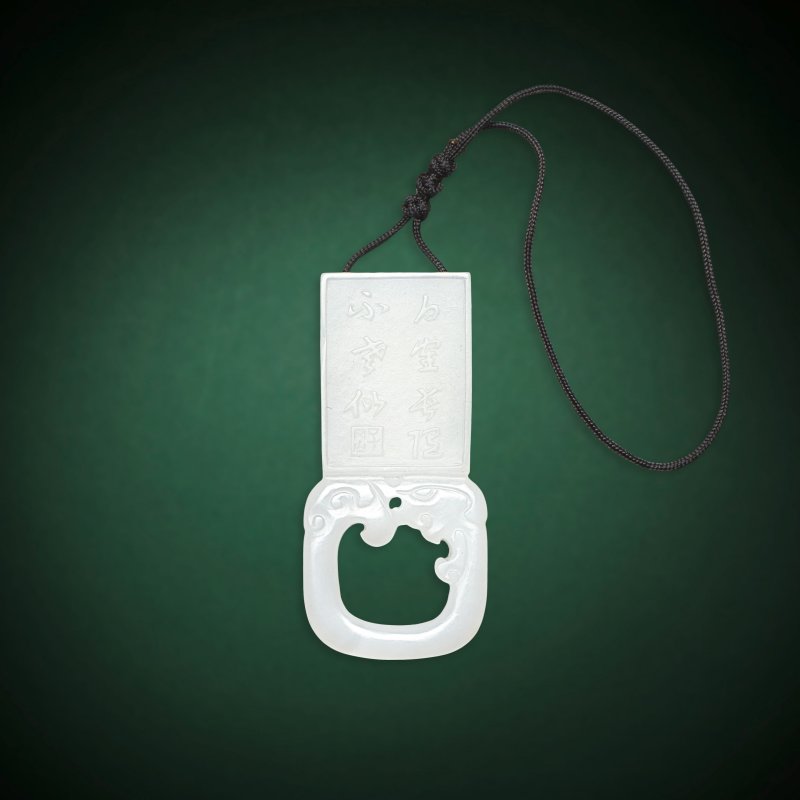
Exquisitely carved with a rectangular sections carved in low-relief with a calligraphic inscription and seal reading Zigang shan, terminating with a loop formed as an archaistic dragon biting its tail, the stone of even white tone. 5.9cm (2 5/8in) high.
Footnotes
清 白玉詩文提攜
款識:白鶴長隨不老仙「子岡山」
The inscription may be translated as:
The white crane remains eternally beside the ageless Immortal.
Lu Zigang (陸子岡, active 16th century) was the most celebrated jade carver of the Ming dynasty, renowned for his refined plaques and pendants produced in Suzhou. His works embodied the literati ideals of the period, combining the techniques of jade carving with the aesthetics of calligraphy and painting through elegant forms, finely incised decoration and poetic inscriptions. His reputation was such that his name became synonymous with the highest standards of jade craftsmanship. During the Qing dynasty, jade carvers frequently adopted the Zigang signature or produced works in the 'Zigang style' as a tribute to his artistic legacy, reflecting continued admiration for the Ming literati tradition rather than necessarily indicating direct authorship by the master himself. See a jade plaque, Zigang mark, in the Palace Museum, Beijing (acc.no.xin00042202). Another jade plaque, Zigang seal marks, late Qing dynasty/Republic, is in the Palace Museum, Taipei (acc.no.贈玉000264N000000000).
The present lot is a (提攜) a term that may be translated literally as 'to take up'. It was an ancient type of belt fitting worn at the waist and used to suspend accessories such as sachets and jade pendants. See a related jade belt ornament, , Yuan/Ming dynasty, in the Qing Court Collection, the Palace Museum, Taipei (acc.no.故玉002216N000000000). See also a similar white jade belt ornament, Zigang seal mark, Ming dynasty, in the C. P. Lin collection, illustrated in , Hong Kong, 2014, p.232, pl.127.
Exquisitely carved with a rectangular sections carved in low-relief with a calligraphic inscription and seal reading Zigang shan, terminating with a loop formed as an archaistic dragon biting its tail, the stone of even white tone. 5.9cm (2 5/8in) high.
Footnotes
清 白玉詩文提攜
款識:白鶴長隨不老仙「子岡山」
The inscription may be translated as:
The white crane remains eternally beside the ageless Immortal.
Lu Zigang (陸子岡, active 16th century) was the most celebrated jade carver of the Ming dynasty, renowned for his refined plaques and pendants produced in Suzhou. His works embodied the literati ideals of the period, combining the techniques of jade carving with the aesthetics of calligraphy and painting through elegant forms, finely incised decoration and poetic inscriptions. His reputation was such that his name became synonymous with the highest standards of jade craftsmanship. During the Qing dynasty, jade carvers frequently adopted the Zigang signature or produced works in the 'Zigang style' as a tribute to his artistic legacy, reflecting continued admiration for the Ming literati tradition rather than necessarily indicating direct authorship by the master himself. See a jade plaque, Zigang mark, in the Palace Museum, Beijing (acc.no.xin00042202). Another jade plaque, Zigang seal marks, late Qing dynasty/Republic, is in the Palace Museum, Taipei (acc.no.贈玉000264N000000000).
The present lot is a (提攜) a term that may be translated literally as 'to take up'. It was an ancient type of belt fitting worn at the waist and used to suspend accessories such as sachets and jade pendants. See a related jade belt ornament, , Yuan/Ming dynasty, in the Qing Court Collection, the Palace Museum, Taipei (acc.no.故玉002216N000000000). See also a similar white jade belt ornament, Zigang seal mark, Ming dynasty, in the C. P. Lin collection, illustrated in , Hong Kong, 2014, p.232, pl.127.
常见问题
这件清 白玉詩文提攜 | A WHITE JADE BELT ORNAMENT, TIXIE的成交价是多少?
落槌价为 预展中。 成交价为 预展中。


