
拍品信息
拍品名称
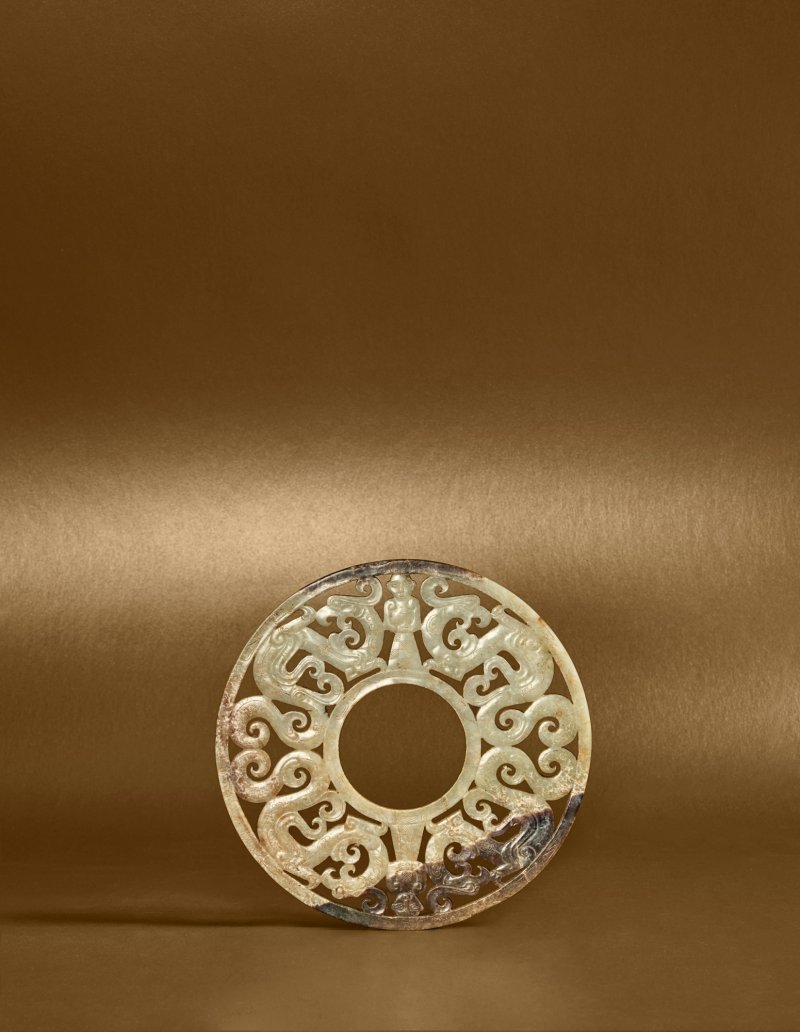
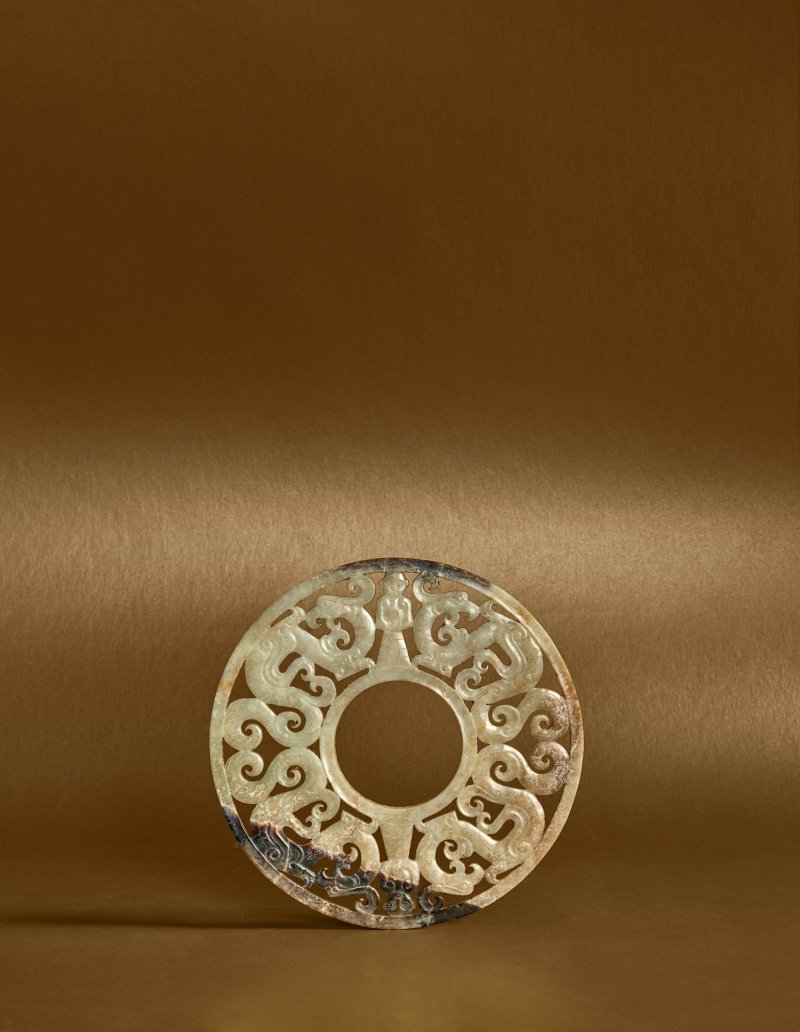
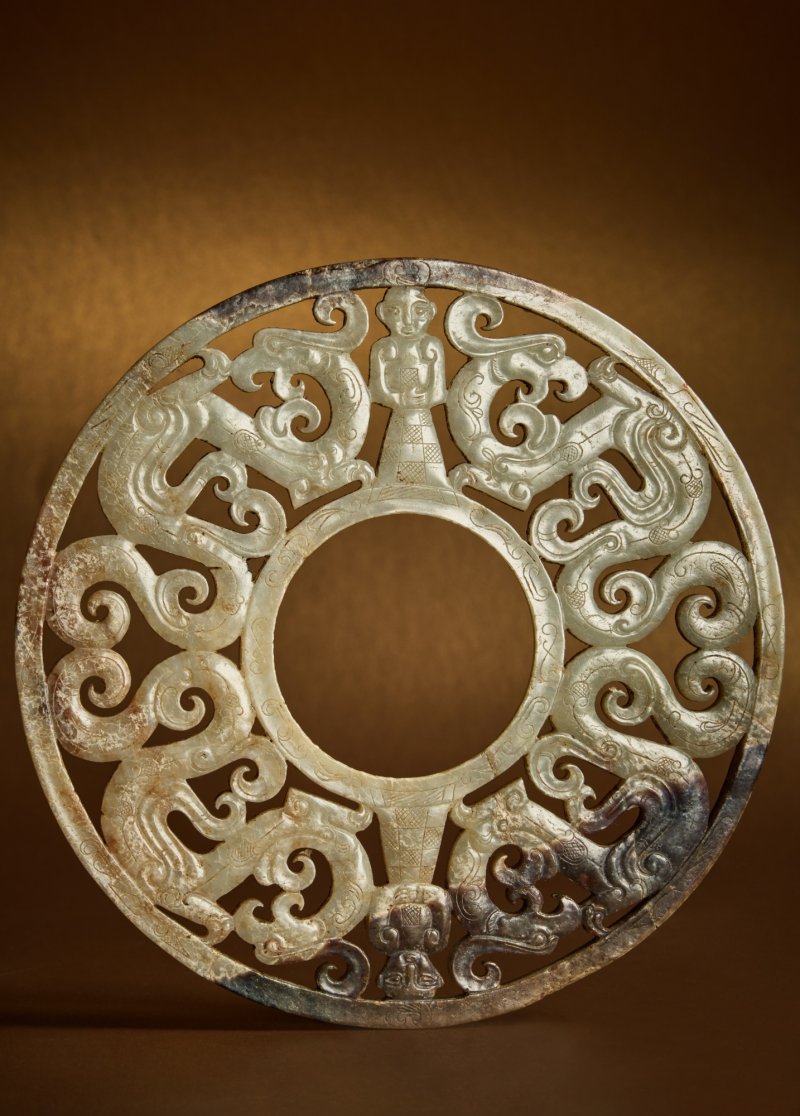
東周 戰國 玉仙人龍紋璧
起拍价
USD 80,000
估值区间
80,000 - 120,000 USD
尺寸
未知
品相
如欲了解本拍品狀況的更多資訊,請聯絡 Drew.Lerner@sothebys.com
更多信息
Diameter 4⅜ in., 11 cm
来源:鍾華培,香港
Anthony Carter Ltd.,倫敦
著录:姜濤及劉雲輝,《熙墀藏玉》,北京,2006年,頁92至93
图录
说明:While bi discs had become a mainstay of elite funerary rites by the Shang and Zhou dynasties, the late Eastern Zhou and Western Han dynasties saw a change in the conception of the form from something primarily austere and practical to a canvas well-suited for cosmological designs and displays of wealth. Delicately hewn from a thin disc of rich celadon tone, the present disc exemplifies the skill of the late Zhou craftsmen in its combination of deep oblique swirls, thin linework and – most notably – bold openwork.
Although the cosmology of the present disc, adorned with four dragons flanked by two human figures, now stands unclear to the contemporary viewer, its visual and emotional impact is immediate and helps to support the dating of the piece. Compare, for example, a closely related jade figure of similar chequered robes to the present details included in Jessica Rawson, Chinese Jades from Neolithic to Qing, British Museum, London, 1995, cat. no. 19:2, similarly attributed to the Eastern Zhou dynasty.
Related openwork discs are exceedingly rare and perhaps most notably associated with the sumptuous Western Han mausoleum of the King of Nanyue in modern-day Guangzhou. Compare three such discs uncovered from the tomb in Gu Fang, The Complete Collection of Jades Unearthed in China, vol. 11, Beijing, 2005: two without outer bands framing the design, pp 84-85, and one depicting two dragons and two phoenixes bounded like the present, p 68. Also compare a related reticulated disc in the National Palace Museum, Taipei of less graceful carving in Illustrated Catalogue of Ancient Jade Artifacts in the National Palace Museum, Taipei, 1988, pl. 196; and a similarly crude example in the Tianjin City Art Museum in Tianjin shi Yishu Bowuguan cang yu [Jades in the Tianjin City Art Museum], Hong Kong, 1993, pl. 127.
A related slightly smaller bi of reticulated four-dragon design was preserved in the Qing Court Collection at the Palace Museum, Beijing and included in The Complete Collection of Treasures of the Palace Museum. Jadeware (I), Hong Kong, 1995, pl. 129; while another, adorned with scrolling chilong, was uncovered from the tomb of Zhang Tingyi in the mausoleum area of the Prince of Sishui in Daqingdun, Siyang, Jiangsu; see Gu Fang, The Complete Collection of Jades Unearthed in China, vol. 7: Jiangsu Shanghai, Beijing, 2005, p. 112.
来源:鍾華培,香港
Anthony Carter Ltd.,倫敦
著录:姜濤及劉雲輝,《熙墀藏玉》,北京,2006年,頁92至93
图录
说明:While bi discs had become a mainstay of elite funerary rites by the Shang and Zhou dynasties, the late Eastern Zhou and Western Han dynasties saw a change in the conception of the form from something primarily austere and practical to a canvas well-suited for cosmological designs and displays of wealth. Delicately hewn from a thin disc of rich celadon tone, the present disc exemplifies the skill of the late Zhou craftsmen in its combination of deep oblique swirls, thin linework and – most notably – bold openwork.
Although the cosmology of the present disc, adorned with four dragons flanked by two human figures, now stands unclear to the contemporary viewer, its visual and emotional impact is immediate and helps to support the dating of the piece. Compare, for example, a closely related jade figure of similar chequered robes to the present details included in Jessica Rawson, Chinese Jades from Neolithic to Qing, British Museum, London, 1995, cat. no. 19:2, similarly attributed to the Eastern Zhou dynasty.
Related openwork discs are exceedingly rare and perhaps most notably associated with the sumptuous Western Han mausoleum of the King of Nanyue in modern-day Guangzhou. Compare three such discs uncovered from the tomb in Gu Fang, The Complete Collection of Jades Unearthed in China, vol. 11, Beijing, 2005: two without outer bands framing the design, pp 84-85, and one depicting two dragons and two phoenixes bounded like the present, p 68. Also compare a related reticulated disc in the National Palace Museum, Taipei of less graceful carving in Illustrated Catalogue of Ancient Jade Artifacts in the National Palace Museum, Taipei, 1988, pl. 196; and a similarly crude example in the Tianjin City Art Museum in Tianjin shi Yishu Bowuguan cang yu [Jades in the Tianjin City Art Museum], Hong Kong, 1993, pl. 127.
A related slightly smaller bi of reticulated four-dragon design was preserved in the Qing Court Collection at the Palace Museum, Beijing and included in The Complete Collection of Treasures of the Palace Museum. Jadeware (I), Hong Kong, 1995, pl. 129; while another, adorned with scrolling chilong, was uncovered from the tomb of Zhang Tingyi in the mausoleum area of the Prince of Sishui in Daqingdun, Siyang, Jiangsu; see Gu Fang, The Complete Collection of Jades Unearthed in China, vol. 7: Jiangsu Shanghai, Beijing, 2005, p. 112.
常见问题
这件東周 戰國 玉仙人龍紋璧的成交价是多少?
落槌价为 预展中。 成交价为 预展中。
拍品的品相状况如何?
如欲了解本拍品狀況的更多資訊,請聯絡 Drew.Lerner@sothebys.com
这件拍品的流传来源是什么?
鍾華培,香港
Anthony Carter Ltd.,倫敦
Anthony Carter Ltd.,倫敦
这件拍品被哪些著录书籍记载?
姜濤及劉雲輝,《熙墀藏玉》,北京,2006年,頁92至93
图录
图录