
拍品信息
拍品名称
溥儒(1896-1963) 行書書法 水墨紙本 鏡框 | PU RU (1896-1963)
年代
Calligraphy in running script
起拍价
GBP 4,000
估值区间
GBP 4000 - 6000
尺寸
未知
品相
未知
更多信息
Calligraphy in running script
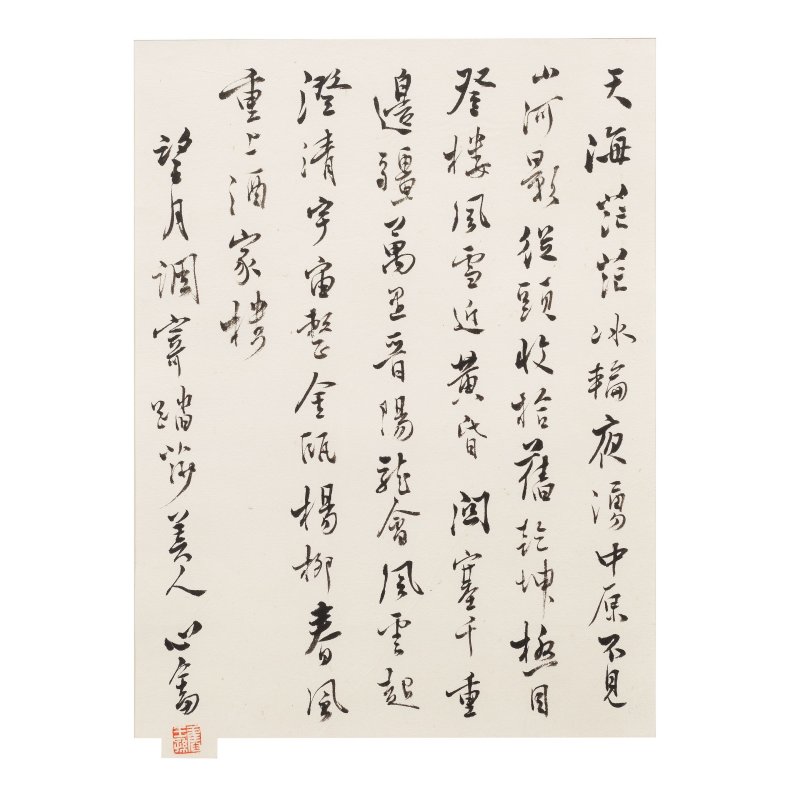
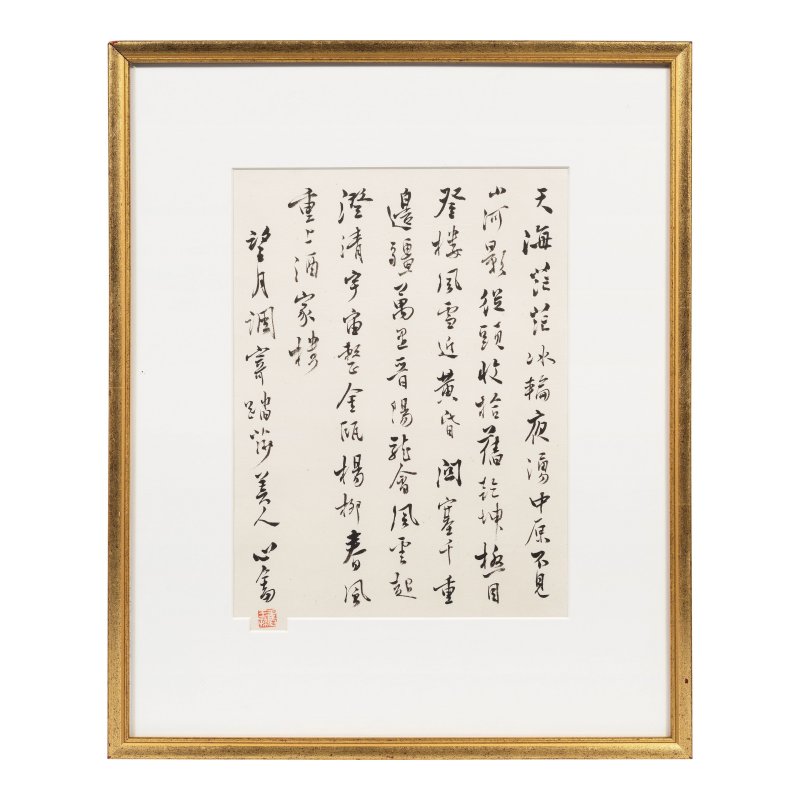
Ink on paper, mounted, framed and glazed, signed Xinyu, with one artist's seal reading Jiu wangsun. The calligraphy: 32.5cm (12 3/4in) high x 24.5cm (9 5/8in) wide; with frame: 52.5cm (20 5/8in) high x 42.5cm (16 3/4in) wide.
Footnotes
溥儒(1896-1963) 行書書法 水墨紙本 鏡框
款識:天海茫茫,冰輪夜湧。中原不見山河影,從頭收拾舊乾坤,極目登樓,風雪近黃昏。關塞千重,邊疆萬里,晉陽龍會風雪超,澄清宇宙整金甌,楊柳春風,重上酒家樓。望月調寄踏莎美人 心畬
鈐印:舊王孫
Provenance: a London private collection
來源:倫敦私人收藏
The inscription may be translated as:
Vast is the sky and boundless the sea; the icy moon surges into the night. The Central Plains no longer reflect the mountains and rivers of old. From the beginning we shall reclaim and restore the ancient realm; ascending the tower, I gaze to the horizon— wind and snow draw near with the coming dusk. A thousand mountain passes, ten thousand miles of frontier. At Jinyang the dragon shall gather, rising above the wind and snow. We shall cleanse the universe and restore the golden realm entire. When willow branches sway in the spring breeze, once more we shall climb the wine-house tower. To the Tune 'Beautiful Lady Treading the Grass' On Gazing at the Moon. Xinyu
The poem, composed by Pu Ru (溥儒) (1896–1963) himself, expresses the profound sense of sorrow and longing experienced by a descendant of the Qing Imperial house and a loyalist of the fallen dynasty as he reflects upon the mountains and rivers of his lost homeland in an era of political upheaval.
Pu Ru, also known as Pu Xinyu (溥心畬), was a member of the Qing Imperial family and a leading figure of the 20th century Chinese literati painting. Born into the Manchu Imperial family, he was a cousin of the last Qing Emperor, Puyi (溥儀), and received a rigorous classical education in Confucian scholarship, poetry, calligraphy, and painting, which profoundly shaped his refined artistic vision. Following the collapse of the Qing dynasty in 1911, Pu Ru dedicated himself to painting and calligraphy, earning recognition as one of the most distinguished artists of his generation. His works, often executed in the scholarly tradition, feature landscapes, birds, and figures imbued with poetic sentiment. His creation was strongly influenced by the Four Masters of the Ming dynasty and earlier literati aesthetics. Following the establishment of the People's Republic of China in 1949, Pu Ru relocated to Taiwan, where he continued to paint and teach. Throughout his career, his style remained deeply rooted in traditional Chinese aesthetics, characterised by expressive brushwork and a cultivated, scholarly sensibility.
See a related calligraphy in running script, inscribed and signed Xinyu, though of slightly smaller size than the present lot, which was sold at Bonhams Hong Kong, 23 November 2014, lot 1392.
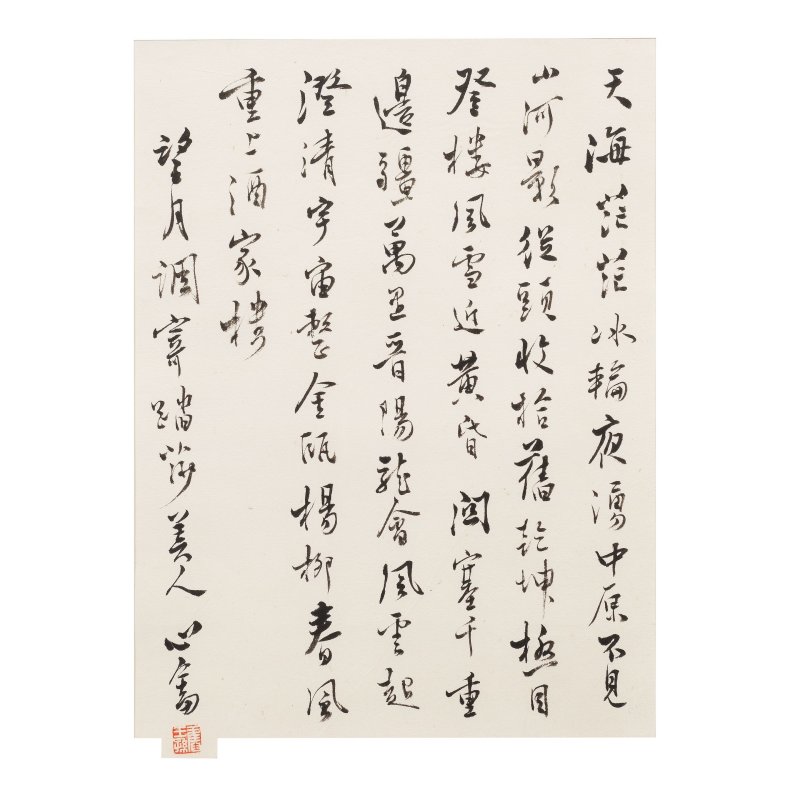
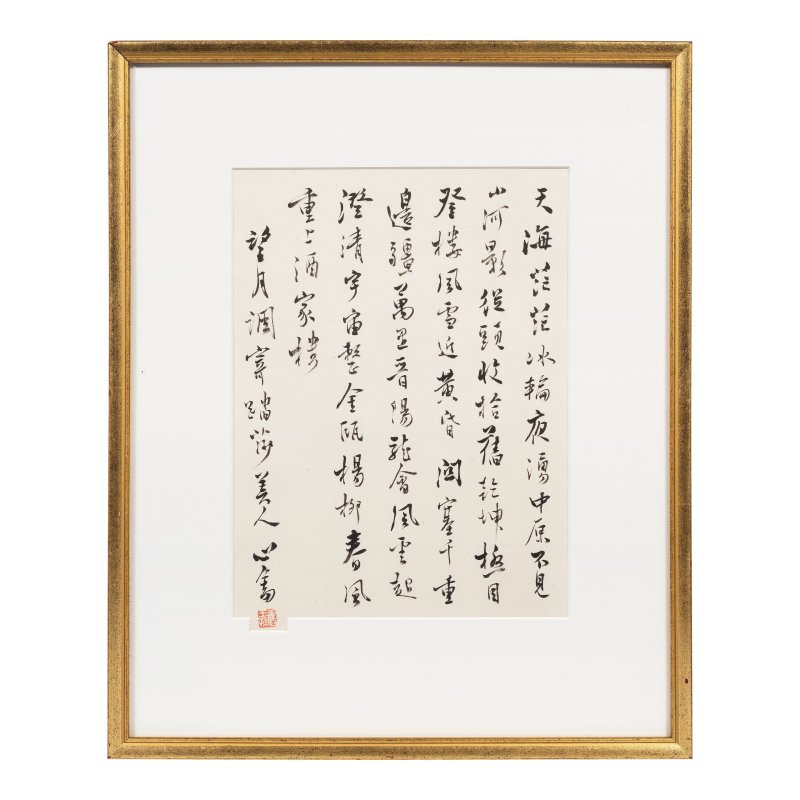
Ink on paper, mounted, framed and glazed, signed Xinyu, with one artist's seal reading Jiu wangsun. The calligraphy: 32.5cm (12 3/4in) high x 24.5cm (9 5/8in) wide; with frame: 52.5cm (20 5/8in) high x 42.5cm (16 3/4in) wide.
Footnotes
溥儒(1896-1963) 行書書法 水墨紙本 鏡框
款識:天海茫茫,冰輪夜湧。中原不見山河影,從頭收拾舊乾坤,極目登樓,風雪近黃昏。關塞千重,邊疆萬里,晉陽龍會風雪超,澄清宇宙整金甌,楊柳春風,重上酒家樓。望月調寄踏莎美人 心畬
鈐印:舊王孫
Provenance: a London private collection
來源:倫敦私人收藏
The inscription may be translated as:
Vast is the sky and boundless the sea; the icy moon surges into the night. The Central Plains no longer reflect the mountains and rivers of old. From the beginning we shall reclaim and restore the ancient realm; ascending the tower, I gaze to the horizon— wind and snow draw near with the coming dusk. A thousand mountain passes, ten thousand miles of frontier. At Jinyang the dragon shall gather, rising above the wind and snow. We shall cleanse the universe and restore the golden realm entire. When willow branches sway in the spring breeze, once more we shall climb the wine-house tower. To the Tune 'Beautiful Lady Treading the Grass' On Gazing at the Moon. Xinyu
The poem, composed by Pu Ru (溥儒) (1896–1963) himself, expresses the profound sense of sorrow and longing experienced by a descendant of the Qing Imperial house and a loyalist of the fallen dynasty as he reflects upon the mountains and rivers of his lost homeland in an era of political upheaval.
Pu Ru, also known as Pu Xinyu (溥心畬), was a member of the Qing Imperial family and a leading figure of the 20th century Chinese literati painting. Born into the Manchu Imperial family, he was a cousin of the last Qing Emperor, Puyi (溥儀), and received a rigorous classical education in Confucian scholarship, poetry, calligraphy, and painting, which profoundly shaped his refined artistic vision. Following the collapse of the Qing dynasty in 1911, Pu Ru dedicated himself to painting and calligraphy, earning recognition as one of the most distinguished artists of his generation. His works, often executed in the scholarly tradition, feature landscapes, birds, and figures imbued with poetic sentiment. His creation was strongly influenced by the Four Masters of the Ming dynasty and earlier literati aesthetics. Following the establishment of the People's Republic of China in 1949, Pu Ru relocated to Taiwan, where he continued to paint and teach. Throughout his career, his style remained deeply rooted in traditional Chinese aesthetics, characterised by expressive brushwork and a cultivated, scholarly sensibility.
See a related calligraphy in running script, inscribed and signed Xinyu, though of slightly smaller size than the present lot, which was sold at Bonhams Hong Kong, 23 November 2014, lot 1392.
常见问题
这件溥儒(1896-1963) 行書書法 水墨紙本 鏡框 | PU RU (1896-1963)的成交价是多少?
落槌价为 预展中。 成交价为 预展中。


