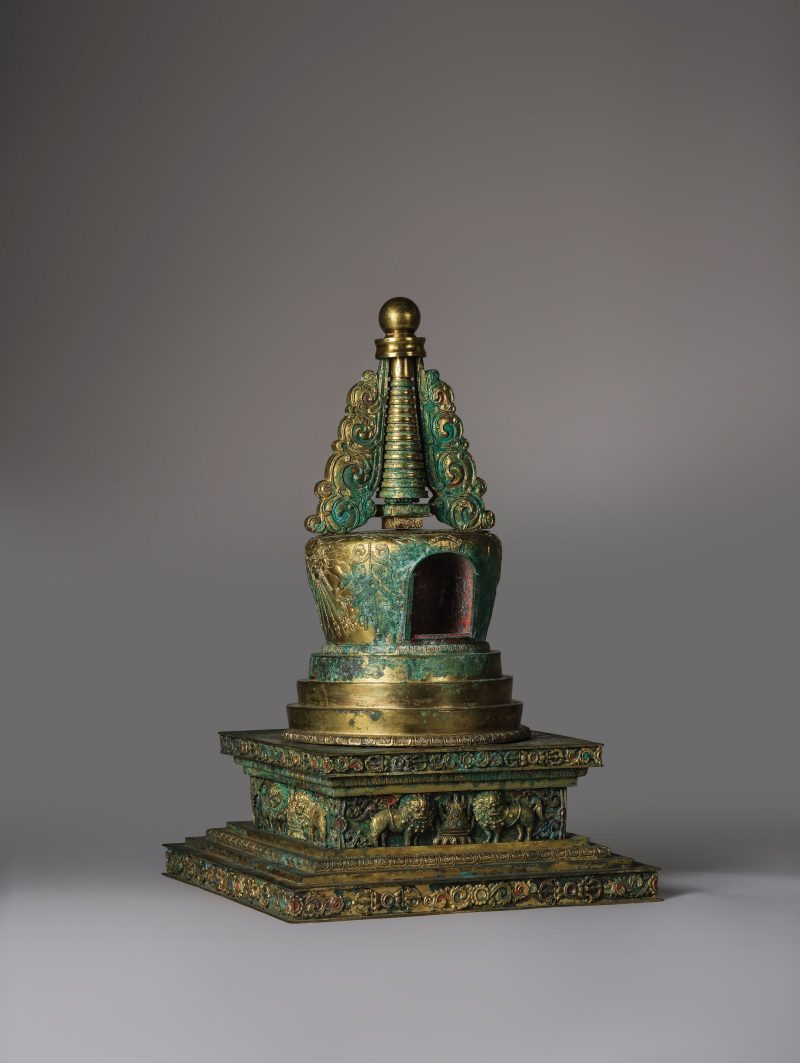

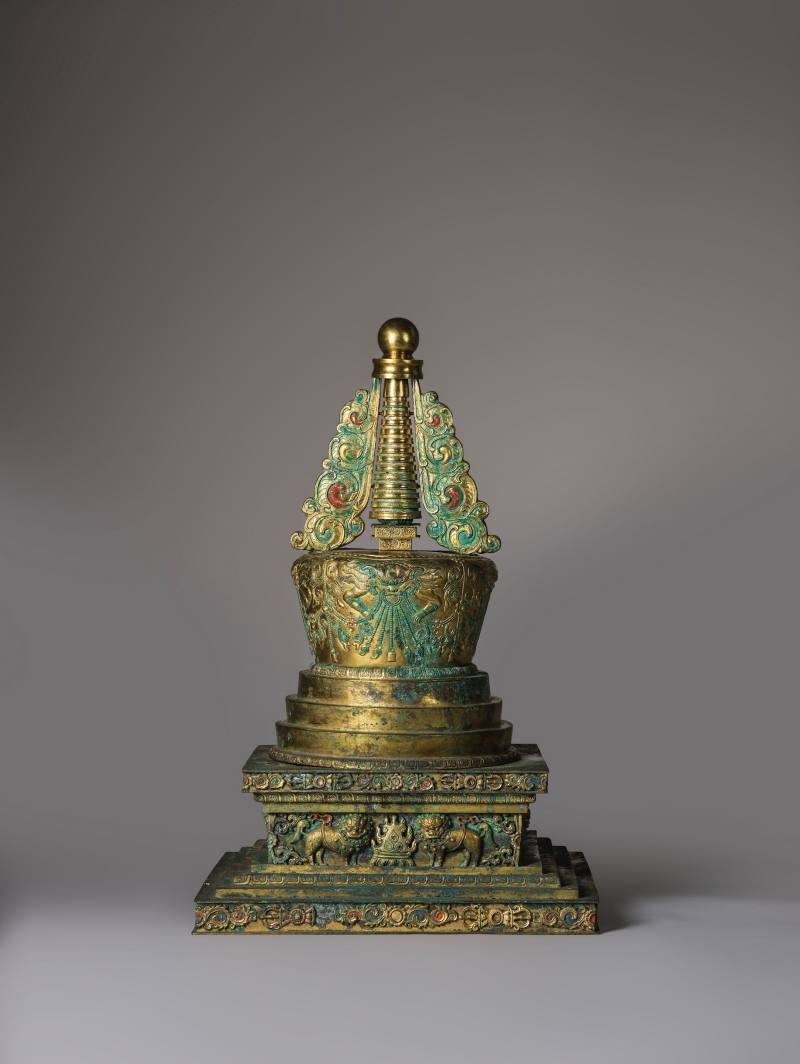
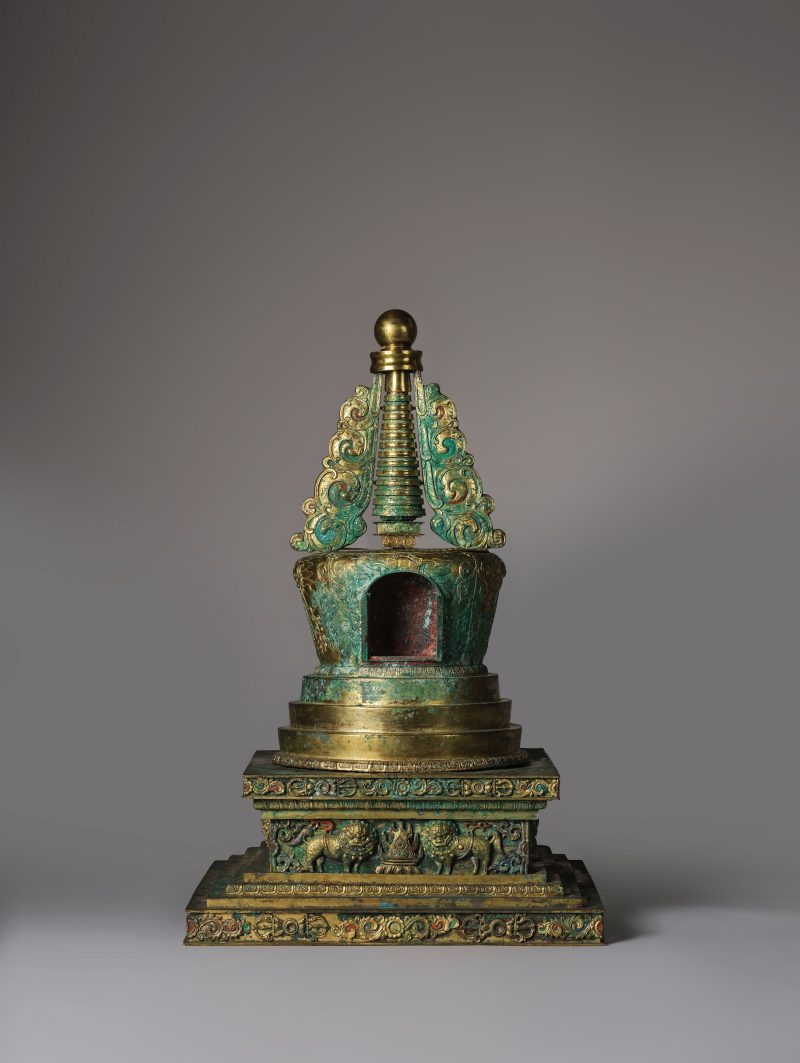
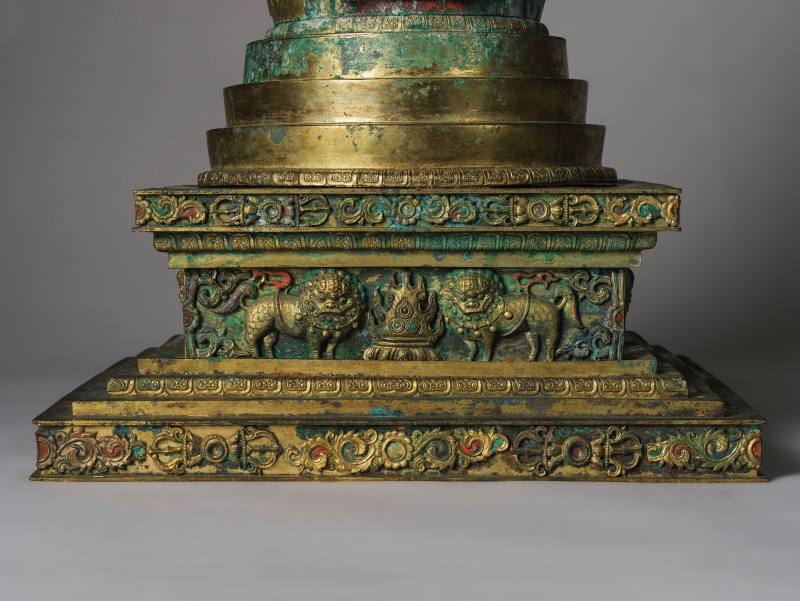
Lot 19 十八世紀 銅鎏金錘揲佛塔 | GRANDE STUPA EN BRONZE REPOUSSÉ ET DORÉ
落槌价
预展中
成交价
预展中
| 拍卖公司 | 邦瀚斯 |
|---|---|
| 拍卖时间 | 2026年12月10日 |
拍品信息
拍品名称
十八世紀 銅鎏金錘揲佛塔 | GRANDE STUPA EN BRONZE REPOUSSÉ ET DORÉ
年代
十八世紀
起拍价
未知
估值区间
EUR 8,000–12,000
尺寸
53 cm (20 7/8 in.) high x 36 cm (14 1/8 in.) wide
品相
未知
更多信息
GRANDE STUPA EN BRONZE REPOUSSÉ ET DORÉ
Sino-tibétain, XVIIIe siècle
A LARGE GILT-BRONZE REPOUSSÉ STUPA
Sino-tibetan, 18th century
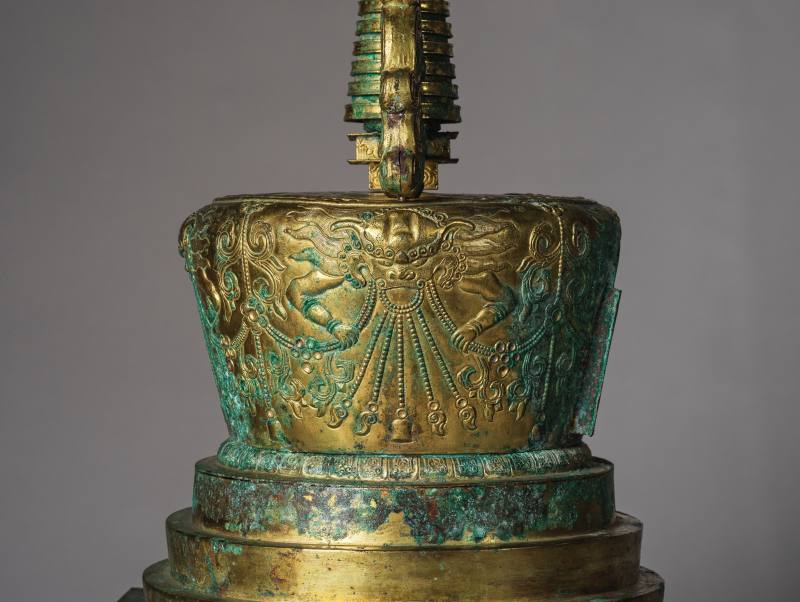
With a stepped, square-section base decorated on each side with pairs of Buddhist lions flanking the three jewels, rising to a stepped circular base supporting a large dome concealing a small niche, the dome surmounted by a tapered parasol flanked by four trailing garlands beneath a circular finial.
53 cm (20 7/8 in.) high x 36 cm (14 1/8 in.) wide (2).
漢藏 十八世紀 銅鎏金錘揲佛塔
Provenance:
Gisèle Croës Arts d'Extrême Orient, Brussels, 2000
來源:
Gisèle Croës Arts d'Extrême Orient,布魯塞爾, 2000年
Made in the 18th century under the Qianlong Emperor, the present lot embodies the Qianlong Emperor's endorsement and patronage of Tibetan Buddhism. It is related to a stupa of similarly large size illustrated in Barbara Lipton and Nima Dorjee Ragnubs, Treasures of Tibetan Art: Collections of the Jacques Marchais Museum of Tibetan Art, New York, 1996, cat.no. 6. Compare also with a massive stupa housed in the Pavilion of the Rain of Flowers in the Forbidden City, Beijing, illustrated in Daisy Yiyou Wang, 'Empresses of China's Forbidden City: New Perspectives on Qing Imperial Women', in Orientations, vol. 49, Number 6, November - December 2018, p. 46. A closely related example of similarly large size and style was sold at Bonhams London, 15 May 2014, lot 295.
A stupa, also known as Chorten, represents a religious monument symbolising the Buddha's enlightened mind. Its distinctive form reproduces the axis mundi, and represents the line that connects the mid-point of this world to the mid-points of all the other states of existence, its layout designed to accord with the directions of space, marking the demarcation of an ordered cosmic space. With its distinctive form, a stupa comprises different, highly symbolic elements including a square platform representing the earth element, a circular base supporting the circular dome guarding the Buddha's relics laying out the Cosmic Wheel, a protective parasol, symbolising the air element, terminating in a sun and moon at the top referring to the space element. Among the eight known types of stupas, each commemorating one of the eight great episodes in the life of Buddha Shakyamuni, the present lot may be referred to as the second type, called the Enlightenment stupa, which represents Buddha's enlightenment under the bodhi tree on the fifteenth day of the fourth month.
以下内容由AI翻译:
【描述】
方形基座分层装饰,每侧有一对佛教狮子夹着三宝,其上承接一层圆形阶式基座,支撑着一个大圆顶,内有一个小龛,圆顶上方有一个锥形伞盖,两侧有四条垂挂的花环,顶部有一个圆形顶饰。
这件拍品制作于18世纪乾隆皇帝时期,体现了乾隆皇帝对藏传佛教的支持和赞助。它与Barbara Lipton和Nima Dorjee Ragnubs在《Treasures of Tibetan Art: Collections of the Jacques Marchais Museum of Tibetan Art》(纽约,1996年)中图录编号6的一座大型佛塔相似。另可比较北京故宫博物院雨花阁内的一座巨大佛塔,见Daisy Yiyou Wang在《Orientations》第49卷第6期(2018年11月至12月)第46页中的插图。一件风格和尺寸相近的例子曾在2014年5月15日伦敦邦瀚斯拍卖会上售出,拍品编号295。
佛塔,又称作Chorten,是一种宗教纪念碑,象征佛陀的觉悟之心。其独特的形式再现了世界轴心,并代表连接此世与其他存在状态中心的线,其布局设计符合空间方向,标志着有序宇宙空间的划分。佛塔由不同的高度象征性元素组成,包括代表地元素的方形平台、承托圆顶、护存佛陀舍利并构成宇宙之轮的圆形基座、象征风元素的保护伞盖,顶部的日月象征空间元素。在已知的八种佛塔类型中,每一种都纪念释迦牟尼佛生平中的八大事件之一,这件拍品可能是第二种类型,称为成道佛塔,代表佛陀在菩提树下于第四个月的第十五天成道。
常见问题
这件十八世紀 銅鎏金錘揲佛塔 | GRANDE STUPA EN BRONZE REPOUSSÉ ET DORÉ的成交价是多少?
落槌价为 预展中。 成交价为 预展中。
拍品的尺寸是多少?
53 cm (20 7/8 in.) high x 36 cm (14 1/8 in.) wide