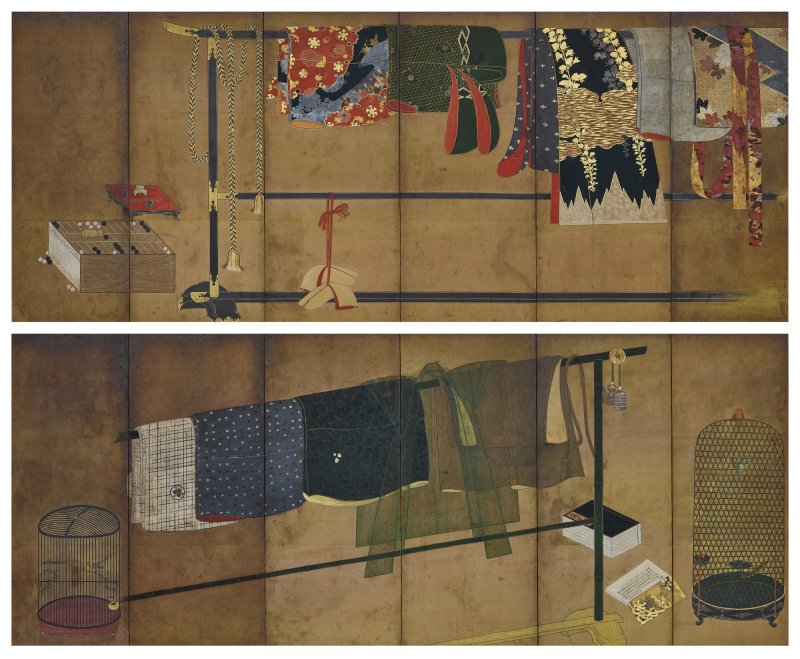

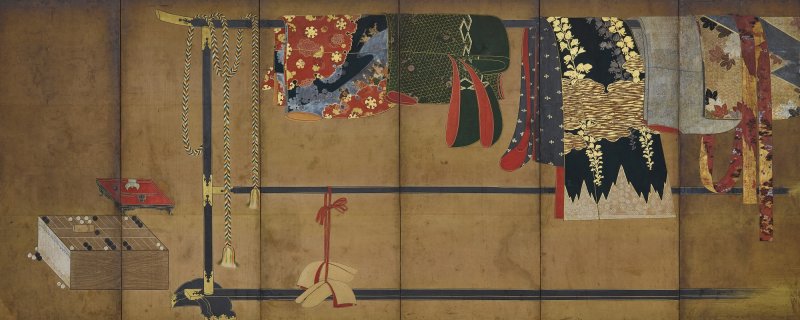
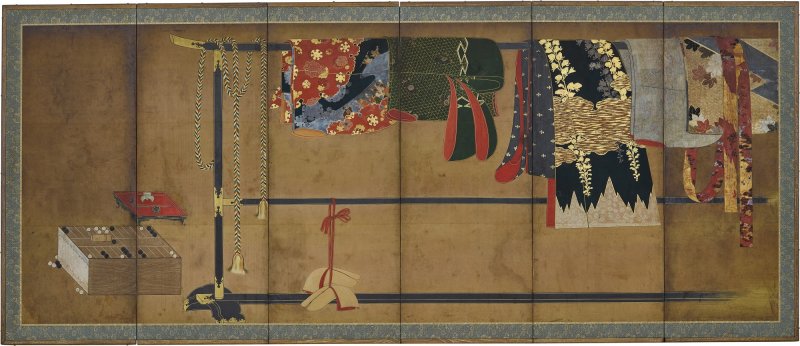
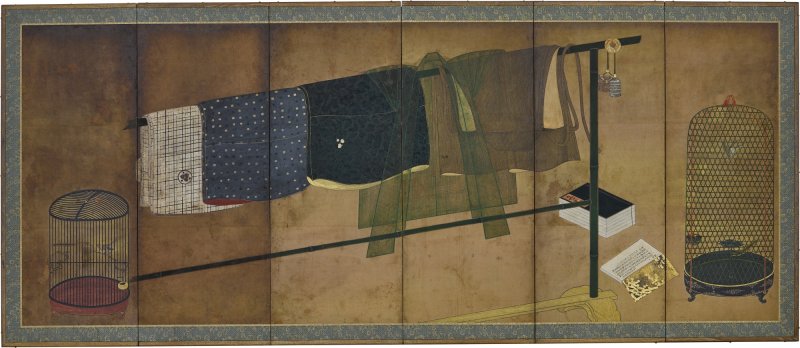
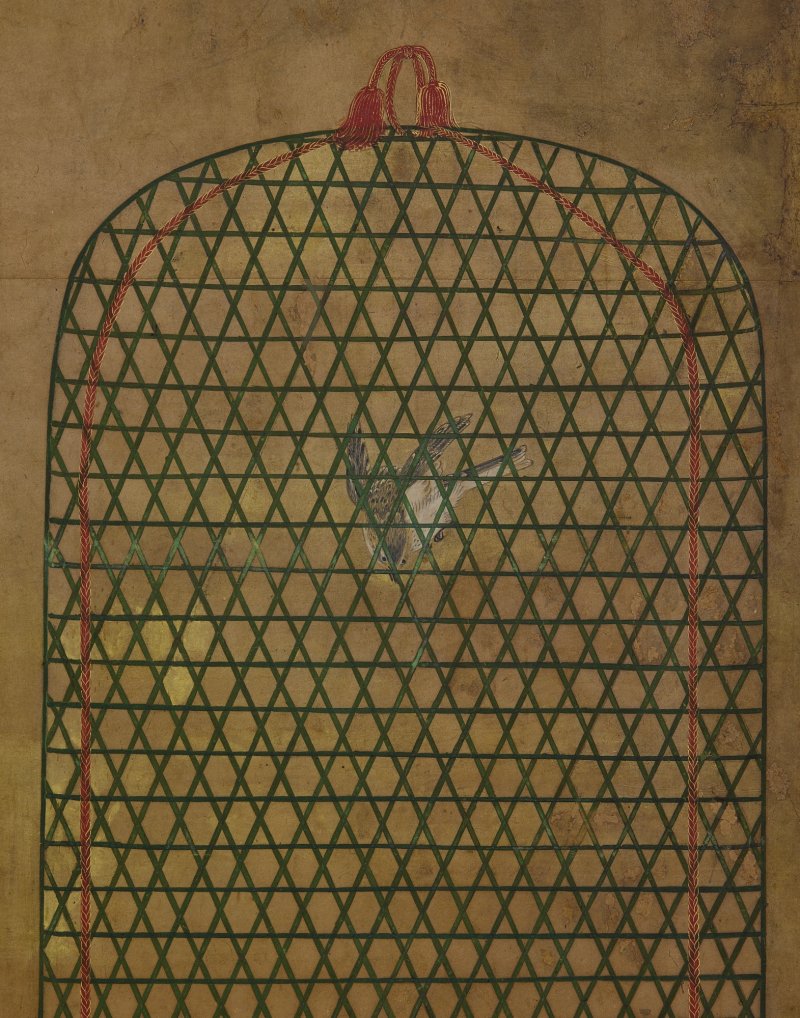
Lot 2016 Anonymous, Whose Sleeves? (Tagasode), Edo period, early 17th century | 誰ヶ袖図屏風 江戸時代初期 17世紀
落槌价
****
成交价
****
拍品信息
拍品名称
Anonymous, Whose Sleeves? (Tagasode), Edo period, early 17th century | 誰ヶ袖図屏風 江戸時代初期 17世紀
起拍价
HKD 300,000
估值区间
300,000 - 500,000 HKD
尺寸
未知
品相
Overall, the screens are in good condition, most Japanese screens have some restoration by the nature of their use being opened and closed repeatedly, there is some wear around the hinges consistent with age and use, each screen with wormage, some discolouration to the paper along the top edges, some small losses to pigments and wear to the surface in places, the right screen with uneven toning to the rightmost and two leftmost panels, the third panel from the right with a repair in between the two bottom tiers of the kimono stand, the rightmost panel with rubbing to the pigments and ink to the stand in the lower right section; the left screen with uneven toning to the two leftmost panels, there is wear to the gufun in places, a few further repairs to the rightmost panel and elsewhere, some soiling and slight marks in places, the leftmost panel with a few scattered pairs, including a repair within the bird cage, there is some wear to the paper surface and wormage in places, some slight soiling to the gofun on the kimono stand.
If a condition report is provided to assist you with assessing the condition of the lot, it is for guidance purposes only. Such condition report may not refer to all faults, restoration, alterations, or adaptations because Sotheby's is not a professional conservator or restorer but rather a condition report is a statement of subjective, qualified opinion genuinely held by Sotheby's. For these reasons, any such condition report is not an alternative to taking your own professional advice regarding the condition of the lot. Prospective buyers should also refer to the Guide for Buyers at Auction which includes important notices concerning the type of property in this sale.
If a condition report is provided to assist you with assessing the condition of the lot, it is for guidance purposes only. Such condition report may not refer to all faults, restoration, alterations, or adaptations because Sotheby's is not a professional conservator or restorer but rather a condition report is a statement of subjective, qualified opinion genuinely held by Sotheby's. For these reasons, any such condition report is not an alternative to taking your own professional advice regarding the condition of the lot. Prospective buyers should also refer to the Guide for Buyers at Auction which includes important notices concerning the type of property in this sale.
更多信息
pair of six-panel folding screens: ink, colour, gold and gofun on paper, silk brocade borders, lacquered wood mounts
each screen approx. 116 x 276 cm. (when unfolded)
each screen approx. 116 x 46 cm. (when folded)
来源:Hasunuma Family
展览:Rimpa meihinten [Rimpa: The Debut of Essential Rimpa Masterpieces in the Okada Museum of Art Collection], Mitsukoshi (Nihonbashi), Tokyo, 2015, cat. no. 2.
Bi no suta-tachi Korin Jakuchu Hokusai joyo nado meihin zoroi [5th Anniversary Exhibition. All-Stars of the Okada Collection: Masterworks of Korin, Jakuchu, Hokusai and the Ru Ware Kilns], Okada Museum of Art, Hakone, 2018-19, exh. no. 422 (unillustrated).
著录:Kobayashi Tadashi ed., Masterpieces of the Okada Museum of Art, vol. 1, Tokyo, 2019, no. 89.
图录
说明:More than its colour,
the fragrance moves me –
whose sleeves, brushing past
left this scent of plum blossoms
at my door?1
Iro yori mo
ka koso aware to
omohoyure
tagasode fureshi
yado no ume zo mo
In the genre painting subject known as Tagasode [lit. ‘another's sleeves’], the viewer is immediately confronted with the question: who is the wearer of these garments? The owner of these sumptuous belongings is expressed in absentia, conveyed through the fashionable patterning and personal accessories arranged on the garment stands. Following a general trajectory toward abbreviation in Edo period (1615-1868) genre painting, such screens evoke an absent presence – an unseen figure of taste and fashion, conjured through dress alone, without face or figure.
Many genre paintings of Japan's early modern period feature men and women dressed in kosode [lit. ‘short sleeves’], which by the Momoyama period (1568-1615) denoted a kimono with narrow hand openings that had become the common outer garment across all classes. The townscape of the period would have appeared a rich tapestry of embroidered silk in motion: the regular, symmetrical designs of the earlier seventeenth century gave way in its latter half to bolder and more asymmetrical forms. Under the strict social order of the Pax Tokugawa, sumptuary edicts enforced status distinctions through dress; it was most often the fashions of the unofficial world (oku) – free to experiment without such constraint – and the demands of the merchant classes and denizens of the floating world, that drove the period's many stylistic shifts.
The theme of Tagasode has roots in classical love poetry, where the phrase evoked a beautiful woman whose presence was longed for. Such screens draw their name from precisely this conceit: the garments draped over a kimono rack hint at the beauty of an unseen wearer. The theme can be traced to the Heian period (794-1185), when the language of robes carried particular significance. Court women customarily veiled themselves behind curtains or screens; a young, inquisitive suitor might glimpse her sumptuous robes and judge her aesthetic sophistication and amorous potential from them alone. Lovers of the period also exchanged waka, the thirty-one syllable court poetry rich in insinuation and veiled meaning, in which incense-scented robes could stand in for an otherwise inaccessible woman. Sleeves were so bound up with the person of the wearer that emotional distress itself was conventionally expressed through them, as in nururu sode [sleeves sodden with tears] or sode no tsuyukeki [sleeves still drenched with dew].
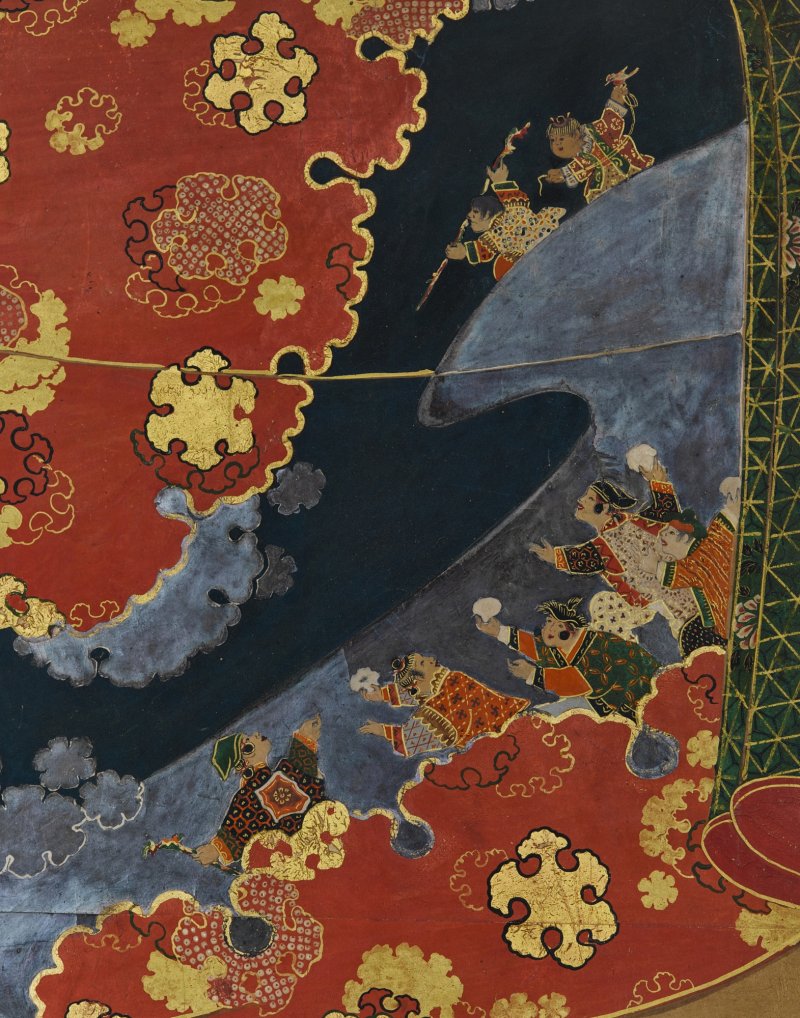
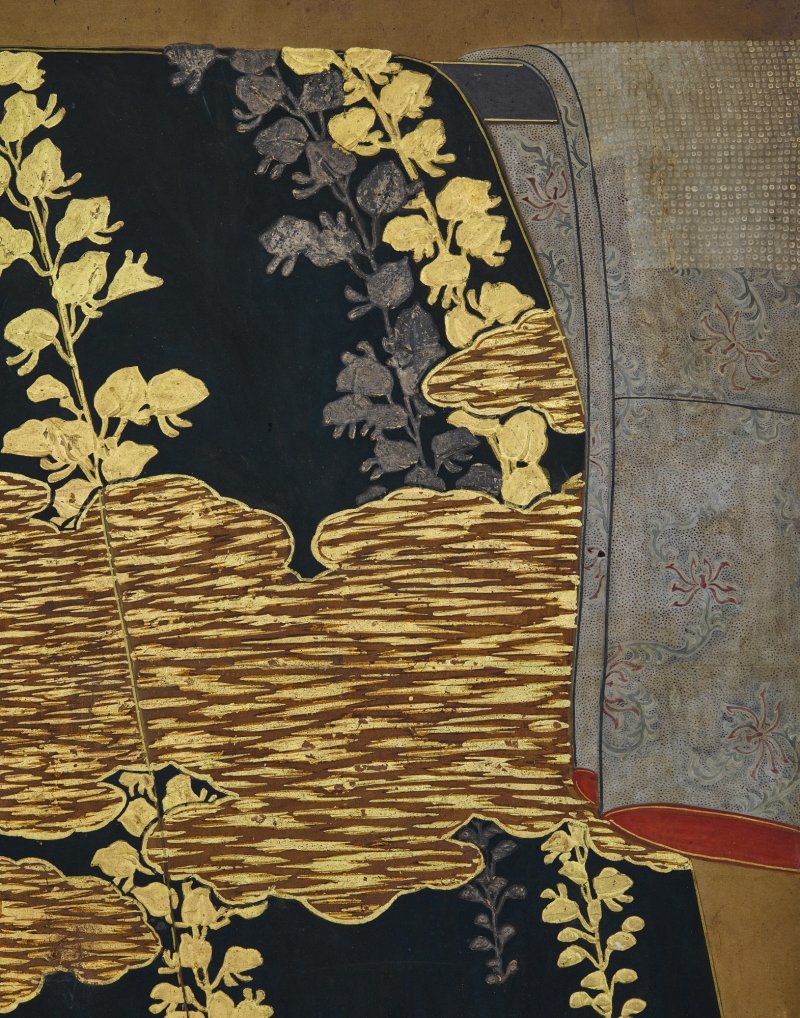
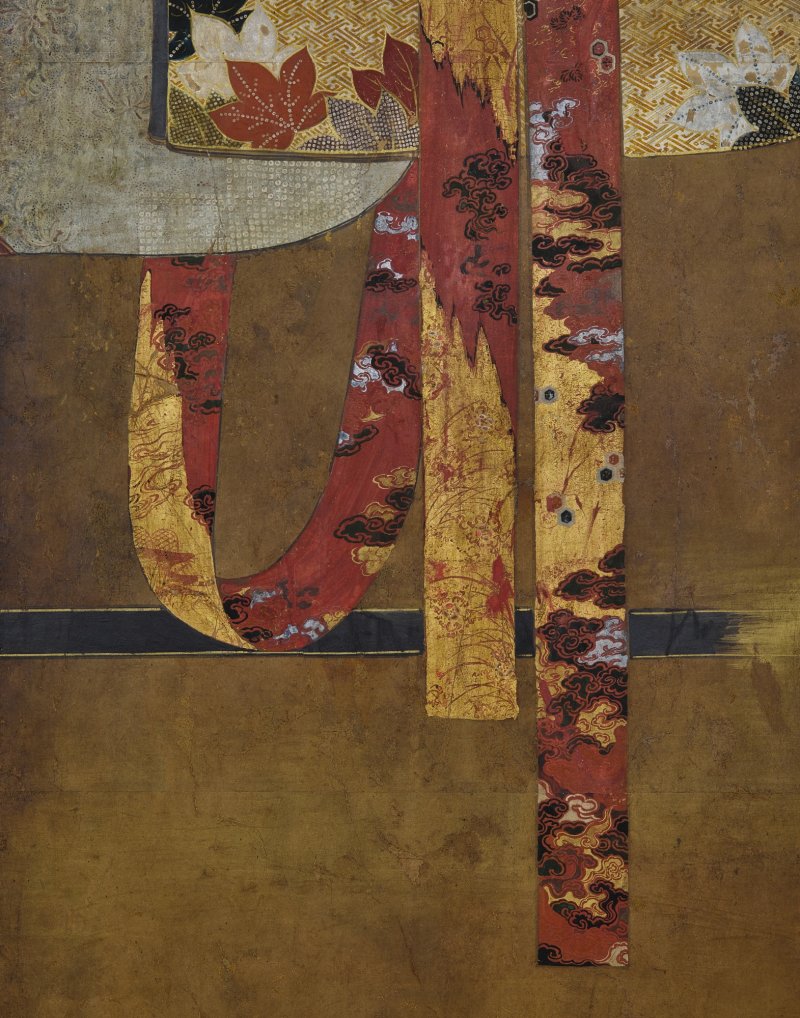
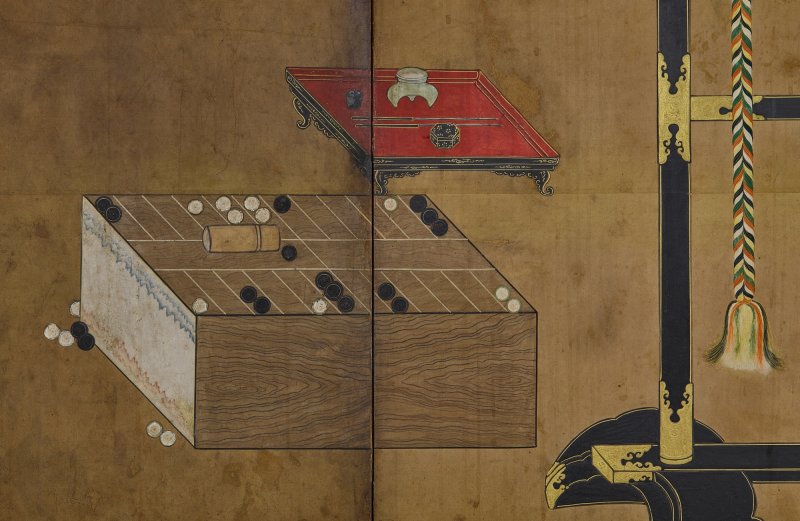
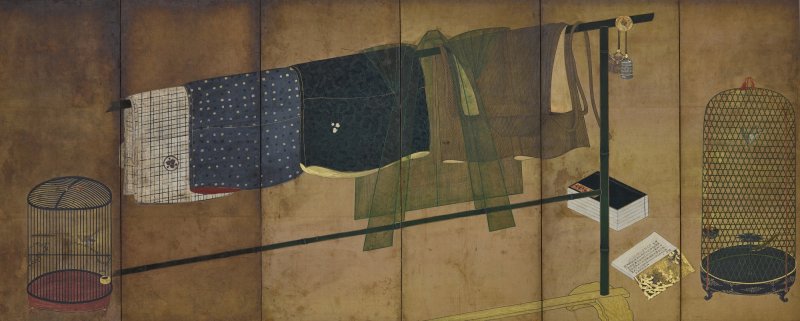
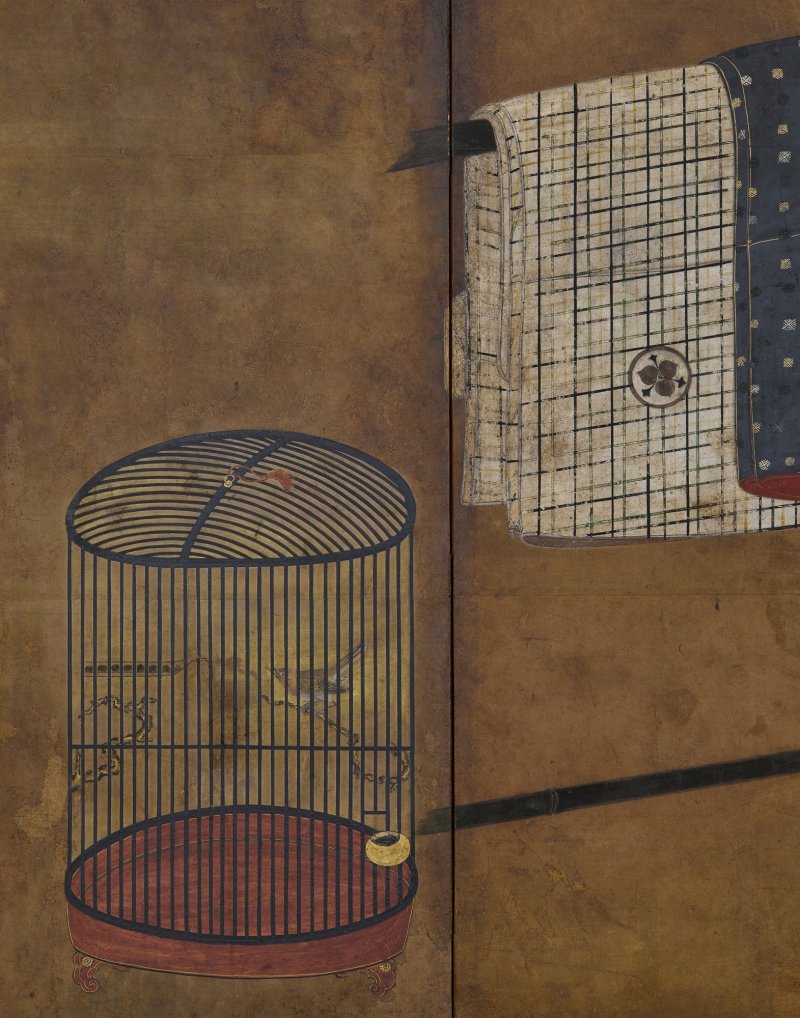
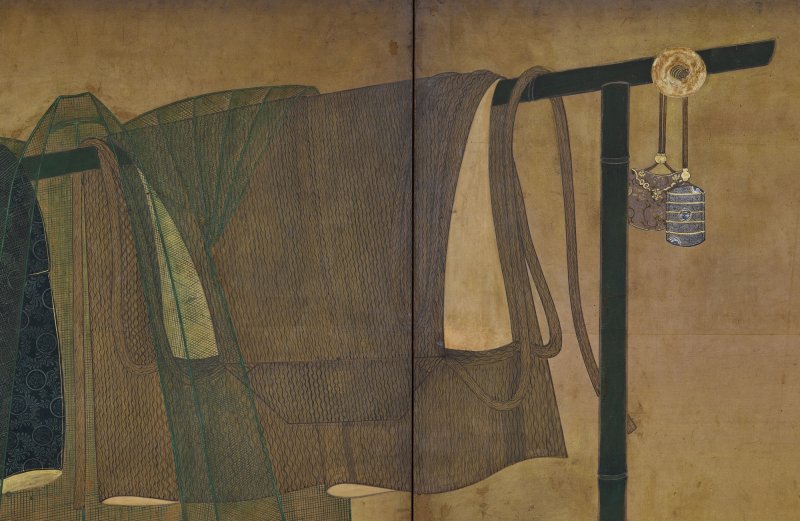
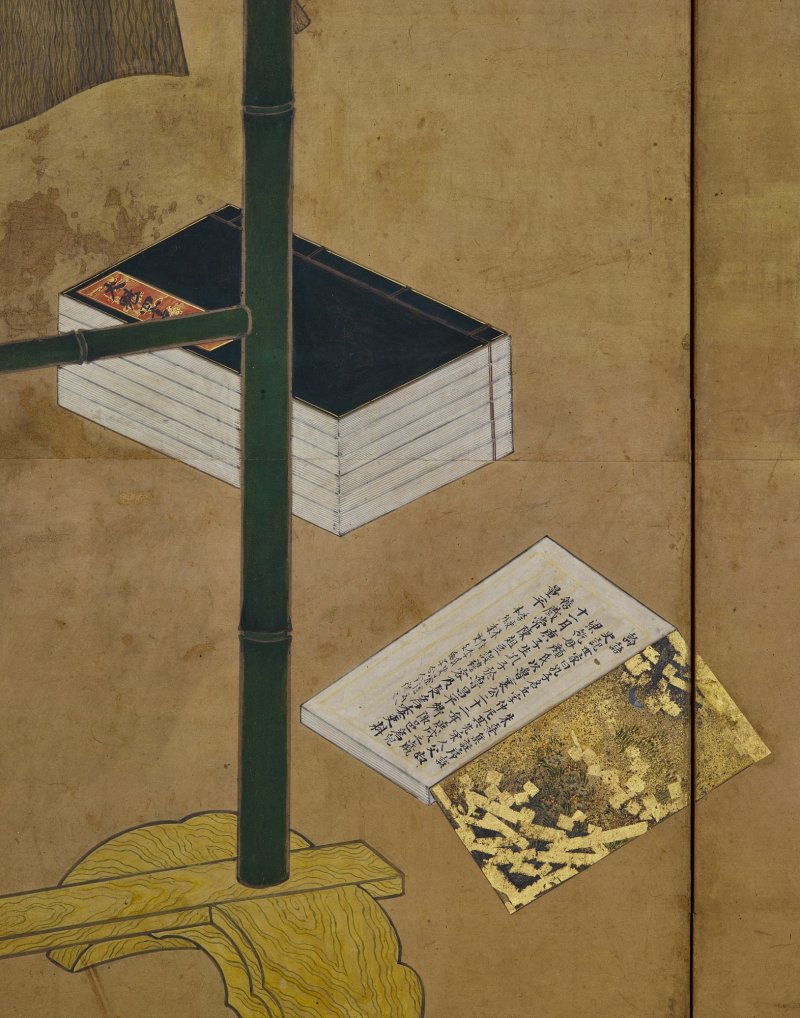
Here, what hangs on the kimono rack is military-class dress, both male and female. A sugoroku board, books, incense burner, and unusually for Tagasode screens, two birdcages housing skylarks or bush warblers are arranged around the stand. On the right screen, women’s and children's kosode are painted with embroidery details and gold and silver surihaku, forming lively, bold designs of golden wisteria fronds and autumn foliage. One robe bears a design of stylised snowflake motifs and karako throwing snowballs. On the left screen, a man's formal kamishimo and a woman's kosode, are emblazoned with family crests and are more subtly patterned. The gauziness of the kamishimo kataginu indicates summer wear. The pairing of adult and children's garments suggests an entire household evoked through dress.
1. Kokin wakashu [Collection of Japanese Poetry Ancient and Modern], Book 1 (Spring I), no. 33.
來源
蓮沼家舊藏
展覽
《琳派名品展》,三越(日本橋),東京,2015年,編號2
《美のスターたち-光琳・若冲・北斎・汝窯など名品ぞろい-》,岡田美術館,箱根,2018–19年,展覽編號422(沒載圖)
出版
小林忠編,《岡田美術館名品撰》,卷1,東京,2013年,編號89
each screen approx. 116 x 276 cm. (when unfolded)
each screen approx. 116 x 46 cm. (when folded)
来源:Hasunuma Family
展览:Rimpa meihinten [Rimpa: The Debut of Essential Rimpa Masterpieces in the Okada Museum of Art Collection], Mitsukoshi (Nihonbashi), Tokyo, 2015, cat. no. 2.
Bi no suta-tachi Korin Jakuchu Hokusai joyo nado meihin zoroi [5th Anniversary Exhibition. All-Stars of the Okada Collection: Masterworks of Korin, Jakuchu, Hokusai and the Ru Ware Kilns], Okada Museum of Art, Hakone, 2018-19, exh. no. 422 (unillustrated).
著录:Kobayashi Tadashi ed., Masterpieces of the Okada Museum of Art, vol. 1, Tokyo, 2019, no. 89.
图录
说明:More than its colour,
the fragrance moves me –
whose sleeves, brushing past
left this scent of plum blossoms
at my door?1
Iro yori mo
ka koso aware to
omohoyure
tagasode fureshi
yado no ume zo mo
In the genre painting subject known as Tagasode [lit. ‘another's sleeves’], the viewer is immediately confronted with the question: who is the wearer of these garments? The owner of these sumptuous belongings is expressed in absentia, conveyed through the fashionable patterning and personal accessories arranged on the garment stands. Following a general trajectory toward abbreviation in Edo period (1615-1868) genre painting, such screens evoke an absent presence – an unseen figure of taste and fashion, conjured through dress alone, without face or figure.
Many genre paintings of Japan's early modern period feature men and women dressed in kosode [lit. ‘short sleeves’], which by the Momoyama period (1568-1615) denoted a kimono with narrow hand openings that had become the common outer garment across all classes. The townscape of the period would have appeared a rich tapestry of embroidered silk in motion: the regular, symmetrical designs of the earlier seventeenth century gave way in its latter half to bolder and more asymmetrical forms. Under the strict social order of the Pax Tokugawa, sumptuary edicts enforced status distinctions through dress; it was most often the fashions of the unofficial world (oku) – free to experiment without such constraint – and the demands of the merchant classes and denizens of the floating world, that drove the period's many stylistic shifts.
The theme of Tagasode has roots in classical love poetry, where the phrase evoked a beautiful woman whose presence was longed for. Such screens draw their name from precisely this conceit: the garments draped over a kimono rack hint at the beauty of an unseen wearer. The theme can be traced to the Heian period (794-1185), when the language of robes carried particular significance. Court women customarily veiled themselves behind curtains or screens; a young, inquisitive suitor might glimpse her sumptuous robes and judge her aesthetic sophistication and amorous potential from them alone. Lovers of the period also exchanged waka, the thirty-one syllable court poetry rich in insinuation and veiled meaning, in which incense-scented robes could stand in for an otherwise inaccessible woman. Sleeves were so bound up with the person of the wearer that emotional distress itself was conventionally expressed through them, as in nururu sode [sleeves sodden with tears] or sode no tsuyukeki [sleeves still drenched with dew].
Here, what hangs on the kimono rack is military-class dress, both male and female. A sugoroku board, books, incense burner, and unusually for Tagasode screens, two birdcages housing skylarks or bush warblers are arranged around the stand. On the right screen, women’s and children's kosode are painted with embroidery details and gold and silver surihaku, forming lively, bold designs of golden wisteria fronds and autumn foliage. One robe bears a design of stylised snowflake motifs and karako throwing snowballs. On the left screen, a man's formal kamishimo and a woman's kosode, are emblazoned with family crests and are more subtly patterned. The gauziness of the kamishimo kataginu indicates summer wear. The pairing of adult and children's garments suggests an entire household evoked through dress.
1. Kokin wakashu [Collection of Japanese Poetry Ancient and Modern], Book 1 (Spring I), no. 33.
來源
蓮沼家舊藏
展覽
《琳派名品展》,三越(日本橋),東京,2015年,編號2
《美のスターたち-光琳・若冲・北斎・汝窯など名品ぞろい-》,岡田美術館,箱根,2018–19年,展覽編號422(沒載圖)
出版
小林忠編,《岡田美術館名品撰》,卷1,東京,2013年,編號89
常见问题
拍品的品相状况如何?
Overall, the screens are in good condition, most Japanese screens have some restoration by the nature of their use being opened and closed repeatedly, there is some wear around the hinges consistent with age and use, each screen with wormage, some discolouration to the paper along the top edges, some small losses to pigments and wear to the surface in places, the right screen with uneven toning to the rightmost and two leftmost panels, the third panel from the right with a repair in between the two bottom tiers of the kimono stand, the rightmost panel with rubbing to the pigments and ink to the stand in the lower right section; the left screen with uneven toning to the two leftmost panels, there is wear to the gufun in places, a few further repairs to the rightmost panel and elsewhere, some soiling and slight marks in places, the leftmost panel with a few scattered pairs, including a repair within the bird cage, there is some wear to the paper surface and wormage in places, some slight soiling to the gofun on the kimono stand.
If a condition report is provided to assist you with assessing the condition of the lot, it is for guidance purposes only. Such condition report may not refer to all faults, restoration, alterations, or adaptations because Sotheby's is not a professional conservator or restorer but rather a condition report is a statement of subjective, qualified opinion genuinely held by Sotheby's. For these reasons, any such condition report is not an alternative to taking your own professional advice regarding the condition of the lot. Prospective buyers should also refer to the Guide for Buyers at Auction which includes important notices concerning the type of property in this sale.
If a condition report is provided to assist you with assessing the condition of the lot, it is for guidance purposes only. Such condition report may not refer to all faults, restoration, alterations, or adaptations because Sotheby's is not a professional conservator or restorer but rather a condition report is a statement of subjective, qualified opinion genuinely held by Sotheby's. For these reasons, any such condition report is not an alternative to taking your own professional advice regarding the condition of the lot. Prospective buyers should also refer to the Guide for Buyers at Auction which includes important notices concerning the type of property in this sale.
这件拍品的流传来源是什么?
Hasunuma Family
这件拍品曾在哪些展览中展出过?
Rimpa meihinten [Rimpa: The Debut of Essential Rimpa Masterpieces in the Okada Museum of Art Collection], Mitsukoshi (Nihonbashi), Tokyo, 2015, cat. no. 2.
Bi no suta-tachi Korin Jakuchu Hokusai joyo nado meihin zoroi [5th Anniversary Exhibition. All-Stars of the Okada Collection: Masterworks of Korin, Jakuchu, Hokusai and the Ru Ware Kilns], Okada Museum of Art, Hakone, 2018-19, exh. no. 422 (unillustrated).
Bi no suta-tachi Korin Jakuchu Hokusai joyo nado meihin zoroi [5th Anniversary Exhibition. All-Stars of the Okada Collection: Masterworks of Korin, Jakuchu, Hokusai and the Ru Ware Kilns], Okada Museum of Art, Hakone, 2018-19, exh. no. 422 (unillustrated).
这件拍品被哪些著录书籍记载?
Kobayashi Tadashi ed., Masterpieces of the Okada Museum of Art, vol. 1, Tokyo, 2019, no. 89.
图录
图录