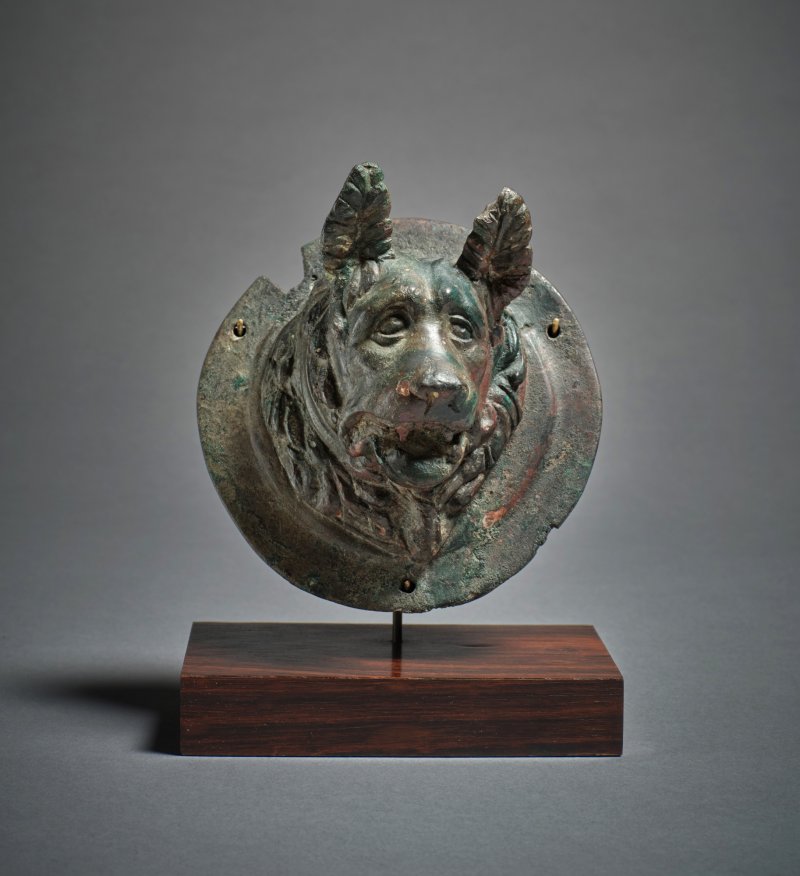

Lot 103 A Roman Bronze Roundel with a Relief Bust of a Molossian Hound, circa 1st/2nd century A.D.
落槌价
预展中
成交价
预展中
| 拍卖公司 | 苏富比 |
|---|---|
| 拍卖时间 | 2026年10月22日 |
拍品信息
拍品名称
A Roman Bronze Roundel with a Relief Bust of a Molossian Hound, circa 1st/2nd century A.D.
起拍价
USD 12,000
估值区间
12,000 - 18,000 USD
尺寸
未知
品相
In stable condition, with the surface worn overall as visible in the illustration. A large chip encircling the flange and the proper left ear damaged, also as visible in the illustration.
If a condition report is provided to assist you with assessing the condition of the lot, it is for guidance purposes only. Such condition report may not refer to all faults, restoration, alterations, or adaptations because Sotheby's is not a professional conservator or restorer but rather a condition report is a statement of subjective, qualified opinion genuinely held by Sotheby's. For these reasons, any such condition report is not an alternative to taking your own professional advice regarding the condition of the lot. Prospective buyers should also refer to the Guide for Buyers at Auction which includes important notices concerning the type of property in this sale.
If a condition report is provided to assist you with assessing the condition of the lot, it is for guidance purposes only. Such condition report may not refer to all faults, restoration, alterations, or adaptations because Sotheby's is not a professional conservator or restorer but rather a condition report is a statement of subjective, qualified opinion genuinely held by Sotheby's. For these reasons, any such condition report is not an alternative to taking your own professional advice regarding the condition of the lot. Prospective buyers should also refer to the Guide for Buyers at Auction which includes important notices concerning the type of property in this sale.
更多信息
A Roman Bronze Roundel with a Relief Bust of a Molossian Hound, circa 1st/2nd century A.D.
the hound with erect ears, eyes with incised pupils and a bared tongue, its curly fur articulated around the head and ears, with three perforations on the roundel for attachment.
bronze
diameter 5¼ in.
13.3 cm
来源:Mathias Komor (1909-1984), New York (inv. no. F670);
James and Marilynn Alsdorf, Chicago, acquired from the above in 1979 (Christie’s, New York, Ancient Art from the James and Marilynn Alsdorf Collection, June 16th, 2020, lot 31, illus.);
Where acquired by the present collector.
展览:The Art Institute of Chicago, Private Taste in Ancient Rome: Selections from Chicago Collections, March 3rd-September 16th, 1990.
著录:K. Alexander and M. Greuel, Private Taste in Ancient Rome: Selections from Chicago Collections, Chicago, 1990, no. 14.
图录
说明:Revered in antiquity for their immense strength, courage and unwavering loyalty, Molossian hounds (now an extinct breed, but an ancestor to the modern mastiff) were prized in the Classical world as hunting companions. The present roundel would have once been mounted as an architectural or furniture ornament.
the hound with erect ears, eyes with incised pupils and a bared tongue, its curly fur articulated around the head and ears, with three perforations on the roundel for attachment.
bronze
diameter 5¼ in.
13.3 cm
来源:Mathias Komor (1909-1984), New York (inv. no. F670);
James and Marilynn Alsdorf, Chicago, acquired from the above in 1979 (Christie’s, New York, Ancient Art from the James and Marilynn Alsdorf Collection, June 16th, 2020, lot 31, illus.);
Where acquired by the present collector.
展览:The Art Institute of Chicago, Private Taste in Ancient Rome: Selections from Chicago Collections, March 3rd-September 16th, 1990.
著录:K. Alexander and M. Greuel, Private Taste in Ancient Rome: Selections from Chicago Collections, Chicago, 1990, no. 14.
图录
说明:Revered in antiquity for their immense strength, courage and unwavering loyalty, Molossian hounds (now an extinct breed, but an ancestor to the modern mastiff) were prized in the Classical world as hunting companions. The present roundel would have once been mounted as an architectural or furniture ornament.
常见问题
这件A Roman Bronze Roundel with a Relief Bust of a Molossian Hound, circa 1st/2nd century A.D.的成交价是多少?
落槌价为 预展中。 成交价为 预展中。
拍品的品相状况如何?
In stable condition, with the surface worn overall as visible in the illustration. A large chip encircling the flange and the proper left ear damaged, also as visible in the illustration.
If a condition report is provided to assist you with assessing the condition of the lot, it is for guidance purposes only. Such condition report may not refer to all faults, restoration, alterations, or adaptations because Sotheby's is not a professional conservator or restorer but rather a condition report is a statement of subjective, qualified opinion genuinely held by Sotheby's. For these reasons, any such condition report is not an alternative to taking your own professional advice regarding the condition of the lot. Prospective buyers should also refer to the Guide for Buyers at Auction which includes important notices concerning the type of property in this sale.
If a condition report is provided to assist you with assessing the condition of the lot, it is for guidance purposes only. Such condition report may not refer to all faults, restoration, alterations, or adaptations because Sotheby's is not a professional conservator or restorer but rather a condition report is a statement of subjective, qualified opinion genuinely held by Sotheby's. For these reasons, any such condition report is not an alternative to taking your own professional advice regarding the condition of the lot. Prospective buyers should also refer to the Guide for Buyers at Auction which includes important notices concerning the type of property in this sale.
这件拍品的流传来源是什么?
Mathias Komor (1909-1984), New York (inv. no. F670);
James and Marilynn Alsdorf, Chicago, acquired from the above in 1979 (Christie’s, New York, Ancient Art from the James and Marilynn Alsdorf Collection, June 16th, 2020, lot 31, illus.);
Where acquired by the present collector.
James and Marilynn Alsdorf, Chicago, acquired from the above in 1979 (Christie’s, New York, Ancient Art from the James and Marilynn Alsdorf Collection, June 16th, 2020, lot 31, illus.);
Where acquired by the present collector.
这件拍品曾在哪些展览中展出过?
The Art Institute of Chicago, Private Taste in Ancient Rome: Selections from Chicago Collections, March 3rd-September 16th, 1990.
这件拍品被哪些著录书籍记载?
K. Alexander and M. Greuel, Private Taste in Ancient Rome: Selections from Chicago Collections, Chicago, 1990, no. 14.
图录
图录