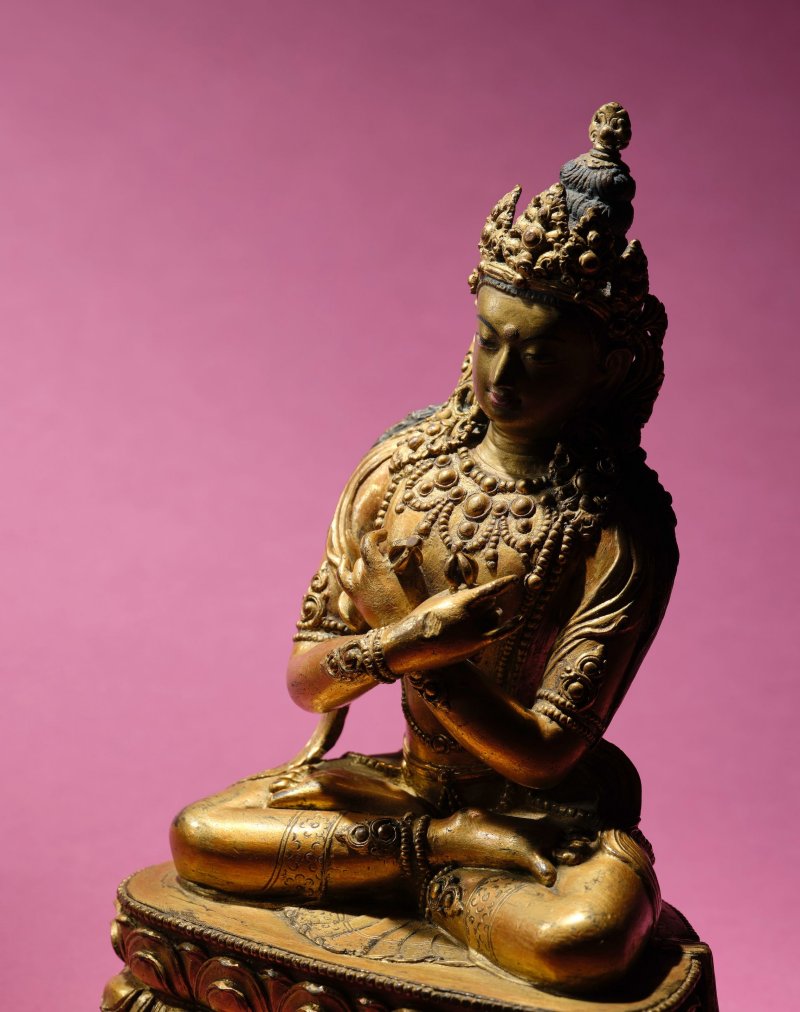

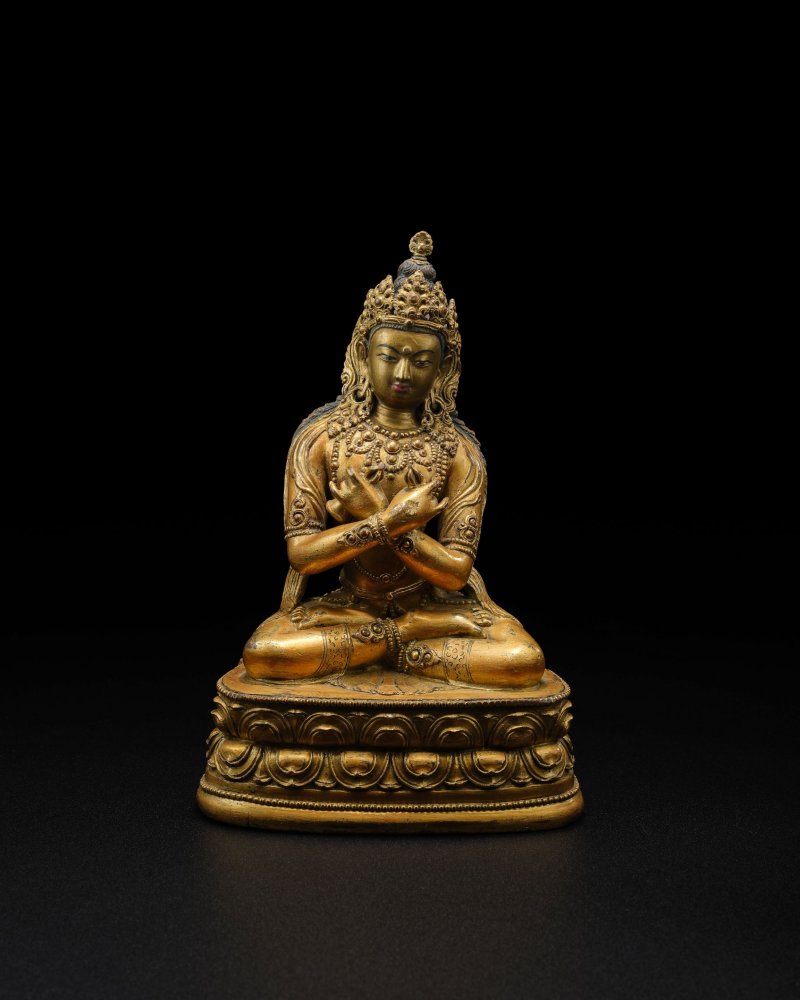
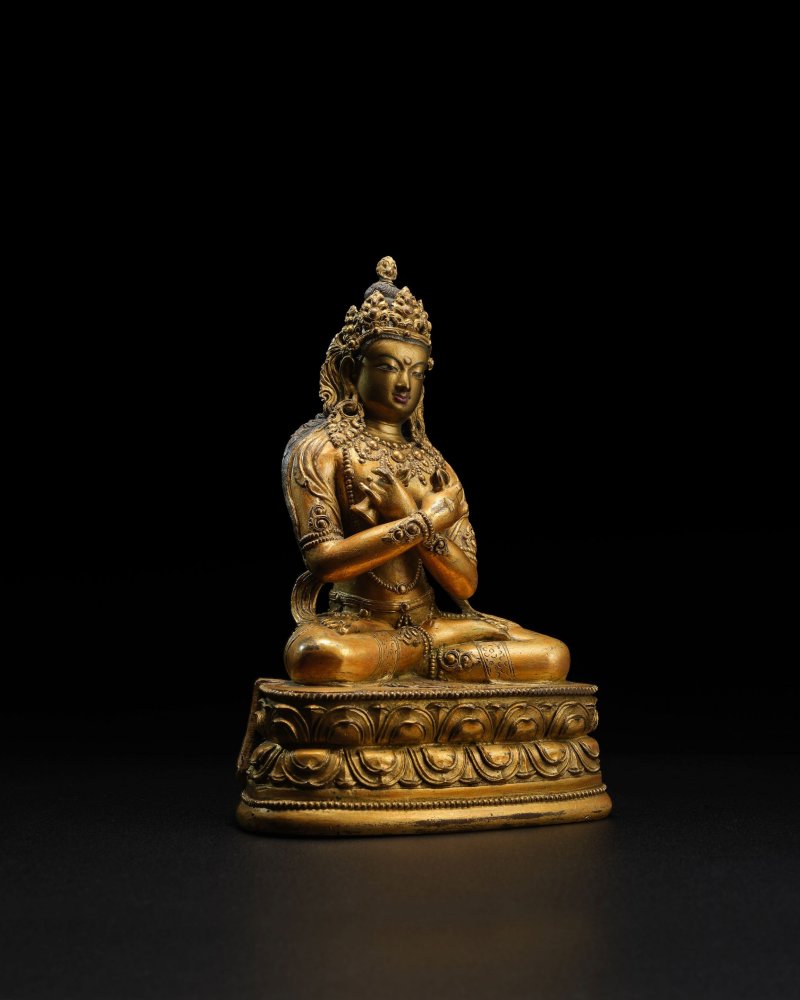
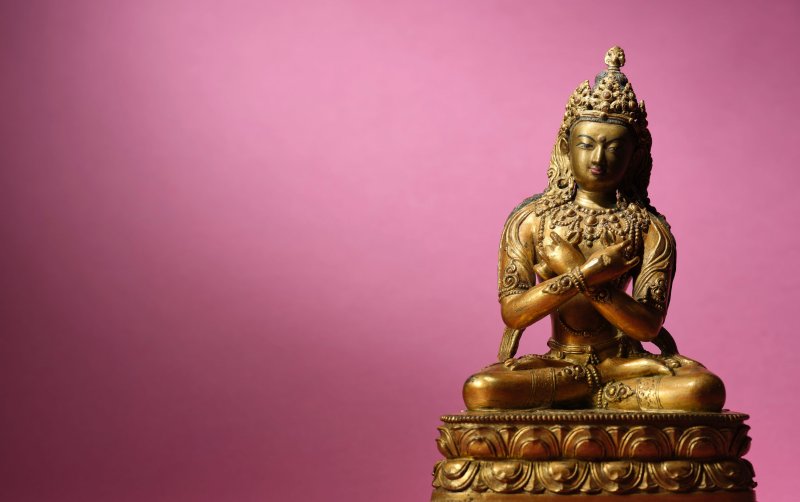
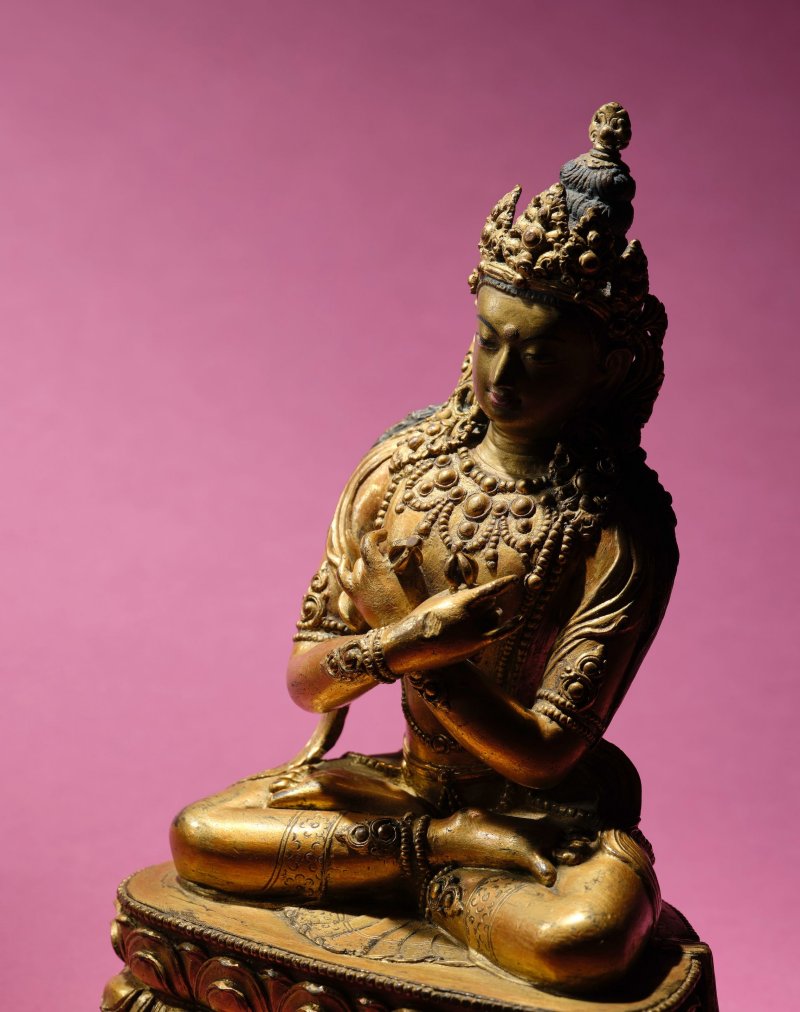
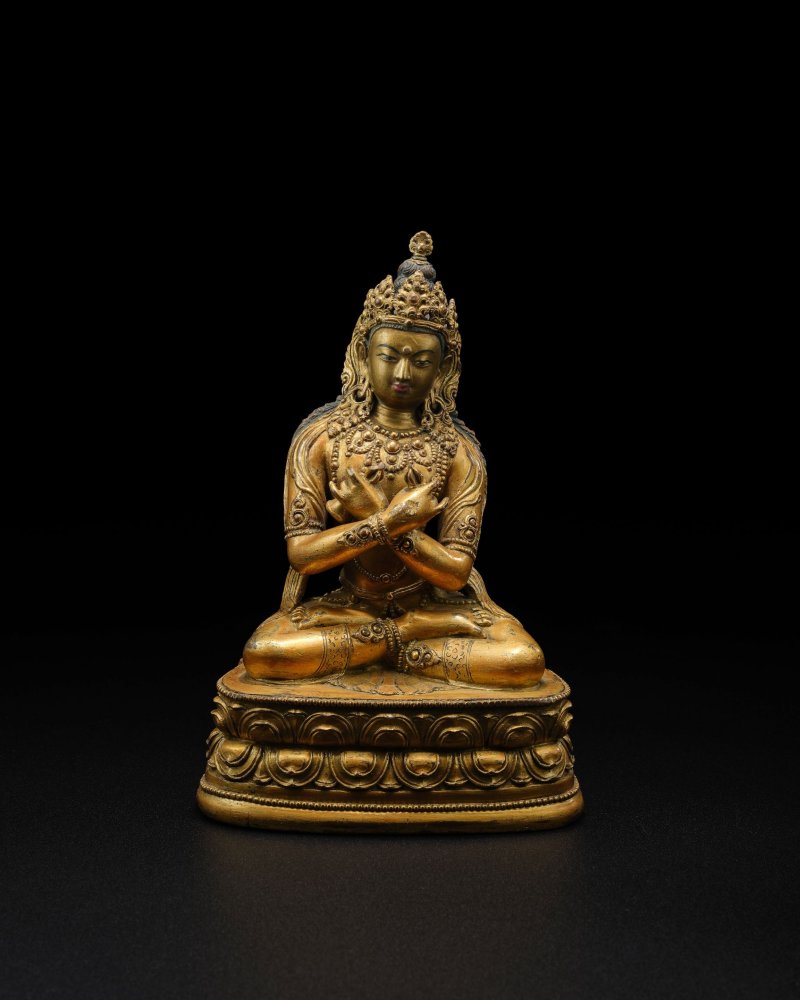
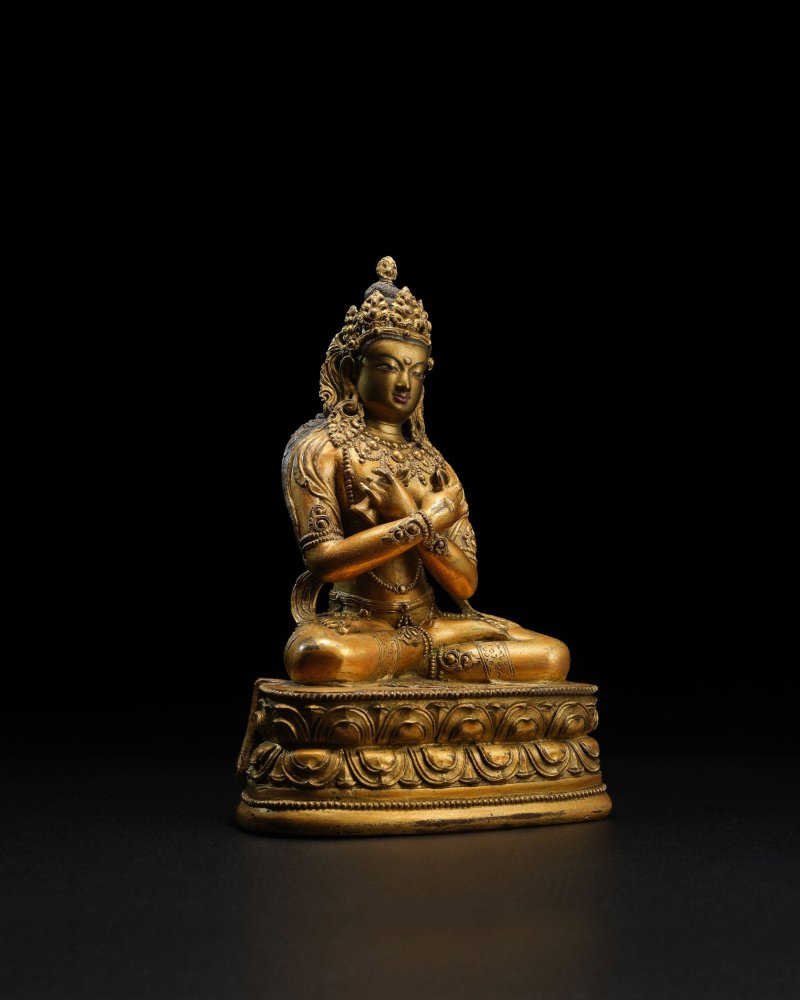
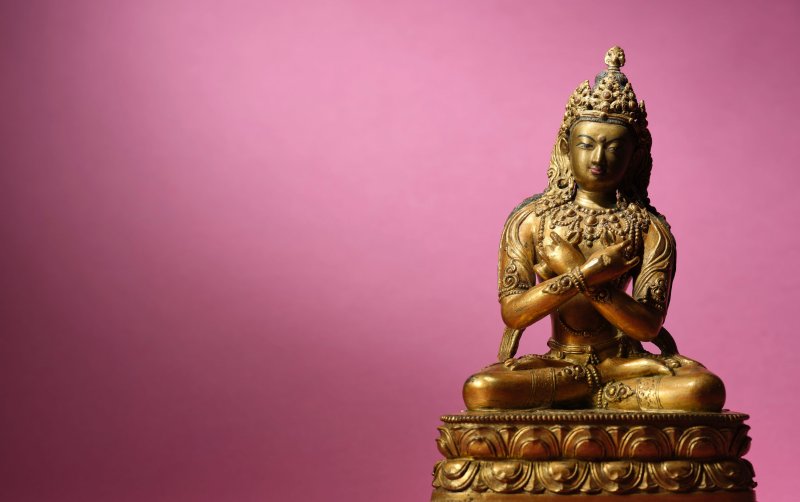
Lot 809 扎納巴扎爾風格 蒙古 十七/十八世紀早期 銅鎏金金剛總持像 | A GILT COPPER ALLOY FIGURE OF VAJRADHARA
落槌价
预展中
成交价
预展中
| 拍卖公司 | 邦瀚斯 |
|---|---|
| 拍卖时间 | 2026年10月29日 |
拍品信息
拍品名称
扎納巴扎爾風格 蒙古 十七/十八世紀早期 銅鎏金金剛總持像 | A GILT COPPER ALLOY FIGURE OF VAJRADHARA
年代
ZANABAZAR SCHOOL, MONGOLIA, 17TH/EARLY 18TH CENTURY
起拍价
HKD 1,200,000
估值区间
HKD 1200000 - 1600000
尺寸
未知
品相
未知
更多信息
ZANABAZAR SCHOOL, MONGOLIA, 17TH/EARLY 18TH CENTURY
Himalayan Art Resources item no. 8867
23.6 cm (9 1/4 in.) high
Footnotes
扎納巴扎爾風格 蒙古 十七/十八世紀早期 銅鎏金金剛總持像
Provenance
Asian Private Collection, 1980
Rossi & Rossi Gallery, Hong Kong, 2016
Exhibited at TEFAF Maastricht, March 2016
Vajradhara is the supreme primordial Buddha (Adibuddha) in Tibetan Buddhism, particularly within the Kagyu, Sakya, and Gelug traditions. He embodies the Dharmakaya (truth body), the ultimate, formless essence of enlightenment, and is regarded as the source of all Tantric teachings. He is depicted here seated in vajraparyankasana upon a double-lotus base, the right hand holding the vajra and the left the ghanta (bell), the arms crossed before the chest in prajnalinganabhinaya—a gesture signifying the highest state of enlightenment.
The sculpture belongs to the Zanabazar artistic tradition, established in Mongolia in the late 17th century under the First Jebtsundamba Khutuktu, Zanabazar (1635–1723). A descendant of Chinggis Khan, and recognized in childhood as the spiritual leader of the Khalkha Mongols, Zanabazar trained in Tibet under the Fourth Panchen Lama and the Fifth Dalai Lama, before returning to Mongolia with artisans who would form the nucleus of his celebrated atelier. Drawing on Tibetan iconographic convention, Newar metalworking technique, and the polished refinement of Qing-period taste, the school produced richly-gilt bronzes renowned for their balanced proportions, fluid modeling, and exacting ornamental control.
The present figure is a refined example of the Zanabazar tradition. The broad shoulders taper to a narrow waist, and the smoothly modeled limbs resolve into a compact, harmonious silhouette. The serene face is finely painted with elongated eyes beneath sharply arched brows, and softly modeled lips retaining traces of red pigment. The hair, with remains of blue pigment, rises into a high chignon surmounted by a finial and is secured by a five-leaf crown () with foliate terminals and beaded ornaments, loose strands falling gracefully to the shoulders.
The sculpture's ornamentation is executed with notable precision. Large pendant earrings frame the face. The necklaces, armlets, bracelets, and anklets are worked with the beaded and roundel embellishments characteristic of the school. The celestial sash () billows from the shoulders and trails over the edge of the lotus base, reinforcing the vertical poise of the composition. The is finely chased at its borders with floral roundels and beaded edging, its hem fanning out beneath the crossed legs in radiating, incised folds. The reverse is finished with equal care, the articulated locks of hair and cascading strands of jewelry fully resolved. The oval double-lotus base is cast with broad, rounded petals between beaded borders, and the recessed underside retains its original consecration plate with a central gilded characteristic of the Zanabazar school. Compare for example, a closely related bronze of a Vajradhara sold at Bonhams, San Francisco, 10 December 2015, lot 8004.
Further comparison can be made with the compact seated posture, elongated facial features, and richly gilt surface of a Zanabazar Vajrasattva sold at Christie's, New York, 14 September 2010, lot 62, and an Amitayus published in Berger & Bartholomew, , 1995, p. 297, no. 108.
Himalayan Art Resources item no. 8867
23.6 cm (9 1/4 in.) high
Footnotes
扎納巴扎爾風格 蒙古 十七/十八世紀早期 銅鎏金金剛總持像
Provenance
Asian Private Collection, 1980
Rossi & Rossi Gallery, Hong Kong, 2016
Exhibited at TEFAF Maastricht, March 2016
Vajradhara is the supreme primordial Buddha (Adibuddha) in Tibetan Buddhism, particularly within the Kagyu, Sakya, and Gelug traditions. He embodies the Dharmakaya (truth body), the ultimate, formless essence of enlightenment, and is regarded as the source of all Tantric teachings. He is depicted here seated in vajraparyankasana upon a double-lotus base, the right hand holding the vajra and the left the ghanta (bell), the arms crossed before the chest in prajnalinganabhinaya—a gesture signifying the highest state of enlightenment.
The sculpture belongs to the Zanabazar artistic tradition, established in Mongolia in the late 17th century under the First Jebtsundamba Khutuktu, Zanabazar (1635–1723). A descendant of Chinggis Khan, and recognized in childhood as the spiritual leader of the Khalkha Mongols, Zanabazar trained in Tibet under the Fourth Panchen Lama and the Fifth Dalai Lama, before returning to Mongolia with artisans who would form the nucleus of his celebrated atelier. Drawing on Tibetan iconographic convention, Newar metalworking technique, and the polished refinement of Qing-period taste, the school produced richly-gilt bronzes renowned for their balanced proportions, fluid modeling, and exacting ornamental control.
The present figure is a refined example of the Zanabazar tradition. The broad shoulders taper to a narrow waist, and the smoothly modeled limbs resolve into a compact, harmonious silhouette. The serene face is finely painted with elongated eyes beneath sharply arched brows, and softly modeled lips retaining traces of red pigment. The hair, with remains of blue pigment, rises into a high chignon surmounted by a finial and is secured by a five-leaf crown () with foliate terminals and beaded ornaments, loose strands falling gracefully to the shoulders.
The sculpture's ornamentation is executed with notable precision. Large pendant earrings frame the face. The necklaces, armlets, bracelets, and anklets are worked with the beaded and roundel embellishments characteristic of the school. The celestial sash () billows from the shoulders and trails over the edge of the lotus base, reinforcing the vertical poise of the composition. The is finely chased at its borders with floral roundels and beaded edging, its hem fanning out beneath the crossed legs in radiating, incised folds. The reverse is finished with equal care, the articulated locks of hair and cascading strands of jewelry fully resolved. The oval double-lotus base is cast with broad, rounded petals between beaded borders, and the recessed underside retains its original consecration plate with a central gilded characteristic of the Zanabazar school. Compare for example, a closely related bronze of a Vajradhara sold at Bonhams, San Francisco, 10 December 2015, lot 8004.
Further comparison can be made with the compact seated posture, elongated facial features, and richly gilt surface of a Zanabazar Vajrasattva sold at Christie's, New York, 14 September 2010, lot 62, and an Amitayus published in Berger & Bartholomew, , 1995, p. 297, no. 108.
常见问题
这件扎納巴扎爾風格 蒙古 十七/十八世紀早期 銅鎏金金剛總持像 | A GILT COPPER ALLOY FIGURE OF VAJRADHARA的成交价是多少?
落槌价为 预展中。 成交价为 预展中。